Think of a film that stayed with you long after the credits rolled. Not because of its plot twists or visual effects, but because of what happened to the person at its center. The way they started as one thing and ended as something else or the way the story made you desperately wish they had.
That experience has a name: character arc. And it is the single most important structural element separating characters who feel alive from characters who merely function.
The strange thing about character arc is that most audiences never consciously notice it. They feel its presence in the emotional weight of a final scene, in the satisfaction or devastation of an ending without being able to name what they are responding to. For a writer, understanding what arc is and how it works is the difference between designing that experience and accidentally stumbling upon it.
What Is a Character Arc?
A character arc is the internal journey a character undergoes over the course of a story; the change, or meaningful lack of change, in who they are at a fundamental level.
This is the critical distinction: arc is not about what happens to a character. It is about what happens inside them. Plot is external. Arc is internal. A character can survive a war, lose a fortune, and cross a continent without undergoing any meaningful arc whatsoever if none of those events change who they are at their core.
Conversely, a character can sit in the same room for an entire film and undergo a profound arc if what they believe, fear, or understand about themselves shifts fundamentally by the end.
The simplest definition: a character arc is the distance between who a character is on page one and who they are on the last page and the credible, emotionally truthful path between those two points.
The Three Components of an Arc
Every character arc, regardless of type or genre, is built from three elements.
The Starting Point: Wound or Flaw Every arc begins with something broken or incomplete in the character. This is sometimes a psychological wound a traumatic past that has shaped a distorted worldview. Sometimes it is a flaw; pride, cowardice, self-deception, an inability to connect. Sometimes it is simply an absence: a character who has never been tested and does not yet know who they are.
This starting point is essential because it creates the internal problem the arc must resolve. Without it, there is nothing to change, and therefore no arc.
The Catalyst: What Forces the Change A character rarely changes voluntarily. Something in the external world, the plot forces them into confrontation with their wound or flaw. This is the intersection of plot and arc: the story's events are specifically designed to pressure the character's internal weakness until it can no longer be avoided.
The most effective stories engineer this collision deliberately. The plot does not just happen around the character it happens to the exact part of them that most needs to be tested.
The Arrival Point: Transformation or Refusal By the end of the story, the character either changes integrating what they have learned and becoming someone different or refuses to change, with consequences that flow from that refusal. Either outcome is dramatically valid. What is not valid is a character who goes through extreme external events and arrives at the end essentially unaltered, as if the story happened beside them rather than through them.
The Three Types of Arc
Not all arcs move in the same direction. There are three fundamental types.
The Positive Arc The character begins with a wound or flaw, is tested by the story, and emerges transformed for the better. They learn something true about themselves or the world. They shed a false belief. They become more fully themselves, or more capable of connection, or more morally courageous than they were at the start.
This is the most common arc in mainstream storytelling it maps onto the audience's desire to see growth and redemption. But it is not automatically more valuable than the other types. A positive arc handled mechanically is far less interesting than a negative or flat arc handled with real conviction.
The Negative Arc The character moves in the opposite direction not toward growth but toward destruction. They begin with a flaw or a false belief, and the story does not correct it. Instead, it amplifies it. By the end, they have become less than they were: more isolated, more corrupt, more trapped.
Negative arcs are not simply sad stories. They are moral arguments. They demonstrate, through the logic of cause and consequence, what happens when a particular flaw goes unaddressed. The tragedy is not arbitrary it is earned, step by step, through the character's own choices.
The Flat Arc The character does not change but the world around them does. They begin the story with a clear, tested set of values or beliefs, and those values are precisely what the story needs. Rather than the world changing the character, the character changes the world.
Flat arcs are often misread as poor writing. In fact, they require a different kind of craft: the character must be compelling enough, and their values distinctive enough, that watching them hold firm under pressure is its own form of drama.
Arc vs. Plot: The Crucial Difference
Plot and arc are not the same thing but they are inseparable.
Plot is the external sequence of events: what happens, to whom, in what order. A heist is discovered. A relationship ends. A war begins. These are plot events.
Arc is the internal sequence of changes: how the character is altered by what happens to them. The heist forces a character to confront their cowardice. The relationship ending reveals a pattern of self-sabotage. The war strips away a false belief about heroism.
The relationship between the two is this: plot is the pressure, arc is the response to that pressure.
In the best-written stories, plot and arc are designed together, so that every major external event is also an internal test. The plot event that raises the external stakes should simultaneously raise the internal stakes — pushing the character closer to the moment when they must either change or break.
When plot and arc are disconnected when a story has exciting external events but no corresponding internal journey audiences sense it immediately, even if they cannot name it. The story feels hollow. Things happen, but nothing matters.
Whiplash (2014) — The Negative Arc
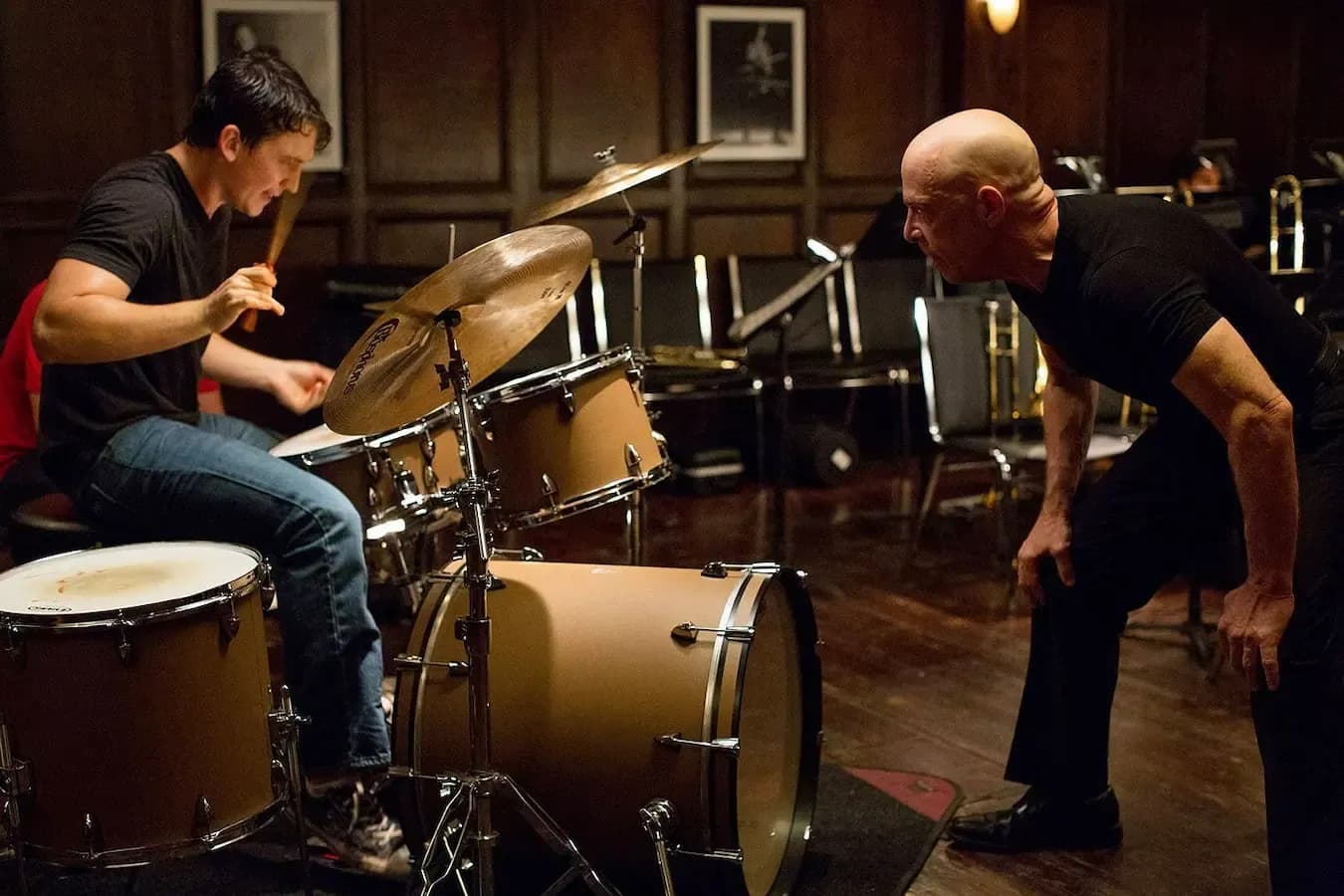
Andrew Neiman begins the film as an ambitious but essentially human young drummer. He wants greatness, but he still has access to warmth, connection, and self-awareness. Fletcher's brutal methods do not unlock his potential they systematically dismantle the parts of him that are not the drumming.
By the film's end, Andrew has sacrificed his relationship, his wellbeing, and arguably his humanity in pursuit of a single goal. The climactic performance is electrifying and deeply troubling. Has he achieved greatness, or has he simply completed his own destruction?
Chazelle never resolves this question, which is precisely what makes the arc so powerful. The negative arc is not a morality tale. It is an interrogation: What are we willing to become in pursuit of what we want? Andrew's arc does not answer that question. It enacts it.
The Lives of Others (2006) — The Positive Arc
Gerd Wiesler is introduced as a model instrument of the East German state: methodical, emotionally sealed, entirely defined by his function as a Stasi surveillance officer. He has no visible inner life because he has suppressed it so completely that he may have forgotten it existed.
His assignment to surveil playwright Georg Dreyman becomes the catalyst his arc requires. Through headphones, Wiesler listens to a life he has never permitted himself art, love, moral courage, the texture of a fully inhabited human existence. Each listening session cracks the seal a little further.
What makes Wiesler's arc exceptional is its restraint. He never announces his transformation. He barely speaks. The change is visible only in small choices: a report filed with a deliberate omission, a typewriter ribbon hidden rather than reported, a book purchased and read in silence. By the end, he has lost his career and his position — and gained something the film treats as more valuable than either.
The final scene, in which Wiesler reads the dedication of Dreyman's published novel and chooses not to hide it, is one of the most quietly devastating positive arc resolutions in contemporary cinema. It works because the arc was earned completely built from specific, visible internal shifts rather than declared through dialogue or imposed by plot convenience.
What Happens Without an Arc
A character without an arc is not automatically a failure. As discussed, flat arcs are a legitimate and powerful choice. But a character who moves through a story without any internal journey who is unchanged by events that should be transformative creates a specific and identifiable problem.
The story feels like it happened around the character rather than through them. Events accumulate without meaning. The ending arrives, but nothing has been resolved internally, so the resolution feels arbitrary things have stopped rather than concluded.
Audiences experience this as emotional flatness. They may admire the production, appreciate the performances, follow the plot but they leave without having felt anything lasting. The story did not cost the character anything real, so it does not cost the audience anything real either.
The investment an audience makes in a story is proportional to the investment the character makes. When a character risks genuine internal transformation when they stand to lose not just their life or their goal but their understanding of who they are the audience follows completely. When that risk is absent, the audience remains at a distance, watching rather than experiencing.
Questions to Test Your Character's Arc
Before drafting, or during revision, run your protagonist through these questions:
- Who are they at the start ? Not their job or their backstory, but their internal state. What do they believe about themselves and the world that is incomplete or false?
- What is the wound or flaw the story will test? If you cannot name it precisely, the arc may not be designed yet.
- How does the plot directly pressure that specific wound? If the plot events could happen to any character without specifically targeting this character's internal weakness, the connection between plot and arc needs strengthening.
- What is the moment of maximum internal pressure? The point at which the character must choose change or refuse to change. Is it clearly identifiable in your story?
- Who are they at the end? How is this different from who they were at the start? Can you articulate the change in a single sentence?
- Is the change earned? Does the transformation follow logically and emotionally from the specific events of the story? Or does it feel imposed a character who changes because the story needs them to, rather than because they have been genuinely broken open?
- What did the arc cost them? Transformation without cost is not transformation — it is upgrade. Real change requires the character to give something up: a false belief, a defense mechanism, a relationship, a version of themselves they have been protecting.
The Structure You Cannot See
Character arc is invisible in the way that architecture is invisible. When a building works when the proportions feel right, when the space moves you in ways you cannot explain you do not think about the load-bearing walls. You simply experience the building.
When a character arc works, audiences do not think about internal journeys or thematic transformation. They simply feel what it is like to watch a person change. They invest completely. They leave the theater carrying something they did not have when they arrived.
That experience does not happen by accident. It is designed in the same careful, structural way that everything meaningful in storytelling is designed. Understanding arc is not about imposing a formula on your characters. It is about learning to see the invisible structure that the best writers have always built into their work, and developing the craft to build it deliberately into yours.