The Ghost in the Script: AI, Authorship, and the Future of Screenwriting
Poetika BlogOctober 7, 20257 min read
The film industry has survived every technological disruption thrown at it. Sound. Color. Digital cameras. Streaming. Each time, the industry adapted, evolved, and found a way to absorb the new without abandoning what made it essential in the first place.
Artificial intelligence may be different. Not because it threatens the technology of filmmaking but because it threatens something more fundamental: the authorship at the center of it. For the first time, the question of who wrote a script is no longer a simple one. And for producers, development executives, and script readers, that question is becoming one of the most consequential they will face.
The Tsunami at the Door
For years, a busy production company might receive twenty scripts a week. That number is now multiplying at a rate that no one in the industry was fully prepared for. The reason is straightforward: writing has become faster. Not better, faster. AI language models can generate a feature-length screenplay in minutes, and the barrier to submission has collapsed.
The result is a wave of material that looks, on the surface, like everything else. Correct formatting. Coherent structure. Grammatically clean dialogue. And underneath, in many cases, no human voice at all.
For script readers tasked with evaluating hundreds of submissions, this is not an abstract problem. It is a daily reality. Identifying the scripts with genuine human authorship the ones worth a producer's time and a development conversation has become significantly harder, and significantly more important.
The Copyright Trap
The legal dimension of this issue is the one most people in the industry are not yet talking about loudly enough but quietly worrying about constantly.
In most major jurisdictions, including the United States and the European Union, copyright protection cannot be granted to work produced entirely by artificial intelligence. Human authorship is a legal requirement, not a creative preference. A script without a human author is, legally speaking, a script without an owner.
The implications for production companies are serious. Consider the scenario: a producer pays a writer for a screenplay, options it, develops it, and greenlights a production. Months or years later, it emerges that the script was generated by AI, with minimal human input. The film and every investment behind it may have no copyright protection. Anyone could copy it. No legal remedy would be available.
This is not a hypothetical risk. It is a structural vulnerability in the current moment, and it is already beginning to surface in legal discussions across the industry. For a producer, knowing the AI composition of a script is not an aesthetic consideration. It is a matter of financial and legal security.
The Voice That Gets Erased
There is a creative dimension to this problem that is harder to quantify but no less important.
What makes a screenplay distinctive is rarely its structure. Structure can be learned, replicated, and as AI has demonstrated automated. What cannot be automated is voice: the specific texture of a writer's language, the rhythm of their dialogue, the idiosyncratic choices that make a character feel like a real person rather than a narrative function.
AI optimizes for correctness. It smooths irregular sentence structures, normalizes dialogue patterns, and removes the productive imperfections that give writing its human quality. A character who speaks in fragments, or in run-on sentences, or in the wrong tense intentionally, expressively will often be "corrected" by an AI model that does not understand why the rule was broken in the first place.
This process sometimes called semantic flattening produces writing that is technically proficient and creatively inert. It reads cleanly and feels like nothing. And in a medium built on emotional specificity, that is a profound loss.
Detecting AI involvement in a script is, among other things, a way of asking: is the human voice still here? Has the writer's specific texture survived the process? Or has it been averaged away into something generic and untraceable?
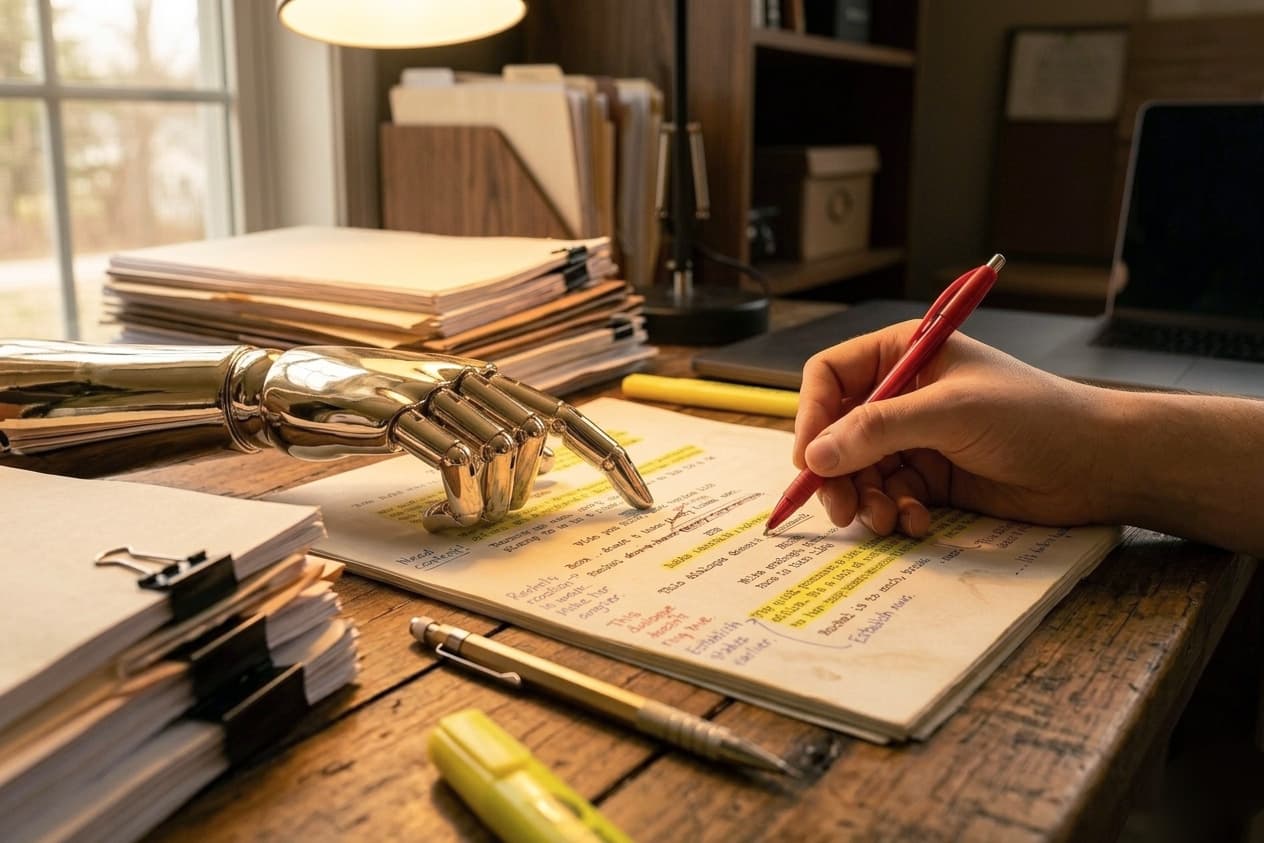
The modern storyteller's new assistant. As artificial intelligence integrates into the creative landscape, a single keystroke opens up entirely new possibilities for script development and brainstorming.
AI Laundering: The Industry's Quiet Problem
There is a practice emerging in the industry that has not yet found its way into mainstream coverage, but is widely discussed in development circles. It goes by the informal name of AI laundering.
The practice works like this: a writer uses an AI model to generate a full draft of a script, makes minimal changes a scene here, a line of dialogue there and submits the result as their own original work. To a casual reader, the script may appear human-written. The formatting is correct. The story follows conventional structure. The characters have names and motivations.
What is missing is the accountability that comes with genuine authorship. The writer has not made the thousands of specific creative decisions that a real draft requires. They have not lived inside the story long enough to know what it needs. And the script, however polished its surface, reflects none of the creative investment that makes development work — the process of refining, challenging, and deepening a script through sustained human attention.
For the industry to function, authorship must mean something. AI laundering erodes that meaning, and the erosion is quiet enough that it can go undetected for a long time.
Co-writing the future of cinema. When human emotion meets AI precision, script doctoring becomes a collaborative journey of refining structure, dialogue, and character arcs.
The False Positive Problem
Any honest discussion of AI detection must acknowledge its limitations and the most significant one is the risk of misidentifying human-written work as machine-generated.
Writers who are highly disciplined, who write in clean and consistent prose, who do not rely on stylistic irregularity these writers can trigger AI detection systems for the wrong reasons. The same is true of writers whose first language is not English, and who write with a grammatical precision that comes from careful construction rather than native fluency.
A detection system that operates as a binary human or AI, guilty or innocent is a blunt instrument with real potential for harm. It can penalize writers for being careful. It can disadvantage non-native speakers. It can produce false confidence in both directions.
The more responsible approach is probabilistic rather than definitive: not a verdict, but a map. Not "this script was written by AI" but "these sections carry patterns consistent with AI generation, and warrant closer attention."
How Poetika Approaches the Problem
Poetika's AI detection system was built with these limitations in mind. Rather than rendering a binary judgment, it assigns a probability score a measured assessment of the likelihood that a given text, or sections of it, were AI-generated. This score is not a conclusion. It is a starting point for human evaluation.
More usefully, when the system identifies sections that carry the markers of AI generation, it flags them specifically listing the relevant passages and explaining, in each case, why they triggered concern. The result is not an accusation but a reading guide: here is where a human reader should look more carefully, and here is what to look for.
This approach acknowledges something important: no automated system can be the final word on authorship. What it can do is direct attention, sharpen scrutiny, and make the work of human evaluation faster and more focused. The final judgment remains where it belongs with a person who understands what they are reading and why it matters.
What This Means for the Industry
The conversation about AI and authorship is still in its early stages, and the industry's responses — legal, contractual, creative are still being worked out. Writers' guilds are negotiating. Studios are drafting new clauses. Festivals are updating submission policies.
What is already clear is that the question of authorship will not resolve itself. It will require active attention, better tools, and a shared commitment to the idea that the origin of a creative work matters not just legally, but artistically.
A script written by a human being carries something that a generated document does not: the specific weight of a specific mind working through a specific problem. That specificity is what makes adaptation possible, collaboration meaningful, and the development process worth undertaking.
AI can be a powerful tool in a writer's hands. Used as an assistant, a sounding board, a first-draft generator that a writer then genuinely inhabits and transforms it can accelerate and enrich the creative process. What it cannot do is replace the process itself. And the industry's ability to tell the difference between a script that has been genuinely written and one that has merely been generated is, increasingly, one of the most important skills it will need.
Christopher Nolan's The Odyssey may be his biggest production yet, but it also feels like the inevitable destination of a career built around memory, time, and the impossible journey home.
Every few years, a beloved novel gets adapted into a film. The announcement generates excitement; finally, that book is becoming a movie. And then, more often than not, something goes wrong. The film arrives and feels thin, rushed, or strangely hollow. The characters who felt so vivid on the page seem flat on screen. The story is technically all there, but whatever made the book extraordinary has somehow failed to survive the journey.
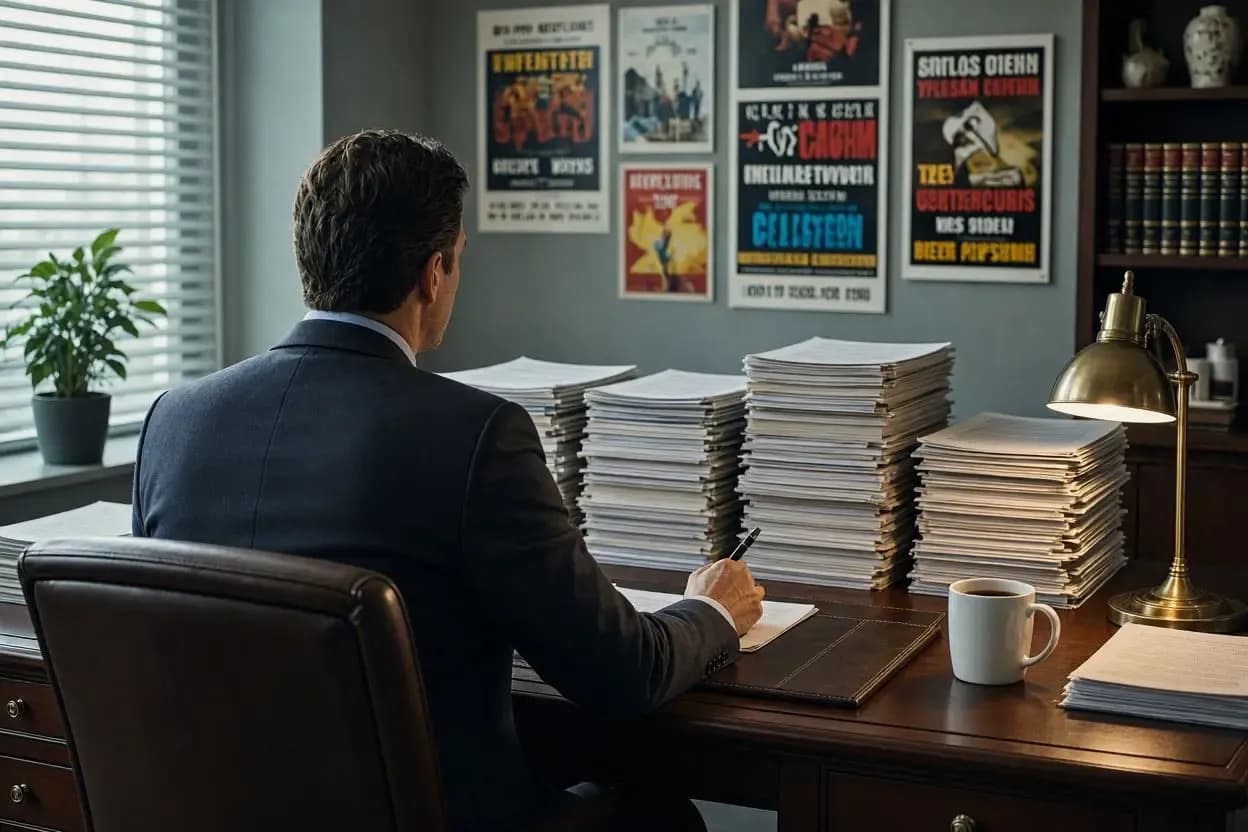
It is Monday morning. Over the weekend, twelve new scripts arrived. Nine more came in the week before. Somewhere in the inbox are scripts that have been waiting since last month, along with a few that have been there even longer. In two hours, the development meeting starts, and there is still a stack of material that nobody has had time to read.