A novel can wear almost any typeface it pleases. Infinite Jest was typeset in Times New Roman. Elena Ferrante's Neapolitan quartet arrives in Minion Pro. Literary quarterlies reach for Garamond; academic presses prefer Palatino. The choice of font, in prose publishing, is a considered aesthetic act a conversation between designer, author, and reader.
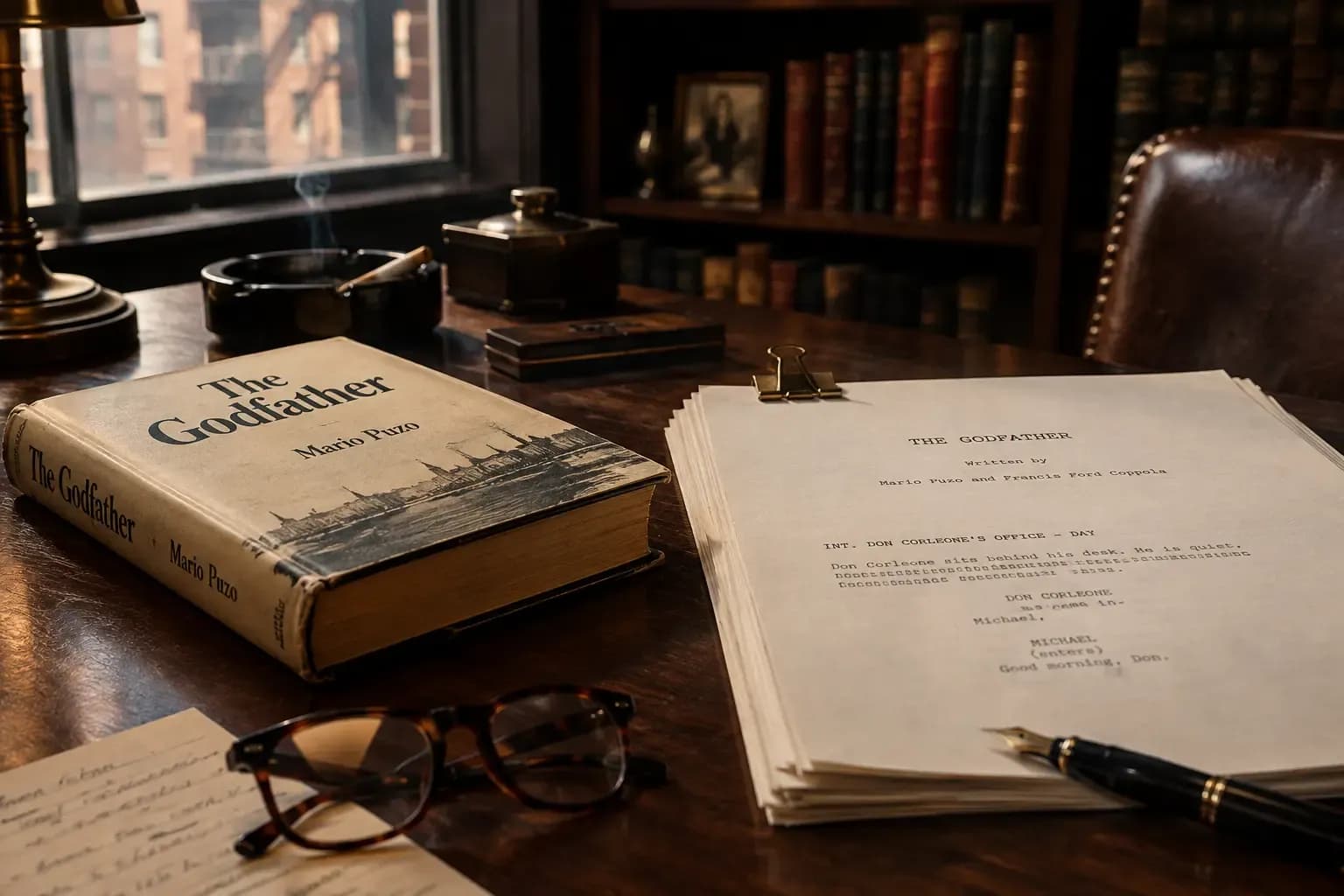
A screenplay cannot afford such conversations. Open any professionally submitted script in Hollywood, on Shaftesbury Avenue, or in a Netflix development office, and you will find the same typeface, the same point size, the same margins: Courier, 12 point, one inch on every side. The format is so uniform that an outsider might reasonably mistake it for bureaucratic boilerplate.
It is not boilerplate. It is, in fact, one of the most consequential design decisions in the history of industrial storytelling and understanding why it persists tells us something important about how creative industries actually work.
The Typewriter That Became a Standard
To understand Courier, you have to return to 1955 and the offices of IBM.
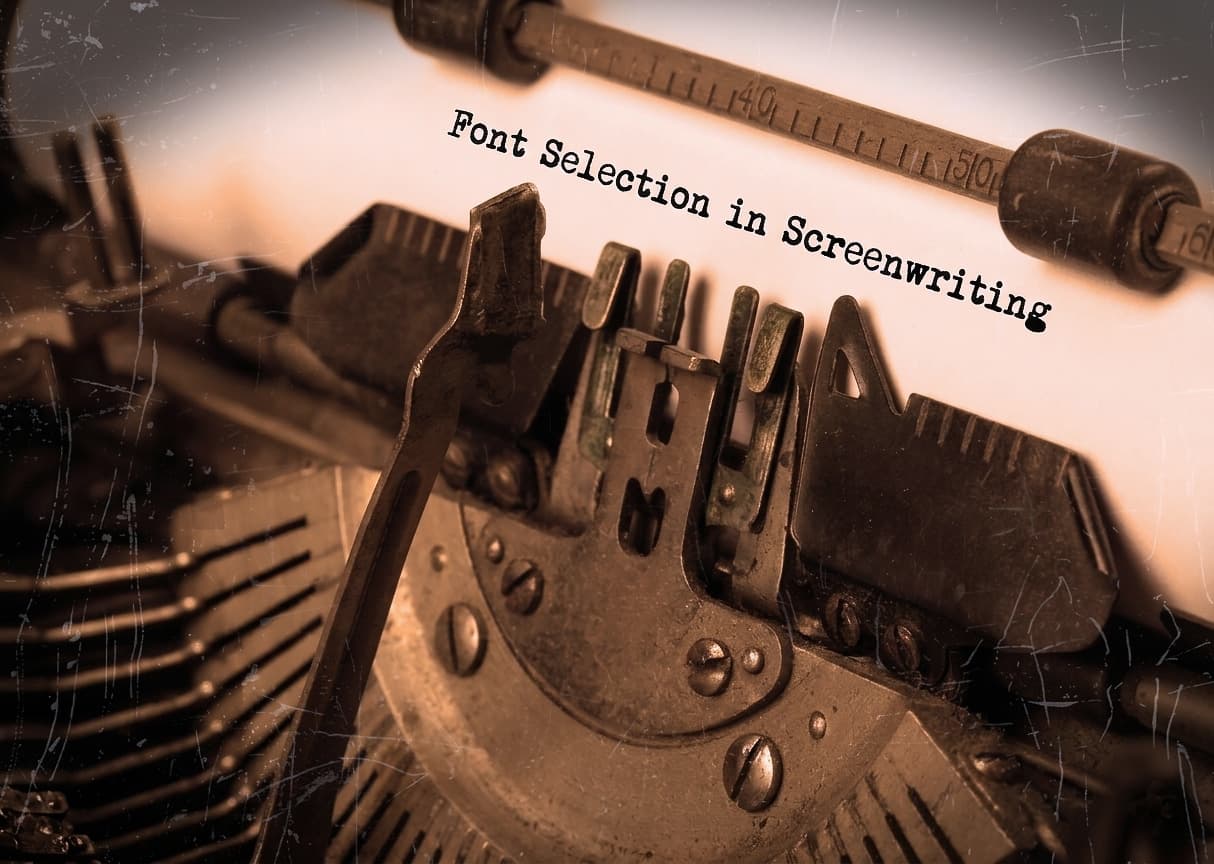
The font was designed by Howard Kettler for the IBM Selectric typewriter a machine that would go on to dominate offices across the English-speaking world for the better part of three decades. Kettler's brief was functional: design a typeface that mimicked the clean, even strokes of a professional typewriter. The result was Courier, a slab-serif monospaced font with a studied neutrality, designed to disappear rather than to announce itself.
Monospaced meaning every character, from the thin i to the broad W, occupies an identical horizontal slot was not an aesthetic choice. It was an engineering necessity. Typewriter carriages advanced at a fixed rate; the font had to match the mechanism. The peculiarity of monospacing, the quality that makes Courier look slightly strange to eyes trained on proportional typefaces, was the direct product of mechanical constraint.
When screenwriters of the 1950s and 1960s typed their scripts on those IBM Selectrics, they were using the only tool available. The format they developed the tab stops for action lines, character cues, and dialogue; the visual grammar of the American screenplay was, whether they knew it or not, calibrated to Courier's dimensions. By the time personal computers arrived in the early 1980s and writers began migrating to word processors, the connection between the screenplay format and Courier's monospaced architecture had become load-bearing. Changing it was no longer simply a matter of preference. It would mean rebuilding the assumptions of an entire industry.
One Page, One Minute and Why It Matters
The most important practical consequence of Courier's monospacing is a rule so widely cited in screenwriting guides that it has the status of physical law: one page of properly formatted screenplay equals approximately one minute of screen time.
The mechanism is straightforward. Because every character in Courier occupies the same width, and because the industry has standardized on 12-point Courier with precise margins and tab stops, the density of text per page remains broadly consistent across scripts. A page of brisk action and a page of compressed dialogue will not yield identical running times but they will yield reliably similar ones. The approximation is close enough to be useful.
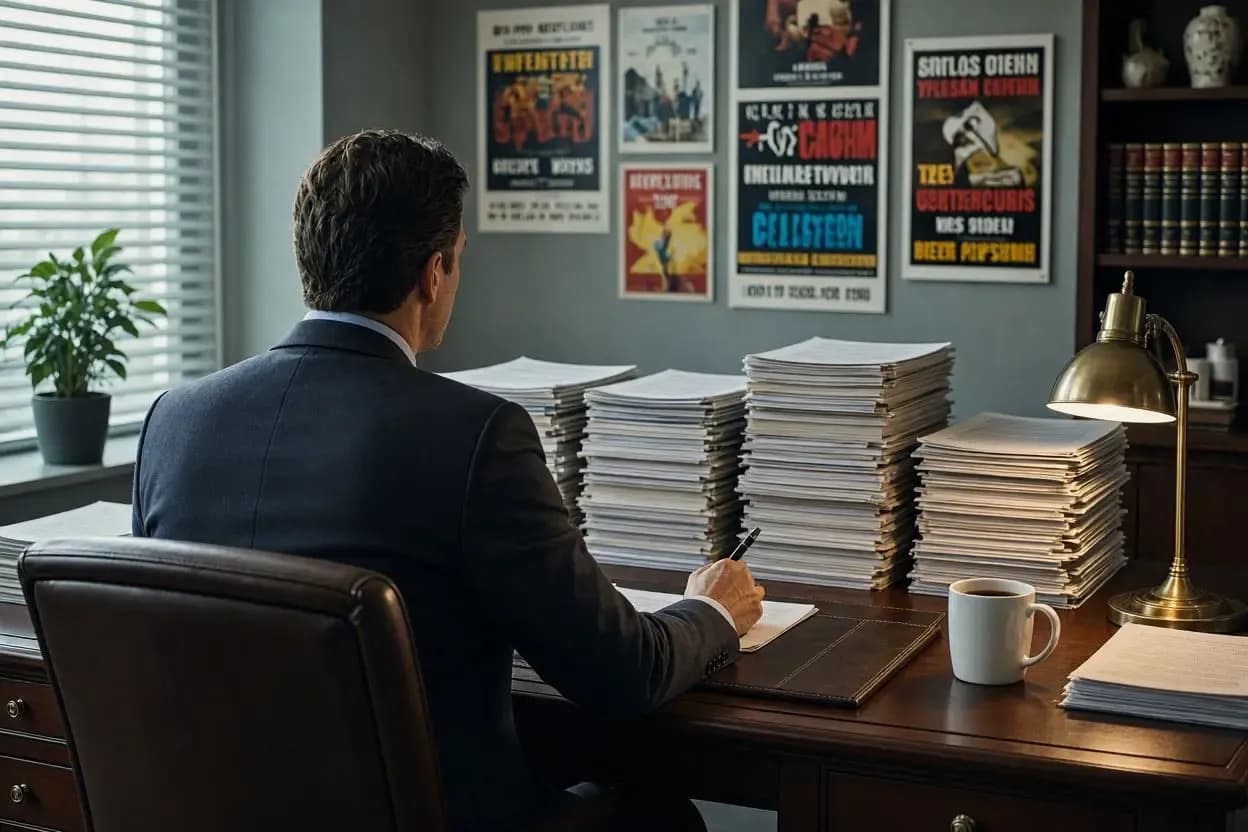
And useful is precisely what the production industry requires. A 110-page script, read by a producer on Monday morning, represents a workable 110 minutes theatrical feature. A 90-page script is a tight drama or a genre picture. A 55-page script is a television hour. Producers, directors, and line producers can make scheduling and budgetary projections before a single frame is shot, before a single actor is cast. The number at the bottom of the title page is not decorative information. It is, in miniature, a financial document.
This is where the rule earns its keep and also where its limits should be acknowledged. The "one page equals one minute" principle is an approximation, not a formula. Quentin Tarantino's scripts, dense with dialogue that runs to the bottom of the page, routinely underestimate his films' running times. Christopher Nolan's action sequences, compressed into lean descriptive lines, can unspool far longer on screen than the page count suggests. Aaron Sorkin, whose walk-and-talk dialogue pages look sparse on paper, produces dense scenes by the time actors deliver the overlapping cadences of his prose.
The rule, in other words, should be read as a useful fiction a shared convention that gives the industry a common language, even while every writer with experience knows it bends. The alternative a world where every producer must perform a bespoke timing analysis before reading a script is too costly to contemplate. The approximation holds because no one has incentive to abandon it.
Does Courier Save Ink?
There is a widely repeated belief among working writers that Courier's sparse, typewriter-aesthetic strokes make it an economical choice for printing that its thin lines and open counters consume less ink than a denser, more finished typeface.
The belief is false. It is, in fact, almost perfectly wrong.
Courier's monospacing means that any given passage of text requires more horizontal space than the same passage set in a proportional font. Because each character, including the slender l, the narrow 1, the minimal i is padded to the same width as the widest glyph in the set, Courier distributes letters across more paper than a proportional font would. The same scene description that fits on three and a half lines in Garamond will run to four and a quarter in Courier. Multiplied across a 110-page script, the difference is not trivial.
Researchers at several universities studying institutional printing costs have found that fonts like Century Gothic and Garamond produce measurably lower ink consumption per page than Courier — the former because of its open, thin strokes; the latter because of its economy with horizontal space. Courier does not appear on any list of ink-efficient typefaces.
Why, then, does the industry persist with it?
Because on a film set, one wasted hour costs more than a year's worth of printer ink.
When a production's schedule slips by a single working hour — when an Assistant Director realises, at the call sheet stage, that the timing estimates embedded in the page count have drifted the financial consequences are immediate and compounding. Crew overtime, equipment rental extensions, location hold fees: the arithmetic is brutal. The precision that Courier's standardization brings to the pre-production process the ability to estimate shooting days, to schedule location sequences, to produce breakdown documents that all parties read from the same set of assumptions is worth a significant cost in paper and toner. No production accountant has ever suggested switching to Garamond to save money on printing.
How Poetika Works?
Explore a complete sample analysis and understand the feedback format.
Why the Standard Holds?
The persistence of Courier is, at its deepest level, a coordination problem. Like the QWERTY keyboard layout — retained not because it is optimal for typing but because the infrastructure surrounding it is too embedded to redesign — Courier endures because the industry has organized itself around its properties.
Consider the production pipeline. Final Draft, the dominant professional screenwriting software, defaults to Courier and calibrates its pagination to Courier's character counts. Movie Magic Scheduling, used by Assistant Directors to produce daily shooting schedules, imports scripts in Final Draft format and makes timing projections on Courier assumptions. Breakdown software tools that parse scripts to count characters, locations, props, and special effects for budgeting purposes has been trained on decades of Courier-formatted documents.
If a writer submits a script in a different typeface, the disruption runs through every downstream tool. The page count no longer correlates reliably to screen time. The breakdown software may miscalculate scene lengths. The AD's schedule becomes unreliable before production begins.
There is also a subtler consequence: a script in the wrong font signals something about its author. In development offices that receive hundreds of unsolicited submissions, a non-standard format is a quick filter. It suggests a writer who has not done the work of understanding the industry they are addressing — who has treated a professional document as a personal artifact. The script may never be read past its title page.
Not All Couriers Are Equal
The category of "Courier," as used in professional screenwriting, is narrower than it might appear. There are, in fact, three distinct variants in common use, each with a different provenance and a different reason for existing.
Courier New is Microsoft's version of the typeface, bundled with Windows since the early 1990s and ubiquitous as a result. Its availability has made it the default choice for writers working outside dedicated screenwriting software — but it carries a slightly heavier stroke weight than the original, and its spacing is less refined for on-screen reading. It is usable; it is not ideal.
Courier Final Draft is the version optimized by the developers of Final Draft for use within their software. It is tighter and cleaner at screen resolution than Courier New, and it reproduces more crisply when exported to PDF. Writers working in Final Draft are, in effect, using this variant whether they are aware of it or not.
Courier Prime, designed in 2013 by screenwriter and blogger John August in collaboration with type designer James T. Edmondson, is the most considered of the three. August's brief was specific: produce a Courier-compatible typeface that was easier to read in long manuscripts, with improved italics for read-throughs, better-formed quotation marks, and a cleaner rendering at modern screen resolutions. Courier Prime maintains full compatibility with the 12-point, standard-margin format a script written in Courier Prime times out identically to one written in Courier New but it is, by most readers' accounts, noticeably more pleasant to read. It is available free of charge.
For writers working on spec scripts scripts written on speculation to demonstrate craft and secure representation or assignments Courier Prime is the current recommendation among working professionals. It meets every industry requirement while eliminating the minor but real friction of Courier New's heavier strokes across a feature-length read.
What matters in every case is the constraint, not the brand: 12-point, standard margins, monospaced. The specific variant is a matter of refinement; departing from those parameters is a professional error.
Where the Rules Bend
Courier's dominance, while nearly total in the spec script context, is not completely universal. There are professional environments where different conventions apply, and a working writer should understand where those exceptions operate — and why they do not extend to the general case.
Shooting scripts the production-locked versions of screenplays used on set, distributed to cast and crew during principal photography sometimes adopt house styles that differ from the submission format. Once a script is in production, the commercial incentive to filter out amateurs no longer applies; the script is being read by people who are already hired. Some production companies paginate differently, use colored revision pages, or apply proprietary headers and footers that interact with the standard font in various ways.
Broadway and West End musical theatre has its own manuscript traditions, and rehearsal scripts in those contexts sometimes employ Arial or Helvetica for the practical reason that non-monospaced fonts are easier for ensemble casts to navigate at table reads. The timing mechanics of a stage musical are governed by song and choreography rather than by page count; the Courier convention imports less cleanly.
Certain long-form television formats particularly in British production, where conventions have always diverged somewhat from Hollywood's have house styles that permit modest typographic variation in internal documents.
None of this extends to spec scripts. The spec script is a writer's calling card: the document by which an unknown quantity presents itself to an industry that has no prior evidence of that writer's craft. In that context, non-standard formatting is not a creative statement. It is a liability.
Will AI Make Courier Obsolete?
The question deserves serious engagement, because the technical arguments for Courier's standardization rest on assumptions that are beginning to shift.
The one-page-per-minute rule depends on page count as a proxy for screen time. That proxy made sense when timing a script meant physically reading it against a stopwatch, or estimating from a producer's experience of the format. Increasingly, however, production software can analyze a script structurally counting dialogue lines, action-line density, scene transitions, and character presence and produce timing estimates that are more accurate than any page-count approximation. If those tools become standard, the typographic basis for Courier's pre-eminence weakens. The page count becomes a less important signal when better signals are available.
More broadly, the migration of script development to collaborative cloud platforms where documents exist as structured data rather than fixed-format PDFs raises questions about the long-term relevance of typeface conventions tied to print-era assumptions. A script that exists as a structured database, with scenes, characters, and durations as discrete fields, does not need to encode its timing information in its font. The font becomes decorative rather than functional.
And yet. The argument from coordination remains powerful. The industry does not adopt new tools quickly or uniformly. The writers, producers, directors, development executives, assistants, agents, and managers who constitute the Hollywood ecosystem use dozens of different software platforms, work in different time zones, and communicate across a vast web of relationships that change continuously. In that environment, a single, universal, unambiguous formatting standard whatever its technical inefficiencies has a value that transcends its technical properties. Courier persists, in part, because no one has the authority to declare a successor, and because the distributed cost of switching, borne across millions of submitted scripts and thousands of production pipelines, is too high to incur voluntarily.
The QWERTY keyboard, again, is instructive. Its ergonomic inferiority to alternative layouts has been documented for decades. Alternatives Dvorak, Colemak, various proprietary layouts are genuinely faster and less strenuous for trained users. They have not displaced QWERTY in any meaningful way. The installed base is too large; the switching cost is too personal; the coordination benefit of a shared standard is too durable.
Courier may, in time, cede ground. The generational shift toward cloud-native screenwriting tools, the increasing sophistication of AI-assisted script analysis, and the gradual loosening of spec script submission norms as digital platforms diversify the development pipeline may eventually render its dominance contingent rather than absolute. But that moment, if it comes, will not arrive through any individual writer's decision to use a different font. It will require the industry's tools, habits, and infrastructure to change together — and industries, as a rule, change slowly.
Stay updated on screenwriting and story development
Receive new articles, practical writing insights, and product updates directly in your inbox.
The Invisible Font
The best tool in any professional context is often the one that disappears. A well-designed knife, a good pair of shoes, a reliable camera: the mark of a serious instrument is that the user stops thinking about it. Attention passes through the tool to the work.
Courier, at 12 point, on a properly formatted page, performs exactly this disappearing act. A reader experienced with the screenplay form does not see the font. She sees the scene, the character, the line of dialogue. The monospacing, the slab serifs, the padded character widths all of it recedes.
This is, in the end, why Courier has survived. Not because it is beautiful it is not, particularly. Not because it saves resources — it does not. Not even because it is technically superior to alternatives Courier Prime is, by almost any measure, a better reading experience.
Courier has survived because the screenplay is not merely a literary document. It is an industrial document: the first in a long chain of production materials, each dependent on shared assumptions, each calibrated to the same standard. In that chain, the font is not a style choice. It is a contract — a signal of professional literacy, a compatibility layer between the writer's imagination and the machinery of production.
To choose a different font for a spec script is to misunderstand what a spec script is. It is not a novel. It is not a poem. It is a document addressed to an industry — and that industry reads in Courier.