What Genre Is Your Film? Why the Answer Matters More Than You Think
Poetika BlogAugust 12, 20251 min read
Ask a filmmaker what genre their film is, and you will often get a hesitant answer. A list of influences. A comparison to three other films. A long pause. But genre is not something a story chooses it is something a story has. And the sooner a filmmaker understands what their story is carrying, the better every decision that follows will be. Genre is not a marketing label applied after the fact. It is a language that audiences, producers, and distributors have been speaking for centuries long before cinema existed. Understanding it is not a commercial compromise. It is a creative advantage.
Where Genre Comes From
The idea of categorizing stories is as old as storytelling itself. Aristotle divided narrative into tragedy and comedy two modes of human experience that he believed demanded different forms, different structures, and different emotional responses from their audiences. The Greeks understood something fundamental: the kind of story you are telling shapes how you tell it, and how it lands.
From ancient mythology to medieval epic poetry, from Shakespearean drama to the nineteenth-century novel, storytelling has always organized itself into recognizable forms. Audiences came to these forms with expectations and skilled storytellers learned to meet those expectations, subvert them, or reinvent them entirely.
When cinema arrived at the end of the nineteenth century, it inherited this entire tradition. The first filmmakers were not starting from scratch. They were working within a storytelling culture that had already developed genres over thousands of years and they adapted them to a new medium.
How Genre Developed in Cinema
The earliest films were novelties brief glimpses of movement that amazed audiences simply by existing. But as cinema matured, genre emerged quickly and naturally. By the 1910s and 1920s, Hollywood was already producing recognizable genre films: westerns, comedies, melodramas, horror pictures. Studios built entire production systems around genre — sets, costumes, lighting styles, and even contract players associated with specific kinds of stories.
Genre served a practical purpose. It allowed studios to produce efficiently and market clearly. It allowed audiences to choose what kind of experience they wanted. And it allowed filmmakers to work within established conventions or to push against them.
The sound era deepened genre further. Musicals became a dominant form in the 1930s. Film noir emerged in the 1940s. Science fiction exploded in the 1950s alongside Cold War anxieties. Each decade brought new genres or reinvented old ones in response to cultural shifts, technological changes, and audience appetites.
Today, genre is more fluid than ever. Films routinely blend multiple genres, and audiences have become sophisticated enough to navigate those combinations. A horror-comedy operates by different rules than a straight horror film. A sci-fi romance makes different demands on its writer than either science fiction or romance alone. Understanding these combinations and using them intentionally is one of the defining skills of contemporary filmmaking.
The Main Genres
Genre is ultimately about emotion. Each genre creates a specific kind of feeling in its audience and that feeling is what drives every creative decision, from structure to casting to cinematography.
Drama invites the audience to feel deeply to be moved, challenged, or unsettled by the weight of human experience. It is the broadest genre and the one most closely associated with prestige filmmaking.
Comedy generates laughter, lightness, and the release of tension. It is deceptively difficult to execute well, and its mechanisms timing, surprise, recognition are among the most technically demanding in cinema.
Suspense creates a low-energy but persistent tension. The audience knows something is coming; they need to see how it resolves. Suspense is less about fear than about anticipation.
Thriller operates at a higher register — high-energy, visceral, designed to make the heart beat faster. Where suspense is cerebral, thriller is physical.
Horror produces fear, revulsion, and dread. It confronts audiences with what they do not want to see, and keeps them watching anyway.
Action delivers larger-than-life moments that engage the body as much as the mind sequences that trigger the fight-or-flight response and hold attention through sheer kinetic force.
Adventure evokes excitement through the idea of new places, new experiences, and the unknown. It is the genre of discovery.
Musical uses music not as accompaniment but as storytelling a form in which emotion becomes literal song, and the heightened reality of the genre becomes its greatest asset.
Tragedy produces sadness and grief rooted in loss the recognition of what cannot be recovered, what cannot be changed.
Science Fiction engages the intellect through ideas that could theoretically exist — futures, technologies, and realities that extend what we know into what might be possible.
Fantasy stirs the imagination through worlds and concepts that exist entirely beyond the real — myth, magic, and the impossible made vivid.
Documentary turns the camera on reality itself, prompting audiences to evaluate the world they live in and the human condition they share.
Mystery provokes curiosity and the desire for knowledge a genre built on questions, clues, and the satisfaction of revelation.
Romance generates the warm, nurturing feelings of love, desire, and human connection. It is one of the oldest and most enduring forms in storytelling.
Experimental surprises through the reinvention of the medium itself films that use form, structure, or image in ways that challenge what cinema can be.
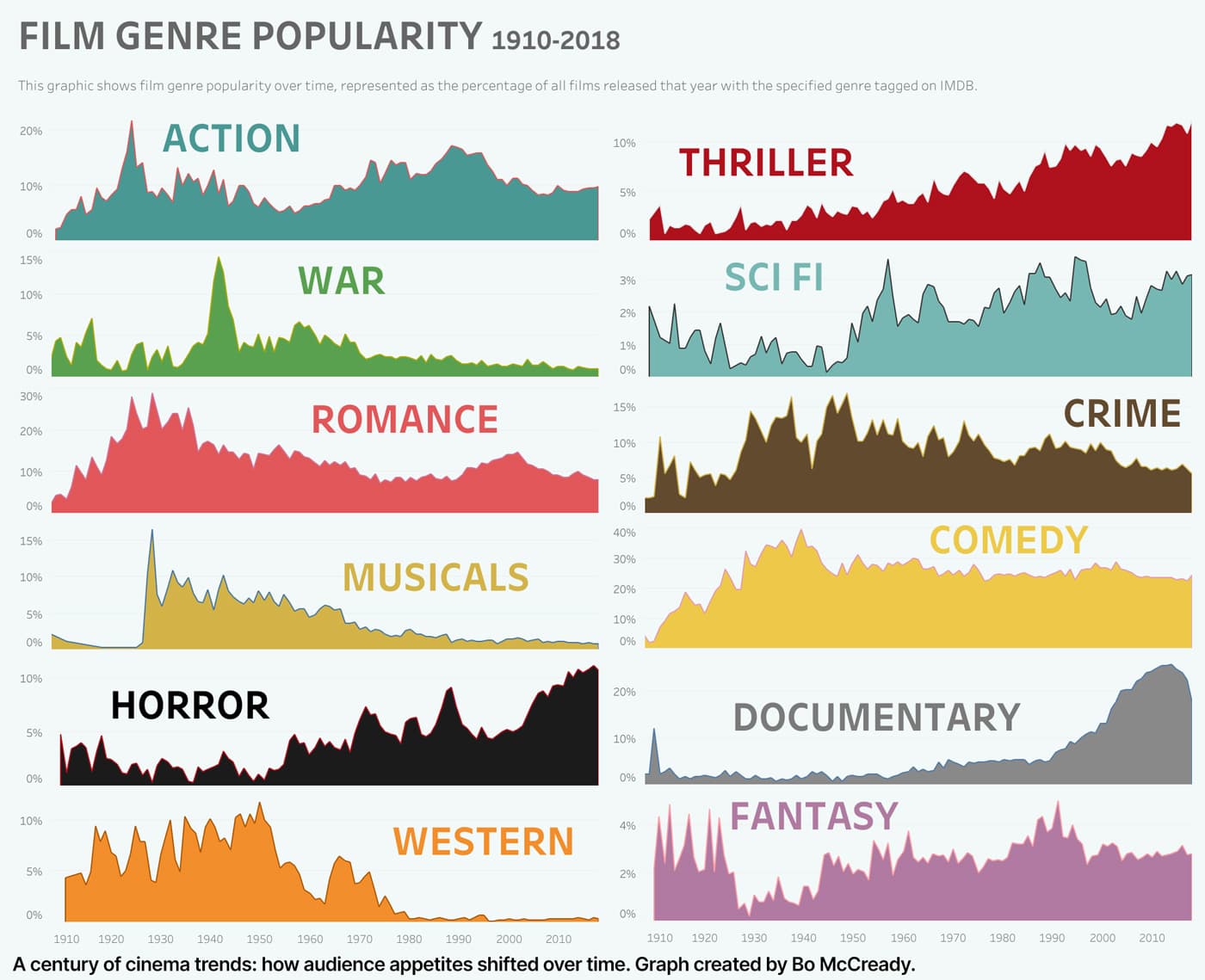
A century of cinema trends: Data tracking from 1910 to 2018 reveals the fascinating rise and fall of film genres, showing how audience appetites shifted from classic Westerns to modern Documentaries and Horror.
Sub-Genres: Where It Gets More Specific
Within each main genre, sub-genres allow for more precise categorization and more precise audience targeting.
Within horror: slasher, psychological horror, supernatural horror, body horror, found footage.
Within comedy: romantic comedy, dark comedy, satire, slapstick, mockumentary.
Within thriller: political thriller, psychological thriller, legal thriller, spy thriller.
Within science fiction: dystopian, space opera, cyberpunk, time travel, post-apocalyptic.
Within drama: period drama, courtroom drama, family drama, social realism.
Within action: martial arts, heist, war, superhero.
Sub-genres matter because they carry their own conventions, their own audience expectations, and their own production requirements. A supernatural horror film and a psychological horror film are made differently, marketed differently, and watched differently even though both are horror.
Hybrid Genres: When Two Worlds Collide
Contemporary cinema is increasingly defined by genre hybrids films that deliberately combine two or more genres to create something new. Some of the most celebrated films of recent decades have been built on this principle.
A horror-comedy like Get Out uses the mechanics of horror to deliver social commentary that a straight drama might not have reached. A sci-fi romance like Eternal Sunshine of the Spotless Mind uses speculative technology to explore emotional truth in ways that realism could not. A thriller-drama like Parasite borrows the tension and pacing of genre cinema to tell a story with the depth and ambition of serious literary fiction. Hybrid genres are not a compromise. They are a creative strategy. But they require clarity because a film that blends genres without intention can end up serving neither audience.
Why Genre Matters for Your Script
Understanding the genre of your script is not a bureaucratic exercise. It is one of the most creatively significant decisions you will make.
Genre determines tone. It shapes structure. It sets the emotional contract between your film and its audience. When a horror film delivers genuine laughs, that is not an accident it is a decision. When a comedy turns unexpectedly dark, the audience needs to trust that the filmmaker knows what they are doing.
More practically: genre determines who your audience is, which producers are right for your project, and which festivals are most likely to respond to it. A producer who specializes in arthouse drama is not the right conversation for a supernatural horror film. A festival that programs experimental cinema is not the right platform for a mainstream romantic comedy. Getting this alignment right saves time, protects relationships, and significantly increases your chances of getting the project made.
Finding Your Genre: A Practical Approach
The most reliable way to understand your script's genre is to look at it from the outside not as its writer, but as its first audience. This is harder than it sounds. Writers are too close to their own work to see it clearly, which is why the genre question is so often answered incorrectly, or not answered at all.
A useful starting point is to ask: what emotion does my script primarily create? Not what emotion I intended but what a reader actually experiences moving through it. Fear, laughter, tension, grief, wonder the dominant feeling points directly to the dominant genre.
The next step is to look at structure. Genre leaves fingerprints on a script in its pacing, its turning points, its character dynamics. A thriller builds and releases tension in specific ways. A drama earns its emotional climax through a different kind of accumulation. Reading your script with these patterns in mind can reveal a genre that was operating beneath the surface all along.
Tools like Poetika can make this process faster and more precise. By analyzing the structural and narrative characteristics of your script, Poetika identifies your primary genre giving you an objective perspective that is difficult to achieve from inside your own work. Writers frequently discover that the film they intended to make and the film they actually wrote belong to different genres. That is not a failure. It is one of the most valuable things you can learn about your script before anyone else reads it.
Genre itself is not static. As culture shifts, new genres emerge and old ones transform. The rise of streaming platforms has already changed what audiences expect and what filmmakers can attempt. Hybrid genres that would have been considered unmarketable a decade ago are now among the most celebrated films in the world. The boundaries are moving and the filmmakers who understand where those boundaries are today are the ones best positioned to push them tomorrow. Knowing your genre is not the end of a creative conversation. It is the beginning of a more informed one. It is a compass. It tells you where you are, so you can decide, with intention, where you want to go.
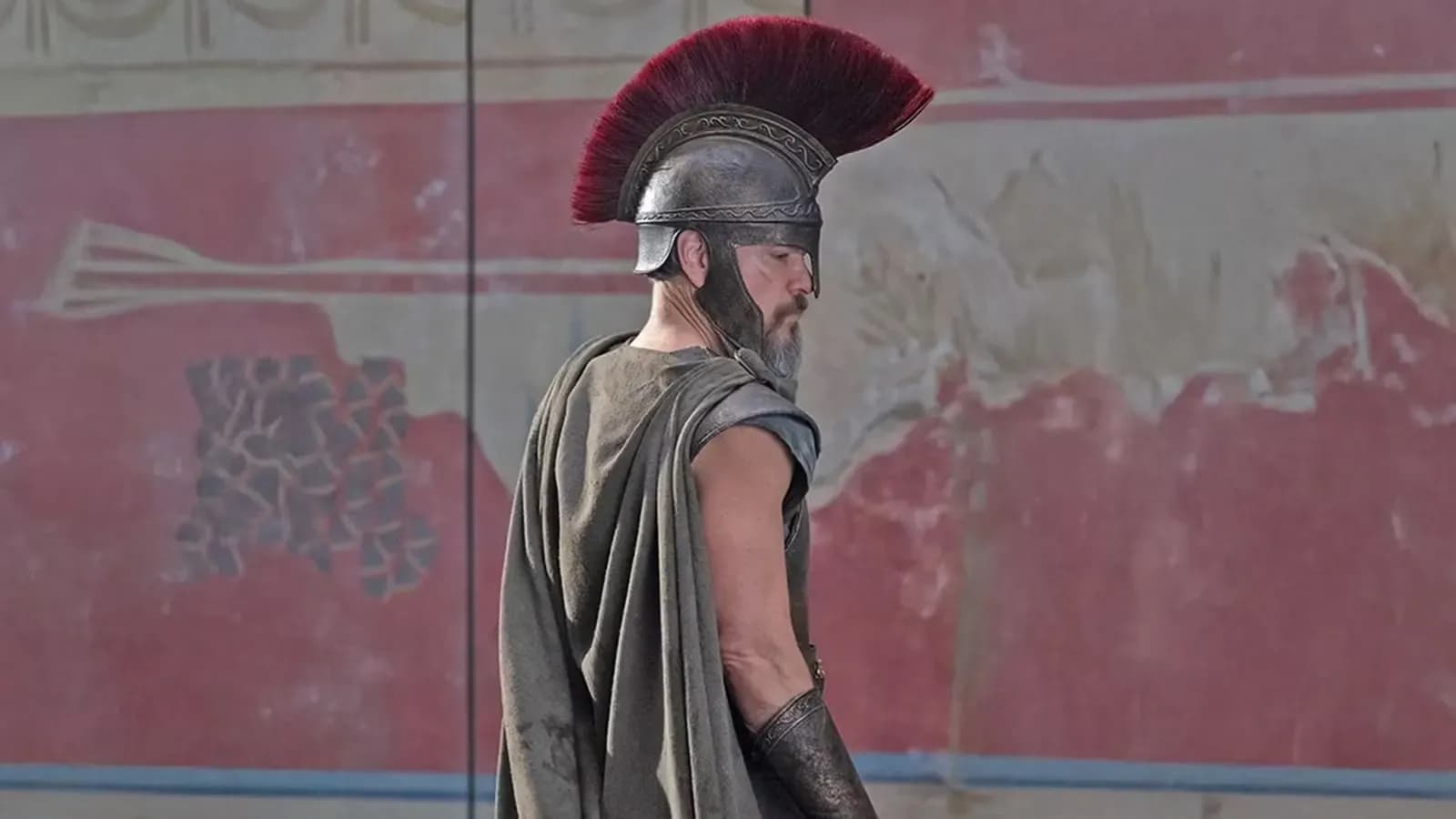
Christopher Nolan's The Odyssey may be his biggest production yet, but it also feels like the inevitable destination of a career built around memory, time, and the impossible journey home.
Every few years, a beloved novel gets adapted into a film. The announcement generates excitement; finally, that book is becoming a movie. And then, more often than not, something goes wrong. The film arrives and feels thin, rushed, or strangely hollow. The characters who felt so vivid on the page seem flat on screen. The story is technically all there, but whatever made the book extraordinary has somehow failed to survive the journey.
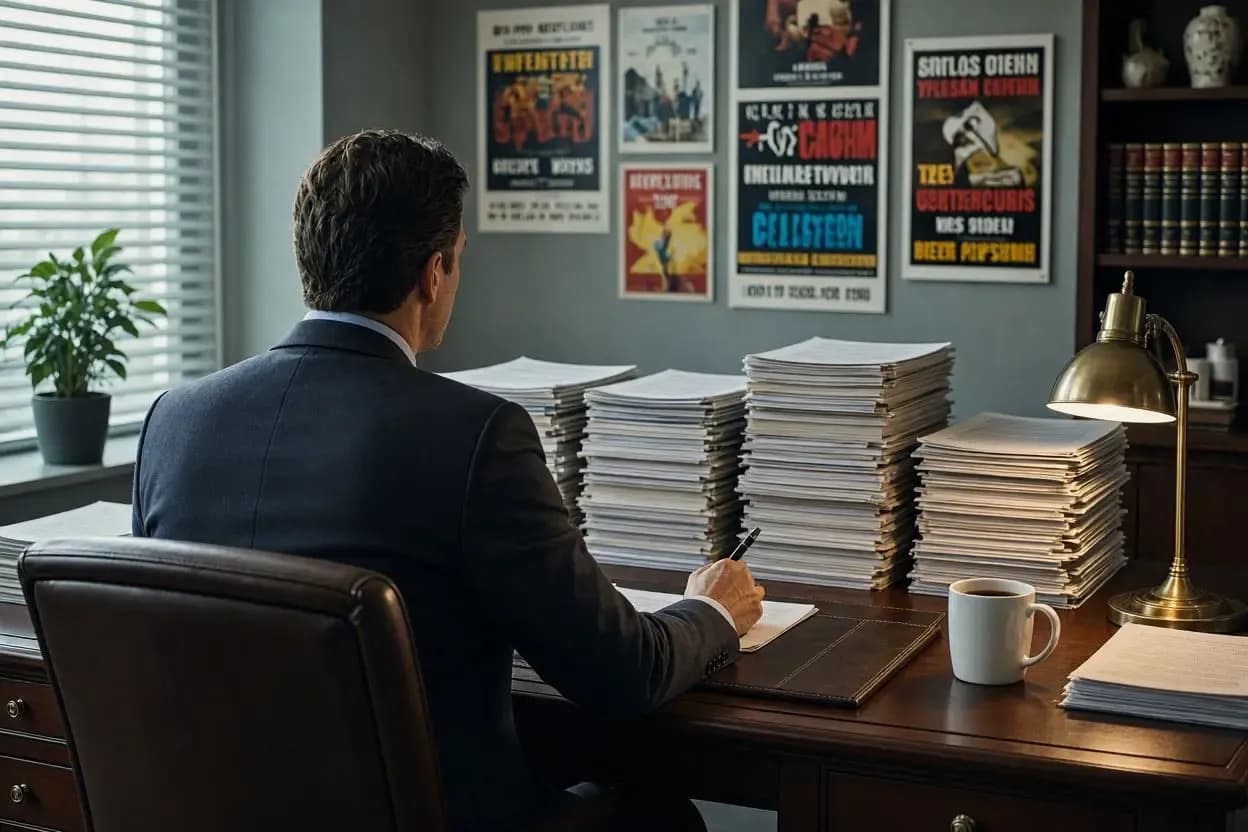
It is Monday morning. Over the weekend, twelve new scripts arrived. Nine more came in the week before. Somewhere in the inbox are scripts that have been waiting since last month, along with a few that have been there even longer. In two hours, the development meeting starts, and there is still a stack of material that nobody has had time to read.