How to Write a Logline That Gets Your Script Read
One sentence stands between your screenplay and the desk it lands on. Here's how to make it count.
March 12, 202417 min
Read 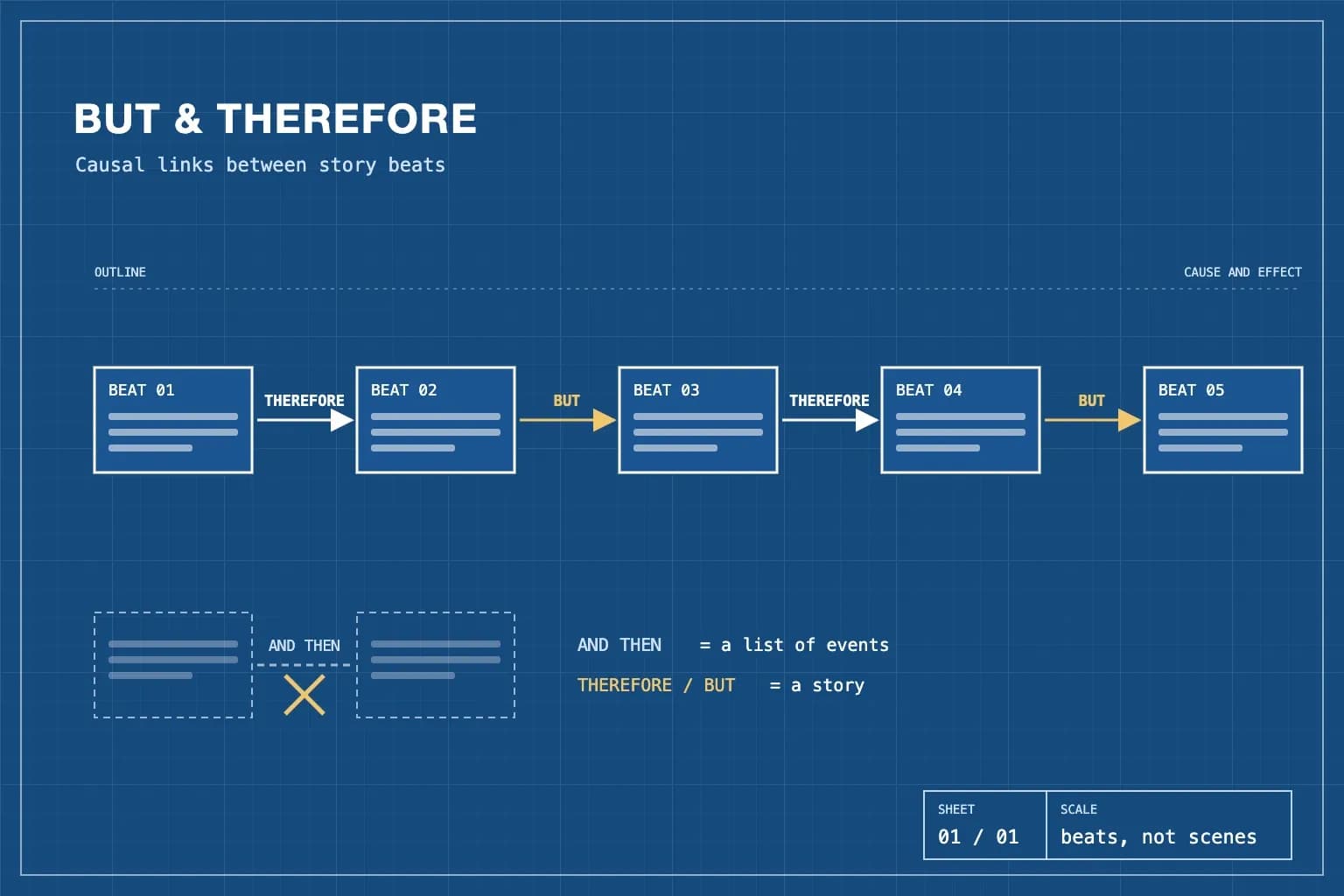
Almost every writer has finished a draft in which each scene works on its own and the script as a whole still drags. The dialogue is sharp, the characters are specific, and you could defend every scene if someone asked why it’s there, yet a reader reaches page sixty and starts checking how much is left. When that happens the trouble is usually not in the scenes. It’s in what connects them.
Trey Parker and Matt Stone, who have been making South Park since 1997, have a test for exactly this. It involves going through the beats of an outline and seeing what word fits between each pair. If the only word that fits is “and then,” the outline is a list of events. If it’s “therefore” or “but,” the events are pushing each other along.
Parker and Stone laid it out in 2011, as guest lecturers in Ken Liotti’s Story-Telling Strategies class at NYU’s Tisch School of the Arts. The visit was filmed for Stand In, an mtvU series built around students who had no idea who was about to teach them. Parker explained that a whole wall of the South Park writers’ room is a board like the one in the classroom, worked over with different coloured markers.
The rule itself concerns the beats of an outline. Parker’s version is that the word between any two beats should be either “therefore” or “but,” and that if “and then” belongs there, the story is going to be dull. A “therefore” says the first beat caused the second. A “but” says something has complicated it. Stone described the pair as what gives you causation between each beat, which is what separates a story from a series of things that happen.
He also put the problem from the viewer’s side: in a film where one thing happens and then another and then another, you start asking why you’re still watching.
The rule gets called “but and therefore” in some places and “therefore and but” in others. The order doesn’t matter, since the two words do the same job.
An outline built on “and then” can be full of good material. Take a librarian who finds a hidden letter about an old crime, and then has lunch with her sister, and then sits through a board meeting about the budget, and then drives out to the lake. Each of these could be a fine scene, and none of them has anything to do with the one before it. The letter could be pulled out of the sequence and nothing after it would change.
Now give the same premise a different outline. She finds the letter, therefore she tries to find out who wrote it, but the trail leads to the town’s most respected family, therefore she has to decide how much to say to people who have known her all her life. Here nothing can be removed without breaking the beat that follows, because every beat is either a consequence of the one before it or a complication of it.
That difference is what a reader feels without being able to name it. After a scene linked by “and then,” the only question the story has raised is what happens next, and almost any answer would do. After a scene linked by “therefore” or “but,” the question is what this will cost her or what she’ll do about it, and the story has already narrowed the answers. A script can be made of good scenes and still leave the reader with nothing to work out between them, which is usually when the pages start to feel long.
Back to the Future gets cited in screenwriting articles so often that it’s easy to stop seeing how it works, and its chain is unusually clean. Laid out with the connecting words between the beats, it reads like this:
There is no “and then” anywhere in it. Try putting one in: Marty goes to 1955, and then meets his father, and then finds Doc, and then goes to a dance, and then goes home. The same events are all there, but any of them could be taken out without the next one noticing. In the real chain that isn’t possible. Without the car accident Lorraine never falls for Marty, and without the fading photograph Marty has no reason to play matchmaker.
The dance is the best “but” in the film, because it doesn’t just block the hero. Marty’s plan fails, and the failure produces what the plan was meant to produce: George does rescue Lorraine, for real this time. A complication doesn’t have to stop the story from reaching its goal. It can change how it gets there, which is often what makes the next beat feel surprising and inevitable at once.
Parasite shows the rule at a larger scale. For roughly its first half it is almost nothing but “therefore,” and then a single “but” changes what kind of film it is.
The first four beats make a staircase. Each job the Kims win is what makes the next one possible: Ki-woo’s position gets him into the house, which lets him recommend his sister, whose position puts her in a place to remove the chauffeur, and so on until the whole family is on the payroll. Every step is something the Kims do on purpose with what the previous step gave them, so none of it reads as luck.
The turn comes with the doorbell in the fifth beat, and it isn’t random. The person standing there is the housekeeper the Kims removed in the fourth. A complication tends to land harder when it grows out of an earlier decision, and here the Kims’ own trick produces the thing that ends their plan. The storm in the seventh beat does the same job from the other side: it is why the Parks come home early, and it is also what floods the Kims’ flat, so a single cause hands them two separate consequences.
A South Park episode is short enough that its whole outline fits in one paragraph, which makes it a good test. “Scott Tenorman Must Die,” written by Parker, is also one of the darkest episodes the show has made, so a warning: the beats below include its ending.
Read quickly, the middle of the episode looks like a run of setbacks for Cartman: the adult’s advice, Scott’s video, the warning from Stan and Kyle. Each one changes his method instead of stopping him, and the pony turns into a fake video, then a letter, then a chili cook-off. The last of those, the warning, is the real surprise. It looks like the thing that ruins Cartman’s plan, and the sixth beat shows it was the first step of the actual one. The chain is a “but” on the surface and a “therefore” underneath, and the ending lets the viewer read the whole episode a second time.
The letter to Radiohead in the fourth beat is also paid off in the last, when the band turns up exactly where Cartman wanted them. Parker and Stone have said this was the first South Park episode with no subplot, just Cartman and Scott chasing each other. A story told entirely through the rule has no room for anything else.
The test works on a plain list. Each beat of the outline goes on its own line, in order, and between each pair of lines goes the word that actually fits: “therefore,” “but,” or “and then.” Stone has said that when they finish writing, he goes back through the beats to see whether any “and then” can be replaced.
The “and then” joins are where the work is. The librarian outline from earlier would fail at all three of its joins, because lunch with her sister doesn’t follow from the letter, the board meeting doesn’t follow from lunch, and the drive to the lake doesn’t follow from the meeting. Fixing a join usually means asking one of two things about the earlier beat: what does it make necessary, or what would make the next step harder? The first answer gives a “therefore,” the second a “but,” and the next beat gets rewritten to grow out of it. Sometimes the honest answer is that the beat doesn’t belong, and it gets moved or cut.
Two more questions help once the words are in. When a join says “but,” does the complication come from something the story has already put in place, the way the housekeeper’s return does in Parasite, or does it arrive from nowhere? When it says “therefore,” is the consequence something a character chooses, or something that merely happens to them? These are additions to the rule, not part of it, but they catch the joins where the right word has been written over a weak connection.
Explore a complete sample analysis and understand the feedback format.
The rule tests how beats connect and says nothing about whether the beats are worth connecting. A chain of perfectly logical consequences can still be dull, and Parker said in the same talk that each scene also has to work on its own. They stressed keeping stories simple as well. It is a way of finding the weak joints in an outline, not a way of writing the scenes between them.
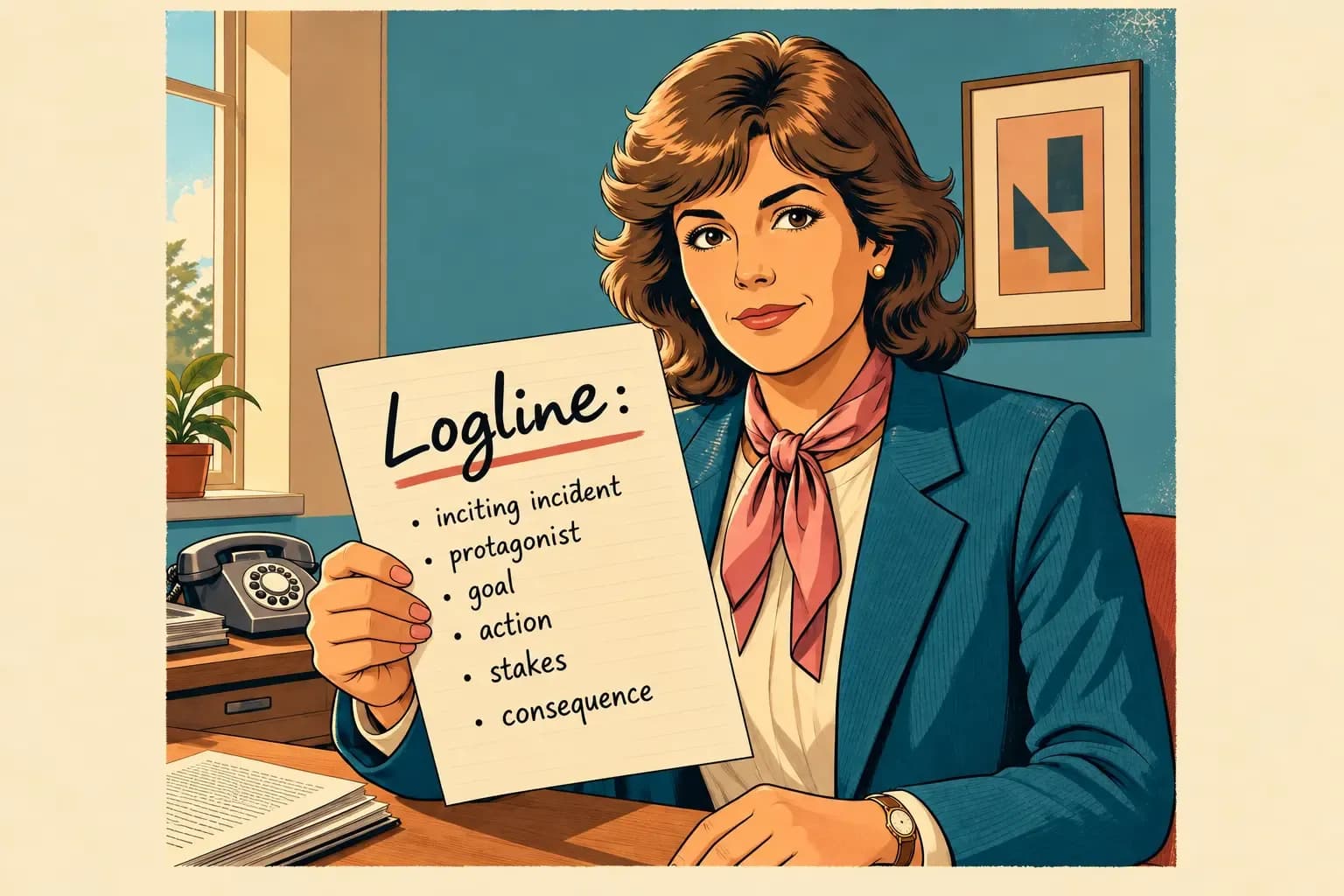
A logline makes a version of the same promise: someone wants something, something stands in the way, and a cost follows. The post on how to write a logline that gets your script read goes through that structure.
One sentence stands between your screenplay and the desk it lands on. Here's how to make it count.
Think of a film that stayed with you long after the credits rolled. Not because of its plot twists or visual effects, but because of what happened to the person at its center. The way they started as one thing and ended as something else or the way the story made you desperately wish they had. That experience has a name: character arc. And it is the single most important structural element separating characters who feel alive from characters who merely function.
There is a moment every screenwriter knows. The script is almost finished. The story has built, the characters have struggled, the themes have accumulated. And then comes the final scene the moment that will determine how every scene before it is remembered.
Explore a complete sample analysis and understand the feedback format.