You’ve finally typed FADE OUT. The structure feels solid, the dialogue reads well on screen, and the script looks “ready.” But a screenplay doesn’t live on the page. It lives in the voice.
The real test begins the moment your words leave the quiet of your laptop and enter a room full of human voices.
In the film and television industry, this moment is called a script read or table read and it is often where a screenplay is quietly saved, or silently exposed.
What is a Script Read?
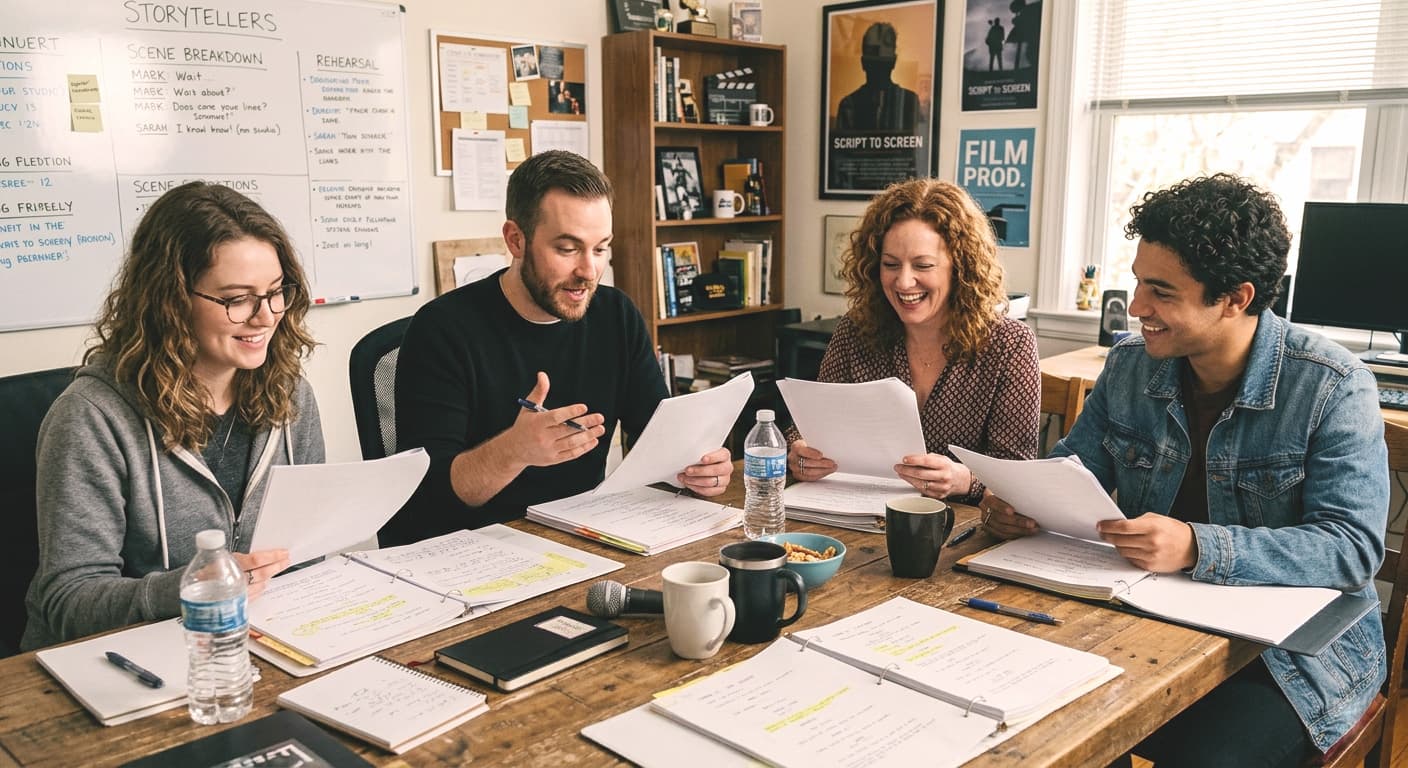
A script read, commonly called a table read, is a collaborative session where actors, writers, directors, and producers gather to read a screenplay aloud. There is no camera, no formal blocking, and no cinematic performance. Just voices, rhythm, timing, and language under real human pressure.
And that pressure reveals something no software or silent reading ever can: whether the script actually works as spoken dialogue.
Because no matter how many times a writer reads their own work in silence, they tend to fill in the gaps. They hear the line the way they intended it. They instinctively pause in the right places. They know what the character means, so they unconsciously supply meaning even when it isn't there on the page.
A table read strips all of that away. When someone else reads your words for the first time, you stop hearing what you meant and start hearing what you actually wrote. That distinction is everything.
How Poetika Works?
Explore a complete sample analysis and understand the feedback format.
Why Table Reads Matter
1. Dialogue reveals itself when spoken
Dialogue can look sharp on the page and collapse completely in the mouth. This happens more often than writers like to admit. A line that reads as emotionally precise becomes flat when spoken. A monologue that feels earned on screen runs out of breath halfway through. A back-and-forth that looks like tension reads aloud as two people taking politely timed turns.
These are not always acting problems. More often, they are writing problems that the page was hiding.
When actors stumble over a line, the problem isn't necessarily that the words are too complex. The sentence structure may be fighting the natural rhythm of speech. The character may be saying something that doesn't quite fit who they are in that moment. Or the line may be trying to do three things at once, pulling the actor in incompatible directions. A table read makes these problems audible in ways that silent reading alone cannot.
The solution is often simpler than the problem: a clause removed or a word changed or a line broken in two. But some problems only become obvious once you've heard the line spoken aloud.
2. Character dynamics become visible
On the page, relationships between characters can remain largely theoretical. You can write she dominates him in every scene in your notes, but whether that dynamic actually comes through is a different question entirely.
In a table read, character dynamics become immediate and impossible to ignore.
Who fills the room when they speak? Who disappears into the background even when they have lines? Where does the energy between two characters actually land? Is there real tension, or just proximity? Where does a scene that looked electric on the page suddenly go quiet in the room?
These questions don't always need to be analyzed in the moment. They tend to answer themselves in real time, often in ways that surprise even the writer. The character you thought was the emotional anchor of Act Two turns out to barely register. The scene you were uncertain about lands with unexpected weight. The subplot you considered cutting turns out to be the thread that keeps the room engaged.
A table read doesn't just test the dialogue. It tests the architecture of your story.
3. It prevents expensive mistakes
There's a hard truth in film and television production: the further you are into the process when you discover a problem, the more it can costs to fix it.
A structural flaw caught during development may take only a conversation or a round of revisions to address. The same flaw discovered during a table read may require a more substantial rewrite. Caught during production, it can cost time, money, and the goodwill of everyone on set. Discovered in post-production, it may mean cutting scenes or sequences or compromise the coherence of the entire film.
The table read sits at a critical point in the process: the script is developed enough to be tested as a complete work, but there is still time to make meaningful changes before production. For many productions, it may be one of the last practical opportunities to restructure a scene, clarify a character motivation, or address a tonal problem before those changes become more expensive and complicated.
Writers and producers who treat the table read as a formality are leaving one of their most valuable tools unused.
Types of Script Reads
Not every table read serves the same purpose, and understanding the differences can help you choose the right format for the right moment.
Formal Table Read — The version most people picture: a full or near-full cast, often joined by the writers, director, producers, and other members of the creative team. Depending on the production, it may take place during development or shortly before filming. The goal is primarily creative to hear the screenplay read aloud as a complete work, evaluate dialogue and pacing, and identify problems before production begins.
Cold Read — Actors read the script with little or no preparation, sometimes seeing the material for the first time on the day. This removes some of the polish that comes with familiarity and can reveal whether dialogue feels immediately natural, whether scenes are easy to follow on first contact, and where the script may create confusion or hesitation. Cold reads can be uncomfortable, but that lack of preparation can also expose problems that a rehearsed reading might smooth over.
Staged Reading — A more developed presentation of the script, often used in development, festival, theater, or pitching contexts. Actors may have preparation time and limited staging may be introduced, while an audience observes the reading. Unlike a traditional table read, a staged reading places more emphasis on the audience's experience and the overall dramatic impact of the material.
Writer's Room Read — A common practice in television development, where the writing staff reads a script aloud, often with writers taking on character roles. The focus is less on performance and more on stress-testing voice, pacing, dialogue, and tonal consistency before the script moves further into development or production.
What Makes a Good Script Read Session?
The quality of a table read depends less on the size of the room or the caliber of the actors than on how the session is structured.
Give participants time to read in advance. The difference between an actor who has had time to understand the script and one who is encountering it for the first time can be significant. When readers come prepared, their choices reveal more about how the dialogue, characters, and scenes are likely to be understood by someone outside the writing process.
Resist the urge to explain. Before a table read, writers often feel compelled to provide context: this character is going through something here, this scene is meant to feel uncertain. Resist it. If the scene needs explanation before it's read, that's important information in itself. Let the script speak without a translator.
Don't interrupt during the reading. The value of a table read comes from hearing the full arc of a scene, a sequence, an act, or the entire script without breaking the rhythm. Notes, reactions, and discussions belong after, not during. Keep a notepad close and capture what surfaces as the reading unfolds.
Pay attention to the room, not just the words. Where does the energy shift? When do people lean in? When does someone check their phone? When does the room laugh earlier than expected or not at all? These are not just social signals. They can tell you where the script is holding attention and where it isn't.
If the team is remote, structure it intentionally. Table reads over video calls can work surprisingly well, but they require clearer facilitation. Assign a moderator, use a shared document or script platform so everyone is on the same page, and build in time for technical issues. The intimacy of a physical room is harder to replicate, but the essential value (hearing the script spoken aloud by different voices) remains.
After the Read: What to Do With What You Heard
A table read is only as useful as what you do with the information it generates.
In the hours immediately after a read, while impressions are still fresh, write down everything you noticed not what you planned to notice, but what actually surprised you. The moments of unexpected silence. The lines that got a laugh you didn't write for. The scene that felt half the length it needed to be. The character who disappeared for twenty pages without anyone noticing.
Then wait a day before touching the script. The instinct to immediately fix everything is understandable, but it often leads to reactive changes that solve symptoms rather than causes. Let the experience settle. The problems that still feel significant after you've had some distance are usually the ones worth addressing.
When you return to the draft, prioritize ruthlessly. Not everything that surfaced in the table read requires a rewrite. Some are performance questions that may resolve in production. Some are individual reader interpretations that don't reflect a real structural issue. Learn to distinguish between what the table read revealed about the script and what it revealed about that particular reading.
Analyze your script with Poetika
Get instant feedback on your screenplay in minutes.
The Script That Survives Being Spoken
A screenplay is not finished when it is written. It is not finished when it is rewritten, or polished, or covered in notes from development executives. It is finished or as close to finished as a script ever gets when it survives being spoken aloud by real people in real time.
That is the test. Not elegance on the page, but durability in the room.
When a script passes that test, something shifts. Structure becomes rhythm. Dialogue becomes behavior. Characters who existed as constructs begin to feel like people. And the story, which until that moment existed mainly in the writer's imagination and on the page, begins to exist somewhere else — in the air between voices, in the attention of the room, in the experience of people who are encountering it for the first time.
That is the moment the screenplay becomes real.
And it starts, always, with someone saying the first line out loud.