The Story That Never Ages: Homer's Odyssey, Aristotle's Poetics, and Why This Story Had to Become a Nolan Film
Poetika BlogJuly 14, 202616 min read
Nolan’s films often explore how time and memory shape who we are. From fractured memories to journeys home that seem impossible, his stories return to questions that Homer explored centuries ago. The Odyssey also offers a lasting lesson in how to build a compelling story.
The Story Nolan Was Always Going to Tell
Christopher Nolan's The Odyssey arrives with the scale audiences have come to expect from him. Reportedly produced with a budget of around $250 million, filmed across Morocco, Greece, Italy, Scotland, Iceland, and Malta, and led by an ensemble cast including Matt Damon, Tom Holland, Anne Hathaway, Zendaya, Robert Pattinson, Lupita Nyong'o, and Charlize Theron, it is one of the most ambitious productions of his career. Yet none of those numbers explains why the project feels so significant.
Christopher Nolan’s adaptation of The Odyssey brings together two traditions of storytelling: Homer’s ancient epic of a journey home and a filmmaker’s enduring fascination with time, memory, identity, and the consequences of leaving the familiar world behind.
The connection is compelling, but not simply because Nolan has made another large-scale film. The deeper link lies in the question at the centre of Homer’s poem: What does it mean to return to a life that has continued without you?
Nearly three thousand years after the poem took shape, its central tensions remain recognisable. The longing for home, the cost of survival, the instability of identity, and the distance between memory and reality are not concerns confined to the ancient world. They are experiences through which each generation can rediscover the story.
Seen in this light, Nolan’s choice of source material feels less like a departure from his previous work than an encounter with familiar territory. His protagonists have repeatedly struggled to recover something they have lost: a reliable memory, a sense of belonging, a relationship, a version of the past, or a world they can still recognise.
Yet there is an important distinction between returning to a place and recovering what that place once meant. The Odyssey makes that distinction the substance of its journey.
How Poetika Works?
Explore a complete sample analysis and understand the feedback format.
The survival of Homer’s poem is not simply a testament to its age. Stories do not remain alive merely because they are old, influential, or repeatedly adapted. They endure when their conflicts can be understood beyond the historical circumstances that first gave them meaning.
In The Odyssey, the journey home is both physical and psychological. Odysseus must cross dangerous seas, survive encounters with extraordinary beings, and overcome obstacles that repeatedly delay his return to Ithaca. But the journey also tests his patience, judgment, self-control, and understanding of what it means to be recognised by others.
The obstacles matter because they place pressure on the person confronting them. A monster is not dramatically significant merely because it is frightening. An encounter becomes meaningful when it forces a character to make a choice, reveals a weakness, changes the available possibilities, or alters the meaning of the journey.
This distinction is useful for anyone writing a screenplay. A succession of exciting events does not automatically create a compelling story. The events must be connected by consequences.
Imagine two versions of a journey narrative. In the first, the protagonist encounters a series of increasingly dangerous obstacles, overcoming each through courage or ingenuity. In the second, every victory comes at a cost: the protagonist loses an ally, discovers that a trusted belief was mistaken, or becomes someone their original destination may no longer welcome.
Both versions can sustain suspense. But the second creates a deeper dramatic question. We are no longer following only the progress of a journey; we are watching the relationship between the traveller and the destination change.
That is one reason The Odyssey continues to invite reinterpretation. Its adventure can be retold through different genres and historical settings, but its central tension survives: the journey changes the person who undertakes it, while the destination changes in their absence.
What Aristotle Can Teach Screenwriters About Change
Centuries after Homer, Aristotle examined the construction of dramatic plots in Poetics. His work remains relevant not because it supplies a universal formula for successful storytelling, but because it asks how events acquire dramatic meaning through their arrangement and consequences.
Two of his concepts are particularly useful: peripeteia, or reversal, and anagnorisis, or recognition.
A reversal changes the direction of the action. Recognition changes what a character (or sometimes the audience) understands about the situation. In powerful dramatic constructions, these can occur together: the discovery of new information transforms the meaning of what has happened and redirects what follows.
For a screenwriter, the practical lesson is that a turning point should do more than introduce a surprise.
Consider a character who believes a missing friend has betrayed them. Discovering that the friend is alive may change the immediate situation, but it does not necessarily transform the story. Discovering that the friend disappeared to protect someone the protagonist endangered can do much more. The new information changes the past, complicates the protagonist’s understanding of themselves, and creates a different set of choices for the future.
The difference is not the quantity of information revealed. It is the number of existing relationships and assumptions that the revelation forces the audience to reconsider.
This does not mean every screenplay needs a dramatic revelation or that every protagonist must undergo a clearly defined moral transformation. Some stories deliberately resist recognition; others build their force through repetition, uncertainty, or the slow accumulation of detail. Aristotle’s concepts are most useful as analytical tools, not rules that every film must obey.
The question to ask is more precise: When the story changes direction, what else changes meaning?
Christopher Nolan directs The Odyssey on location, bringing Homer's timeless epic to the big screen with IMAX cameras.
Nolan's Recurring Journey Home
Christopher Nolan has often been described as a filmmaker preoccupied with time. That description is accurate, but time in his films frequently serves a larger dramatic purpose. It changes what characters can know, what they can recover, and what they must eventually accept.
In Memento, Leonard Shelby attempts to solve a mystery while living with a condition that prevents him from forming new long-term memories. The film’s fragmented structure places the audience inside the instability of his understanding. Information does not simply arrive late; its meaning depends on what the audience has been able to retain and how earlier assumptions must be revised.
The film offers a useful lesson about narrative structure: withholding information is not inherently suspenseful. It becomes dramatically effective when the order of revelation changes the audience’s interpretation of character and action.
In Inception, Cobb’s attempt to return to his children gives the elaborate mechanics of dream infiltration an emotional destination. The story’s layers of reality are not merely intellectual puzzles. They complicate his ability to distinguish what he wants from what he can trust. The journey outward into increasingly constructed worlds is tied to a desire to return to an intimate, recognisable one.
Interstellar approaches separation on a different scale. Cooper leaves Earth expecting that the passage of time will not have the same consequences for him as it does for the people he leaves behind. The resulting distance is not just geographical. Time transforms the relationships he hopes to recover, making the cost of his journey inseparable from its purpose.
These films differ in genre, structure, and emotional register. Their protagonists do not all learn the same lesson, and their endings do not offer equivalent resolutions. What connects them is a recurring dramatic problem: characters pursue a desired future while discovering that the past cannot remain untouched by the pursuit.
This is where the comparison with The Odyssey becomes useful. Odysseus’s journey is not simply a matter of crossing a distance. His return takes place in a world that has continued to change, and the recognition of home must be negotiated rather than assumed.
For screenwriters, this suggests a way to deepen a seemingly straightforward objective. A protagonist may want to return to a family, recover a lost career, reclaim a house, or reunite with an old friend. But what if the journey makes that original goal impossible to achieve in the form imagined?
The objective can remain the engine of the plot even as its meaning changes. In fact, the gap between what the protagonist wants at the beginning and what that desire comes to mean can become the story’s emotional centre.
Why The Odyssey Now?
It is tempting to interpret a filmmaker’s latest project as the inevitable culmination of everything that came before. Such readings can be illuminating, but they can also make a career appear more coherent in retrospect than it was in practice.
Nolan’s films do not form a single continuous argument. His interest in time, for instance, takes different forms in Tenet, Interstellar, Memento, and Oppenheimer. In one film, time becomes a mechanism of action; in another, a condition of separation; in another, a problem of knowledge or historical consequence.
Nevertheless, a recurring tension runs through much of his work: the desire to control events collides with the limits of human understanding.
Leonard tries to construct a reliable system around his failing memory. Cobb builds elaborate dream worlds in an effort to confront a loss he cannot simply undo. Cooper’s journey is shaped by the conflict between scientific possibility and the irreversible passage of time. In Oppenheimer, the consequences of a historical transformation extend beyond the protagonist’s ability to control them.
These are not interchangeable stories, but they repeatedly test the distance between intention and consequence.
The Odyssey offers a particularly rich framework for examining that tension because its hero cannot simply decide to return and make the years disappear. The destination matters, but so does everything that has happened along the way. Survival is not the same as restoration.
This may be the most productive connection between Homer and Nolan not that the filmmaker was always destined to adapt the epic, but that the poem gathers several questions his cinema has explored in different forms.
It also raises a broader question about adaptation. A familiar story does not become relevant simply because a new filmmaker retells it. Its relevance emerges from the relationship between the source material and the questions the adaptation makes possible. The challenge is not to reproduce an old narrative’s reputation, but to find what it can express in a different artistic and historical context.
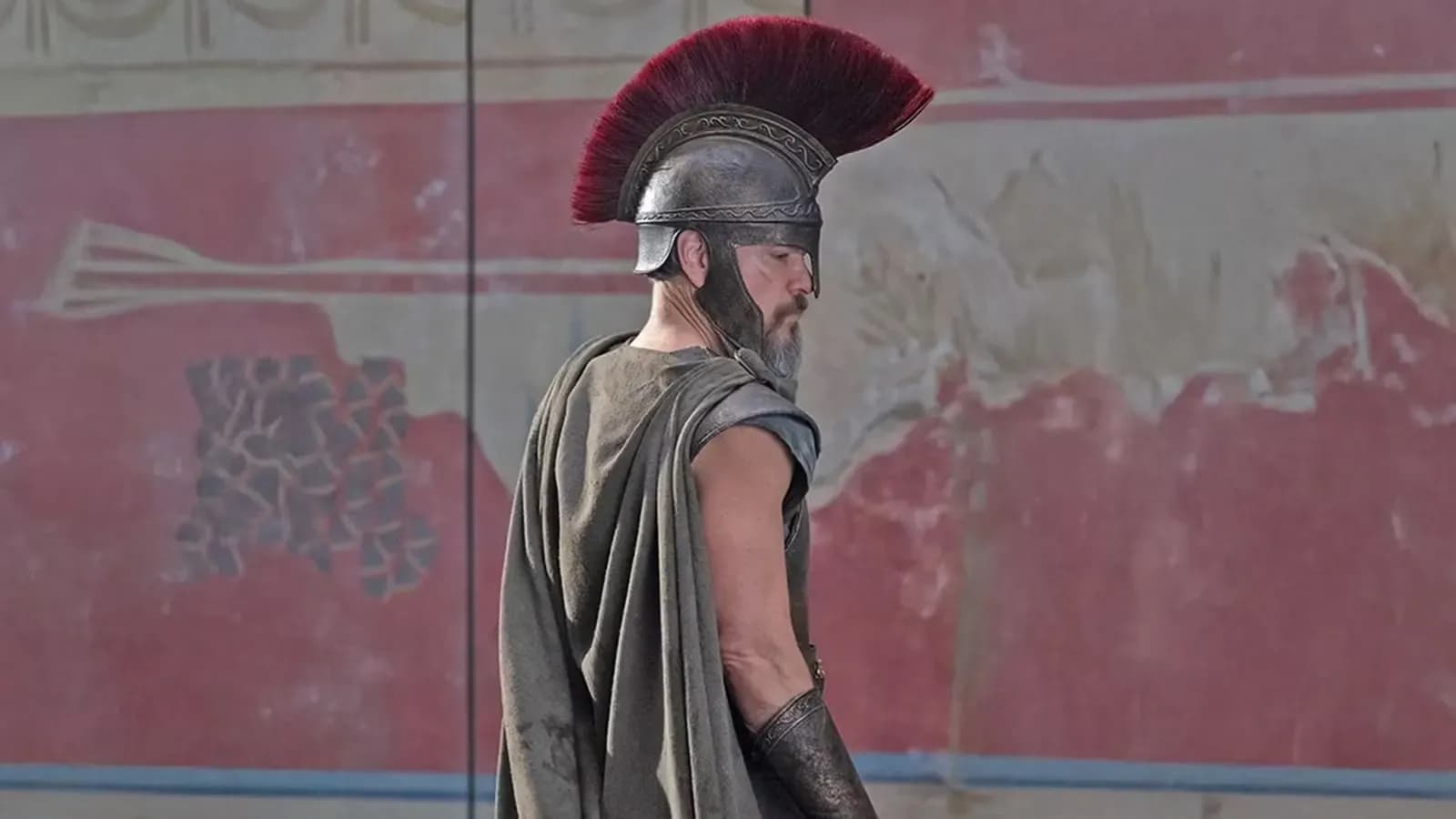
Matt Damon as Odysseus in the first official image from Christopher Nolan's The Odyssey.
From Aristotle to Algorithms: How to Analyse a Screenplay Without Losing Sight of the Story
More than 2,000 years ago, Aristotle tried to understand why some stories work better than others. Today, screenwriters are still asking similar questions. Why does one scene hold our attention while another feels unnecessary? Why does a twist change everything in one film but feel forced in another?
AI can help writers explore these questions. But understanding a screenplay takes more than spotting patterns. It also requires judgment, context, and an understanding of what makes a story unique.
What Makes a Story Work?
In Poetics, Aristotle explored how plot, character, and dramatic events work together. Two ideas are especially useful for screenwriters: reversal and recognition.
A reversal changes the direction of the story. Recognition happens when a character discovers something that changes their understanding of the situation.
Imagine a thriller in which a detective suspects a colleague of leaking information. Later, the detective discovers that the colleague was secretly protecting a witness. This revelation does more than introduce new information. It changes how the detective and the audience understands what came before. This is what makes a strong turning point effective. It doesn't simply surprise us. It changes the meaning of the story.
Screenwriters can use the same principle when reviewing their own work. Does a major revelation change the protagonist's choices? Does a turning point grow naturally from earlier events? Or does it feel as though it has been added simply to keep the plot moving? These questions help writers look beyond what happens in a screenplay and examine why it happens.
What Can AI Bring to Screenplay Analysis?
Writers often spend months working on the same script. Over time, they become familiar with every scene, character, and plot point. This familiarity can make it difficult to see problems that a new reader might notice. AI-assisted analysis can offer another perspective. It can help writers examine character motivations, follow the development of the plot, identify recurring patterns, and flag scenes or relationships that may need closer attention.
Consider a screenplay whose middle section feels slow. Cutting scenes may seem like the obvious solution, but the real problem could be something else. Perhaps the protagonist has stopped making meaningful decisions. Perhaps the obstacles repeat without becoming more difficult. Or perhaps the character's goal remains unchanged even after important events.
Each possibility points to a different solution. Before cutting a scene, the writer needs to understand what is causing the problem. AI can help organise this investigation by highlighting patterns and suggesting questions to explore. It cannot automatically determine which scenes deserve to stay or which creative choices are right for the story.
Analysis Is a Starting Point, Not a Verdict
The purpose of screenplay analysis is not to decide whether a story is good or bad. It is to help writers understand how their choices affect the story.
A report might suggest that a protagonist's motivation becomes unclear in the second act. The next step is to examine the relevant scenes. Does the character's goal actually change? Is that change explained? Or is the audience missing information that the writer assumes is already clear?
Sometimes the analysis will reveal a genuine weakness. Sometimes it will help the writer recognise that an unconventional choice is working as intended. Either way, the value lies in examining the evidence rather than accepting a conclusion without question.
This is also the difference between analysis and prescription. Analysis helps explain what may be happening in a screenplay. Revision is the writer's decision.
A More Structured Way to Review Your Script
Poetika helps writers examine their screenplays through AI-assisted analysis across many dimensions. It offers a structured starting point for reviewing elements such as story development, character motivations, and dramatic structure.
If you have reached a point where you are no longer sure what is working in your screenplay, a structured analysis can help you identify areas worth revisiting. You can then return to the script, examine the relevant scenes, and decide which suggestions serve your story.
The goal is not to make every screenplay follow the same rules. It is to help writers see their own choices more clearly. A useful analysis should leave you with better questions about your screenplay not simply a list of things to change.
Analyze your script with Poetika
Get instant feedback on your screenplay in minutes.
Stories survive across centuries because their meanings go beyond a single interpretation. Homer’s Odyssey can be read as an adventure, a story of endurance, a reflection on identity, or an exploration of the difficult relationship between memory and home. Each reading reveals something different without cancelling out the others.
The same is true of screenwriting. A story’s deeper meaning does not need to be explained in dialogue or stated as a theme. It can emerge from what a character wants, the choices they make, and the consequences they face.
Writers can put this idea into practice by returning to the beginning of their screenplay. What does the protagonist believe they need to recover, achieve, or escape? Then look at the key moments along the way. Do these events simply bring the character closer to their goal, or do they change what that goal means?
The answer may reveal a structural weakness. It may also show that apparent detours are doing more important work than the writer first realised. A journey becomes a story not because the protagonist travels far, but because the journey changes how they see the place they are trying to reach.
That is one of the enduring ideas in The Odyssey. It also offers a useful question for any screenwriter: When your protagonist finally reaches the place they have been trying to reach, what will have changed and will the destination still mean the same thing?
A great novel can become a disappointing film. A modest novel can inspire a remarkable one. The difference often lies not in the quality of the original story, but in how the story is told.
It is Monday morning. Over the weekend, twelve new scripts arrived. Nine more came in the week before. Somewhere in the inbox are scripts that have been waiting since last month, along with a few that have been there even longer. In two hours, the development meeting starts, and there is still a stack of material that nobody has had time to read.
Ask ten screenwriters what "script coverage" means, and most will give you the same answer: a reader's report that determines whether a screenplay receives a Pass, Consider, or Recommend.
They're not wrong. But they're only describing the industry's most familiar form of coverage. Behind the scenes, many other types of coverage quietly influence whether a screenplay gets made, who joins the project, how much it costs to produce, and whether it creates legal or financial risks.