How Rewriting Makes a Screenplay Better: Why Every Draft Matters
Poetika Editor TeamNovember 18, 202510 min read
Finishing a first draft feels like crossing a finish line, but most working screenwriters treat it as the moment the real work begins. A first draft shows you what your story is, and the drafts that follow decide what it becomes. Each rewrite lets you read the script with a different question in mind, and a screenplay that has passed through several of those questions tends to read more clearly, feel more deliberate and ask less patience from its reader. This article looks at why rewriting works, what each draft can do for your script, and what Lulu Wang's comparison of several drafts of a single scene from The Farewell tells us about the process.
Why the First Draft Is Only a Beginning
A first draft is where you find out what you are writing about. Characters surprise you, scenes grow longer than planned, and an ending you were sure of may stop feeling right halfway through the second act. All of that is useful information, but it is information about the story, not yet the story itself.
The second draft is where you can act on what the first one taught you. You now know who the characters really are, what the story is really about, and which scenes carry the weight and which are only there because they were easy to write. Rewriting means taking that knowledge back to the beginning, so that the opening pages are written by someone who already knows how the story ends.
What Rewriting Really Means
Rewriting is more than correcting typos or polishing sentences, and it often begins with taking things apart. It can mean combining two scenes into one, moving a line to a different place, renaming a character, cutting a subplot or deciding that a moment works better when nobody speaks.
It is also a way of checking that the script says what you intended. A line that sounded natural in your head may read as stiff on the page, and a scene that felt essential on the first pass may repeat something the audience already knows. Each rewrite is a chance to ask whether the page matches what you hear and see when you imagine the film.
In a seven-minute video made for Vanity Fair, writer-director Lulu Wang compares several drafts of one scene from The Farewell, in which Billi talks with her grandmother, Nai, in a wedding photo studio. Wang points out what changed from draft to draft and what survived, which makes the video a rare look at rewriting as a series of small, deliberate decisions. Everything below is taken from her account in the video.
Several things also stayed the same through every draft, according to Wang: Nai's dissatisfaction with the bride, Billi's defense of her, and the phrase "silly child." Nai's remark about Billi having been generous as a child and not seeming like herself lately also survived, even after the breakup storyline it referred to was removed. The scene changed a great deal, yet its core stayed recognizable, because each rewrite served what the scene was for.
The video is also about writing between two languages. Wang speaks Mandarin but does not read or write it, so she wrote the dialogue in English, translators rendered it in Chinese, and her mother read the Chinese pages to check whether they matched what Wang heard in her head. Some lines were too formal for how a grandmother would speak to her grandchild, and she had to choose between the translators' versions and her mother's corrections. Rewriting, in that process, was partly a search for the way people in the family really talk.
What Each Draft Can Do
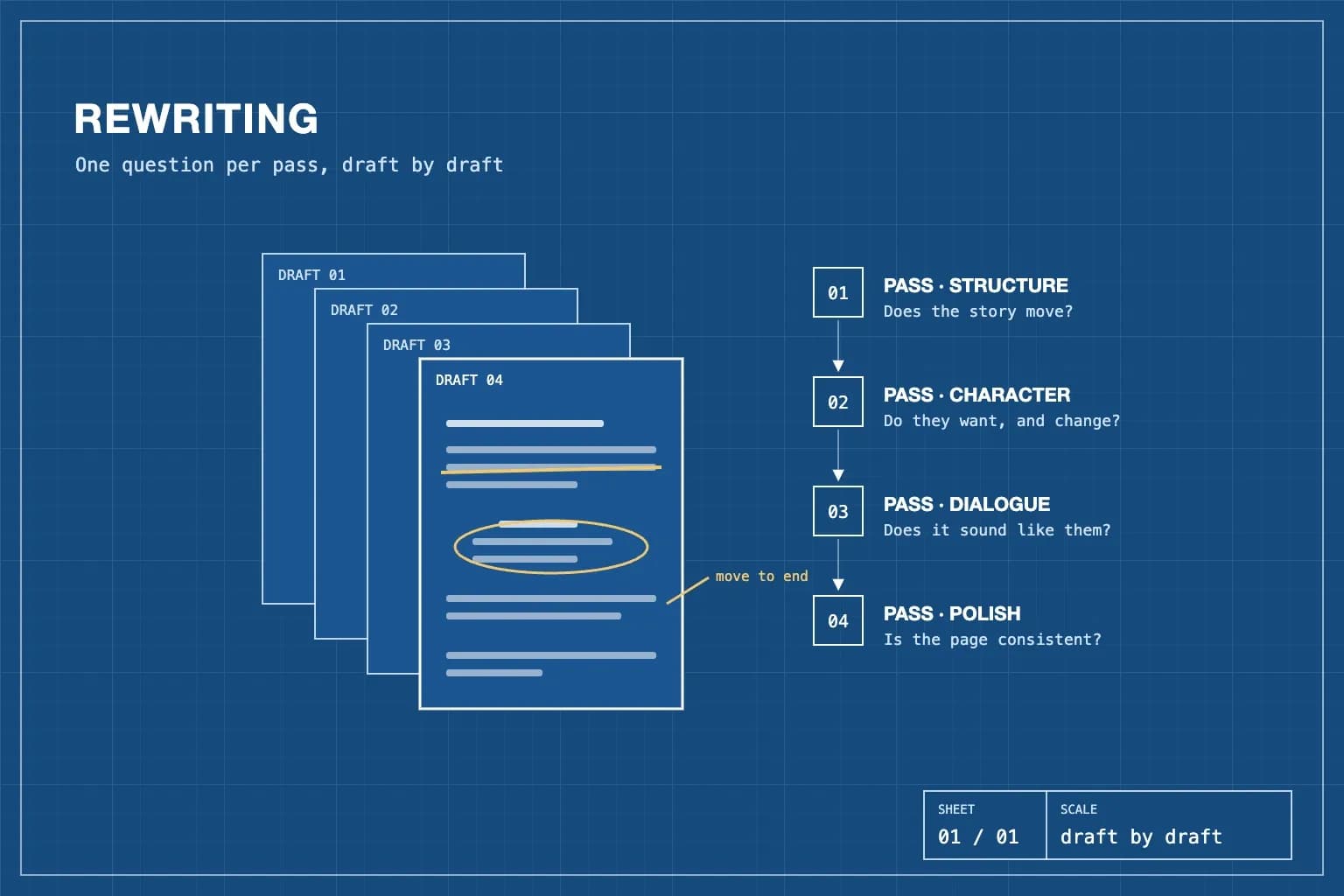
The changes in Wang's drafts fall into different kinds, and that suggests a practical way to rewrite: give each pass one main question instead of trying to fix everything at once. Here is one way to divide the work.
The order matters. Polishing sentences in a scene you may cut later wastes effort, so the larger questions usually come first and the smaller ones last.
Giving the Script Distance Before You Rewrite
A script you finished yesterday is hard to read honestly, because your memory fills in everything the page leaves out. Many writers set a draft aside for a week or two before opening it again, and some work on something else in between. When you return, you read what is actually written rather than what you meant.
It helps to read the draft once from beginning to end without changing anything, ideally in a different format than the one you wrote it in, such as printed pages or a read-aloud session. Notes made during that read will show you where you got lost, where you got bored and where you felt something, and those three kinds of notes are a good map for the rewrite.
How to Rewrite Without Losing Your Story
The fear behind many rewrites is that fixing one thing will break another. Wang's example suggests a way to manage that: identify what in a scene must survive, and let everything else change around it. In her drafts, the hint that Billi may lose her grandmother was the fixed point, while the location, the order of lines and even the tone of an insult were free to move.
Name the core of each scene before you change it. Write one sentence about what the scene must do for the story, and test every change against it.
Save every draft as a new file. If a rewrite turns out worse, you can go back, and you can compare versions the way Wang does.
Change one kind of thing per pass. A structural pass and a dialogue pass done at the same time make it hard to tell which change helped.
Keep a list of lines you love. If a good line no longer fits any scene, it may belong somewhere else, and Wang's key line is a good example of a line that found its best position late.
When to Stop Rewriting
A script is rarely finished in the sense of being perfect, and rewriting can turn into a way of avoiding the moment when others read it. A useful sign that a draft is ready for readers is that your changes have become smaller: you are adjusting words rather than moving scenes, and the notes you give yourself no longer change what the story is about.
Another sign is that new drafts start undoing the previous ones. If you are restoring a line you cut last week and cutting one you restored the week before, you have probably reached the point where the next useful information has to come from someone else.
Getting Feedback Between Drafts
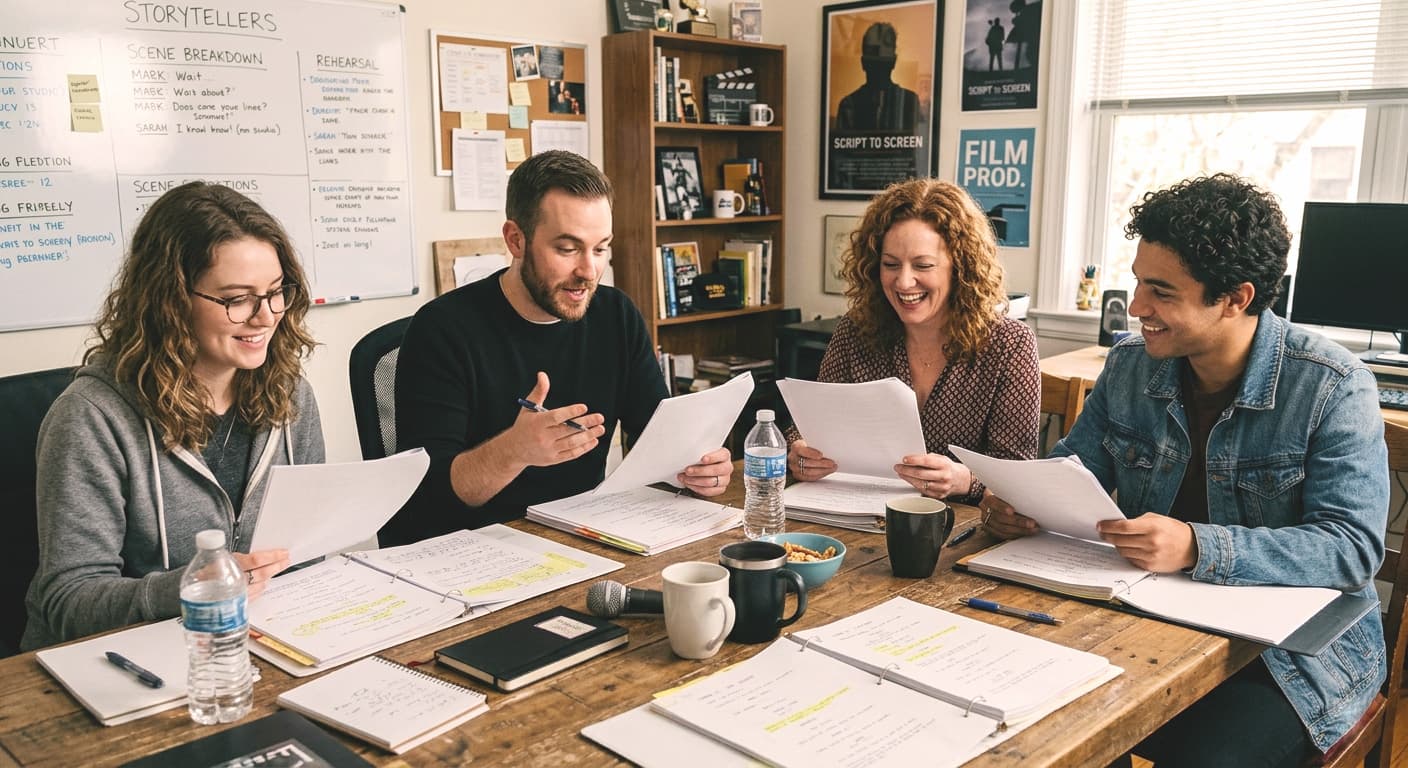
Outside readers see what you can no longer see, and Wang's account shows how much a script can improve when it is heard rather than only read. She describes making some corrections only after hearing the actors speak the lines in a read-through or on set, and relying on her mother to tell her when a line did not sound like something a grandmother would say. Your own version of this might be a friend reading roles aloud, a table read with other writers or a trusted reader who knows the kind of film you are making.
Feedback works best when you tell readers what kind of draft they are reading and what you want to know. A structure draft needs notes on pacing and turning points, while a late draft is better served by notes on consistency and clarity. Between drafts, a written analysis of structure, characters and pacing can also give you a second opinion that is not shaped by what you meant to write.
How Poetika Can Support Each Draft
Rewriting goes faster when you know where to look, and that is where Poetika can help between drafts. Its script analysis reviews story structure, character development, plot and pacing and key turning points, and it gives actionable feedback on what to work on next. The coverage report also shows details such as the logline, a location breakdown, emotional arc and comparable films, which you can compare from one draft to the next to see how your changes affected the script.
The idea is not to replace your own judgment, as Wang's drafts show how personal those decisions are. It is to give you a clear picture of the current draft quickly, so each rewrite starts from specific questions instead of a general feeling that something is off.
Try It Yourself: A Rewrite Plan for Your Next Draft
Pick one scene from your current script, ideally one with a conversation at its center, and rewrite it using the same kind of questions Wang's drafts answer.
Write one sentence about what the scene must do for the story.
Mark the line or moment that carries the most feeling. Ask whether it sits where it has the most effect, or whether it would land better at the end.
Check whether the scene could happen in a place that adds tension, or whether it could absorb a conversation from another scene.
Find one thing you explain in words that an actor's face could carry instead.
Read the dialogue aloud, and mark every line that sounds more formal than the person speaking would be.
Check names, labels and markings, such as how you show another language, for consistency across the whole script.
Save the result as a new draft and compare it with the old one. Seeing what changed, and what you chose to keep, is the quickest way to understand your own process.
FAQ
How many drafts does a screenplay need? There is no fixed number. A script is ready for readers when your changes have become small and the major questions about structure and character have been answered, and that can take three drafts or many more depending on the story.
Should I rewrite from scratch or edit what I have? Most rewrites work with the existing pages, but some scenes are better rewritten from a blank page, especially when the purpose of the scene has changed. Saving the old version lets you take either route without losing anything.
Can I fix everything in one pass? It is possible, but it is harder to judge the results. Working on one kind of problem at a time, such as structure first and formatting last, makes it clearer which changes helped.
How do I know whether a change made the script better? Compare the versions side by side and check each change against what the scene or the story is meant to do. Feedback from a fresh reader, or a written analysis of the new draft, can confirm what you cannot judge alone.
You’ve finally typed FADE OUT. The structure feels solid, the dialogue reads well on screen, and the script looks “ready.” But a screenplay doesn’t live on the page. It lives in the voice.
You sent the draft to three people you trust. A close friend who loves films. A colleague who writes. Maybe a family member who has always been your most enthusiastic reader. They came back with variations of the same response: they loved it. A few small notes here and there a line of dialogue that felt off, a scene they wanted more of but overall, they thought it was great. Really great.
You've written a script. Maybe two. You've spent months on it; rewriting scenes, adjusting dialogue, getting feedback from friends. And then you send it out, and nothing happens. No response, no meeting, no conversation. Just silence.