A one-page pitch is a single-page document that sells a screenplay or film project to someone who has not read it yet. It usually holds the title, a logline, the genre and format, a short story summary, the main characters, a few comparable titles and the writer's contact details. Its only job is to make a producer, agent, fund or contest reader want to ask for the full script.
The document goes by several names: one-sheet, pitch sheet, leave-behind. Writers attach it to query emails, hand it over after a pitch meeting, bring it to pitch events and film markets, and adapt it for fund and lab applications. Because it is often the first thing a busy reader sees, it decides whether your screenplay is ever opened.
This guide explains how a one-page pitch differs from the documents around it, what it must include, and how to write one in ten steps, with a sample layout and a checklist at the end.
What is a one-page pitch?
Think of the one-page pitch as the bridge between a logline and a screenplay. The logline tells the reader what the story is in a sentence. The script tells the whole story in a hundred pages. The one-page pitch sits in between: enough story to show that the idea holds together, plus enough context (genre, tone, audience, who you are) for the reader to judge whether it fits their slate.
It is a sales document, not a creative summary. Every line should answer a question a decision-maker has: What is this? Who is it for? Why would people watch it? Why is this writer the right person to tell it?
One-page pitch vs. treatment vs. pitch deck
Writers often confuse the one-page pitch with other development documents. Here is how they compare:
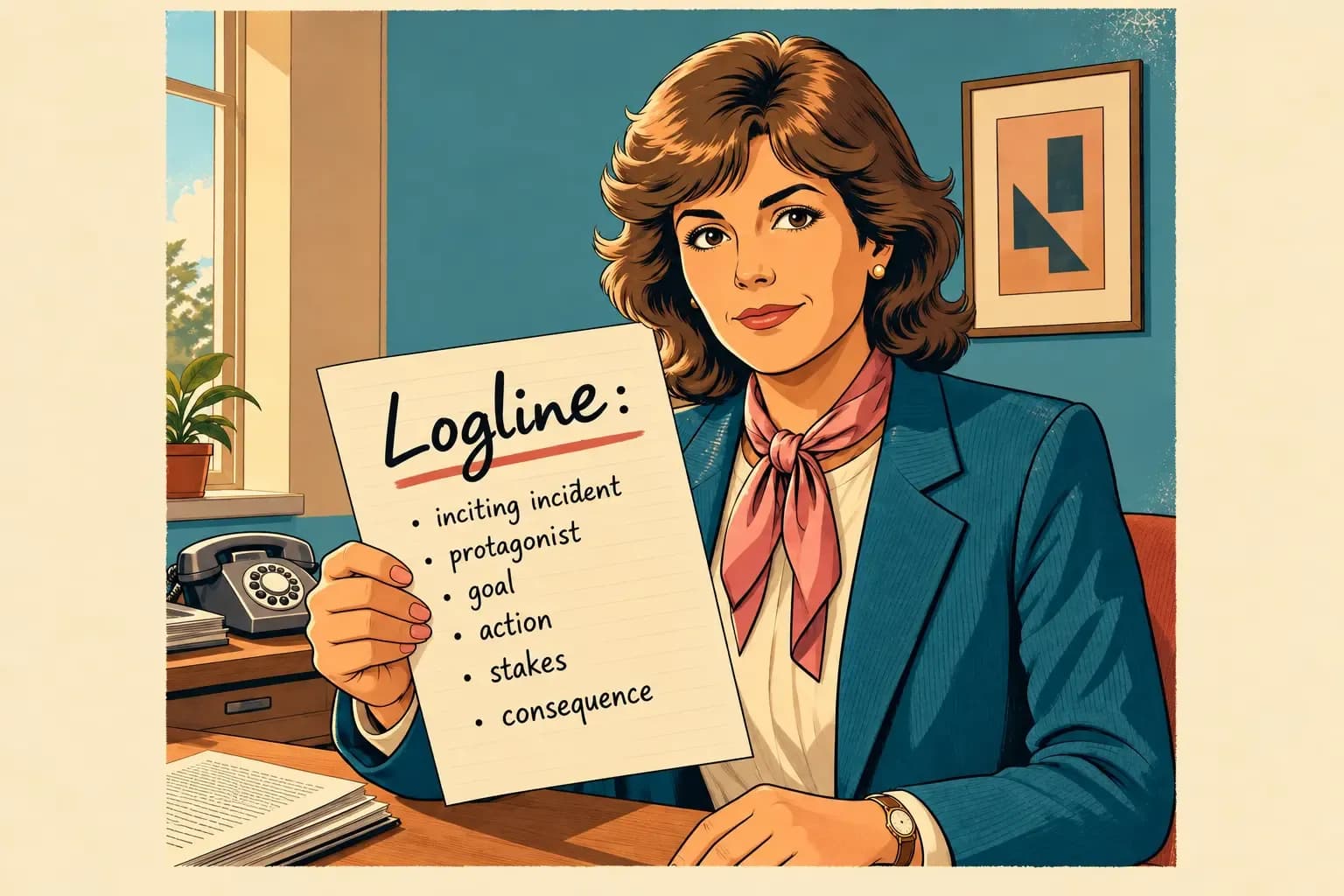
- Logline: one or two sentences that state the protagonist, the conflict and the stakes. It opens the one-page pitch. See our guide on how to write a logline.
- One-page pitch: a single page that combines the logline, a short summary, characters, tone, comparable titles and contact details. It is built to get a read request.
- Synopsis: a prose summary of the plot from beginning to end, usually one or two pages, with the ending revealed. A screenplay synopsis tells the story; a one-page pitch sells the project.
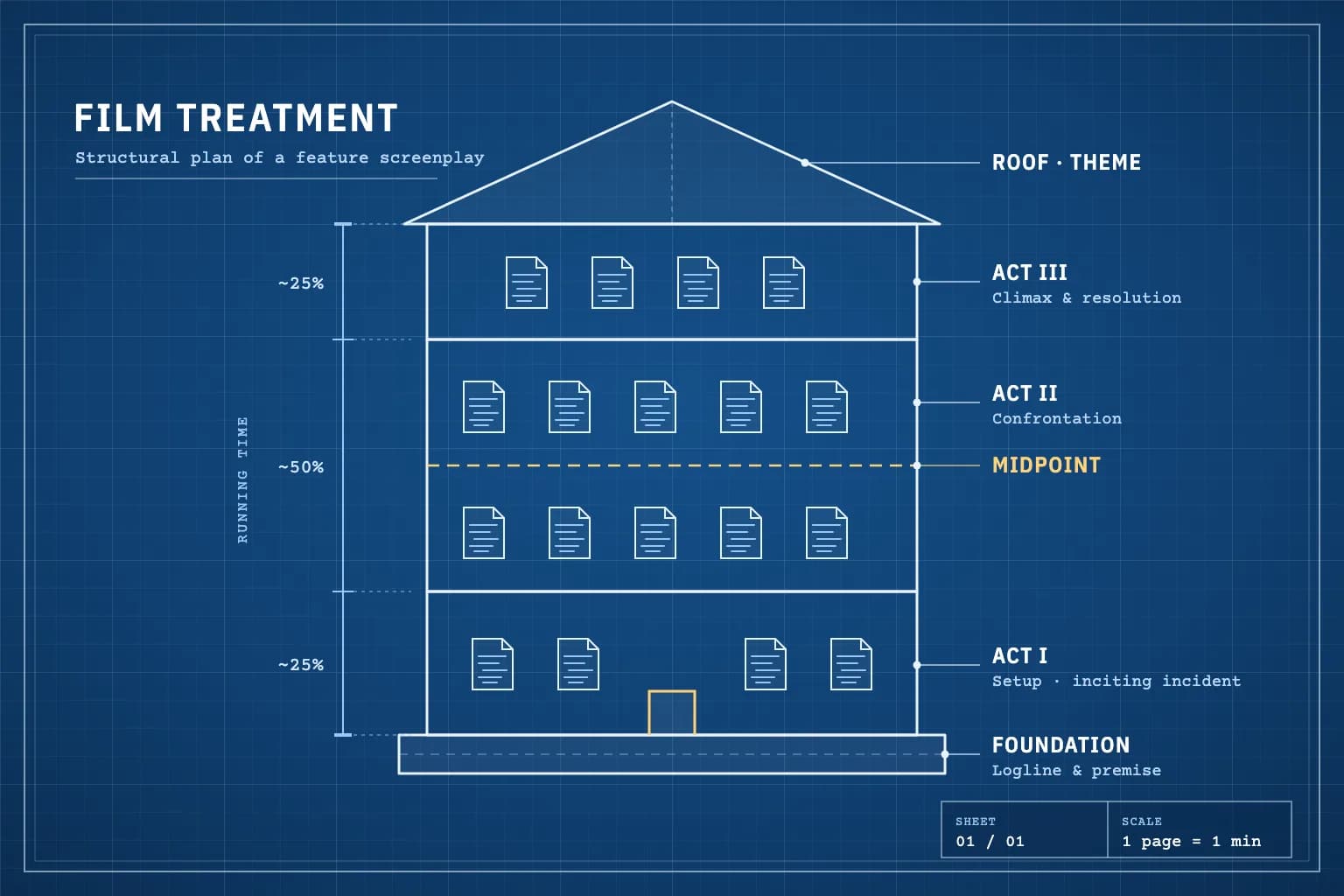
- Treatment: a longer, scene-by-scene or sequence-by-sequence account of the story, often written before the script. Its structure is covered in the architecture of a film treatment.
- Pitch deck: a multi-page visual presentation with mood images, character pages, a look book and often a director's or producer's statement. It is common for projects that already have a team attached.
Why a one-page pitch matters
Producers, agents and development executives receive far more scripts than they can read. A one-page pitch lets them decide in a couple of minutes whether your project is worth a hundred pages of their time, which is why so many companies ask for one before they ask for a script. It is a key step in getting your script read by producers.
It also helps you. Writing a one-page pitch forces you to say what your story is about, who it is for and why it matters now. If you cannot do that on one page, the problem is often in the script, not in the pitch.
Finally, it is reusable. You can adapt one strong page for queries, contests and fund applications, which makes it a practical tool for anyone learning how to sell a screenplay.
What a strong one-page pitch includes
Most one-page pitches contain the same core elements, in roughly this order:
- Title and writer's name
- Logline
- Genre, tone and format (feature, limited series, pilot, short)
- Short story summary, usually two to four paragraphs
- Main characters, one or two lines each
- Vision: what makes this story yours, and why now
- Comparable titles and target audience
- Practical details: setting, period, scale, status of the script
- Short bio and contact details
Not every pitch needs every element; a contest one-sheet may skip the production details. But starting from this list, you will rarely leave out something a reader needs.
How to write a one-page pitch, step by step
Step 1: Define the core of your story
Before you write anything for the page, answer three questions for yourself: Who is the story about? What do they want? What stands in their way, and what happens if they fail? If you cannot answer them clearly, go back to the script first.
Step 2: Write a strong logline
The logline is the most-read line on the page, so put it at the top. A good logline names a specific protagonist, a clear conflict and real stakes in one or two sentences. Compare a vague version with a specific one, using Die Hard (1988): "A cop fights terrorists" says almost nothing; "An off-duty New York cop must save his estranged wife and her colleagues when terrorists seize a Los Angeles skyscraper on Christmas Eve" gives the reader a whole film.
If your premise can be grasped in a single phrase, say so early. Projects with a strong high concept are easier to pitch on paper because the logline does most of the work.
Step 3: Add genre, tone and format
State the genre and format in one line, directly under the logline: "Feature film, contained thriller, 95 pages" or "Drama limited series, 6 x 50 minutes". Add a word or two about tone if the genre alone is misleading. Get Out (2017) is a horror film, but it is also sharply satirical, and a pitch that said only "horror" would undersell it. Knowing exactly what genre your film is tells a producer who the audience is and what kind of budget they are imagining.
Step 4: Summarize the story
Write two to four short paragraphs covering the setup, the main conflict and the direction of the climax. Leave subplots out unless they drive the plot.
Should you reveal the ending? For a producer, usually yes: readers want to know that you can land the story. A teaser-style summary can work for a cold query, but if in doubt, show the ending.
Step 5: Introduce your main characters
Give each main character a single line that shows who they are, what they want and what makes them interesting. Limit yourself to two to four characters. "Ki-taek, an unemployed father who will do anything to lift his family out of their basement flat" (Parasite, 2019) is more useful than a paragraph of backstory.
Step 6: Show your vision
This is where you explain why the story matters and why you are the one to tell it. In two or three sentences, describe the tone, the visual or narrative approach, and your personal connection to the material, if there is one. "Why now?" is a fair question to answer here: a theme that speaks to the present, a world audiences have not seen, a fresh angle on a familiar genre. Avoid empty adjectives such as "gripping" or "unique"; show the vision through specifics instead.
Step 7: Position your project with comparable titles and audience
Comparable titles, or comps, help the reader place your project in the market. Pick two or three films or series with a similar tone, audience or scale, ideally ones that were released in recent years and found an audience. A familiar shorthand is "X meets Y", or a single image such as "a haunted-house story set in space". That kind of pairing tells a producer more in a few words than a paragraph of explanation.
Choose realistic comps, not the decade's biggest blockbusters. Then add one line on the target audience: who will watch this, and where.
Step 8: Add practical production details
If it helps your case, mention the setting, the period, the number of main locations, the rough scale (micro-budget, low budget, studio scale) and the status of the project: finished script, revised draft, attached director or producer, festival or contest placements. A contained story with few locations appeals to independent producers, so say it plainly.
Proof of concept counts too. Damien Chazelle shot a short film from part of his Whiplash script, and its success at Sundance helped get the feature financed. If you have a short, a pilot reading or a published source, note it here.
Step 9: Add your bio and contact details
Two or three lines are enough: produced work, training, awards or placements, and any personal or professional experience that connects you to the story. Then give your name, email and phone number, and your representative's details if you have one.
Step 10: Edit and fit it on one page
Your first draft will be too long. Cut adjectives first, then subplots, then any sentence that repeats the logline. Keep a readable font size and white space. Ask someone who does not know the story to explain it back to you, and check that the pitch matches the script. A reader who requests the screenplay and finds a different story will not trust your next pitch.
Example one-page pitch layout
Here is a sample layout for a fictional project, so you can see how the pieces fit:
- Title: SALT LINE, written by [Your Name]
- Logline: When a storm cuts off a remote fishing village, a disgraced coastguard officer must find out which of her neighbors sank the boat that killed her brother before the road reopens and the evidence washes away.
- Genre and format: Feature film, contained mystery thriller, 98 pages
- Story: Three short paragraphs: the storm and the wreck; the investigation and rising suspicion inside a closed community; the confrontation at the harbor and its cost.
- Characters: Mara, the officer who left the village in disgrace; Tomas, the harbor master who wants the past buried; Elin, Mara's teenage niece, who saw more than she admits.
- Vision: A slow-burn thriller with one setting and a small cast, shot in the real light of a northern winter, about grief and loyalty in a place where everybody owes everybody.
- Comparables and audience: The Guilty (2018) meets Wind River (2017); adult audiences for character-driven thrillers on streaming and in arthouse cinemas.
- Practical details: One village, six main locations, low budget; finished script, second draft.
- Bio and contact: Two lines of relevant experience; email, phone, representation.
Common mistakes to avoid
- Burying the logline. If the reader has to search for what the story is, you have lost them. Put it at the top.
- Telling instead of selling. A dense plot summary with every twist is a synopsis, not a pitch. Leave room for tone, audience and vision.
- Unrealistic comps. Comparing a small drama to the biggest franchise films suggests you do not know where your project fits.
- Forgetting contact details. Every pitch should make it effortless to ask for the script.
If a pitch keeps coming back with no response, treat it as information rather than a verdict; our guide on what to do when your pitch is rejected covers how to rework it.
One-page pitch checklist
- Does the logline name a specific protagonist, a clear conflict and real stakes?
- Are genre, tone and format stated in one line near the top?
- Does the summary cover setup, main conflict and climax in a few short paragraphs?
- Are there no more than four characters, each in one line?
- Does the vision section explain why this story, why now and why you?
- Are the comparable titles recent, realistic and close in tone and scale?
- Are your bio and contact details on the page?
- Does it fit on one readable page?
- Does the pitch match the script the reader will request?
That last question is worth testing from the outside. When you analyze your screenplay with Poetika, the report includes a logline, a synopsis and notes on structure, characters and market potential drawn from the script itself. Comparing those with your one-page pitch shows quickly whether the page promises the story you actually wrote.
FAQ
How long should a one-page pitch be?
Exactly one page, at a normal, readable font size with clear margins. In practice that means a few hundred words. If you need to shrink the type or remove all the white space to make it fit, the pitch is too long and needs cutting, not compressing.
Is a one-page pitch the same as a one-sheet?
Yes, in most cases. "One-sheet", "one-page pitch" and "pitch sheet" are used interchangeably for a single page that sells a screenplay. Some people use "one-sheet" for a more visual version with a key image or poster-style design, but the content (logline, summary, characters, comps and contact details) is the same.
Should a one-page pitch reveal the ending?
For producers, agents and funds, usually yes. Decision-makers want to know that the story has a satisfying payoff and that you can deliver it. A teaser-style pitch that hides the ending can work for a cold query or a contest, but when you are unsure, include the ending in a sentence or two.
Do I need a one-page pitch if I already have a pitch deck?
Often, yes. A pitch deck is long and visual, and many readers want something they can scan in two minutes before deciding whether to open it. A one-page pitch also travels better: it fits in an email, a fund application or a meeting folder, and it is the version people forward to colleagues.
Can I write a one-page pitch before the script is finished?
You can, and many writers do it to test an idea. But most producers and agents will want a finished script before they act on a pitch from a writer they do not know. Write the pitch early as a planning tool, then revise it once the script is done so that the two match.