What Is a High Concept Movie? The Idea That Sells Itself
Poetika BlogApril 7, 202611 min read
Picture the scene: a writer walks into a producer's office. They have forty seconds. The producer has heard three pitches already this morning, has two more after this, and is thinking about a project that has been in development for eighteen months and still does not have a second act.
The writer opens their mouth and says: "A theme park where the attractions are real dinosaurs and the dinosaurs escape."
The producer does not need to hear the rest. They already know what the movie is, what it looks like, who will go see it, and approximately how much it will cost to make. The idea has sold itself before a single scene has been described.
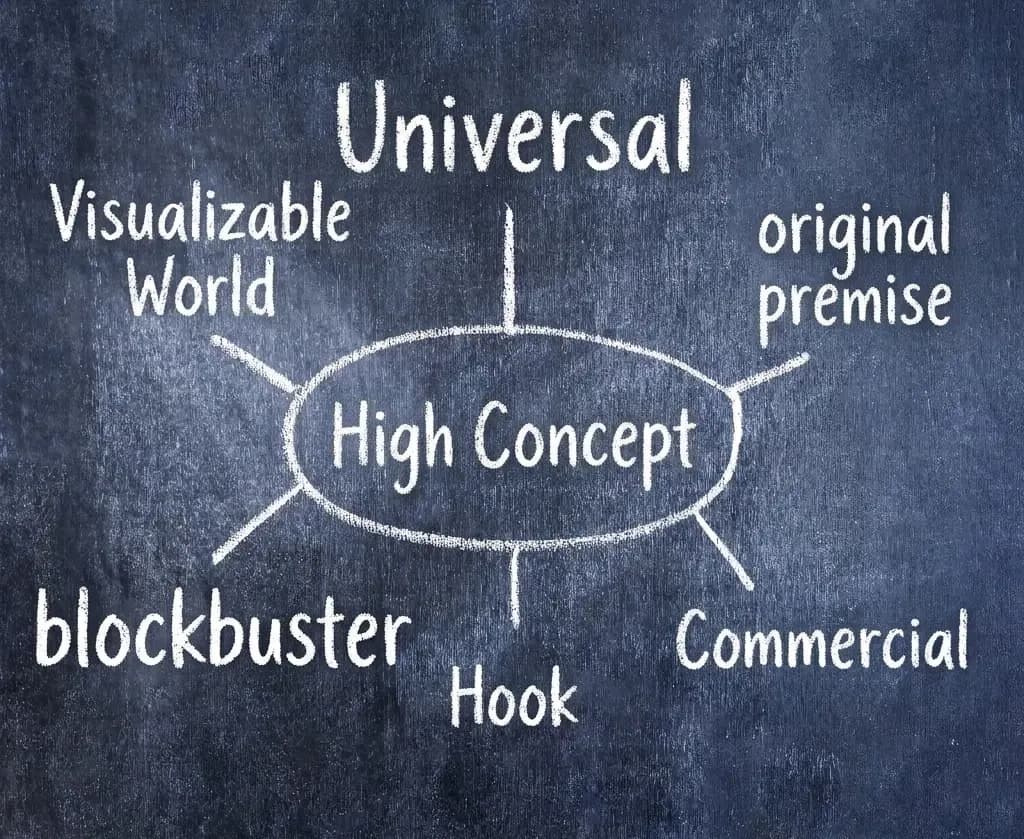
This is what a high concept movie is. Not a big-budget movie. Not a blockbuster. Not a franchise. A specific kind of idea one whose premise is so clear, so visual, and so immediately compelling that it generates an entire world in the listener's imagination before the pitch is finished.
Analyze your script with Poetika
Get instant feedback on your screenplay in minutes.
The term has been used loosely for so long that it has lost some of its precision. People use it to mean "big," or "commercial," or "special-effects-heavy," or simply "not an art film." None of these are quite right.
The concept has a specific origin. In the late 1970s and early 1980s, Hollywood was changing rapidly. The studio system had collapsed, independent production was rising, and the industry was trying to understand why certain films became cultural phenomena while others, equally well-made, disappeared. Steven Spielberg's Jaws (1975) and Close Encounters of the Third Kind (1977), and George Lucas's Star Wars (1977), had demonstrated that a film built around a single, powerful, immediately communicable idea could generate an audience response that no amount of craft or prestige alone could replicate.
Michael Eisner, then at Paramount, began describing these films as "high concept" meaning that the concept itself was the primary driver of audience interest. The execution mattered, but the idea came first. You could describe Jaws in four words: shark attacks beach town. You already wanted to see it.
The formal definition is this: a high concept film is one whose premise can be stated in a single sentence, immediately understood by anyone who hears it, and instantly suggests a visual world, a central conflict, and an emotional stakes all without further explanation.
What high concept is not: a synonym for expensive, action-heavy, or commercially safe. A low-budget horror film can be as high concept as a $200 million blockbuster. A prestige drama can be high concept. What matters is not the scale of execution but the clarity and power of the underlying idea.
Pondering the high-concept hook
The Three Components of a Strong High Concept
Not every simple premise is a high concept. "A man goes on a journey" is simple. It is not high concept. The distinction lies in three specific qualities that every genuine high concept possesses simultaneously.
A clear and original premise
The premise must do two things at once: be immediately understandable and feel like something that has not been done before. "Sharks attack swimmers" is clear but not original. "A resort island's summer season is threatened by a great white shark that the local authorities refuse to acknowledge" is both clear and specific enough to feel new. The specificity is what creates the concept. Vagueness does not generate a high concept; it generates a vague film.
An immediately visualizable world
A high concept premise generates images in the listener's mind before a single scene has been described. "Dinosaurs in a theme park" produces an instant visual: the gates, the grandeur, the moment when something goes wrong. "A man discovers he is living in a simulated reality" produces an instant visual: the glitch, the choice, the world behind the world. If a premise requires explanation before the listener can picture anything, it is not yet high concept.
A universal but specific conflict
The best high concept films are built on conflicts that are both completely specific to their world and completely universal in their human stakes. Jurassic Park is about dinosaurs, but it is also about the hubris of believing we can control nature. Get Out is about a Black man visiting his white girlfriend's family, but it is also about the specific, insidious way that liberal performance can mask something deeply dangerous. The specificity makes the film feel original. The universality makes the audience care.
When all three of these elements are present in a single, clearly stated premise, the idea genuinely sells itself.
High Concept vs. Low Concept
The distinction between high concept and low concept is not a distinction between good and bad. It is a distinction between two different kinds of storytelling, each with its own strengths and its own demands.
A high concept film leads with its premise. The idea is the primary source of the audience's interest, and the film's job is to fulfill the promise that the premise made. When you hear "a lawyer who cannot lie for twenty-four hours," you already have a relationship with the film before you have seen a frame of it. The premise has made a promise. The film must keep it.
A low concept film leads with character, tone, or emotional truth rather than a distinctive premise. Lost in Translation, Marriage Story, Moonlight — these films are not easy to summarize in a sentence that makes you immediately want to see them. Their value lies in the experience of watching them, in the accumulation of specific, observed human behavior, in the feeling they produce rather than the concept they propose.
Neither approach is superior. Some of the greatest films ever made are low concept. Some high concept films are shallow. But the demands they place on their makers are genuinely different, and confusing the two leads to problems in both directions: a high concept film that forgets to deliver on its premise, and a low concept film that tries to package its subtlety as a high concept pitch and fails to communicate what makes it worth experiencing.
The question a writer should ask is not "is my film high concept?" but "what kind of film am I making, and am I pursuing it on its own terms?"
Real Examples
The clearest way to understand high concept is to see it working.
Jaws (1975) A great white shark terrorizes a small island resort town during its most profitable season, and the local police chief, a marine biologist, and a seasoned shark hunter must kill it. Every element of this premise does work: the location creates claustrophobia, the seasonal stakes create urgency, the three-man dynamic creates character conflict, and the shark creates fear. You can feel the film before you have seen it.
Jurassic Park (1993) A billionaire builds a theme park populated by genetically resurrected dinosaurs. The dinosaurs escape. Five words — "the dinosaurs escape" — contain an entire film. The premise generates spectacle, terror, and a clear moral argument about the limits of human ambition, all in one sentence.
Get Out (2017) A Black man visits his white girlfriend's family for the weekend and discovers something deeply wrong beneath their liberal warmth. This premise works on every level: it is specific, it is immediately visualizable, and it is built on a social tension that carries genuine weight. Jordan Peele's film is a high concept horror film that is also a precise and uncomfortable piece of social observation. The premise made both possible.
Knives Out (2019) A famous mystery novelist is found dead the morning after his birthday party, and a renowned detective investigates a family of suspects who all had motive. What makes this high concept is not just the premise but the specific inversion it promises: a whodunit where we learn who did it early, and the film becomes about something else entirely. The premise signals genre, tone, and a twist on expectations simultaneously.
What these films share is that their premises generate an audience before the films generate a frame. People heard the concept and wanted to see the execution. That is the high concept at work.
Stay updated on screenwriting and story development
Receive new articles, practical writing insights, and product updates directly in your inbox.
The Traps of High Concept
A powerful premise is not a guarantee of a powerful film. High concept creates a problem as often as it solves one, and the most common failure mode is worth understanding.
The first trap is the premise that consumes the film. When a concept is strong enough to generate immediate audience interest, there is a temptation to spend the first act establishing the concept rather than telling the story. The setup becomes the film. By the time the premise has been fully explained and the world fully established, there is no time left for the characters to do anything meaningful within it. The audience came for the idea and left without the experience.
The second trap is the premise that overwhelms the characters. A high concept film is, at its best, a story about human beings who happen to inhabit an extraordinary world. At its worst, it is a tour of an extraordinary world that happens to contain some people. The dinosaurs of Jurassic Park are extraordinary. But the film works because Dr. Grant's reluctance to connect with children, and the way the crisis forces him to become someone who can, is a genuine character arc that the spectacle serves rather than replaces.
The third trap is mistaking novelty for concept. A high concept premise must be immediately comprehensible. A premise that is merely strange or original or unexpected, but that requires explanation before it generates interest, is not high concept. It is a puzzle. Puzzles can be the basis for interesting films. They are not the same as an idea that sells itself.
The premise is the beginning of the work, not the end of it. Every film on the list above succeeds not because its premise is strong but because its execution honors the promise the premise made.
Testing Whether Your Idea Is High Concept
If you are developing a project and want to assess whether it has high concept potential, the one-sentence test is the most useful starting point. Can you describe your film in a single sentence that makes someone immediately want to see it?
If the answer is yes, push further. Ask these questions:
Does the sentence generate a visual world without further explanation? If the listener needs to ask what the setting looks like, or who the characters are, or what the tone is, the premise is not yet doing enough work on its own.
Does the conflict feel both specific and universal? The best high concept premises are not just distinctive. They connect the specific world of the film to something the audience already cares about. The dinosaurs are specific. The hubris is universal.
Does the premise make a promise the film can keep? A concept that generates more excitement than the film can deliver is not a strong concept. It is a setup for disappointment. The premise should match the ambition of what you are actually able to make.
And finally: does the idea feel like it could only exist as a film? The best high concept ideas are not just story ideas. They are cinematic ideas. They generate not just interest but anticipation of a specifically visual experience. If the concept works equally well as a novel or a podcast or a stage play, it may not yet be fully realized as a film premise.
High concept is not a genre. It is not a budget level. It is not a measure of a film's quality or seriousness. It is a specific quality of a premise: the ability to communicate an entire world, a central conflict, and a set of emotional stakes in the time it takes to say one sentence.
When that quality is present, the idea does something remarkable. It generates an audience before the film exists. It creates anticipation in the mind of everyone who hears it. It makes the case for the film's existence before a single scene has been written.
That is what it means for an idea to sell itself. And it is why, when it works, there is no more powerful tool in a screenwriter's arsenal than a premise that does not need to be explained.
Christopher Nolan's The Odyssey may be his biggest production yet, but it also feels like the inevitable destination of a career built around memory, time, and the impossible journey home.
Every few years, a beloved novel gets adapted into a film. The announcement generates excitement; finally, that book is becoming a movie. And then, more often than not, something goes wrong. The film arrives and feels thin, rushed, or strangely hollow. The characters who felt so vivid on the page seem flat on screen. The story is technically all there, but whatever made the book extraordinary has somehow failed to survive the journey.
It is Monday morning. Over the weekend, twelve new scripts arrived. Nine more came in the week before. Somewhere in the inbox are scripts that have been waiting since last month, along with a few that have been there even longer. In two hours, the development meeting starts, and there is still a stack of material that nobody has had time to read.