Rick Blaine's Character Arc in Casablanca: From Cynicism to Commitment
Poetika Editor TeamFebruary 25, 20259 min read
This article discusses the whole plot of Casablanca, including the ending.
A character arc is the way a character changes over the course of a story, and studying one closely is one of the quickest ways to understand how a screenplay turns events into meaning, because a well-built arc shows you exactly which scenes push a character from who they are toward who they become. Casablanca is a good place to start, since Rick Blaine's journey from guarded cynic to committed ally is told so clearly that every step can be traced to a specific choice on screen.
Rick Blaine at a glance
The film's script took shape while it was being shot, and a number of writers touched it along the way. That history is worth keeping in mind, because Rick's arc was sharpened in those rewrites, as we will see in the final sections.
Starting point: a man who has stopped taking sides
When we first meet Rick, he is running the most popular café in a city full of refugees waiting for exit visas, and he keeps every one of them at arm's length. He is proud, aloof and attractive on the surface, and he declares that he will not risk himself for anyone. His neutrality is not an accident but a policy, and the film makes that visible quickly: when Ugarte, a small-time crook who has asked Rick to hide stolen letters of transit, is arrested in the café, Rick refuses to lift a finger and leaves him to the police.
The film also gives us hints that this is a man who has closed himself off rather than one who was always this way. We hear that Rick once fought on the side of the underdog in earlier conflicts, so his cynicism reads as a response to a wound and not as his true nature. That gap between the man he presents and the man he used to be is where the whole arc lives.
What Rick wants and what Rick needs
What Rick wants is simple and entirely defensive: to be left alone, to keep his café running and to avoid any situation that might make him feel something again. Every early scene shows him protecting that wish, whether he is turning down the police, the black market or the regulars.
What he needs is the opposite. He needs to stop hiding behind neutrality and rediscover that he cares about something larger than his own comfort, and in this story that means choosing a side. The film turns this need into a concrete dilemma: Rick is holding the one object that can help Victor Laszlo continue the resistance, and the woman who broke his heart is asking him to hand it over. His wish to stay out of things and his deeper need to act are now in direct conflict.
The inciting incident: Ilsa walks in
Casablanca actually sets two things in motion early on. The plot begins when Ugarte leaves the letters of transit with Rick, which puts the object everyone will fight over into his hands. The arc begins a little later, when Ilsa arrives at the café with Victor Laszlo and Rick is visibly shaken by seeing her again.
The distinction matters for anyone writing a character-driven story. The letters give the plot its stakes, but it is Ilsa who gives those stakes a personal cost, because handing the letters to Laszlo means helping the man she is married to. The film joins an external problem to an internal wound, and that is why Rick cannot simply stay neutral.
Key turning points
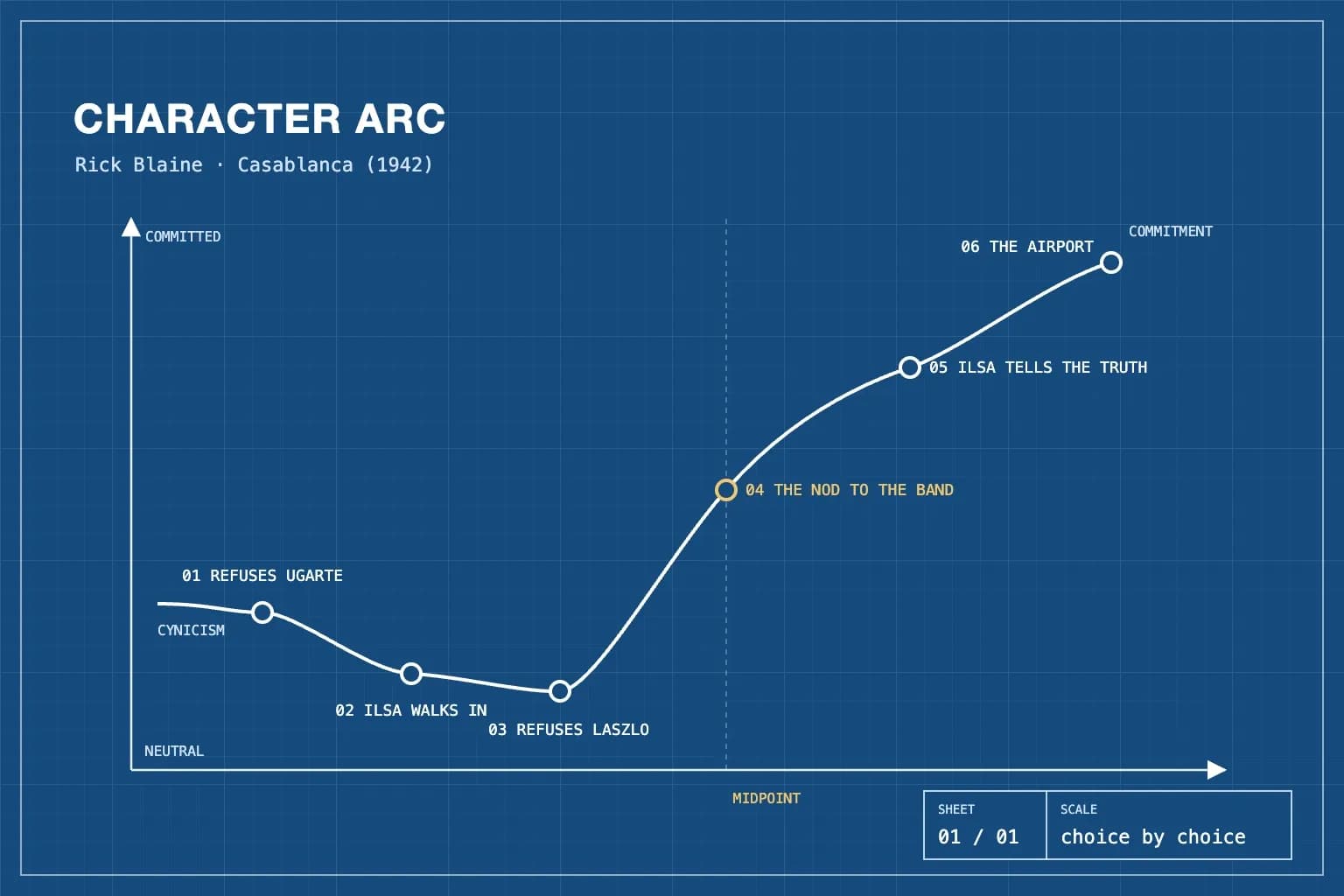
Rick does not change in one scene. His arc moves through a handful of choices, each of which asks a little more of him than the last:
He refuses to help Ugarte. This sets his baseline: he protects himself and leaves others to the consequences.
Ilsa arrives and he drinks alone. The wall holds, but we see what it is hiding, and a flashback to Paris shows the love affair that ended when Ilsa left him without an explanation.
He refuses to give Laszlo the letters. Rick tells Laszlo to ask his wife why. It is the peak of his bitterness, and it puts a personal grudge ahead of a cause he once might have supported.
He allows the Marseillaise. When the café band looks to Rick for permission to play against the German officers, he nods, which is his first public act of defiance.
Ilsa confronts him and then tells him the truth. She confesses that she still loves him and explains why she left, and the reason removes the grievance that has justified his coldness.
He makes his choice at the airport. Rick gives up Ilsa, shoots Major Strasser and helps Laszlo escape.
There are also smaller moments along the way that show Rick's idealism was never gone, such as the help he quietly gives a young couple trying to leave Casablanca. These are the cracks that keep his transformation believable, because the audience has already seen the person he is going to become.
The midpoint shift: the nod to the band
In our reading, the middle of the film belongs to the Marseillaise scene. A group of German officers begins to sing in the café, Laszlo tells the band to answer with the French anthem, and the musicians hesitate and look at Rick, because it is his café and his decision. When he nods, the whole room joins in and drowns out the Germans.
Nothing about the scene requires Rick to speak. The shift is carried entirely by a small physical choice, and it works because it is the first time he stops being a bystander in his own place. From this point on, neutrality is no longer a position he can credibly claim, which is why the second half of the film is about the cost of the choice he has just begun to make.
The lowest point: cynicism at its peak
Casablanca places Rick's emotional low early, which is one of the reasons the film feels so well paced. The night after Ilsa arrives, he sits in his closed café, drinking and visibly hurt, and the Paris flashback shows us why. The next day he turns cruel when she tries to talk to him, and he refuses Laszlo the letters, so his bitterness reaches its height before the story begins to turn him around.
The lesson for a writer is that a low point does not have to come late. In this film the real cost of the arc arrives at the end, when Rick has to give up the woman he loves, so the early low plants the wound and the final scene shows what it takes to move past it.
The final transformation: the airport
The ending is where Rick's arc becomes action. He has Renault take the letters to the airport instead of arresting Laszlo as planned, he puts Ilsa on the plane with her husband and he shoots Major Strasser when Strasser tries to stop them. He tells Ilsa that the problems of three people matter little next to what is happening in the world, which is the clearest statement of the change: the man who would not stick his neck out for anyone has done exactly that.
The film then lets Renault confirm the transformation by choosing a side of his own. Instead of arresting Rick, he covers for him and the two men leave Casablanca to join the Free French, so the arc ends with Rick belonging to something rather than standing apart from it.
It is also a notable decision that Rick loses Ilsa. A happier ending would have rewarded him, but the film makes his commitment real by making it costly, and a change that costs nothing rarely convinces an audience.
How the screenplay shows the change
The script rarely tells us that Rick is changing, and it shows it through what he does, says and is placed beside.
Action over explanation. Each turning point is a choice: refusing Ugarte, nodding to the band, sending Ilsa away. Rick's change is something the audience watches him do.
Dialogue that shifts register. Early on, his lines are short, guarded and deflecting. By the end he speaks plainly about what matters, so the same voice carries a different meaning.
Repetition with variation. The film returns to the same situations, such as a refugee in trouble or a choice about whom to help, and Rick answers differently each time. Repetition is one of the cleanest ways to measure an arc.
Contrast characters. Laszlo is committed from the start, Renault is opportunistic, and Ilsa is torn. Standing beside them, Rick's position becomes easy to read.
Objects and settings. The letters of transit, the café and the airport turn an internal change into something we can see and hold.
What screenwriters can learn
Give the wall a reason. Rick's coldness works because we know what it protects. A cynical character with no wound is only a pose.
Join the plot problem to the personal wound. The letters alone would have been a thriller device, and it is Ilsa that makes them hurt.
Make the turn a physical choice. The nod to the band says more than a speech could.
Let the change cost something. Rick's commitment is credible because it takes the woman he loves away from him.
Keep refining the arc in rewrites. According to American Heritage, the film was shot while the script was still being finished, with several writers contributing, and the changes gave Rick more depth and less self-pity. The ending was also reworked so that he acts against the Nazis instead of surrendering, as the original play had him do. The arc we admire is partly the result of rewriting.
Try it yourself
Take the main character of your own screenplay and answer these questions in a few sentences each:
What does your character want at the start, and what do they need?
Which wound or past event explains the wall they have built?
What is the first scene in which they are asked to give something up?
Which small physical choice could show a turning point without a line of dialogue?
What does the ending cost them?
If you cannot answer one of these, that is usually the place where the arc is thinnest. A structured read of your script, such as the one Poetika provides, can then show you where your turning points actually fall on the page.
Think of a film that stayed with you long after the credits rolled. Not because of its plot twists or visual effects, but because of what happened to the person at its center. The way they started as one thing and ended as something else or the way the story made you desperately wish they had.
That experience has a name: character arc. And it is the single most important structural element separating characters who feel alive from characters who merely function.
Great films are often remembered through their protagonists. We speak of Michael Corleone rather than the structure of The Godfather, Travis Bickle rather than the plot of Taxi Driver, Charles Foster Kane rather than the investigative framework of Citizen Kane. This is not because character is more important than story, but because story is often experienced through character.
Characters are the story. Plot is simply what happens when particular people, with particular desires and particular contradictions, come into contact with the world around them.