Spoiler note: this post discusses the endings of 12 Angry Men, To Kill a Mockingbird and A Few Good Men.
Ethos, pathos and logos are the three modes of persuasion described by Aristotle: ethos persuades through the character and credibility of the speaker, pathos through the emotions of the audience, and logos through logic and evidence. In film, they work on two levels at once. Characters use them to persuade each other inside the story, and the screenplay uses them to persuade the audience to trust a character, feel a moment and believe a plot.
Many of the scenes people remember are persuasion scenes: a cross-examination, a jury room argument, a con artist talking their way into a house. This guide explains where the three appeals come from, how well-known films use them, and how to use them in dialogue, character, turning points and your pitch.
What are ethos, pathos and logos?
- Ethos (character): we are persuaded because we trust the person speaking. They seem knowledgeable, honest or morally serious.
- Pathos (emotion): we are persuaded because the speaker puts us in a certain state of mind: fear, pity, anger, hope.
- Logos (reason): we are persuaded by the argument itself: evidence, cause and effect, a conclusion that follows from what we know.
In a screenplay, the film itself is also a speaker, always arguing that this person is worth following and this ending is the only one that could happen.
Where they come from: Aristotle's three appeals
The terms come from Aristotle's Rhetoric, written in the 4th century BC. In the second chapter of its first book, Aristotle divides the proofs a speaker can offer into three kinds: those that depend on the speaker's character, those that depend on putting the listener in the right frame of mind, and those that depend on the argument, which proves or seems to prove a point. Later teachers called them the three appeals.
Aristotle also wrote the Poetics, the oldest surviving study of drama (see Homer's Odyssey and Aristotle's Poetics). The two books are connected: the Poetics lists "thought", the moments when characters argue and persuade, as a part of tragedy and refers the reader to the Rhetoric for how it works. Persuasion was part of the dramatist's craft.
For a wider view of rhetoric, including its types and common devices, see what rhetoric is and how it works in speeches and film.
Ethos: credibility and character
Ethos is the reason we believe someone before we have checked what they say: expertise, reputation, experience, visible integrity.
In drama, ethos is built, not announced. A detective who says they are the best has no ethos yet; one who notices the detail everyone missed has plenty. Screenwriters build it through:
- Competence on screen: the character does something skilled in front of us.
- Consistency: what they say matches what they do, scene after scene.
- Testimony from others: other characters treat them with respect, or fear.
- Cost: they tell the truth when it hurts them, which makes us trust them more.
Pathos: emotion
Pathos is the appeal to feeling. Aristotle's point was not that emotion is a trick, but that people judge differently when they are angry, afraid or moved. On screen, performance and music shape feeling, but on the page, pathos comes mainly from stakes and specificity. We feel for a character when we understand what they stand to lose and when the loss is shown through concrete details rather than general statements about sadness.
Logos: logic and reason
Logos is the appeal to reason: facts, evidence, cause and effect, a conclusion that follows. In a screenplay, logos lives in two places. Inside scenes, it is the argument a character makes. Across the whole story, it is plot logic: the sense that each event causes the next, that clues were planted fairly and that the ending follows from what came before.
When an audience says a plot "doesn't make sense", they are reporting a failure of logos.
Examples from everyday life
You meet the three appeals every day, often in the same message:
- Advertising: a dentist recommending a toothpaste is ethos; a charity ad showing one child's face is pathos; a chart comparing fuel consumption is logos.
- Famous speeches: Martin Luther King Jr.'s "I Have a Dream" speech in 1963 drew on all three: moral authority, vivid images of a hoped-for future, and an argument grounded in America's founding documents.
Examples from film
Ethos in a film scene
In Jaws (1975), Quint is introduced scratching his nails down a chalkboard to silence a town meeting, then naming his price to catch the shark. He commands the room, but the audience does not fully trust him yet. That changes on the boat. As Quint, Hooper and Brody compare scars, Quint reveals that he survived the sinking of the USS Indianapolis in 1945, when the crew spent days in the water among sharks. The scene adds no plot, only ethos: from then on, when Quint talks about sharks, we believe him.
Parasite (2019) shows the dark side of ethos. Ki-woo gets a tutoring job with the wealthy Park family on a friend's recommendation and a university document forged by his sister. Once inside, the Kims pass credibility from one member to the next until the whole family works in the house. Ethos, the film shows, can be borrowed and faked.
Pathos in a film scene
The opening of Up (2009) is one of the clearest pathos sequences in modern film. In a few wordless minutes, set to Michael Giacchino's score, we watch Carl and Ellie marry, build a home, learn they cannot have children, and save for a trip to Paradise Falls, only to spend the savings again and again on everyday emergencies. When Carl finally buys the tickets, Ellie falls ill and dies. The sequence makes no argument; it makes us care, and that care carries the rest of the film.
Logos in a film scene
12 Angry Men (1957) is a whole film built on logos. Juror 8 (Henry Fonda) argues not that the defendant is innocent but that the case has not been proved, and tests the evidence piece by piece. He produces a knife identical to the supposedly unique murder weapon, bought in the defendant's neighborhood. He questions whether an elderly witness could have reached his door in the time he claimed. When Juror 9 notices marks on Juror 4's nose from his glasses, the jurors realize the key eyewitness had similar marks and was probably not wearing her glasses when she saw the killing.
The film also shows the limits of logos. The last holdout, Juror 3, is not defeated by evidence. He breaks down over his estranged son, tears up a photograph of the two of them, and changes his vote. His resistance was never about logic.
How screenwriters use the three appeals
In dialogue and arguments between characters
Every argument scene is a contest of appeals. In A Few Good Men (1992), Kaffee, a junior Navy lawyer known for plea bargains, cannot match Colonel Jessup's ethos, so he attacks with logos. Jessup has testified that his orders are always obeyed and that he ordered his men not to touch Santiago. Kaffee asks: if that order would be obeyed, why did Santiago need a transfer for his safety? Trapped by his own logic, Jessup loses his temper and confesses to ordering the Code Red.
When you write an argument, ask which appeal each character leans on, and what happens when one of them switches. For more on how memorable lines work, see the best movie dialogue for writers.
In building a character the audience trusts
The audience decides early whether to follow your protagonist, and that is a matter of ethos. They need not like the character, but they must believe in them. We look at the elements that make a lead worth following in the anatomy of a great protagonist.
In To Kill a Mockingbird (1962), Atticus Finch's ethos is built through his children's eyes and through the town's response to him. After the verdict, the Black spectators in the balcony stand as he leaves the courtroom, and Reverend Sykes tells Scout to stand: "Your father's passin'." He has just lost the case, yet the film tells us he was right.
Antagonists need ethos and logos too. A villain whose argument almost convinces us is far more frightening than a straw man. See protagonist and antagonist: not all villains are evil.
In emotional turning points
The biggest turning points usually combine all three appeals. Atticus's closing argument in To Kill a Mockingbird is built on logos: Tom Robinson's left arm was crippled in an accident, while the injuries to Mayella Ewell's face suggest a left-handed attacker, and her father, Bob Ewell, is left-handed. It is delivered with pathos, as an appeal to the jurors' conscience, and it rests on Atticus's ethos as the most trusted man in the room. The jury convicts Tom anyway.
Finding the balance between the three
There is no correct ratio. A courtroom drama leans on logos, a family drama on pathos, but stories feel thin when one appeal does all the work.
A useful model is A Separation (2011), Asghar Farhadi's Iranian drama. When a caregiver suffers a miscarriage, the legal case turns on a simple question: did Nader know she was pregnant when he pushed her out of his apartment? Farhadi gives each side credible character, real emotional stakes and a reasonable argument. The audience keeps changing its mind.
When you read a draft, check each key scene:
- Ethos: do we believe this character has the right to say this?
- Pathos: do we understand what is at stake for them, and feel it?
- Logos: does what happens follow from what came before?
Writers rarely see gaps in their own logic, so an outside read helps. A structured analysis such as Poetika's screenplay report looks at character, structure and stakes separately, which makes it easier to see whether a scene is missing credibility, emotion or cause and effect.
Common mistakes
- Relying only on emotion. Swelling music and tears cannot replace stakes the audience understands. Pathos without logos turns into melodrama, and audiences notice when they are being pushed.
- Telling us about ethos. Characters who describe how brilliant or brave someone is, instead of showing it, make us trust the character less.
- Logos as exposition. Arguments that recite facts with nothing at stake read like a lecture.
- Straw-man opponents. If the other side's argument is weak, the protagonist's victory means nothing.
- Unearned turns. A character who changes their mind without a reason, emotional or logical, breaks the scene.
Using the three appeals in your logline and pitch
A pitch is a persuasion scene in which you are the speaker. The three appeals map onto it directly:
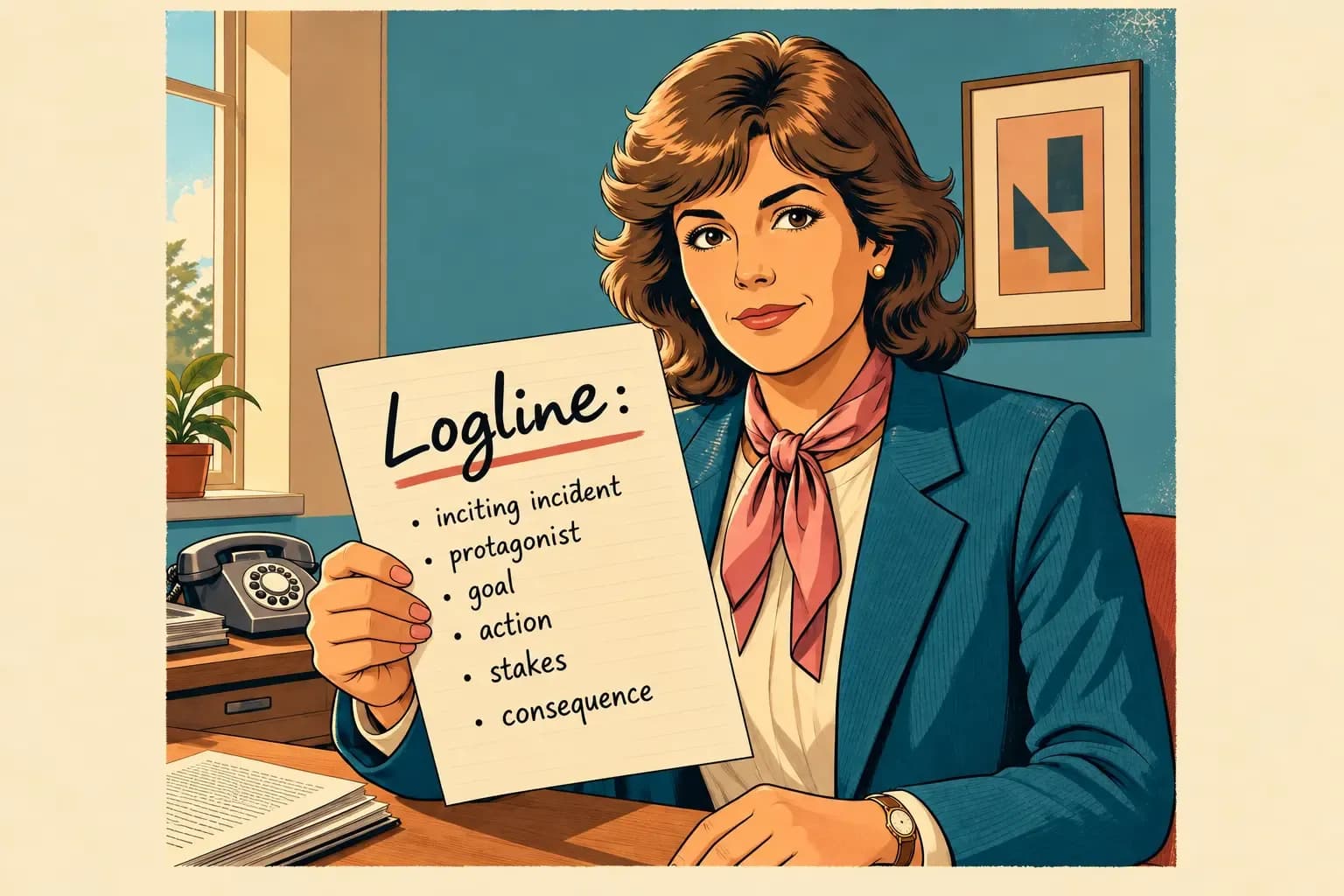
- Logos in the logline: a clear protagonist, goal, obstacle and stakes, linked by cause and effect. A reader should understand the story in one sentence; see how to write a logline that gets your script read.
- Pathos in the stakes: what the protagonist could lose, and why it matters to anyone watching.
- Ethos in "why you": your connection to the material, whether it is research, experience or a body of work. Producers want to know why you are the right writer for this story.
If a pitch has gone badly, the cause often falls along these lines; we cover what to do next in your pitch was rejected. Now what?
Try it yourself
Pick one important scene from your current draft and work through it:
- Underline every line in which a character tries to persuade someone. Note which appeal each line uses.
- Check whether the scene's turn comes from ethos, pathos or logos, and whether that fits the character.
- Find the weakest appeal in the scene and strengthen it with one concrete action or detail.
- Give the opposing character a better argument than they have now.
When your draft is ready for an outside view, you can get a structured analysis of your screenplay and see how its characters, stakes and structure read to a first-time reader.
FAQ
What is the difference between ethos, pathos and logos?
Ethos persuades through the speaker's credibility and character, pathos through the emotions of the audience, and logos through logic and evidence. A doctor's advice relies on ethos, a moving story about one patient relies on pathos, and clinical trial results rely on logos. Strong persuasion, in speeches and in film scenes, usually combines all three.
Who came up with ethos, pathos and logos?
Aristotle described the three modes of persuasion in his Rhetoric in the 4th century BC. He divided the proofs a speaker can offer into those based on the speaker's character, those based on the listener's state of mind and those based on the argument itself. Later teachers popularized them as the three appeals.
What is a good film example of ethos, pathos and logos?
12 Angry Men (1957) is a classic example of logos, as Juror 8 tests the evidence point by point. The opening montage of Up (2009) is a strong example of pathos. Quint's USS Indianapolis story in Jaws (1975) shows ethos: after it, the audience trusts his knowledge of sharks.
Which appeal is most important in a screenplay?
None is most important on its own. Pathos makes an audience care, but without logos the plot feels arbitrary, and without ethos the audience will not follow the protagonist. Different genres lean on different appeals, so the useful question is not which one matters most, but which one is missing from a given scene.
How can I use ethos, pathos and logos in a pitch?
Use logos to make the logline clear and causal, pathos to show what is at stake for the protagonist, and ethos to explain why you are the right writer for the story. A pitch that lands on all three gives a producer a story they understand, a reason to care and a reason to trust you.