Spoiler note: this post discusses the final scenes of The Great Dictator, The King's Speech and Darkest Hour.
Rhetoric is the art of persuasion: the deliberate use of language, argument and emotion to move an audience to believe, feel or do something. Rhetoric in film works on two levels at once. Inside the story, characters use it on each other in speeches, trials, negotiations and arguments. Outside the story, the film itself is a piece of rhetoric, built shot by shot and line by line to make an audience trust one character, fear another and accept an ending.
For screenwriters, every scene in which one character wants another to change their mind is a rhetorical scene, and every logline is a small persuasive argument. This guide covers where rhetoric comes from, its three classical types, the devices behind famous movie speeches, and how to use them without preaching.
What is rhetoric?
Aristotle defined rhetoric as the ability to see, in any given situation, the available means of persuasion. The definition is practical: rhetoric is not about sounding grand, but about knowing who you are talking to and what would actually move them.
A character who shouts how angry they are is expressing themselves. A character who chooses words to make someone else angry, guilty or hopeful is using rhetoric. The second scene is more dramatic, because it has a target and a result: the other person is persuaded or not.
A short history of rhetoric
Rhetoric began as a practical skill in ancient Greece, where citizens spoke for themselves in assemblies and law courts. Plato distrusted the teachers of persuasion, the Sophists, and in his dialogue Gorgias he attacked rhetoric as a knack for pleasing crowds with no concern for truth. Aristotle answered with his Rhetoric in the fourth century BCE, the most influential early study of how persuasion works. His Poetics, written for storytellers, sits beside it; we explore its influence on film in Homer's Odyssey, Aristotle's Poetics and Nolan.
Roman writers turned rhetoric into an education. Cicero and the anonymous author of the Rhetorica ad Herennium described the five canons of rhetoric: invention (finding arguments), arrangement (ordering them), style (choosing the words), memory and delivery. Quintilian, borrowing a phrase from Cato the Elder, described the ideal orator as a good man skilled in speaking, which tied persuasion to character.
Through the Middle Ages and the Renaissance, rhetoric was a core school subject alongside grammar and logic. In the twentieth century, critics applied it to fiction itself: Wayne C. Booth's The Rhetoric of Fiction (1961) argued that stories persuade readers to see events in a particular way. Soviet filmmakers of the 1920s built a theory of editing around steering the audience's response, as we explain in Soviet montage theory.
The three appeals: ethos, pathos and logos
Aristotle described three ways a speaker persuades:
- Ethos: persuasion through the character and credibility of the speaker. We believe people we trust.
- Pathos: persuasion through the emotions of the audience. We act on what we feel.
- Logos: persuasion through reasoning and evidence. We accept what seems to follow logically.
Strong rhetoric usually blends all three. We cover them in depth, with film examples, in ethos, pathos and logos in film.
The three types of rhetoric
Aristotle also divided rhetoric into three types, depending on the time the argument is about and what it tries to prove. The division shows what a big speech is actually doing.
Deliberative rhetoric: arguing about the future
Deliberative rhetoric tries to persuade an audience to take, or avoid, a course of action. Its question is: what should we do next? Its arguments are about what is useful or harmful.
Most rousing movie speeches are deliberative. In Kenneth Branagh's Henry V (1989), the St Crispin's Day speech persuades an outnumbered army to fight at Agincourt. In Steven Spielberg's Lincoln (2012), written by Tony Kushner, most scenes are deliberative arguments to win votes for the Thirteenth Amendment.
Forensic rhetoric: arguing about the past
Forensic, or judicial, rhetoric argues about what happened and whether it was just. It is the rhetoric of the courtroom: accusation and defense. Its question is: who did what, and who is to blame?
Some of the best examples turn the audience into the judge. In Akira Kurosawa's Rashomon (1950), witnesses give their versions of a killing directly to the camera, as if to an unseen magistrate. Asghar Farhadi's A Separation (2011) opens the same way: an Iranian couple argue their case for and against a divorce to a judge we never see, and we have to weigh both sides from the first minute.
Epideictic rhetoric: praise and blame
Epideictic, or ceremonial, rhetoric praises or blames. It is the rhetoric of funerals, ceremonies and toasts, and its arguments are about values.
In Wall Street (1987), Gordon Gekko's speech to the shareholders of Teldar Paper is epideictic in form: it is a speech in praise of greed. In Joseph L. Mankiewicz's Julius Caesar (1953), Marlon Brando's Mark Antony delivers a funeral oration over Caesar's body. It begins as epideictic rhetoric, honoring the dead, and turns into deliberative rhetoric that sends a crowd into the streets. That shift from praise to a call for action is one of the most useful patterns a screenwriter can borrow.
Common rhetorical devices
Rhetorical devices are patterns of words that make an argument stick. These are the most common in film dialogue.
Repetition
Repeating a word or phrase builds rhythm and emphasis. Repeating it at the start of successive sentences is called anaphora, the device behind Martin Luther King Jr.'s "I have a dream" in 1963 and behind Churchill's "we shall fight" sequence, which Darkest Hour (2017) restages in its final scene. In Network (1976), Paddy Chayefsky's anchorman Howard Beale gets viewers to shout one line out of their windows, and the repetition turns a private rant into a public movement.
Rhetorical questions
A rhetorical question is asked for effect, not for an answer; it makes the audience supply the answer themselves. In Gladiator (2000), Maximus kills his opponents in a provincial arena, then turns to the crowd and shouts, "Are you not entertained?" The question accuses the crowd of enjoying the slaughter.
Metaphor and analogy
A metaphor describes one thing in terms of another; an analogy uses a comparison to make an argument. In The Third Man (1949), Harry Lime justifies his crimes with an analogy: Renaissance Italy had war and murder and produced great art, while peaceful Switzerland produced only "the cuckoo clock." The argument is morally empty, which is why it chills. For more on how films think in images as well as words, see our guide to metaphor in film.
The rule of three
Ideas grouped in threes feel complete and memorable; rhetoricians call this a tricolon. Gekko's speech in Wall Street uses two in a row: greed is good, greed is right, greed works, and then greed clarifies, cuts through and captures.
Irony
Verbal irony says one thing and means another. Mark Antony's funeral speech in Julius Caesar is the classic case: he keeps calling Brutus an honorable man until the phrase means its opposite and the crowd turns on the conspirators. Irony works because the audience reverses the meaning themselves. A related tool, where the audience knows more than the characters, is covered in our guide to dramatic irony.
Rhetoric in everyday life
Rhetoric shapes most of what you read and watch every day:
- Advertising leans on pathos and ethos: an emotional image, a trusted face, a slogan built on repetition or a rule of three.
- Politics uses all three types: deliberative campaign promises, forensic attacks on an opponent's record and epideictic speeches at memorials and national holidays.
- Social media rewards compressed rhetoric: rhetorical questions, irony, us-versus-them framing and repetition across thousands of posts.
The same moves that sell a product or win a vote can make a character persuasive, or reveal one who persuades for the wrong reasons.
Rhetoric in film and screenwriting
Speeches that turn a story
A great movie speech is not a pause in the story. It is a turning point: the speech has to change what a character or a crowd does next. In Charlie Chaplin's The Great Dictator (1940), a Jewish barber mistaken for the dictator Hynkel steps up to a microphone and gives a plea for humanity instead of the expected call to war. In The King's Speech (2010), written by David Seidler, the climax is the 1939 wartime broadcast by George VI, and the drama is entirely about delivery, the fifth canon of rhetoric: whether a man who stammers can get the words out.
In both, we know who is speaking and what it costs them, who is listening, and what is at stake if the speech fails. Without those elements, a speech is an essay read aloud.
Arguments between characters
Most film rhetoric happens in smaller scenes. In Thank You for Smoking (2005), the tobacco lobbyist Nick Naylor teaches his son that winning an argument is not about proving you are right. It is about persuading whoever is watching. Arguments are performed for an audience, on screen and off.
Give each side a real case; if one has no good points, the scene is a lecture. The strongest arguments let us feel the pull of both positions, as in A Separation. For examples of dialogue that persuades without announcing itself, see our list of the best movie dialogue for writers.
The pitch and the logline as rhetoric
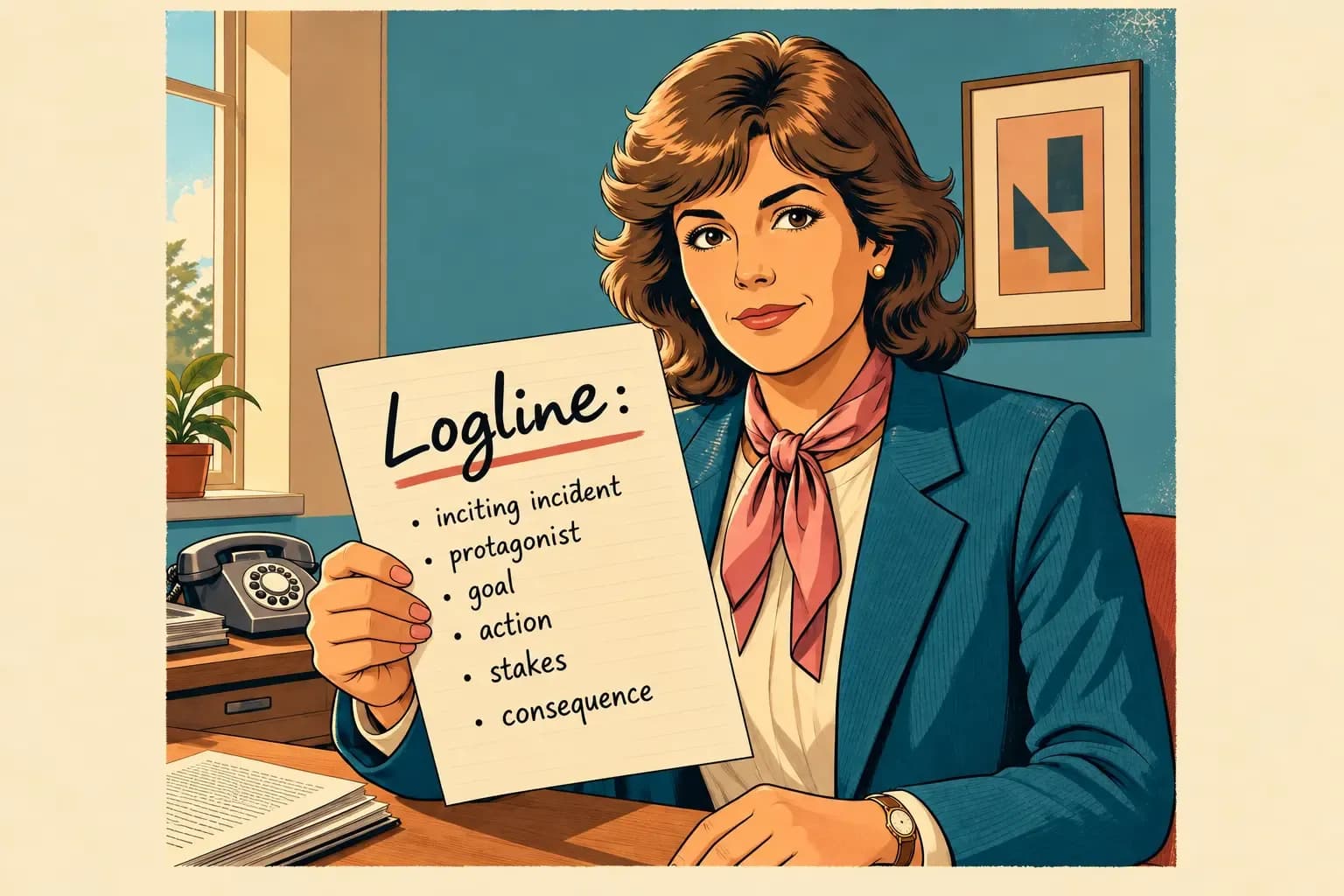
Your screenplay also has to persuade people who never see the film. A logline is a one-sentence deliberative argument: it asks a reader to spend time on your script. It needs logos (a clear premise and conflict), pathos (a situation that makes us care) and ethos (a writer who knows the genre). Our guides on how to write a logline that gets your script read and the one-page pitch show how to build that argument.
Before you pitch, it helps to know whether the script itself makes its case. You can run your screenplay through Poetika for a structured analysis of logline, structure, character and dialogue, and see whether your key scenes persuade the way you intended.
Rhetoric versus manipulation
Plato's worry still matters. A rough line: persuasion gives the audience reasons they could examine and accept; manipulation gets around their judgment with fear, flattery, false logic or selective facts.
Film has a long history on both sides. Leni Riefenstahl's Triumph of the Will (1935) used every tool of cinema to glorify the Nazi regime, and it is still studied as a warning about what film rhetoric can do. Films like Network make manipulation their subject and let us watch the machinery.
For screenwriters, this is also a character tool. An honest hero and a manipulative villain can use the same devices; what separates them is what they hide and whom they are willing to hurt.
Common mistakes when using rhetoric
- Speeches without stakes. If nothing changes when the speech ends, cut it or rewrite it as a scene with a goal.
- Every character sounds like an orator. A shy teenager and a trial lawyer should not argue the same way.
- The writer's argument in a character's mouth. If a speech exists only to deliver the theme, readers notice.
- Too many devices at once. Repetition, questions and tricolons in every line turn rhetoric into noise. Choose one or two patterns per speech.
Try it yourself
Pick a scene in your screenplay in which one character needs another to change their mind, then work through these questions:
- Which type of rhetoric is the scene: deliberative (what should we do?), forensic (what happened?) or epideictic (what do we value?)
- What does the listener believe at the start, and what would actually move them?
- Which appeal does the speaker rely on most, and which one are they missing?
- Choose one device, such as repetition, a rhetorical question or irony, and use it once, at the moment of greatest pressure.
- Decide whether the persuasion succeeds, and make sure the story changes either way.
If you want an outside read of how your scenes and characters come across, try Poetika's screenplay analysis before you send the draft out.
FAQ
What is rhetoric in film?
Rhetoric in film is the use of persuasion inside and through a movie. Characters use it on each other in speeches, trials and arguments, and the film uses it on the audience through dialogue, structure, performance and editing. It shapes whom we trust, what we feel and which conclusions we accept by the end.
What are the three types of rhetoric?
Aristotle named three types. Deliberative rhetoric argues about future action and asks what we should do. Forensic rhetoric argues about past events and asks who is to blame, as in a courtroom. Epideictic rhetoric praises or blames in the present, as in funeral speeches, toasts and award ceremonies, and focuses on shared values.
What are some famous examples of rhetoric in movies?
Mark Antony's funeral oration in Julius Caesar (1953), the St Crispin's Day speech in Henry V (1989), Gordon Gekko's greed speech in Wall Street (1987), the barber's final speech in The Great Dictator (1940) and the wartime broadcast in The King's Speech (2010) are widely studied examples of persuasion on screen.
What is the difference between rhetoric and rhetorical devices?
Rhetoric is the whole art of persuasion: understanding the audience, building the argument, choosing the appeal and delivering it. Rhetorical devices are specific stylistic techniques within it, such as repetition, rhetorical questions, metaphor, the rule of three and irony. Devices make an argument memorable, but they cannot replace a real argument.
How can screenwriters use rhetoric without making dialogue preachy?
Give every persuasive line a listener and a goal, let the opposing side make a strong case, and keep devices sparing. Tie the speech to a turning point so it changes what happens next. When rhetoric serves character and conflict rather than the writer's message, it reads as drama instead of a sermon.