How Does a Producer Decide Which Script to Read When Hundreds Are Waiting?
Poetika BlogJune 30, 20268 min read
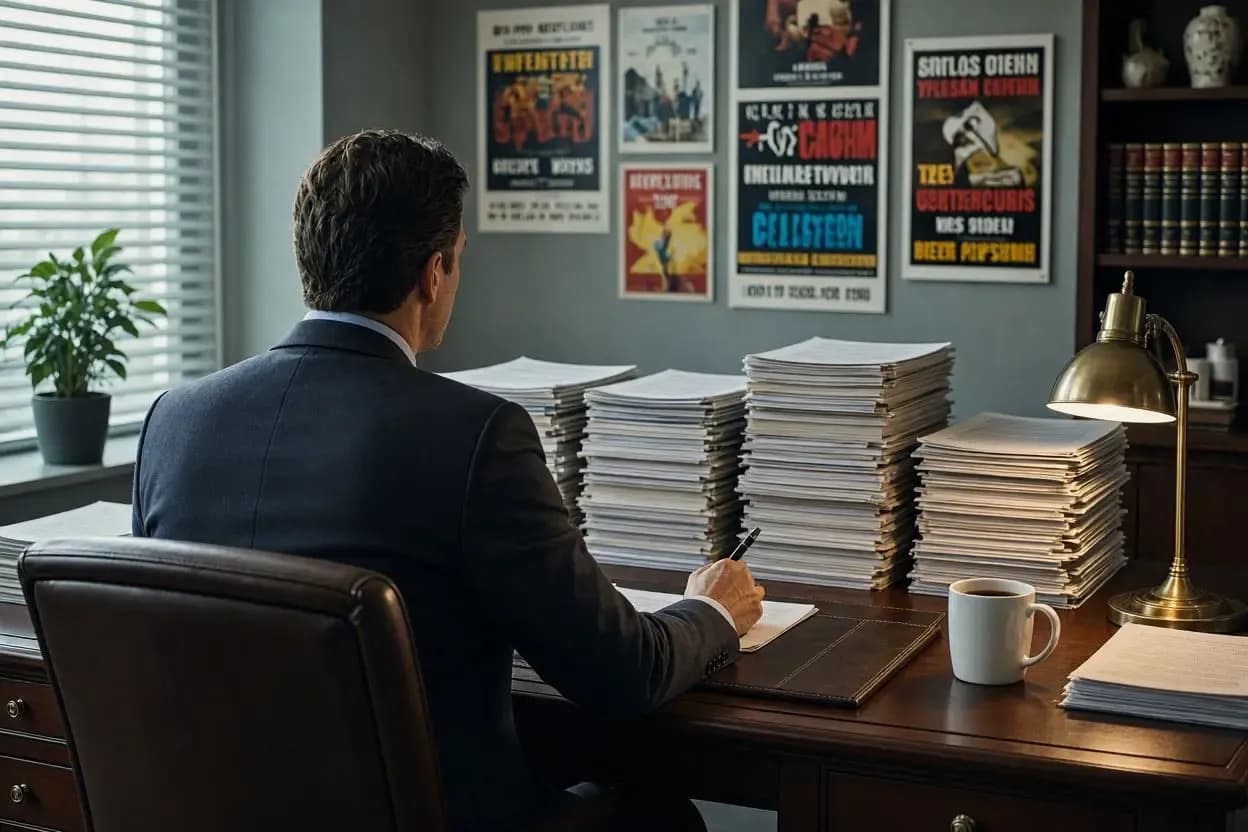
It is Monday morning. Over the weekend, twelve new scripts arrived. Nine more came in the week before. Somewhere in the inbox are scripts that have been waiting since last month, along with a few that have been there even longer. In two hours, the development meeting starts, and there is still a stack of material that nobody has had time to read.
For producers and development executives, this is hardly an unusual situation. The film industry produces an enormous amount of material, while the number of people available to read and evaluate it remains relatively small. Every company develops its own way of dealing with the imbalance, but the underlying problem is the same: there are far more scripts competing for attention than there is time to give them.
That makes the first question in development surprisingly difficult. Before a producer can decide whether a script is good, they have to decide whether they are going to read it at all.
Analyze your script with Poetika
Get instant feedback on your screenplay in minutes.
A production company with an active development slate might receive hundreds of submissions over the course of a year. Larger companies, particularly those with a recognizable producer or director attached, can receive considerably more. The development team, meanwhile, may consist of only a few people, many of whom are also dealing with projects already in progress.
Screenplays are unusually expensive to evaluate in terms of time. A serious read can easily take an hour and a half or more. Once notes, coverage and follow-up conversations are included, the amount of attention required increases considerably. If a script moves into development, that process can involve months of further work.
There is therefore a point at which the arithmetic simply stops working. Even a diligent reader cannot give several hundred scripts the same level of attention.
Some selection has to happen before the full read.
The Filters We Have Built
The industry has developed a number of ways to make that selection, most of them long before anyone thought of using AI.
Relationships are among the most powerful. A script submitted by a trusted agent is likely to be opened before one sent directly by an unknown writer. A recommendation from a director, producer or executive who is already part of the company's network carries an obvious advantage. This is not necessarily because the script itself is considered better. The recommendation simply provides a reason to believe that the material is worth investigating.
The logline is another filter. Before committing an hour or two to a screenplay, someone wants to know what the film is about. Does the premise immediately make sense? Is there an identifiable audience? Does the project fit the company's interests? A strong logline does not guarantee a strong screenplay, but in an environment where attention is scarce, it can determine whether the script gets opened in the first place.
Then there are the opening pages. Ten pages is not a formal rule across the industry, but the idea is familiar: if the writing, characters and dramatic situation do not establish themselves quickly, the reader may not continue.
None of these filters is inherently unreasonable. In fact, they are perfectly understandable responses to a difficult practical problem. The weakness is that they are primarily designed to reduce the amount of material a person has to read. They were never designed to provide a comprehensive method for discovering every promising script.
What Might Never Be Seen
That distinction creates an uncomfortable consequence.
Scripts that arrive through established channels tend to benefit from signals that have little to do with the actual quality of the screenplay. A writer may have an agent, a producer may already know the filmmaker, or the project may come recommended by someone whose judgment is trusted. All of this makes it easier for a busy development team to decide where to look first.
An unknown writer has none of those advantages.
That does not mean independent writers produce weaker material. It means they are asking the reader to take a larger initial risk with their time.
A great screenplay may therefore fail before anyone has had the opportunity to discover that it is great. A writer with an unconventional voice may be dismissed because the first pages do not resemble what the reader expected. A story that takes time to reveal its central idea may never reach the point at which that idea becomes apparent.
The result is not a conspiracy and does not require anyone to behave unfairly. It is what happens when a system is forced to make decisions with incomplete information.
The industry has developed competitions, fellowships, open submission programmes and other initiatives partly to compensate for this problem. These programmes create additional routes into the system, particularly for writers who lack representation or established connections. But they also introduce another practical difficulty: someone still has to read everything.
The bottleneck has not disappeared. It has simply moved.
Where AI Could Enter the Process
This is where AI-based screenplay analysis becomes interesting, not as a substitute for the producer's judgment but as an additional layer between submission and decision.
Imagine a production company receiving several hundred scripts in a year. Instead of asking a reader to begin with a blank page every time, the company could first obtain a structured analysis of each screenplay. The analysis might examine elements such as narrative structure, character development, pacing, dialogue, themes and genre conventions, giving the development team a common set of information before deciding where to invest more time.
That would not tell the producer which film to make.
It could, however, change how the producer decides which script to read next.
This is essentially what a tool such as Poetika is trying to address. Its role is not to produce a definitive judgment on a screenplay. It is to make a large volume of material easier to evaluate at the preliminary stage, when the central problem is not creative decision-making but limited attention.
That distinction is important because there is no reason to assume that an AI system will always recognize a good screenplay. Human readers make mistakes as well, and unusual or unconventional work can be difficult for any analytical system to evaluate. The useful proposition is therefore not that AI can identify the objectively best script. It is that it can provide another source of information before a human reader makes the decision to invest significant time.
A visual screenplay analysis interface mapping narrative structure, emotional development, genre, and audience.
The Producer Still Has to Read the Script
There is a tendency to frame this discussion as a choice between human readers and artificial intelligence. For development departments, that is probably the wrong way to look at it.
A producer's job is not simply to determine whether a screenplay is technically well constructed. They are trying to understand what a project could become. That involves questions that are difficult to reduce to a score: whether the voice feels distinctive, whether the director is the right person for the material, whether the idea fits the company's identity, whether the budget makes sense and whether there is an audience for the finished film.
Those decisions require experience and judgment.
The value of a preliminary analysis is that it can make more room for those decisions. If a producer can spend less time sorting through material that is clearly not ready for development, more of their attention can go toward the scripts that warrant a closer look and, eventually, toward the writers behind them.
In that sense, the objective is not to read less. It is to make the time spent reading more valuable.
A Different Development Workflow
The development office of the future may not look dramatically different from the one we have now. There will still be producers reading scripts, writers rewriting them, directors discussing ideas and executives deciding which projects deserve another round of development.
What may change is what happens before those conversations begin.
Instead of relying almost entirely on relationships, loglines, reputation and a quick look at the opening pages to determine which material receives attention, companies could introduce a more systematic preliminary assessment. The human reader would still make the final call, but that decision would be made with more information and, potentially, after a much larger proportion of the available material had been considered.
For independent filmmakers and writers, this could be particularly significant. One of the industry's persistent problems is not necessarily a shortage of strong material. It is the difficulty of finding that material among everything else.
Technology cannot remove the subjective nature of filmmaking, and it should not try to. There will always be stories that divide opinion, scripts that need another draft and projects whose potential is invisible until the right filmmaker becomes attached.
But if AI can help a development team process more material before scarce human attention is committed, it changes one important part of the equation.
Hundreds of scripts are going to keep arriving on Monday morning. The question is whether the development office has a better way of deciding which ones deserve to be opened.
Christopher Nolan's The Odyssey may be his biggest production yet, but it also feels like the inevitable destination of a career built around memory, time, and the impossible journey home.
Every few years, a beloved novel gets adapted into a film. The announcement generates excitement; finally, that book is becoming a movie. And then, more often than not, something goes wrong. The film arrives and feels thin, rushed, or strangely hollow. The characters who felt so vivid on the page seem flat on screen. The story is technically all there, but whatever made the book extraordinary has somehow failed to survive the journey.
Ask ten screenwriters what "script coverage" means, and most will give you the same answer: a reader's report that determines whether a screenplay receives a Pass, Consider, or Recommend.
They're not wrong. But they're only describing the industry's most familiar form of coverage. Behind the scenes, many other types of coverage quietly influence whether a screenplay gets made, who joins the project, how much it costs to produce, and whether it creates legal or financial risks.