To write a TV pilot, you design a series before you write an episode: a story engine that can generate conflict week after week, characters whose friction will not run out, an arena that forces them together and a format that fits a real platform. Then you write a first episode that does two jobs at once. It tells a complete, satisfying story on its own, and it proves to a reader that this world can keep producing stories for seasons.
Spoiler note: this post discusses the pilot episodes of Breaking Bad, Succession and Ted Lasso, including how the Succession pilot ends.
That double job is what separates a pilot from a feature. This guide walks through the process, from testing your series idea to typing FADE OUT on the first episode, with a checklist at the end.
How is a TV pilot different from a feature screenplay?
Ask what the ending does. A feature builds toward a climax that resolves the protagonist's central problem. A TV idea sets up a problem that can be tested and reshaped for years without being solved.
- Feature: a finite arc. One central conflict, one dramatic question, one ending that answers it.
- TV series: an engine. A situation that keeps producing new conflicts, with characters who change slowly or in cycles.
- Feature protagonist: usually transformed by the end. The character arc is the shape of the film.
- Series protagonist: tested again and again; some change across seasons, others stay recognizably themselves.
The pilot sits at the start of that engine. It usually takes a world in balance, disrupts it with an inciting incident, and leaves the characters in a new normal that will keep testing them. In Breaking Bad (2008), Vince Gilligan's pilot takes a mild chemistry teacher, gives him a terminal cancer diagnosis and ends with him committed to cooking methamphetamine with a former student.
What is a story engine, and why does a pilot need one?
A story engine is the mechanism that generates episodes. If a reader finishes your pilot and cannot imagine what episode five is about, the engine is missing. Most engines fall somewhere between two poles.
Procedural engines
In a procedural, each episode brings a new case or problem that is solved by the end. Law & Order (1990) built its engine on a fixed two-part shape: the police investigate a crime in the first half, the prosecutors try the case in the second. Columbo used an inverted mystery, showing the murder first, so every episode became a contest of wits between the lieutenant and a killer the audience already knew.
Serialized engines
In a serialized show, one continuous story carries across episodes and seasons. Succession (2018), created by Jesse Armstrong, runs on a single question: who will take over Logan Roy's media empire? The pilot is set on Logan's birthday, when his son Kendall expects to be named successor and Logan reverses course. The episode ends with Logan collapsing, which throws the question wide open.
Hybrid engines
Most modern shows mix the two. A case-of-the-week structure carries a slower serialized thread, or a serialized drama gives each episode its own contained mission. Spain's Money Heist (La Casa de Papel, 2017) follows one long robbery of the Royal Mint, but individual episodes still turn on their own crises inside the building. Decide where on this spectrum you sit, and make sure the pilot shows it.
The arena
An engine needs a place to run. The arena is the compressed environment where your characters are forced to collide: a hospital, a newsroom, a crime family, a restaurant kitchen, a small town. The Bear (2022) puts a fine-dining chef in his late brother's chaotic Chicago sandwich shop, where the kitchen produces pressure every day. Dark (2017) uses the German town of Winden, where a child's disappearance exposes connections between families across generations. If your arena would stop producing stories without the main plot, it may be a movie.
How do you build characters that last for seasons?
Feature characters need to sustain two hours. Series characters may need to sustain a hundred episodes, which changes how you design them.
- Built-in friction. The strongest series pair characters whose goals or values clash in ways that will never fully resolve. Walter White and Jesse Pinkman need each other and cannot stand each other. In Ted Lasso (2020), an endlessly optimistic American coach meets Roy Kent, a fading, furious captain who has no time for him.
- Wants that can't be satisfied quickly. If a character's goal can be achieved in one episode, it is a plot, not a series. Logan Roy's children want his approval and his empire; neither will be given freely.
- Secrets and wounds. A hidden truth gives a series slow-burning tension. The Ted Lasso pilot lets the audience in on the fact that the club's owner, Rebecca Welton, hired Ted hoping he would fail, as revenge on her ex-husband. That secret powers much of the first season.
- A distinct point of view for each regular. In an ensemble, every main character should represent a different attitude toward the story's central question. If two characters would react to every situation the same way, merge them.
A useful test: write one sentence per regular stating what they want, fear and hide.
How do you write a logline for a TV series?
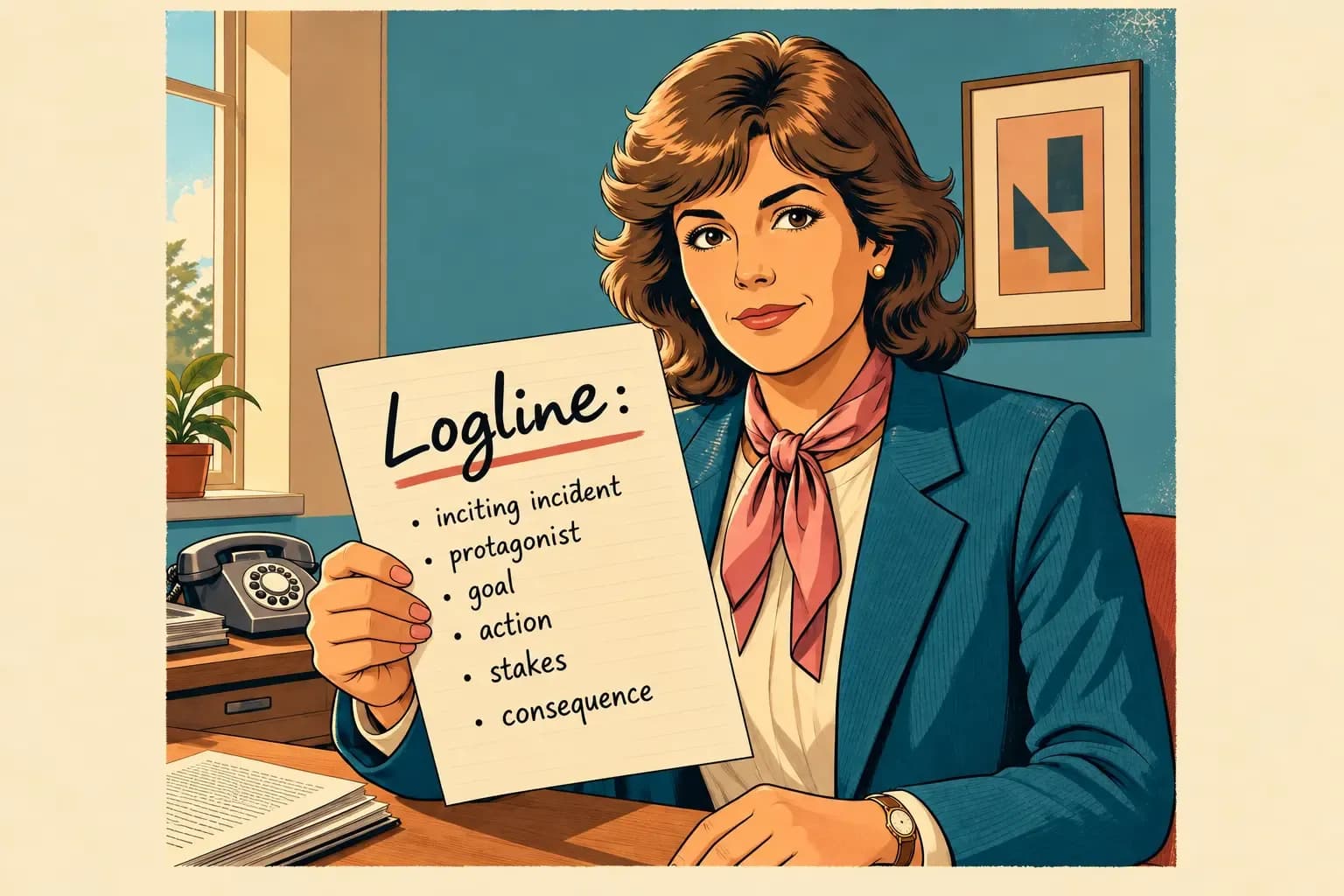
Before you write the pilot, you should be able to state the series in one or two sentences. A TV logline names the protagonist, the event that disrupts their life, the arena, and the ongoing conflict that will drive the show. It describes the series, not only the first episode.
- Protagonist: who we follow, defined by what makes them interesting in this situation.
- Catalyst: what changes in the pilot.
- Arena: where the conflict lives.
- Engine: what keeps the conflict going.
Squid Game (2021), created by Hwang Dong-hyuk, can be summed up in one line: a man drowning in debt joins hundreds of other desperate players in a contest of children's games for a huge cash prize, where losing means death. The engine (another game, another elimination) is obvious.
Writers often add an "X meets Y" comparison to signal tone; used lazily, it suggests the idea has no identity of its own. Our guide to how to write a logline covers the craft in detail, and a strong high-concept premise makes the job much easier.
Which format is your show: half-hour, one-hour or limited series?
Format shapes everything from page count to structure, so decide it before you outline.
- Half-hour comedy: pilots usually run about 25 to 35 pages. Traditional network sitcoms often use a cold open, two or three acts and a short tag.
- One-hour drama: pilots usually run about 50 to 65 pages. Shows written for ad-supported networks traditionally use a teaser plus four to six acts, each ending on a turn that brings the viewer back after the break.
- Streaming series: no commercial breaks, so formal act breaks are optional, though many writers still structure in movements. Episode lengths vary more.
- Limited series: a closed story told over a set number of episodes. The pilot still needs an engine, but the reader should sense an ending.
Length expectations for every format are collected in how many pages a screenplay should be.
How do you structure a TV pilot episode?
There are two broad kinds of pilot.
- Premise pilot: the episode shows how the series situation begins. Breaking Bad is a premise pilot: we meet Walter before his diagnosis and watch the decision that creates the show.
- Non-premise (or situation) pilot: the episode drops us into the world as it already runs, as a typical episode would. Many procedurals and workplace comedies work this way, because the situation needs no origin story.
Premise pilots risk spending the whole episode on setup; non-premise pilots must still introduce everyone. Either way, a pilot usually moves through the same stages:
- Open with a hook. The cold open or teaser should tell the reader what kind of show this is. Breaking Bad opens with a man in his underwear driving an RV through the desert, a flash-forward that makes the reader ask how a chemistry teacher got there.
- Establish the world and its normal. Show the protagonist's life and the arena quickly, through action rather than explanation.
- Disrupt it. The inciting event arrives early, often within the first act.
- Escalate. Each act break should turn the situation, raising the stakes or revealing something new.
- Land the episode. Resolve the episode's own story so the reader feels satisfied.
- Open the series. End on the new normal, a reveal or a decision that makes the next episode feel necessary.
The last two steps are the pilot's balancing act. A pilot that resolves everything feels like a short film. A pilot that resolves nothing feels like a trailer.
Writing the pilot script: practical steps
Once the engine, characters, logline and format are clear, a few TV-specific habits help.
- Outline first. Break the episode into acts and scenes before drafting.
- Introduce characters through behavior. You have many regulars to establish in little space. Give each one an entrance that shows who they are in a single action or line.
- Resist exposition. Pilots are notorious for characters explaining the world to each other. Trust the reader to pick up rules from what happens.
- Write the voice of the show. Tone is a large part of what a pilot sells. Fleabag (2016) grew out of Phoebe Waller-Bridge's one-woman stage show, and its direct address to the camera tells the reader in the first page how this series will feel.
- Get a cold read. You know your world too well to see what is missing.
A structured analysis can help at this stage. Poetika reads your uploaded script and returns coverage-style feedback, including a logline, a synopsis and notes on structure, character and dialogue, so you can see whether the story you meant to tell is the one on the page before a producer or a contest reader sees it.
What goes in a series bible and pitch materials?
The pilot proves the show works on the page; the supporting documents prove it can last. Writing them also sharpens the pilot.
- Series overview: the logline, the premise and the tone in a page or two.
- Characters: each regular, with what they want, their central conflict and where they might go over the season.
- World and rules: how the arena works, especially for genre shows with their own logic.
- Season roadmap: how the first season unfolds and where it ends, plus a sense of later seasons.
- Episode ideas: short springboards that show the engine producing stories.
The way you present a series to buyers also differs from how you pitch a film, which we cover in TV pitch vs. movie pitch. If you are deciding between writing an original pilot or a spec episode of an existing show, see what a spec script is.
Where a pilot fits in a screenwriting career
For many writers, an original pilot is the main sample for getting representation, applying to fellowships or staffing on a show, because it shows your voice and your ability to sustain characters. Our guide to building a sustainable screenwriting career looks at how samples like these fit into a longer plan.
TV pilot checklist
- I can describe the series in one or two sentences that include protagonist, catalyst, arena and engine.
- I know whether the show is procedural, serialized or a hybrid, and the pilot shows it.
- The arena would generate stories even without the main plot.
- Each regular has a want, a fear and a secret, and they clash with each other.
- I chose a format and the page count fits it.
- The episode resolves its own story.
- The ending creates a new normal that demands a next episode.
- I can pitch five more episodes from memory.
FAQ
How long should a TV pilot be?
A half-hour pilot usually runs about 25 to 35 pages, and a one-hour pilot about 50 to 65 pages. Comedies, especially multi-camera sitcoms, can have more white space per page. Staying within the range of comparable shows matters, because an overlong pilot suggests the writer has not yet found the episode inside the idea.
Should my pilot be a premise pilot?
Not necessarily. A premise pilot shows how the series situation begins and gives a strong dramatic arc, as in Breaking Bad. A non-premise pilot shows the world already running, which suits procedurals and workplace comedies. Choose the one that best demonstrates your engine and your characters in a single episode.
Do I need a series bible to submit a pilot?
Most contests, fellowships and representatives ask for the pilot script first, sometimes with a short overview. A full bible is usually requested later, if someone is interested. Writing a short version anyway is worthwhile, because working out the season roadmap and episode ideas often reveals weaknesses in the pilot.
Can I write a pilot for an existing show?
A script for an existing show is a spec episode, not a pilot. Spec episodes are good practice for capturing someone else's voice, but most agents, managers and showrunners now prefer original pilots as samples, because they show your own world, characters and tone rather than an imitation.
How many acts does a TV pilot have?
It depends on the format. Network half-hour comedies often use two or three acts with a cold open and tag, while network one-hour dramas traditionally use a teaser plus four to six acts. Streaming shows have no commercial breaks, so act breaks are optional, though most writers still build the episode in clear movements.
Ready to test your pilot on a cold reader? Upload your script to Poetika for a structured analysis of its story, structure and characters.