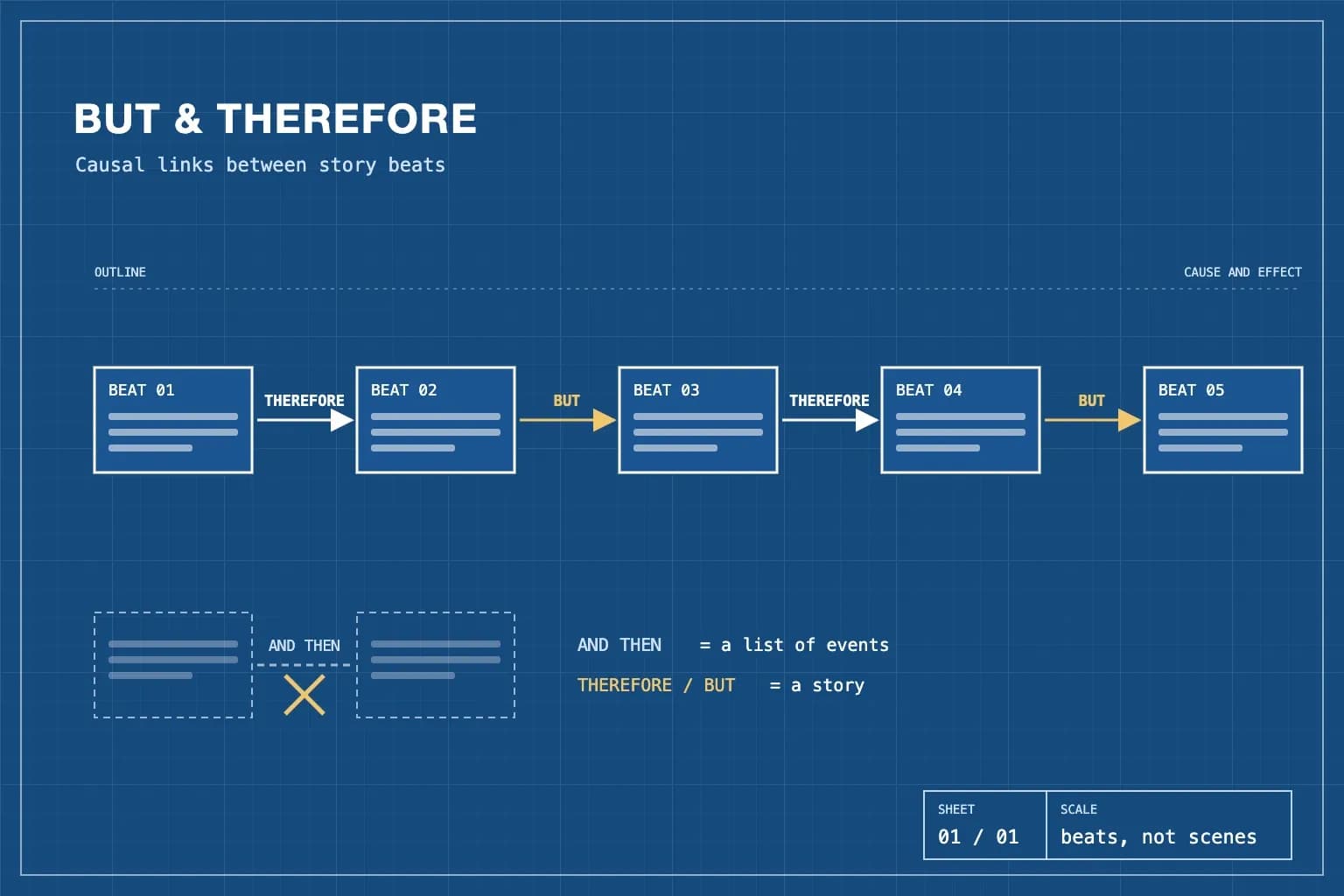
What Is the “But and Therefore” Rule in Screenwriting?
Why some scripts drag even when every scene works, and how Trey Parker and Matt Stone's “therefore or but” test finds the weak joints in an outline.
May 12, 202612 min
Read 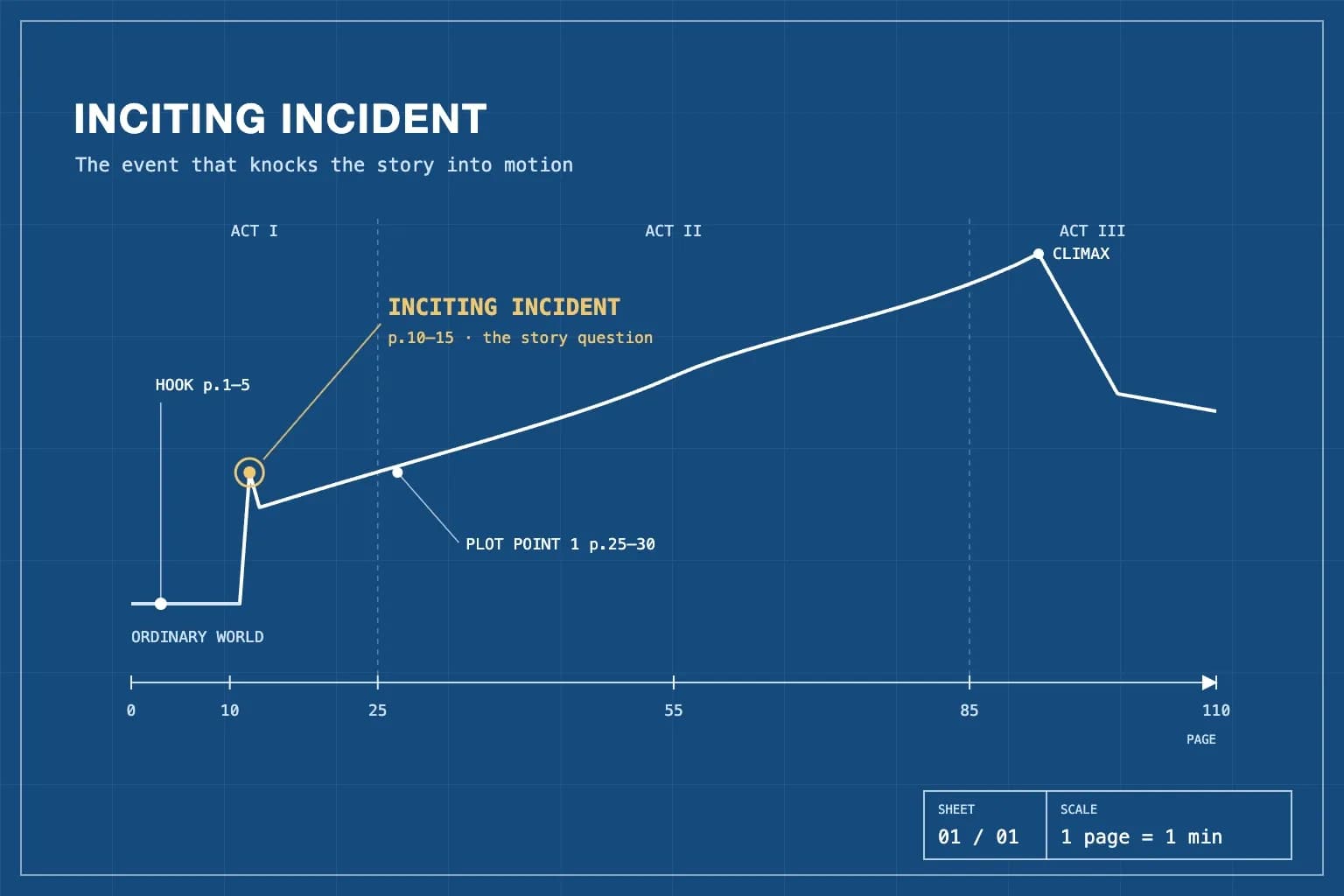
The inciting incident is the event that knocks a protagonist's life out of balance and sets the story in motion. Before it, the character lives in a world that more or less works; after it, something has to be done, and the rest of the screenplay is the story of what they do. A shark kills a swimmer off Amity Island. A message from a captured princess turns up inside a droid. A ten-year-old girl's parents eat food that isn't meant for them and turn into pigs.
Almost every screenwriting book describes this moment, under one name or another. Robert McKee calls it the inciting incident, Blake Snyder calls it the catalyst, and Joseph Campbell's hero's journey calls it the call to adventure. The labels differ, but the job is the same: to give the story its question. This guide explains what an inciting incident is, how it differs from the moments around it, where it usually falls in a feature script, and how to write one that a reader cannot ignore.
An inciting incident is a single event, early in the story, that changes the protagonist's situation so much that they can no longer carry on as before. It creates the central problem or desire of the story and raises the dramatic question the ending will answer: will Brody stop the shark, will Chihiro save her parents, will Clarice catch the killer?
Three things make an event an inciting incident rather than just something that happens:
Without an inciting incident there is no story, only a situation. A screenplay can introduce a vivid world and an interesting protagonist, but until something disrupts that world, the reader has nothing to follow. The inciting incident turns a portrait into a plot.
It also tells a script reader what kind of film they are reading. A body on the beach promises a thriller; a chance meeting at a wedding promises a romance. When the inciting incident arrives late, or is unclear, readers often describe the opening as "slow" even when the writing is good, because they don't yet know what the story is about. That is why it shows up in almost every list of common screenplay mistakes.
Finally, the inciting incident is the root of your logline. "When a great white shark starts killing swimmers in a beach town, a police chief who is afraid of the water must hunt it down" is an inciting incident plus a protagonist plus a goal. If you can't name your inciting incident, writing the logline will be hard.
These three moments sit close together in the first act, and writers often mix them up.
Here is how they line up in a feature screenplay, using Star Wars (1977) as the example:
The hook can happen without the protagonist (Jaws opens with a victim, not with Brody). The inciting incident happens to the protagonist, or reaches them directly. The first plot point, or "break into two", is the protagonist's decision: the moment they stop resisting and step into the story. Some writers treat the hook and the inciting incident as one event, and in tightly built thrillers they often are.
In a feature film the inciting incident usually comes in the first 10 to 15 percent of the running time. In a 100- to 110-page screenplay, that means somewhere between pages 10 and 15. Blake Snyder's Save the Cat! beat sheet places the catalyst on page 12, and many produced scripts land close to that.
These numbers are guidelines, not rules:
For TV pilots the logic is the same but compressed: the inciting incident often arrives in the teaser or the first act. If you are unsure how long your script should be overall, see our guide to screenplay length.
Inciting incidents come in many forms. A few common types:
Whatever the type, the event should be visible. Readers and audiences experience a screenplay through what happens on the page, so an inciting incident that exists only in a character's head needs an outward form.
Notice that in each case the event is specific, it happens to the protagonist, and it raises a question the film spends the rest of its running time answering. Many of these moments also set up the protagonist's character arc: the event creates the pressure that will force the character to change.
The inciting incident disrupts something, so you need to show what it disrupts. Give the reader a few pages of the protagonist's routine, their wants and the flaw that keeps them stuck. The sharper the ordinary world, the harder the inciting incident hits.
Ask what single event would make this particular character's life impossible to continue. The best inciting incidents are tailored to the protagonist: a shark is terrible for anyone, but especially for a police chief who is afraid of the water.
If the event could be ignored for a while, the story will stall. Raise the stakes or the time pressure so that the protagonist has to react now, even if the first reaction is refusal. From here on, each scene should follow from the one before it, linked by a "but" or a "therefore" rather than an "and then", which is the idea behind the but and therefore rule.
After the inciting incident, the reader should be able to state what the story is about in one line. "Will Chihiro get her parents back?" If you can't phrase the question, the event may be too vague, or it may be a complication rather than the inciting incident.
Read your first fifteen pages and mark the page where the disruption happens. If it is after page 15 in a feature, ask whether the pages before it are doing enough work. Often a late inciting incident means the setup can be shortened, not that the event should be rewritten.
A structured outside read is one of the quickest ways to test these questions. When you run your screenplay through Poetika, the analysis looks at structure and pacing, including how early the story question arrives, and shows where the first act is losing momentum.
Yes, in practice. "Catalyst" is Blake Snyder's term in Save the Cat!, "inciting incident" is the older term used by Robert McKee and most screenwriting teachers, and "call to adventure" is the hero's journey equivalent. All three describe the event that sets the story in motion.
Sometimes the cause lies in the past, but the inciting incident should still happen on screen. A film can begin after a murder, for example, with the discovery of the body or the detective being assigned to the case as the event we see.
A story has one central inciting incident, but subplots can have their own. In ensemble films, each main character may have a personal inciting incident, usually tied to one shared event, such as the pageant phone call in Little Miss Sunshine.
In a feature screenplay, usually between pages 10 and 15. Genre films can go earlier and slower dramas a little later. What matters more than the page number is that the opening pages hold the reader's attention until the disruption arrives.
The inciting incident is the event that creates the problem; the first plot point is the protagonist's decision to act on it, which ends the first act. In Star Wars, Luke finds Leia's message (inciting incident) but leaves Tatooine only after his family is killed (first plot point).
Why some scripts drag even when every scene works, and how Trey Parker and Matt Stone's “therefore or but” test finds the weak joints in an outline.
Think of a film that stayed with you long after the credits rolled. Not because of its plot twists or visual effects, but because of what happened to the person at its center. The way they started as one thing and ended as something else or the way the story made you desperately wish they had. That experience has a name: character arc. And it is the single most important structural element separating characters who feel alive from characters who merely function.
There is a moment every screenwriter knows. The script is almost finished. The story has built, the characters have struggled, the themes have accumulated. And then comes the final scene the moment that will determine how every scene before it is remembered.
Explore a complete sample analysis and understand the feedback format.