🎬
The Screenwriter's Glossary: 37 Essential Terms Every New Writer Must Know
A complete reference for the vocabulary of the craft from the first slug line to the final fade out.
May 21, 202423 min
Read A working title is the temporary name a film, screenplay, book or song carries while it is being written or produced, before the final title is decided. It lets everyone involved refer to the project, and it can be kept, changed or replaced by a completely different title before release. Annie Hall was written as Anhedonia, Alien began as Star Beast, and Scream was sold as Scary Movie.
For a screenwriter, the working title is usually the name on the first draft's title page. For a studio, it can be a placeholder or even a deliberate disguise. This guide explains what a working title is, how it differs from a final and an alternate title, why titles change so often, and how to choose a strong one for your own screenplay.
A working title is a provisional name. The word "working" means the same thing as in "working draft": it is good enough to work with, but nobody has promised it is final. In film production, the working title appears on call sheets, contracts, budgets and trade announcements until the release title is locked.
A working title can be:
In each case, the working title does its job if it lets people talk about the project. Whether it is the right title is a question answered later.
Writers need a name for the file and the title page. Committing to a "perfect" title before the story exists is a good way to stall, so most writers pick something serviceable and move on; the real title often becomes clear only after a few drafts.
Studios and producers use working titles for practical reasons:
The three terms sit at different points in a project's life:
A film can have all three. Blade Runner (1982) was developed under working titles including Dangerous Days, released as Blade Runner, and adapted from Philip K. Dick's novel Do Androids Dream of Electric Sheep?. Like many terms in the screenwriter's glossary, the distinction sounds obvious until you are filling in a festival form that asks for "original title" and "English title" on separate lines.
Titles change for many reasons, and few of them have to do with the writer doing something wrong:
Some of the most famous films in history were nearly released under other names. Annie Hall (1977) carried the working title Anhedonia, the clinical term for the inability to feel pleasure. Dan O'Bannon's script that became Alien (1979) was originally titled Star Beast. Casablanca (1942) was adapted from an unproduced play called Everybody Comes to Rick's. E.T. the Extra-Terrestrial (1982) was prepared under the title A Boy's Life, which also helped keep the project's subject quiet.
The change can also go the other way. During production, Snakes on a Plane (2006) was briefly given the blander title Pacific Air Flight 121. Samuel L. Jackson, who had said he signed on because of the original title, pushed for it to be restored, and it was.
Television works the same way. Before Friends (1994) settled on its title, the show went through working titles such as Insomnia Cafe, Friends Like Us and Six of One.
Large franchise films often shoot under titles chosen to mean nothing at all. The best-known example is Return of the Jedi (1983), which used the fake title Blue Harvest, presented as a horror film, to keep location costs down and avoid attention. Christopher Nolan shot The Dark Knight (2008) under the title Rory's First Kiss, which did little to fool the fans who spotted the Batmobile on the streets of Chicago.
These codenames are a production tool, not a creative choice, and a spec writer will never need one.
A film's release title can also change from one country to another, for reasons of language, culture or confusion with an existing work:
Working titles are not unique to film. Jane Austen's first version of Pride and Prejudice was called First Impressions. George Orwell's working title for Nineteen Eighty-Four was The Last Man in Europe. In music, Paul McCartney famously used the placeholder title "Scrambled Eggs" for the melody that became "Yesterday".
It needs a usable one, and it helps if it is good. A script reader sees your title before anything else: on the cover page, in a contest list, in a query email, at the top of the coverage they write. A strong title sets expectations about genre and tone before page one. A weak or generic one does not ruin a script, but it gives the reader nothing to hold on to. If you are unsure what a reader notices first, our guide to what a script reader does explains the process.
It is also worth remembering that if your script sells, the title may change anyway. Writers who sell a screenplay often see it released under a different name. That is not a reason to stop caring about your title; it is a reason not to treat it as untouchable.
Look for the idea or image the whole story turns on. Jaws, Alien and Parasite each name the threat at the centre of the film. Casablanca names the place everyone is trying to leave. A title drawn from the core of the story tends to survive rewrites, because the core usually does.
Most memorable film titles are one to three words. Short titles are easier to remember and to say. Specific beats generic: Whiplash tells you more than "The Drummer" would.
A title that names the twist, the death or the final reveal takes something from the reader before they start. Point at the story's question, not its answer.
Pitch the title in a sentence: "I've written a thriller called..." If it is hard to pronounce, easy to mishear or embarrassing to say, it will be hard to pitch. Reading your title aloud next to your logline is a quick test of whether the two promise the same film.
Whether you keep your working title or replace it, a strong title usually does several of these things at once:
On a standard screenplay, the title appears on the title page, centred horizontally and placed roughly a third of the way down the page, usually in capital letters. Below it go "Written by" (or simply "by") and the writer's name. Contact details, such as an email address and phone number or your representative's details, sit in the lower left or lower right corner.
For a spec script, keep the title page clean: no images, no logos, no quotes, and usually no draft numbers or dates. The title is the only creative element on the page, so it carries more weight than writers expect. For the rest of the layout, see our guide on why screenplay format matters, and use the same title consistently on your screenplay synopsis and any submission materials.
A title can only promise what the screenplay delivers. If you want to know whether your story's genre, tone and structure land the way your title suggests, you can run your screenplay through Poetika for a structured analysis of the whole script, from logline and synopsis to structure and character.
A working title is the temporary name used for a film, screenplay, book or song while it is being created. It lets writers, producers and crews refer to the project. It may become the final title, or it may be replaced before release, sometimes by a completely different name chosen by the distributor or marketing team.
Big productions use fake working titles to avoid attention while filming. A neutral codename on signs and call sheets makes it harder for fans and press to identify the project and can keep location costs down. Return of the Jedi was shot as Blue Harvest, and The Dark Knight as Rory's First Kiss.
In the United States, titles generally cannot be protected by copyright, because short phrases and names are not covered. Your screenplay as a whole is protected, but someone else may use the same title. Studios check titles for legal conflicts and trademark issues before release, so it is wise to search for existing films with your title.
Change it if it is generic, misleading about genre or hard to say. Otherwise, a solid working title is fine to submit; buyers expect that titles may change later. What matters most is consistency: use the same title on the script, the synopsis and every query or contest entry, so readers can track it.
No. A working title is used before release, during writing and production. An alternate title is used alongside the release title, usually in another country, language or format, such as Harry Potter and the Sorcerer's Stone in the United States. A film can have several of each over its life.
A complete reference for the vocabulary of the craft from the first slug line to the final fade out.
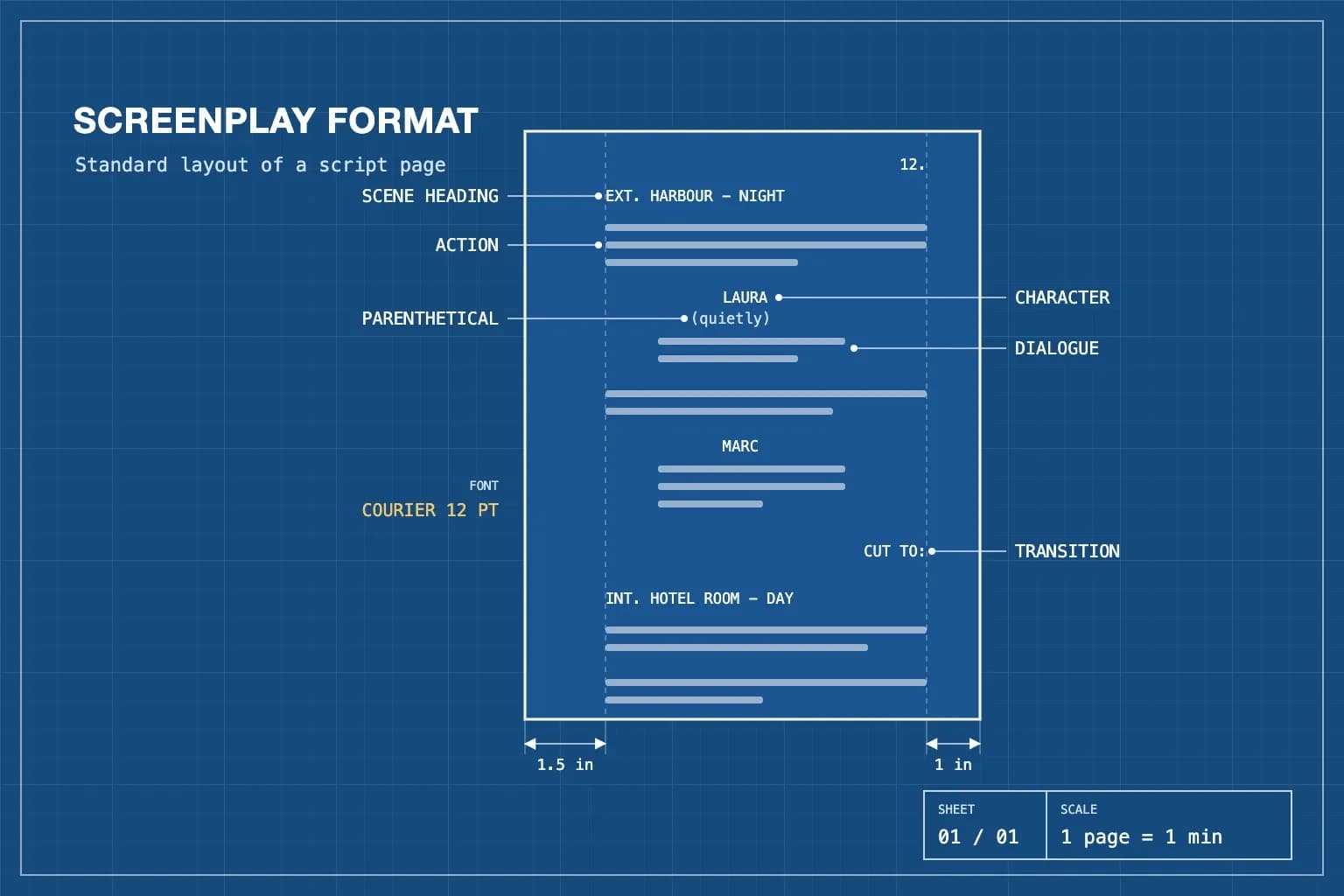
Screenplay format is more than a set of rules. Here is how it signals professionalism, feeds production planning and shapes the read, plus a checklist to get it right.
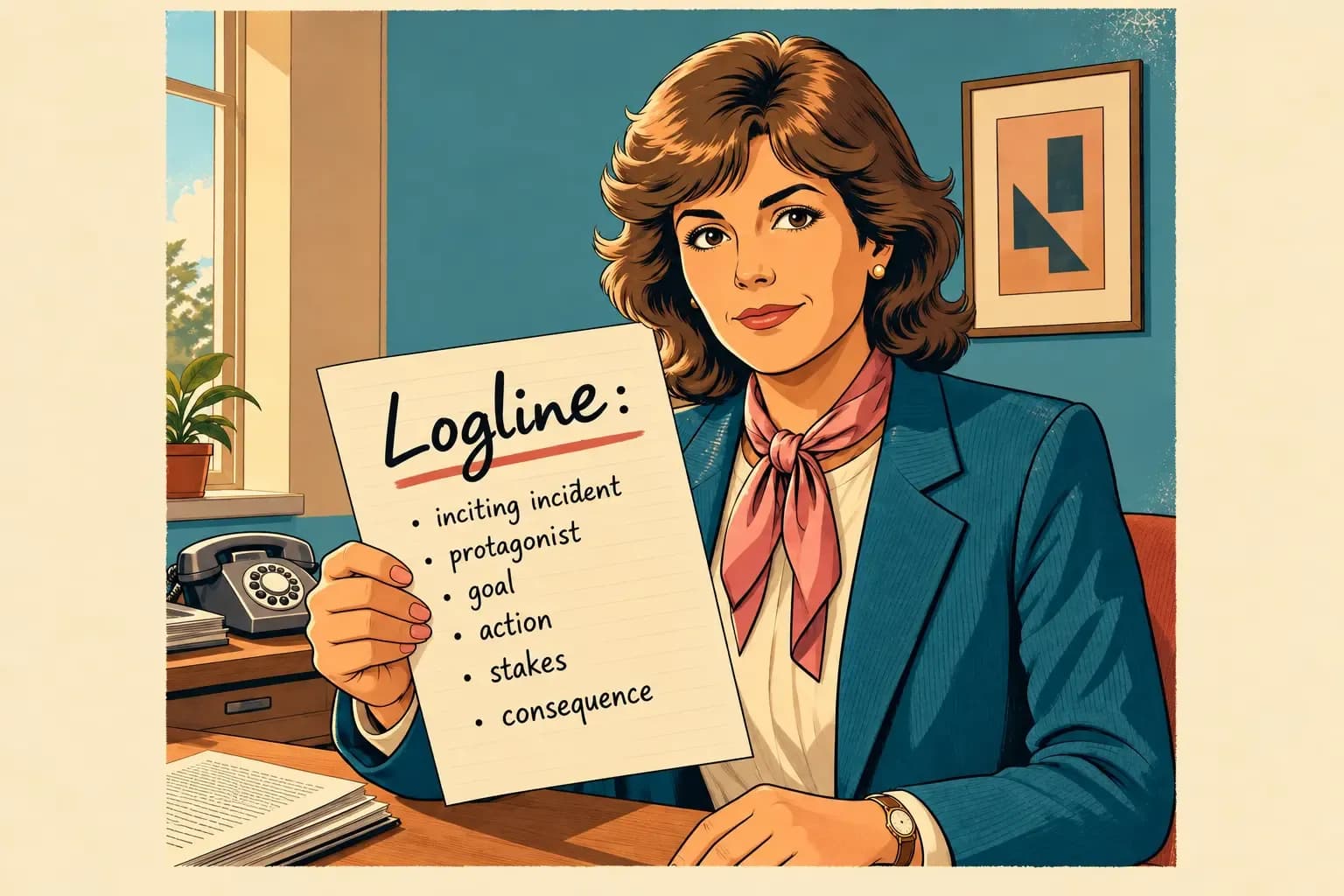
One sentence stands between your screenplay and the desk it lands on. Here's how to make it count.
Explore a complete sample analysis and understand the feedback format.