When you send a screenplay to an agency, a production company or a contest, the first person to read it is rarely the producer or the agent you addressed it to. It is usually a script reader: a professional whose job is to read submissions, summarize them and recommend which ones deserve a closer look. Their report decides whether your script moves up the ladder or stops on the first rung.
Script readers are sometimes called story analysts, especially in studios, and their written reports are called coverage. This guide explains what a script reader does, where readers work, what they look for on the page, how they differ from consultants and editors, and what that means for the way you write and submit your screenplay.
What is a script reader?
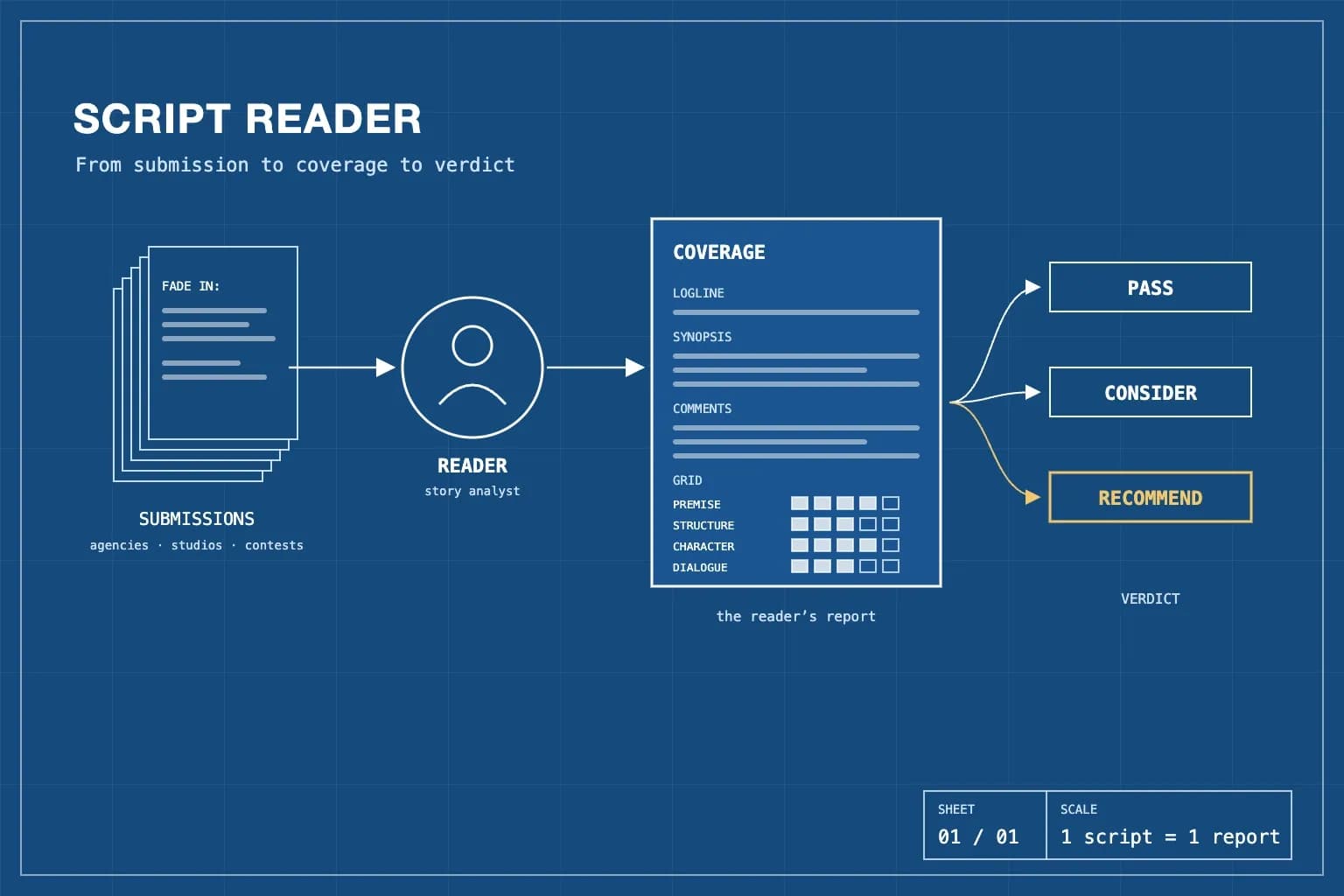
A script reader is a person who reads screenplays on behalf of someone else and reports on them. That someone may be a producer, a development executive, an agent, a manager, a studio, a fund or a screenwriting competition. The reader's job is to save that person time: to read many scripts closely, filter out the ones that are not ready or not right, and flag the ones worth reading in full.
A reader is not the final decision-maker. They don't buy scripts or sign writers. But because decision-makers rarely have time to read everything themselves, the reader's verdict often decides whether a script gets a second read at all.
What does a script reader do?
Most of a reader's work is reading and writing. For each screenplay, a reader typically:
- Reads the whole script, usually in one sitting, paying attention to story, structure, character, dialogue and format.
- Writes a logline: a one- or two-sentence summary of the story. (If they struggle to write one, that is already a note. See how to write a logline.)
- Writes a synopsis, usually a page or two, summarizing the plot from beginning to end. Your own synopsis is a different document, written to sell; the reader's synopsis is written to report.
- Writes comments: an assessment of the script's strengths and weaknesses, from premise and structure to characters, dialogue, pacing and marketability.
- Gives a verdict, usually pass, consider or recommend, sometimes with separate verdicts for the script and for the writer.
Together, these pieces are called coverage. Many readers also fill in a ratings grid that scores elements such as premise, structure, characters and dialogue on a scale from poor to excellent.
Where script readers work
- Production companies and studios. Readers cover submissions and projects the company is considering, from original specs to books that might be adapted. In US studios, staff story analysts are a recognized job category.
- Talent agencies and management companies. Readers help agents and managers decide which writers to sign and which scripts to send out.
- Screenwriting contests and fellowships. Large competitions rely on teams of readers for the early rounds. A contest's first-round reader is, in effect, your first audience.
- Film funds, labs and broadcasters. Public funds and development labs use readers or committee members to assess applications.
- Coverage services and consultants. Writers can also pay for coverage before they submit, to see their script through a reader's eyes. These services vary widely in depth and purpose; not all script coverage is the same.
Many readers work freelance and read for several companies or contests at once. Reading is also a common entry-level job in development: plenty of producers and executives started by covering scripts.
What is script coverage?
Coverage is the reader's report. It usually runs a few pages and follows a template set by the company. A typical coverage report contains:
- Header: title, writer, genre, page count, setting, period and sometimes budget level.
- Logline: one or two sentences summarizing the story.
- Synopsis: a short plot summary from beginning to end.
- Comments: the reader's analysis of what works and what doesn't.
- Grid: ratings for premise, structure, characters, dialogue and so on.
- Verdict: pass, consider or recommend.
Producers use coverage to decide what to develop, a process described in more detail in how script coverage helps producers decide. For writers, a coverage report is one of the clearest pictures of how their script reads to a stranger.
What readers look for in a screenplay
Every reader has their own taste, but most look for the same core qualities:
- A clear, compelling premise. Can the story be summed up in a sentence that makes someone want to read it?
- A protagonist with a goal. Who is the story about, what do they want, and what stands in their way? A passive protagonist is one of the most common reasons for a pass.
- Structure that holds. Does the story start early enough, build through the middle and pay off at the end? Readers notice when the inciting incident comes late or the second act sags.
- Characters who feel real. Distinct voices, believable motivations, people who change or are tested.
- Dialogue that does more than one job. Lines that reveal character and move the story, rather than explaining the plot.
- Professional format and a reasonable length. Format errors and a 150-page draft tell a reader the writer is new before the story has a chance. See how many pages a screenplay should be.
- Market fit. For a production company, is this a film they could make? For an agency, is this a writer they could sell?
Readers often read several scripts a day, so the first ten pages carry extra weight. A reader who is not engaged by page ten will usually still finish the script, but they are reading for reasons to pass rather than reasons to recommend.
How a reader's verdict shapes your script's journey
- Pass means the script stops there. The company is not interested in this draft, though a strong writer may still be noted for the future.
- Consider means the script has real strengths and deserves a read by someone more senior, often with reservations.
- Recommend is rare. It means the reader believes the company should pursue the script or the writer.
Some coverage gives two verdicts: one for the script and one for the writer. A "pass on script, consider on writer" can still open doors, because it means the reader saw talent even if this story is not right for the company.
Because a pass is final for that draft at that company, many writers wait to submit until they are confident the script is ready. Once a company has passed on a script, sending it back with small changes rarely works.
Script reader vs. script consultant vs. script editor
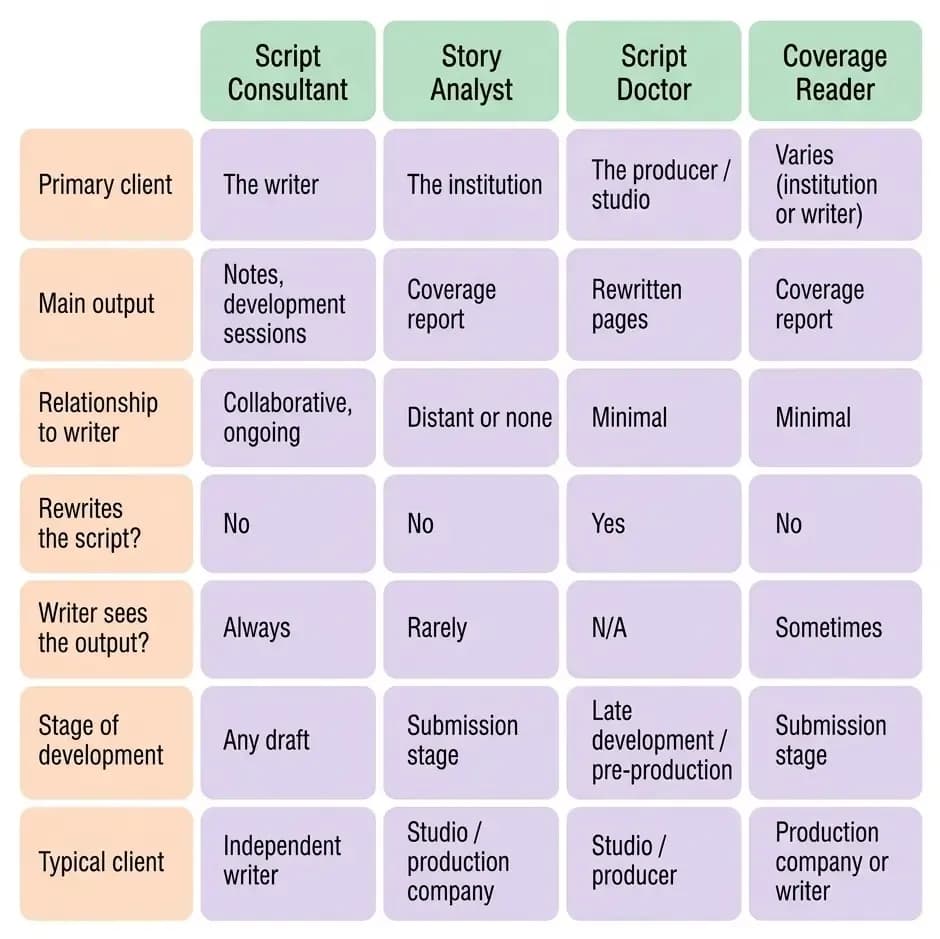
- Script reader or story analyst: works for the company, agency or contest, and evaluates the script to recommend whether to pursue it.
- Script consultant: works for the writer, diagnosing problems and suggesting how to fix them.
- Script editor: works with the writer during development, through successive drafts.
- Script doctor: works for the production, rewriting parts of a script, often late in development.
The key difference is who the reader works for: a reader serves the company's decision, while a consultant serves the writer's draft. We look at these roles in more depth in script consultant, story analyst, script doctor, coverage reader: what's the difference?
How to become a script reader
There is no formal qualification. Most readers get in through one of these routes:
- Internships at production companies, agencies or development departments, where reading is often part of the job.
- Contest reading, since many competitions recruit readers for their early rounds.
- Writing sample coverage. Companies usually ask for a sample report on a script they choose, so practice writing coverage on produced screenplays.
- Film school and network. Classmates and teachers who work in development often recommend readers.
The skills that matter are reading quickly without skimming, explaining clearly why something works or doesn't, and knowing the market a company works in.
How to write a script a reader will want to finish
- Hook the reader early. Open with a scene that establishes tone and raises a question, and get to the disruption of your protagonist's life without long setup.
- Make the protagonist's goal clear by the end of the first act. Readers need to know what the story is about.
- Keep action lines lean. Short paragraphs, active verbs, nothing the audience could not see or hear.
- Check the format and the page count before you send. These are the easiest problems to fix and the fastest way to lose a reader's trust.
- Get an outside read first. Your friends may be too kind to tell you what is wrong; a consultant or a structured analysis won't be.
Human readers and AI script analysis
Human readers bring taste, market knowledge and a sense of what a particular company wants, and no software replaces that. What AI analysis can offer is a fast, consistent first read: a structured report on story, structure, character, dialogue and market potential that you can use before a human reader sees the script.
That is how Poetika works. You upload your screenplay and receive coverage-style feedback, including a logline, a synopsis and section-by-section notes, that shows where the script is strong and where a reader is likely to stop. Writers use it between drafts; producers and readers use it to get a quick overview of a submission before reading it in full.
FAQ
Is a script reader the same as a story analyst?
Mostly, yes. "Story analyst" is the more formal title, used especially for staff readers at US studios and in union job classifications. "Script reader" is the general term for anyone who reads and reports on screenplays, freelance or staff.
Do script readers read the whole script?
Professional readers are expected to read the whole script before writing coverage, because the synopsis and comments cover the ending. In practice, a reader who is lost by page ten reads the rest looking for reasons to pass, which is why the opening pages matter so much.
What does "consider" mean in coverage?
"Consider" means the reader thinks the script has enough strengths to be read by someone more senior, but has reservations. It sits between "pass" and "recommend", and it is the verdict most good scripts receive.
Can I get coverage on my own script?
Yes. Writers can buy coverage from paid services or consultants, or use an AI tool such as Poetika for a structured analysis. Choose based on what you need: a verdict, detailed development notes, or a quick check before submitting.
How long does a script reader spend on one screenplay?
Reading a feature script and writing coverage typically takes a few hours, depending on the script's length and the depth of the report the company expects.