Spoiler note: this post discusses the endings of Inception, No Country for Old Men, Parasite, 2001: A Space Odyssey, Blade Runner, The Graduate and The Turn of the Screw.
An ambiguous ending is a deliberate story ending that leaves a central question unresolved, such as what really happened, what a character will do next, or what the events meant, so the audience can reasonably hold more than one interpretation after the story is over. The writer chooses which question stays open, builds the story so that each reading is supported by evidence, and trusts the audience to finish the thought.
Audiences like answers, but they tend to remember the stories that leave them with a question. Done badly, ambiguity feels like a writer who could not decide. Done well, it turns viewers into participants who keep working on the story after the film ends. Below: what makes an ending ambiguous, why it works, the main types, famous examples and how to write one.
What makes an ending ambiguous?
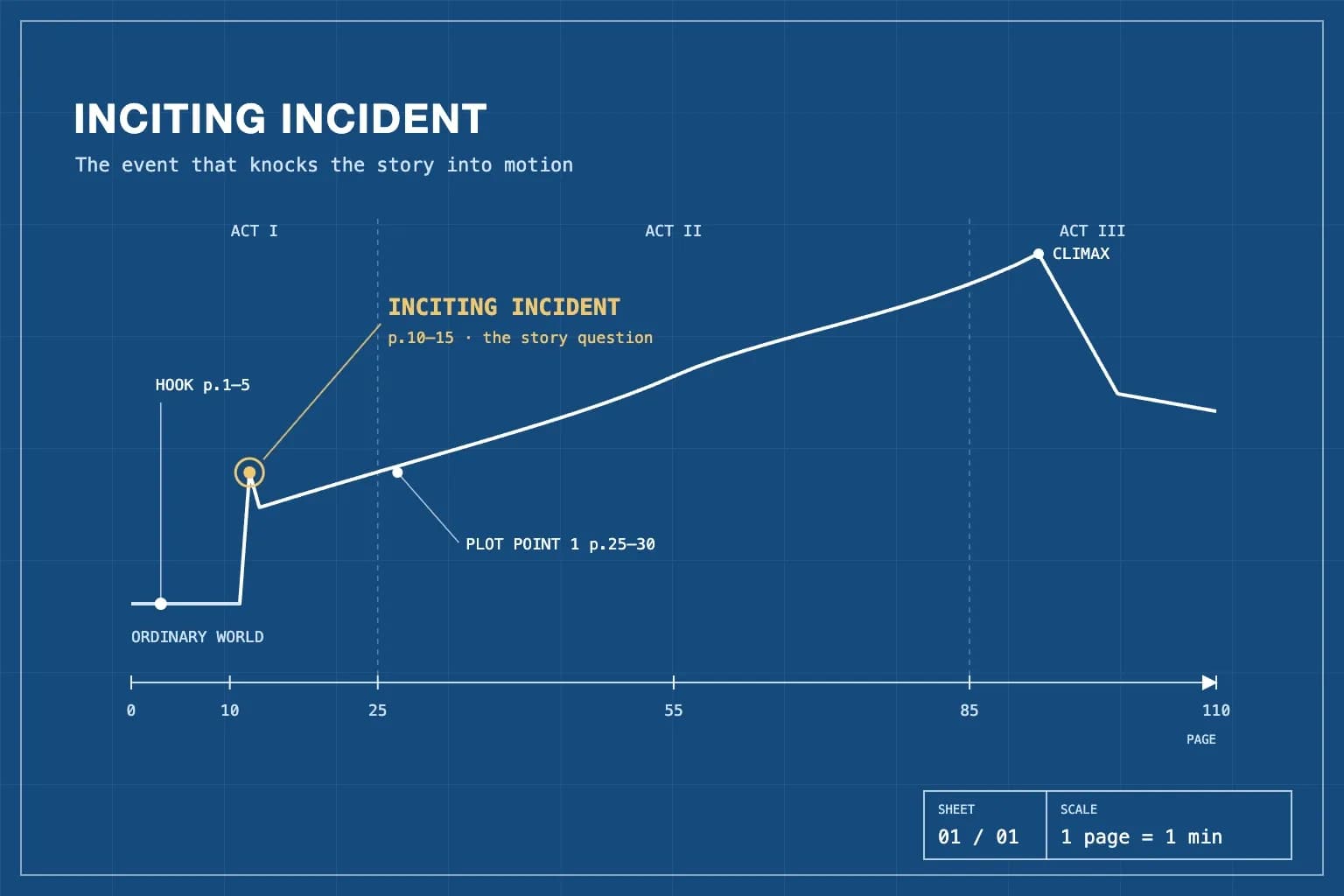
Every story raises a dramatic question early on, usually around the inciting incident: will the hero get what they want, and at what cost? A closed ending answers that question clearly. An ambiguous ending answers part of it, or answers it in a way that can be read in two or more directions.
Three things separate a true ambiguous ending from an unfinished one:
- The open question is specific. The audience knows exactly what they are unsure about. Is Cobb dreaming? Did the ghosts exist? Vague confusion about everything is not ambiguity; it is a muddle.
- Each reading has evidence. The story supports more than one interpretation with concrete details planted earlier. If one answer is obviously right, the ending is not ambiguous, only coy.
- The main arc is resolved. The protagonist's emotional journey usually reaches a clear endpoint even when the plot question stays open. The audience gets a sense of completion and a question at the same time.
This is why ambiguous endings sit inside the larger craft of the denouement, the final movement where a story shows what its climax means. Ambiguity is one possible shape for that movement, not a way of skipping it.
Why ambiguous endings work
They keep the story running in the viewer's head
In the 1920s, psychologist Bluma Zeigarnik reported that people tended to recall interrupted tasks better than completed ones. Later attempts to replicate the finding have produced mixed results, so it is better treated as a useful metaphor than a law, but the intuition behind it is familiar to every storyteller: an unfinished pattern nags at us. An ambiguous ending hands the audience an unfinished pattern on purpose, and the story keeps playing in their heads on the way home.
They make subtext do the work
When every motive is explained, a story becomes literal. Ambiguity pushes meaning into subtext: what a character does not say, what the camera does not show. The audience has to read the scene instead of being told what it means.
They reflect how life feels
Real people rarely know for certain why others acted as they did. An ending that refuses to tidy everything can feel more honest, especially in stories about grief, violence, memory or moral choice.
They invite the audience to co-author the meaning
Optimists and pessimists leave the same ambiguous film with different endings. That personal stake is a large part of why these films get rewatched and debated.
The main types of ambiguous ending
Knowing which kind of ambiguity you are writing helps you control it.
Plot ambiguity: what happened, or what happens next?
The facts of the outcome stay uncertain. We do not know whether the event we care about happened, or what will happen in the next moment. The final shot of Inception is the classic case: the audience never sees whether the top falls.
Character and moral ambiguity: who is this person, really?
The question is about identity, sanity or ethics. Blade Runner (1982) leaves open whether Deckard himself is a replicant, a question the 1992 Director's Cut sharpened by adding his unicorn dream, which echoes the origami unicorn Gaff leaves behind at the end. Ridley Scott has said in interviews that Deckard is a replicant, while Harrison Ford has said he played him as human. That disagreement shows how carefully the film keeps both readings alive. Moral ambiguity also shapes characters who resist the simple hero and villain labels discussed in our guide to protagonist and antagonist.
Thematic and symbolic ambiguity: what did it mean?
Here the events on screen are clear enough, but their meaning is not. Images and surreal moments carry several possible readings rather than one coded message. The ending of 2001: A Space Odyssey (1968), written by Stanley Kubrick and Arthur C. Clarke, shows Dave Bowman passing through the Star Gate, ageing in an elegant room, and being reborn as the Star Child. What it signifies, whether evolution, transcendence or something stranger, is left to the viewer.
Emotional ambiguity: how should we feel?
Sometimes the plot is resolved but the feeling is not. At the end of The Graduate (1967), Benjamin and Elaine escape her wedding and run onto a bus, laughing. The camera stays on them as their smiles fade into uncertain stares. They got what they wanted. Whether that is a happy ending is the question the film leaves behind.
Famous ambiguous endings, and what writers can learn from them
Inception (2010): the top that keeps spinning
Christopher Nolan's film ends with Cobb returning home to his children. He spins his totem, the top that tells him whether he is in a dream, then walks away to greet them. The top wobbles slightly, and the film cuts to black.
The craft lesson is in where the camera looks. Cobb no longer checks the top; he has chosen his children over certainty. Nolan has said in later talks and interviews that the point is that Cobb has stopped caring whether he is dreaming. The audience is left holding the question the protagonist has let go of. His emotional arc is complete; only the plot question stays open.
No Country for Old Men (2007): the dream instead of the showdown
Joel and Ethan Coen's adaptation of Cormac McCarthy's 2005 novel refuses almost every expected payoff. Llewelyn Moss, the man we followed for most of the film, is killed off screen. Anton Chigurh's visit to Carla Jean ends with him leaving the house and checking the soles of his boots, a quiet detail that implies what happened inside without showing it. Then Chigurh is injured in a car crash and walks away.
The film ends not with a confrontation but with retired Sheriff Ed Tom Bell telling his wife about two dreams of his late father, the second of him riding ahead through the cold dark, carrying fire. Then Bell wakes up. The dream offers a faint hope in a world ruled by chance and violence, with no instructions on how to read it, mirroring Bell's own inability to make sense of what he has seen.
The Turn of the Screw (1898): are the ghosts real?
Henry James's novella is told by a governess caring for two children, Miles and Flora, at an isolated country house. She becomes convinced that the ghosts of two former servants, Peter Quint and Miss Jessel, are pursuing the children. Nobody else in the story clearly confirms seeing them.
Critics have long argued whether the ghosts are real or the product of the governess's mind; Edmund Wilson's 1934 essay made the psychological reading famous. The lesson for screenwriters is about point of view: by filtering everything through one unreliable witness, James makes both readings fit every scene. Jack Clayton's film adaptation The Innocents (1961) keeps the same balance on screen.
Parasite (2019): a plan or a fantasy?
After the violent climax of Bong Joon-ho's film, written with Han Jin-won, Ki-taek is hiding in the secret bunker beneath the house where the family once worked. His son Ki-woo writes him a letter promising to earn enough money to buy the house so his father can simply walk up the stairs. We see that future play out, then cut back to Ki-woo in the semi-basement flat, still writing.
The gap between the realistic situation and the dream-like escape is the point. Bong has indicated in interviews that he does not expect Ki-woo to ever afford the house, yet many viewers leave holding on to the hope: the plan is sincere, and the system the film describes makes it close to impossible.
How to write an ambiguous ending that feels earned
Earn the uncertainty with a solid setup
Ambiguity only works when everything before it is clear. If the story's logic is broken, the audience feels cheated rather than intrigued. Plant your clues the way you would plant any setup, so each possible reading has a payoff; our guide to Chekhov's gun covers how to make planted details pay off.
Know the answer yourself, or know exactly why there isn't one
Strong ambiguous endings come from writers who know what they believe happened, or who designed the question so that both answers are true to the story, never from writers who could not decide. Write down your own answer, then write the ending so that it does not give it away.
Ground the ambiguity in character
The best open endings come from a character's blind spot, choice or state of mind, not from the author hiding information at random. Cobb chooses not to look. The governess cannot be trusted. Bell cannot make sense of the world. When the uncertainty comes from inside the character, it feels like meaning rather than a trick.
Close the emotional arc even if you leave the plot open
Give the audience a clear sense of where the protagonist has arrived emotionally. That sense of completion is what makes the open question feel like a gift instead of a loose end. If both the plot and the arc stay unresolved, most viewers will simply feel the film stopped.
Choose one question, and make it the right one
Leave one central question open, ideally the one the whole story has been building towards, and resolve everything else. If too many threads stay loose, the ending reads as unfinished. Stories built on clear cause and effect, as in the but and therefore rule, give ambiguity a solid floor to stand on.
Avoid the cop-out ending
Some endings use ambiguity to dodge a climax the writer could not make work. Others reach for a sudden outside rescue, the opposite problem covered in our post on deus ex machina. A useful test is to ask whether the ending would still be satisfying if the audience chose either interpretation. If one of them makes the story pointless, the ambiguity is not doing its job.
Test it on readers before you send it out
You already know the answer, so you cannot judge your own ambiguity. Ask readers who don't what they think happened and why. If they all choose the same reading, the ending is not ambiguous. If they cannot name the question at all, it is unclear. A structured read, such as an analysis of your screenplay with Poetika, can also flag whether your setups, payoffs and character arc support the ending you intend. For a broader look at the hardest part of the script, see why endings are the hardest thing to write.
Checklist: is your ambiguous ending working?
- You can state the one open question in a single sentence
- Each possible reading is supported by specific moments planted earlier
- The protagonist's emotional arc reaches a clear endpoint
- All subplots and secondary questions are resolved
- The ambiguity comes from character or theme, not from a broken plot
- You know your own answer, or why both answers are true
- Test readers disagree about the answer but agree on the question
FAQ
What is an example of an ambiguous ending?
The final shot of Inception (2010) is the best known. Cobb spins his top to check whether he is dreaming, walks away to greet his children, and the film cuts to black as the top wobbles. Other examples include No Country for Old Men, Parasite, Blade Runner and The Graduate, each leaving a different kind of question open.
What is the difference between an open ending and an ambiguous ending?
The terms overlap and are often used interchangeably. Strictly, an open ending leaves the future uncertain, so we do not know what happens next. An ambiguous ending leaves the meaning or the facts uncertain, so we cannot be sure what happened or what it meant. Many endings, like Inception's, do both at once.
Are ambiguous endings bad?
Not in themselves. Audiences dislike endings that feel unfinished or evasive, not endings that ask a question. An ambiguous ending works when the setup is clear, the protagonist's arc is complete and every possible reading is supported by the story. It fails when it hides a broken plot or a writer who never decided what the story means.
How do you write an ambiguous ending?
Choose one central question to leave open, plant evidence for each possible answer earlier in the script, and resolve everything else, including the protagonist's emotional arc. Ground the uncertainty in a character's choice or point of view. Then test the ending on readers who do not know your intention and check that they argue about the same question.
Should a first screenplay have an ambiguous ending?
It can, but it raises the bar. Readers judging a spec script from a new writer may read an open ending as indecision unless the rest of the script shows clear control of structure and character. If you choose ambiguity, make sure the setup, payoffs and arc are especially strong, and get outside feedback before you submit.
If you want to see how your own ending reads to a stranger, run your screenplay through Poetika and check whether your setups and character arc support the question you mean to leave open.