Finding the Right Story: How Script Coverage Helps Producers Decide What to Develop
Poetika BlogMarch 26, 20249 min read
A production company can receive dozens of screenplays in a single week. Some come through agents, others through open submissions, personal connections or established relationships with writers. Every script needs something from the people who receive it: time, attention and a decision.
But a producer's time is limited. Reading every screenplay from beginning to end is not always practical, especially when several projects are already in development. The challenge is not simply finding a good story. It is understanding which projects deserve a closer look, which fit the company's creative direction and which need more work before they are ready to move forward.
This is where script coverage becomes valuable. A well-prepared coverage report gives producers an initial understanding of a screenplay and helps them decide whether it is worth exploring further.
Analyze your script with Poetika
Get instant feedback on your screenplay in minutes.
Traditionally, this is the role of script readers and coverage writers. They read screenplays, summarize their stories and assess their strengths and weaknesses. Their reports help producers make an initial decision without having to read every submission themselves.
But coverage is not always easy to access. Smaller production companies may not have dedicated readers, while larger teams face their own challenges. Different readers also bring different experiences, expectations and tastes. One reader may appreciate an unconventional structure, while another may find the same approach difficult to follow.
That subjectivity is not necessarily a problem. Film development depends on creative judgment, and no report can remove personal taste from the process. The real problem is making decisions with incomplete information, or dismissing a promising screenplay before understanding what makes it different.
Good coverage does not replace reading. It helps producers decide what deserves their attention and gives them a clearer basis for that decision.
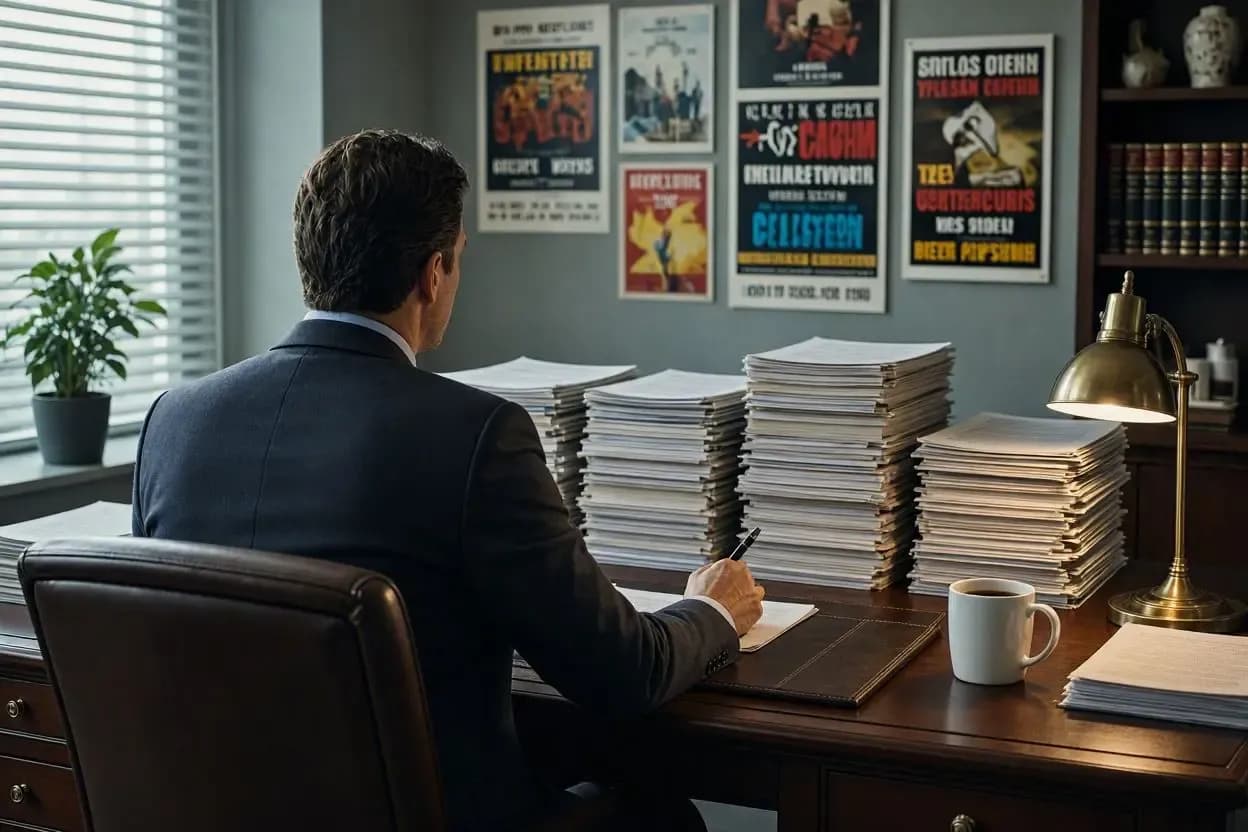
With multiple scripts competing for attention, producers must decide which stories deserve a closer look.
A useful report typically addresses several questions:
What is the story about? A concise synopsis presents the main events, central conflict and direction of the plot. It gives the producer a clear picture of the story before committing to a full read.
How does the screenplay work structurally? An analysis of the dramatic structure shows how the story develops, where its momentum builds and where the pacing or progression begins to weaken.
Are the characters convincing? Character analysis looks at motivations, relationships, development and the choices characters make. A compelling premise may still fall short if its central character lacks agency or important relationships remain unexplored.
Who might the film reach? Genre, target audience and age classification help place the project in a broader context. They provide useful starting points for discussion, but they cannot guarantee commercial performance or determine a film's final classification.
What does the screenplay involve from a production perspective? Scene and character breakdowns give producers a practical overview of the material. The number of scenes, the characters involved and the locations described in the script help them begin to understand the project's scale and complexity.
Each of these elements serves a different purpose. The synopsis explains what the story is about. Dramaturgical analysis examines how it works. Production breakdowns show what the screenplay contains.
Together, they provide a more complete first picture of the project. But they cannot replace the producer's judgment, a full reading or the practical work of assessing the budget, financing and production requirements.
The Right Script for the Right Producer
A strong screenplay can still be the wrong choice for a particular production company.
Consider two producers. One focuses on intimate character dramas and emerging filmmakers. The other specializes in commercial thrillers and established intellectual property. Both may recognize the quality of the same screenplay, but their reasons for pursuing it—or passing on it—will be very different.
This is because creative quality and production suitability are not the same thing.
A slow-burning arthouse drama may have considerable artistic value but fall outside a company's usual audience or financing strategy. A contained thriller, on the other hand, may be a natural fit for a producer who understands the genre and knows how to position it. Neither decision necessarily reflects the screenplay's overall quality.
Coverage can help producers see this distinction more clearly. By identifying a script's genre, dramatic approach, target audience and comparable works, a report helps them consider not only whether a story works, but whether it belongs in their particular slate of projects.
It can also make the decision to pass on a project more straightforward. When a producer understands why a screenplay does not fit, they can reach a decision sooner instead of leaving the writer waiting for weeks without an answer.
The goal is not to find a screenplay that every producer will like. It is to find the producer who understands what the story is trying to achieve and has the right conditions to develop it.
A Shared Language in the Office
In a production company, the person who first receives a screenplay is not always the person who decides whether to develop it.
Not everyone has time to read every script in full. But everyone involved needs a shared understanding of the project.
A structured coverage report provides a common starting point. Instead of relying entirely on separate impressions, team members can refer to the same synopsis, character breakdown and observations about the story's structure. This allows them to focus their discussions on more specific questions: Does the project fit the company? Are its weaknesses manageable? What needs to change before development can move forward?
A shared report does not mean everyone will reach the same conclusion. In fact, it can make disagreements more useful by giving people specific elements to discuss. For example, one reader may see an unconventional structure as a weakness, while another considers it essential to the film's identity. With a shared report, they can discuss exactly where their interpretations differ instead of simply saying that they have different opinions.
Coverage does not replace conversation. It gives that conversation a more useful starting point.
International Co-Productions: Making the Material Easier to Evaluate
International co-productions add another layer of complexity. A German producer developing a project with a French partner and an American distributor may need to explain the same screenplay to people with different professional backgrounds, market expectations and cultural reference points.
The full screenplay remains essential for a serious creative evaluation. But asking every partner to read it before an initial discussion can slow things down, especially when several projects are being considered at once.
A concise, structured report can help everyone understand the project before those conversations begin. The synopsis communicates the story, while the genre and audience analysis provide a starting point for discussing how the film might be positioned. Character and scene breakdowns help partners understand the material in more practical terms.
It is important, however, to distinguish an initial assessment from a market evaluation. Identifying a target audience does not tell producers how audiences in different countries will respond to the film. An age classification analysis does not automatically determine the rating the finished film will receive in every territory. These questions require further research and, where necessary, consultation with local distributors and classification bodies.
Coverage has a more specific role at this stage: it gives partners a shared understanding of the screenplay and helps them identify which questions need further investigation.
Script coverage helps producers look beyond a story's premise and evaluate how a screenplay works.
Coverage as the Beginning of a Conversation
Coverage is often treated as a gatekeeping tool. A report arrives, a producer reads it, and the project receives a yes or no. But its value can go beyond that first decision.
A screenplay may have a compelling premise and well-developed characters, yet lose momentum in its second act. The protagonist may become increasingly passive as the story progresses. A subplot may introduce an interesting conflict but never have any real effect on the main story.
Simply pointing out these problems is not enough. What matters is understanding how they affect the story and what might be done about them.
For example, saying that a screenplay loses momentum in its second act identifies a problem, but not its cause. Looking more closely at the sequence of events may reveal that the protagonist stops making meaningful decisions. External events continue to move the plot forward, but the main character no longer influences what happens.
That is a much more useful observation. It identifies a specific dramatic problem and gives the development team something concrete to discuss.
There is an important difference between saying, "The second act doesn't work," and explaining, "The protagonist's choices stop changing the direction of the story." The first is a judgment. The second helps explain what is happening and why it matters.
Coverage can help producers move from the first kind of response to the second. It provides a way to discuss a screenplay's potential without reducing the conversation to whether it is simply good or bad.
A report should not dictate how a writer rewrites a screenplay. Its purpose is to identify patterns, clarify problems and make the next stage of development more focused.
How Poetika Works?
Explore a complete sample analysis and understand the feedback format.
The challenge facing producers is not simply the number of screenplays they receive. It is finding enough time to understand each one and make a meaningful decision.
Good coverage cannot tell a producer which film to make. It cannot predict whether a screenplay will find an audience, secure financing or succeed in production. Those decisions depend on creative judgment, experience and information that no script report can provide on its own.
What coverage can do is make a screenplay easier to understand. It can reveal the structure beneath the story, clarify its strengths and weaknesses, and give a production team a more informed starting point.
Finding the right story is not simply a matter of reading more scripts. It is a matter of understanding what each story has to offer and recognizing where it might belong.
Nolan’s films often explore how time and memory shape who we are. From fractured memories to journeys home that seem impossible, his stories return to questions that Homer explored centuries ago. The Odyssey also offers a lasting lesson in how to build a compelling story.
A great novel can become a disappointing film. A modest novel can inspire a remarkable one. The difference often lies not in the quality of the original story, but in how the story is told.
It is Monday morning. Over the weekend, twelve new scripts arrived. Nine more came in the week before. Somewhere in the inbox are scripts that have been waiting since last month, along with a few that have been there even longer. In two hours, the development meeting starts, and there is still a stack of material that nobody has had time to read.