To write a screenplay, you turn a story idea into a sequence of visual scenes on standard, formatted pages: you shape the idea into a one-sentence logline, build a protagonist who wants something badly, outline the story in three acts, write a fast first draft in screenplay format (Courier 12 point, about one page per minute of screen time), and then rewrite it in focused passes until a stranger can read it without getting lost. Talent helps, but the process itself is a craft that anyone can learn and practise.
The blank page feels intimidating mostly because "write a movie" is too big to act on. Broken into steps, it becomes a series of small, concrete tasks. This guide walks through them in order, with film examples, common first-script mistakes and a checklist.
Step 1: Read screenplays and watch films actively
Before writing your first script, read a few. A screenplay is not a novel or a transcript of a film; it is a blueprint for readers, actors and crew. Choose produced scripts from films you know, in your genre, and read them from first page to last. Our guide on where to read screenplays lists legal places to find them.
Good scripts to start with show very different voices:
- Get Out (2017): Jordan Peele's script shows how a thriller builds dread through small, specific details long before anything openly violent happens.
- The Social Network (2010): Aaron Sorkin's script is famously dialogue-heavy, which makes it a useful study in how fast, overlapping talk still reads clearly on the page.
- Parasite (2019): Bong Joon Ho and Han Jin-won's script (read it in English translation) moves between comedy and thriller, and its scene transitions are worth studying closely.
Then watch films the way a writer does. Note roughly when the first act ends, where the story shifts in the middle, and how a scene says one thing on the surface and another underneath. Screenwriting is visual storytelling: readers should see the story through action and behaviour, not be told it.
Step 2: Find your concept and write a logline
Every screenplay starts with an idea, but an idea is not yet a story. "A family of con artists" is a situation. "A poor family schemes its way into jobs with a wealthy household, one member at a time" has a protagonist, a goal and built-in conflict. That second version is close to a logline.
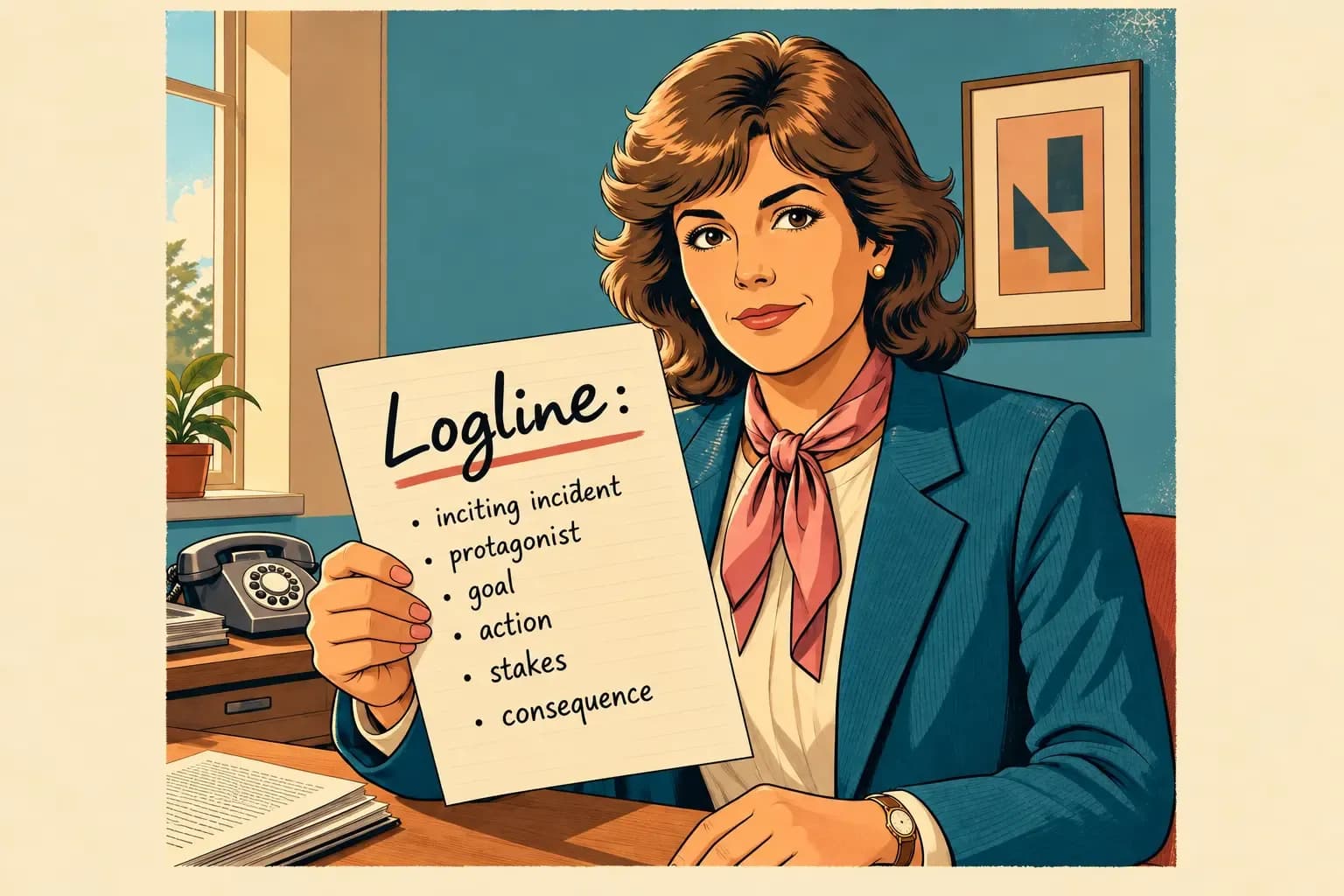
A logline is the story in one or two sentences. It usually names:
- The protagonist: who the story follows, described by what makes them interesting, not by their name.
- The inciting incident: the event that starts the story. If you are unsure what this is, read our guide to the inciting incident.
- The goal: what the protagonist sets out to do.
- The obstacle and the stakes: what stands in the way, and what happens if they fail.
Writing the logline first shows whether there is a story at all. Then test it with two blunt questions. So what? Is there enough conflict here to fill a feature, or does the problem solve itself in twenty pages? Why this character? Is your protagonist the person this situation will hurt or change the most? For a fuller method and examples, see how to write a logline.
Step 3: Build characters driven by desire
Plot comes from characters wanting things and being blocked. The most useful tool for a first screenplay is the difference between want and need:
- Want: the external goal the protagonist chases, the one you can photograph. In Spirited Away (2001), Chihiro wants to free her parents and get out of the spirit world.
- Need: the internal change they must go through to get there, or that the story forces on them. Chihiro starts the film sulky and frightened, and she has to find courage and stop depending on others to save her.
When the want and the need pull against each other, you get drama. In Toy Story (1995), Woody wants to stay Andy's favourite toy, and that want makes him act badly toward Buzz; what he needs is to let go of his jealousy. The gap between the two is the shape of his character arc.
Two more things matter for a first script:
- Agency. Your protagonist should make choices that push the story forward, not just react to events.
- Distinct voices. Cover the character names on a page of dialogue. If you can't tell who is speaking, the characters sound like you, not like themselves.
Step 4: Outline your story structure
Most first screenplays fail in the middle, and most middles fail because the writer started without a plan. An outline does not need to be long, but you should know the major turning points before you write scenes.
The classic three-act structure is the simplest map. In a feature screenplay of about 100 pages, it roughly looks like this:
- Act I (about the first quarter): the setup. We meet the protagonist and their world, the inciting incident disrupts it, and around page 25 to 30 the protagonist commits to the journey.
- Act II (about the middle half): the confrontation. Obstacles grow, a midpoint near the centre of the script raises the stakes or changes the direction, and the act ends at a low point where all seems lost.
- Act III (about the last quarter): the resolution. The protagonist makes a final push, the central conflict comes to a climax, and we see the new normal it leaves behind.
These page numbers are guidelines, not rules. They help you notice when your first act runs long or your second act has no turning point.
Outlining methods vary, so pick the one that suits how you think:
- Beat sheet: a list of the main story beats, as in Blake Snyder's Save the Cat! (2005).
- Index cards: one scene per card, laid out on a table or wall so you can move them around.
- Scene breakdown: a numbered list of every scene with one line on what happens and why it matters.
- Treatment: a prose version of the story, written in the present tense, which is also a useful document for producers.
Whichever you choose, check that each scene follows from the one before it by cause and effect.
Step 5: Learn screenplay format and choose your tools
Format scares beginners most and matters least creatively, but readers notice when it is wrong. The basics:
- Page setup: US Letter pages, 12-point Courier, and standard margins. Because the layout is fixed, one page runs about one minute of screen time, and most feature scripts land somewhere between 90 and 120 pages.
- Scene headings (sluglines): INT. or EXT., the location, and the time of day, such as INT. KITCHEN - NIGHT.
- Action lines: what we see and hear, in the present tense, in short paragraphs.
- Character cues and dialogue: the speaker's name in capitals, with their lines beneath.
- Parentheticals and transitions: used sparingly, only when they are really needed.
Write action that a camera could record. "Maria is nervous about the interview" describes a feeling; "Maria checks her reflection in the elevator doors, then checks it again" shows it. Keep action paragraphs to three or four lines.
Screenwriting software, such as Final Draft, Fade In, WriterDuet or Arc Studio, applies the format as you type. For a full element-by-element reference, read how to format a screenplay.
Step 6: Write the first draft without stopping
The first draft has one job: to exist. Many writers call it the "garbage draft" for a reason. You can fix a bad page; you cannot fix a blank one.
A few habits keep the draft moving:
- Set a page goal. Two or three pages a day is a common target. At that pace a feature draft takes roughly one to two months, and a daily goal is easier to keep than a vague plan to "write this month".
- Don't rewrite while drafting. If you notice a problem in Act I while writing Act II, leave a note in brackets and keep going. Polishing page ten for three weeks is how first screenplays die.
- Push through the muddy middle. The second act is where energy drops, because the excitement of the setup is gone and the ending is still far away. Go back to your outline, find the next turning point, and write toward it.
- Write the ending. A complete draft with a weak ending teaches you more than a strong unfinished one.
Step 7: Rewrite in passes
Screenwriting is rewriting. Once the draft is done, put it away for at least a week or two, then read it in one sitting, as close to a stranger as you can manage. Take notes, but don't fix anything on the first read.
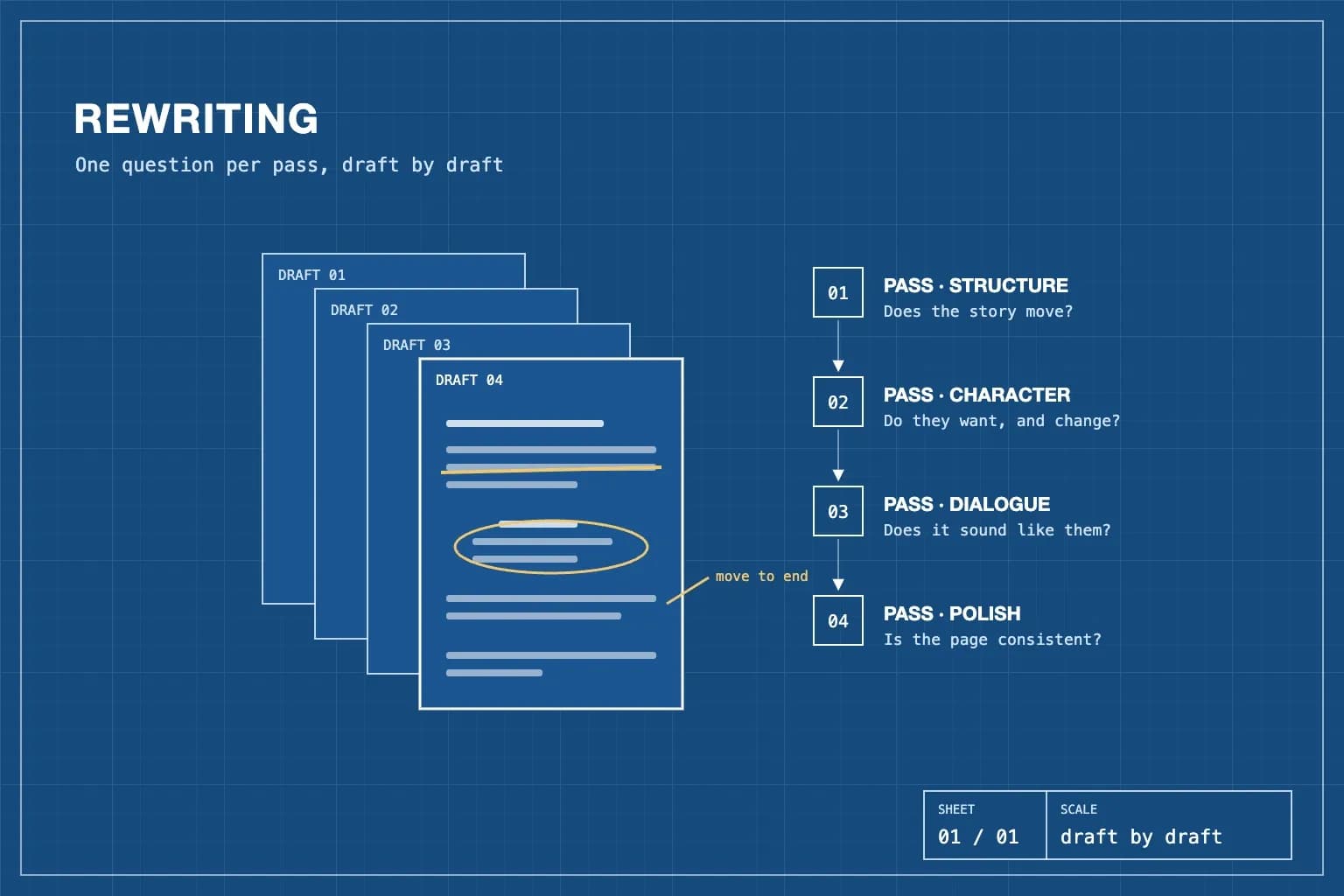
Then rewrite in passes, from the biggest problems to the smallest:
- Structure pass: Does the story start early enough? Does the second act escalate? Does the ending answer the question the opening raised?
- Character pass: Is the protagonist active? Is their want clear by the end of Act I? Does the arc land?
- Scene pass: Does every scene change something? Cut or merge the ones that only repeat information.
- Dialogue pass: Remove lines that explain what the audience already knows, and look for chances to let subtext do the work.
- Polish pass: Format, typos, consistent character names, and action lines trimmed to the essentials.
Polishing dialogue before the structure works wastes effort. We explain why each draft improves a script in how rewriting makes a screenplay better.
Step 8: Get feedback and learn to use notes
After a rewrite or two, you need outside eyes: only a reader can tell you what is actually on the page.
- Trusted readers. Choose people who read critically, and ask specific questions: where did you get bored, what confused you, who did you care about?
- Writing groups and table reads. Hearing actors or friends read your script aloud exposes clunky dialogue faster than any silent reread.
- Structured analysis. A consistent, structured read helps you see patterns across the whole script rather than scene-level reactions. You can get a structured analysis of your screenplay with Poetika, which looks at structure, character, pacing and dialogue and points to the pages where the story loses momentum.
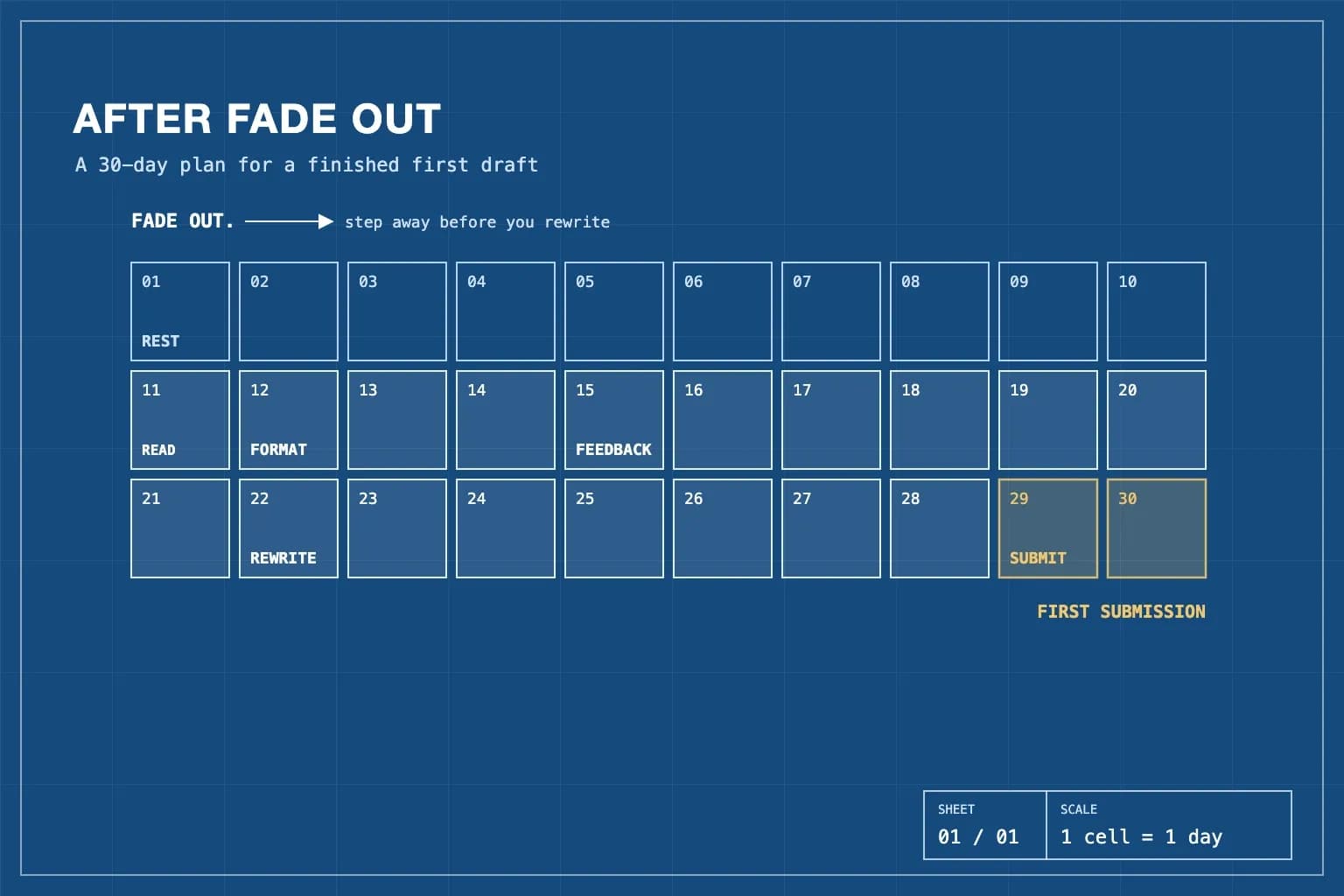
When notes come in, look for agreement: one reader disliking a scene may be taste, but three readers losing interest in the same stretch is a problem. Treat notes as symptoms to diagnose rather than instructions to follow. For what to do once the draft is solid, see our 30-day plan for after you finish a screenplay.
Common mistakes in a first screenplay
- A slow start. Ten pages of daily routine before anything happens. Readers want to know what the story is about early.
- A passive protagonist. Things happen to the main character, who never makes a hard choice.
- Dialogue that explains. Characters tell each other things they both already know, so the audience can hear it.
- Novelistic action lines. Long paragraphs about thoughts, backstory or feelings that cannot be filmed.
- Camera directions. "We see" or "close on" in every scene. Leave most shot choices to the director.
- Sending the first draft. Most readers will only read a script once.
Your first screenplay checklist
- Have you read at least three produced screenplays in your genre?
- Can you state the story in a one- or two-sentence logline?
- Does your protagonist have a clear external want and an internal need?
- Do you know your inciting incident, your act breaks and your ending before you start?
- Is the script in standard format, in screenwriting software?
- Did you finish a complete draft before rewriting anything?
- Did you rewrite structure and character before polishing dialogue?
- Has at least one outside reader given you notes?
Finishing a first screenplay is a real milestone. Once you have one or two finished drafts, our guide to building a sustainable screenwriting career covers the longer road. When your draft is ready for an honest read, Poetika can analyze it in detail.
FAQ
How long does it take to write a screenplay?
It varies widely. A first draft of a feature written at two or three pages a day takes roughly one to two months, but outlining before and rewriting after usually take longer than the draft itself. Many writers spend several months to a year getting a first screenplay into shape they are happy to share.
How many pages should a screenplay be?
Most feature screenplays run between 90 and 120 pages, because one formatted page equals about one minute of screen time. Comedies and horror films often sit at the shorter end, while dramas can run longer. For a first spec script, staying near 100 pages is a safe target that readers will not find intimidating.
Do I need special software to write a screenplay?
You don't strictly need it, but it makes life much easier. Screenwriting programs apply standard format automatically, so you can focus on the story instead of margins and indents. Most well-known tools let you try them before committing, and any of them is enough to write a first script that looks professional on the page.
Should I outline before writing a screenplay?
For a first screenplay, yes. Some experienced writers discover the story as they draft, but beginners who skip outlining usually get stuck in the second act. Even a one-page beat sheet with the inciting incident, act breaks, midpoint and ending gives you a map to write toward and makes the draft much faster.
Can I write a screenplay without going to film school?
Yes. Screenwriting is learned by reading scripts, writing them and rewriting them, and none of that requires a degree. Film school can offer structure, feedback and contacts, but many working screenwriters learned on their own through books, writing groups and finished drafts. What matters to readers is the script, not the writer's education.