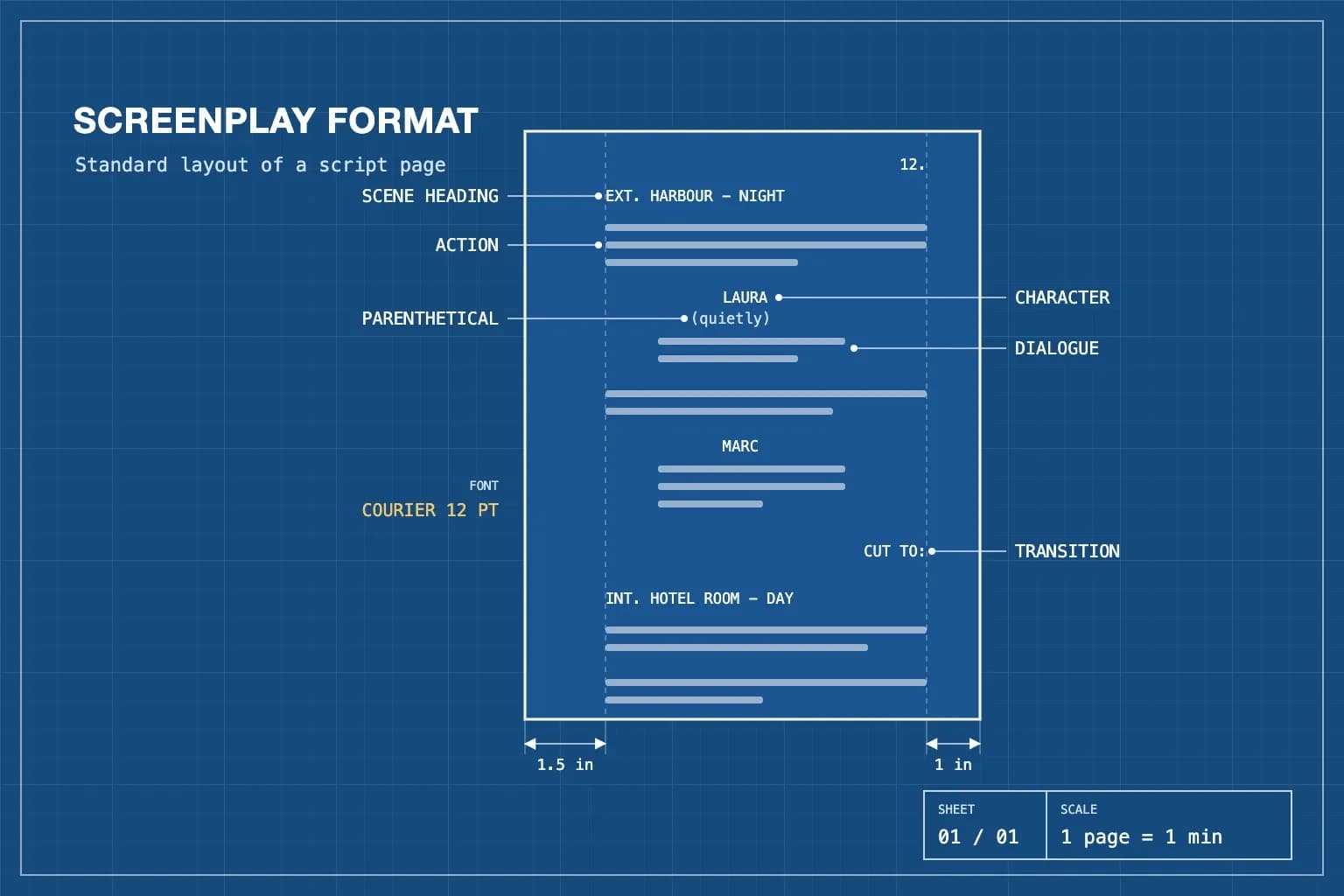
To format a screenplay, you write on US Letter pages in 12-point Courier, with a 1.5-inch left margin and roughly 1-inch margins elsewhere, and you build every scene from a small set of standard elements: scene headings, action lines, character names, dialogue, parentheticals and transitions, each with its own fixed indent. This layout, usually called American screenplay format, makes one page run about one minute of screen time and lets anyone in the industry read your script without friction.
The rules look fussy, but there are few of them, and screenwriting software applies most of them for you. This guide covers page setup, each element, common mistakes and a checklist. If you want the bigger picture of why format matters to readers, start with our guide to why screenplay format matters; this page is the element-by-element reference.
What is American screenplay format?
American screenplay format is the page layout used for feature films and most television in the US, and widely accepted in other markets. It defines the paper size, font, margins and the position of each element on the page. It is sometimes called "Hollywood format". Spec scripts and shooting scripts differ in a few details, covered below. It exists so that a script can be read quickly, broken down for production and timed.
Why it is the industry standard
The format grew out of the studio era, when scripts were typed on typewriters in a monospaced font. Because every Courier character takes the same width, a page of properly formatted script holds a predictable amount of material, which is why the familiar rule of thumb holds: one page is roughly one minute of screen time. (For target page counts, see how many pages a screenplay should be.)
Format also signals professionalism. Correct format won't sell a weak story, but unusual fonts or numbered scenes in a spec draft tell a reader within seconds that the writer is new to the craft.
Page setup: paper size, font and margins
These are the usual settings; small differences between programs are normal.
- Paper: US Letter, 8.5 × 11 inches.
- Font: Courier 12 point. Courier New, Courier Prime and Courier Final Draft all work. Our article on font selection in screenwriting explains why the industry still uses a typewriter face.
- Top and bottom margins: about 1 inch.
- Left margin: 1.5 inches, which leaves room for binding.
- Right margin: about 1 inch for action lines.
- Line spacing: single spaced, with one blank line between elements.
Elements are then indented from the left edge of the page. Typical positions are:
- Scene headings and action: start at 1.5 inches and run the full width.
- Character names: start around 3.5 to 3.7 inches.
- Dialogue: starts around 2.5 inches and is about 3.5 inches wide.
- Parentheticals: start around 3 inches, between the character name and the dialogue.
- Transitions: aligned to the right, ending near the right margin.
The core elements of a screenplay
Scene headings (sluglines)
A scene heading tells the reader where and when a scene takes place. It is written in capitals and has three parts:
- Interior or exterior: INT. for inside, EXT. for outside, INT./EXT. for a scene that moves between the two, such as a car.
- Location: as specific as the story needs, such as KITCHEN or MARIA'S APARTMENT - KITCHEN.
- Time of day: usually DAY or NIGHT. Use CONTINUOUS when the action flows directly from the previous scene, and LATER or MOMENTS LATER for short time jumps in the same place.
A full heading reads like this: INT. POLICE STATION - INTERROGATION ROOM - NIGHT. Write a new scene heading every time the location or time changes.
Action lines
Action lines (also called description) describe what the audience sees and hears. They are written in the present tense, in plain sentences, at full width from the left margin.
Keep paragraphs to three or four lines and write only what can be filmed: thoughts and backstory belong in what characters do or say. When a speaking character appears for the first time, write their name in capitals, usually followed by a short description, for example "JANE (40s), a paramedic still in uniform, counts the cash twice." After that, the name is written normally in action. We look at this element in depth in how to write action lines in a screenplay.
Character names
The character cue sits above each block of dialogue, in capitals, at the character indent. Use the same name every time: if a character is introduced as DETECTIVE RUIZ, don't switch to RUIZ halfway through.
Dialogue
Dialogue sits directly under the character name in a narrower column. It is written as people speak, including contractions and broken sentences, without quotation marks.
When a single speech runs across a page break, software splits it with (MORE) at the bottom of the first page and repeats the character name with (CONT'D) at the top of the next. Where you can, break at the end of a sentence.
Parentheticals
A parenthetical is a short direction in brackets under the character name, such as (quietly), (to Sam) or (in Spanish). It clarifies how a line is meant or to whom it is addressed when the page doesn't make it obvious.
Use them sparingly: actors dislike scripts that dictate every reading. If a direction takes more than a few words, it belongs in an action line.
Transitions
Transitions describe how one scene moves to the next: CUT TO:, DISSOLVE TO:, MATCH CUT TO:, SMASH CUT TO:. They are written in capitals, aligned right, and followed by a colon. FADE IN: traditionally opens a script at the left margin, and FADE OUT. closes it.
In modern spec scripts, transitions are optional. A cut is assumed between scenes, so keep them for moments where the edit itself carries meaning.
Dialogue extensions: V.O., O.S. and CONT'D
Extensions sit in brackets after the character name and tell the reader where the voice comes from.
- (V.O.) Voice-over: the character is not physically in the scene, such as a narrator, a voice on the radio or a character's inner voice.
- (O.S.) Off-screen: the character is in the scene's location but out of view, for example shouting from another room. Some television scripts use (O.C.), off-camera, instead.
- (CONT'D) Continued: many writers and programs add it when the same character keeps speaking after an action line interrupts their dialogue. It is a style choice; some writers turn it off to save space.
The difference between the first two trips up many beginners. Our guide to V.O. vs. O.S. in a screenplay shows when to use each.
Title page and page numbers
The title page is plain. It contains:
- Title: centered, in capitals, about a third of the way down the page.
- Byline: "Written by" on a line below, then your name. If the script is based on another work, say so under the byline (for example "Based on the novel by…").
- Contact details: in the bottom left or right corner: email, phone, and your agent or manager if you have one.
Leave out images, logos, taglines and copyright symbols, and in a spec script most writers also leave out draft dates and version numbers. The title page has no page number. The script itself starts on page 1, but the number is not printed on the first page; from page 2 on, numbers appear in the top right corner, followed by a period.
Spec scripts vs. shooting scripts
The script you write to sell or submit is a spec script. Once a project goes into production, it becomes a shooting script, and the format changes to serve the crew.
- Scene numbers: absent in a spec script; added to both sides of every scene heading in a shooting script.
- Camera directions: kept to a minimum in a spec script; a shooting script may include shots and angles chosen by the director.
- Revisions: a shooting script tracks changes with colored revision pages, asterisks in the margin and "A" pages (such as 34A) so page numbers stay locked.
If you are writing on spec, write a spec script. Adding scene numbers or camera angles to a submission makes it look like you are directing on the page. For more on what a spec draft is and how it is used, see our guide to what a spec script is.
US Letter vs. A4: formatting for international writers
Most countries outside North America use A4 paper (210 × 297 mm), which is slightly narrower and taller than US Letter.
The practical rule is to match the market you are submitting to. For US agents, managers, studios and American contests, use US Letter. For a local fund, broadcaster or producer, use whatever they ask for. Because A4 pages are taller, the same script runs to a slightly different page count on each size, so check the page count again after converting. Screenwriting software can switch between the two in a setting; do that rather than resizing a PDF.
Common formatting mistakes
- Wrong font or size: anything other than 12-point Courier changes the page count and looks amateur.
- Directing on the page: camera angles, shot lists and scene numbers in a spec script.
- Dense action blocks: paragraphs of eight or ten lines that slow the read.
- Parentheticals everywhere: directing the actor on every line.
- Inconsistent names and locations: a character or place that changes name halfway through.
- CUT TO: after every scene: unnecessary in a modern spec.
- A title page full of extras: artwork, taglines, draft dates or WGA registration numbers.
Format errors often travel with deeper problems in structure and character. Our list of common screenplay errors and how to fix them covers both kinds.
Screenwriting software and templates
You can format a screenplay by hand in a word processor, but dedicated software is faster and far less error-prone. Programs such as Final Draft, Fade In, WriterDuet, Highland and Arc Studio apply the margins automatically: press Tab or Enter and the next element moves to the correct position, (MORE) and (CONT'D) appear on their own, and you can export a clean PDF. For a broader look at the tools working writers use, see the modern screenwriter's desk.
Whatever you use, always send a PDF, never an editable file, unless someone asks for a specific format. A PDF keeps the layout and page breaks exactly as you set them.
Once your draft is formatted, it's worth checking how it reads as a whole. When you upload your screenplay to Poetika, the analysis covers story, structure, character and dialogue, and flags presentation issues that a reader would notice in the first pages.
Screenplay format checklist
- US Letter (or A4 if the recipient asks for it), 12-point Courier
- Left margin 1.5 inches, other margins about 1 inch
- Every scene starts with a heading: INT. or EXT., location, time of day
- Character and location names are consistent
- Action is in the present tense, in short paragraphs, describing only what can be seen or heard
- Parentheticals are short and rare
- Transitions are used only where they add meaning
- V.O. and O.S. are used correctly
- No scene numbers or camera directions in a spec script
- Title page has title, byline and contact details only
- Page count is in the right range for the format
- Exported as a PDF with the title in the file name
Get the format out of the way, and the reader's attention goes where you want it: on the story.
FAQ
What font is used for screenplays?
Screenplays are written in 12-point Courier or a close variant such as Courier New, Courier Prime or Courier Final Draft. Courier is monospaced, so every character takes the same width, which keeps page counts consistent and preserves the rule that one formatted page is roughly one minute of screen time. Using a different font is one of the quickest ways to look inexperienced.
Can I format a screenplay in Microsoft Word or Google Docs?
Yes. You can set up styles for each element with the correct indents, or use a template, and export a PDF. It takes more care than dedicated software, because page breaks, (MORE) and (CONT'D) are not handled automatically. For a first script it works fine; for regular writing, screenwriting software saves a lot of time and errors.
Should a spec script include scene numbers?
No. Scene numbers are added when a script goes into production and becomes a shooting script, because the crew uses them for scheduling and revisions. In a spec script they add clutter and suggest you don't know the difference. Leave numbering to the production, and keep camera directions out of the draft as well.
Is screenplay format different for TV?
The basic elements are the same, but TV scripts often add act breaks and, for some multi-camera sitcoms, use a different layout with double-spaced dialogue and capitalized action. Single-camera dramas and comedies look very close to feature format. When in doubt, read produced scripts from the show or genre you're writing for.
Does correct formatting really matter to readers?
Yes, because readers notice format before they notice story. Clean format doesn't make a script good, but errors signal inexperience and can make a reader less generous from the first page. Since software handles most of the work, there is little reason to lose a reader's trust over margins, fonts or scene numbers.