You typed FADE OUT. After weeks or months of work, you have a complete screenplay, and most people who start one never get that far. It is worth celebrating. It is also the moment when many writers make their most expensive mistake: sending the first draft out the same week.
A finished first draft proves that the story can be told from beginning to end. It rarely proves that it is told well yet. The 30 days after you finish are when a draft becomes a script you can show, and when you decide where it should go. This guide walks through those days step by step, with a simple calendar and a checklist at the end.
Why a first draft is not ready to send
The people who read submissions, from script readers at production companies to first-round contest judges, read a lot of scripts. A script that is almost ready reads, to them, exactly like a script that is not ready, and in most cases they will read it only once. A company that passes on your draft is unlikely to read the same story again a month later.
First drafts usually share the same problems: an opening that takes too long to start, a middle that loses direction, characters who explain themselves, scenes that repeat information, and format slips the writer stopped noticing weeks ago. None of these are signs of a bad writer. They are signs of a first draft. Rewriting fixes them, and rewriting is where most of the improvement in a screenplay happens; we explain why in how rewriting makes a screenplay better.
Step by step: what to do after you finish your screenplay
Step 1: Step away from the script
Put the screenplay away for at least a week, ideally two. You know the story too well right now: you read what you meant, not what is on the page. Distance lets you come back as a reader instead of the writer.
Use the time well. Read two or three produced screenplays in your genre, watch the films, and write down ideas for your next project. Don't touch the draft.
Step 2: Read it like a stranger
When you come back, read the whole script in one sitting, ideally printed or on a different device than the one you wrote on. Don't fix anything yet. Keep a notebook and write down every place where you got bored, confused or lost track of what a character wants.
Then ask the big questions:
- What is the story about, in one sentence?
- Whose story is it, and what do they want?
- Does the story start early enough? Where is the inciting incident?
- Does the ending answer the question the beginning raised?
If you can't answer these, that is your rewrite. If you can, you are ready for the smaller questions.
Step 3: Check format and consistency
Format will not sell a script, but bad format can sink one. Check scene headings, character cues, parentheticals and transitions. Make sure characters' names are spelled the same way throughout and that the font and page setup follow the standard. Check your page count against the norms for your format; our guide to screenplay length has the ranges. For a full list of the errors that make readers stop, see common screenplay errors and why screenplay format matters.
Step 4: Get structured feedback
You can only see your script from the inside. Before anyone with power reads it, get it read by people whose job, or willingness, is to tell you the truth.
- A table read. Hearing actors or friends read the dialogue aloud exposes stiff lines and slow scenes faster than any notes. Here is why a script isn't finished until it's spoken aloud.
- Trusted readers. Two or three readers who know screenplays, ideally not your closest friends. Ask specific questions: where did you get bored, who did you care about, what confused you?
- Professional coverage or analysis. A coverage report shows you how your script reads to a stranger, with a logline, synopsis and notes. You can run your screenplay through Poetika for a structured analysis of story, structure, character and dialogue within minutes, and use it alongside human feedback.
Collect all notes before you change anything. Look for patterns: one reader disliking a scene is a taste; three readers getting lost in the same place is a problem.
Step 5: Rewrite with a plan
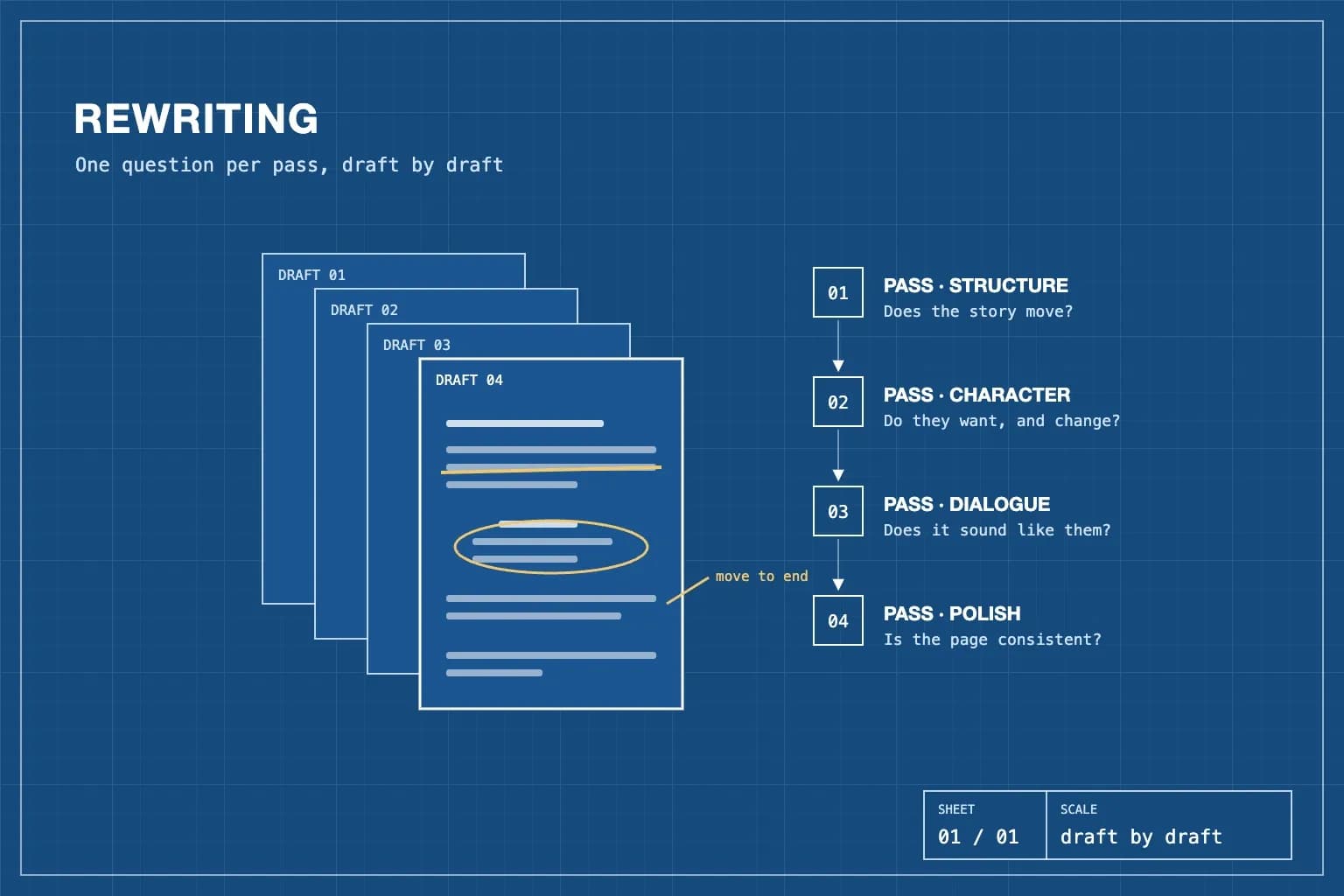
Don't start at page one and polish forward. Work from the largest problems to the smallest:
- Story and structure: the premise, the protagonist's goal, act breaks, the ending.
- Characters: motivations, arcs, the antagonist's strength, whose scenes can be merged or cut.
- Scenes: does each scene change something? If not, cut or combine.
- Dialogue: remove explanations, give each character a distinct voice.
- Polish: action lines, typos, format.
Write a short rewrite plan before you begin: the three to five changes this draft must make. It stops you from rewriting at random.
Step 6: Prepare your supporting materials
While the rewrite settles, write the documents that will travel with your script:
Step 7: Protect your work
In most countries, copyright applies automatically as soon as you write something down. Registration gives you dated proof of authorship, which helps if a dispute ever arises. In the United States, writers commonly register scripts with the U.S. Copyright Office and with the WGA Registry; other countries have their own registration options through writers' guilds and copyright offices. Keep dated drafts and emails as well.
Step 8: Decide where to send it
Not every script should go everywhere. Match the script to the opportunity:
- Contests and fellowships are good for new writers without contacts, as long as the contest has a track record.
- Managers and agents look for writers they can build careers with; a strong sample matters more than one sellable script.
- Production companies look for projects that fit their slate, budget and genre.
- Labs and funds often support specific kinds of stories, regions or first-time filmmakers.
Research each target before submitting, and keep a simple spreadsheet of where you sent the script, when and what happened. Our guide on how to get your script read by producers covers this step in detail.
Step 9: Submit strategically, then start your next script
Send to a small first round of targets rather than everyone at once. If the feedback reveals a problem, you can fix it before the second round without having burned every door.
Then start writing the next script. Waiting for answers is slow, and a writer with two strong scripts is more interesting to managers and producers than a writer with one.
What not to do after finishing your screenplay
- Don't send it the same week. Every reader gets one first impression.
- Don't send it to everyone at once. Keep targets in reserve for the next draft.
- Don't rewrite endlessly. At some point, more drafts make the script different, not better. When notes start contradicting each other, it may be time to send.
- Don't argue with feedback. Thank readers, take notes and decide later. A defensive reply ends the conversation.
- Don't pay for anything you haven't researched. Check contests, services and "producers" who ask for money before you send a script or a fee.
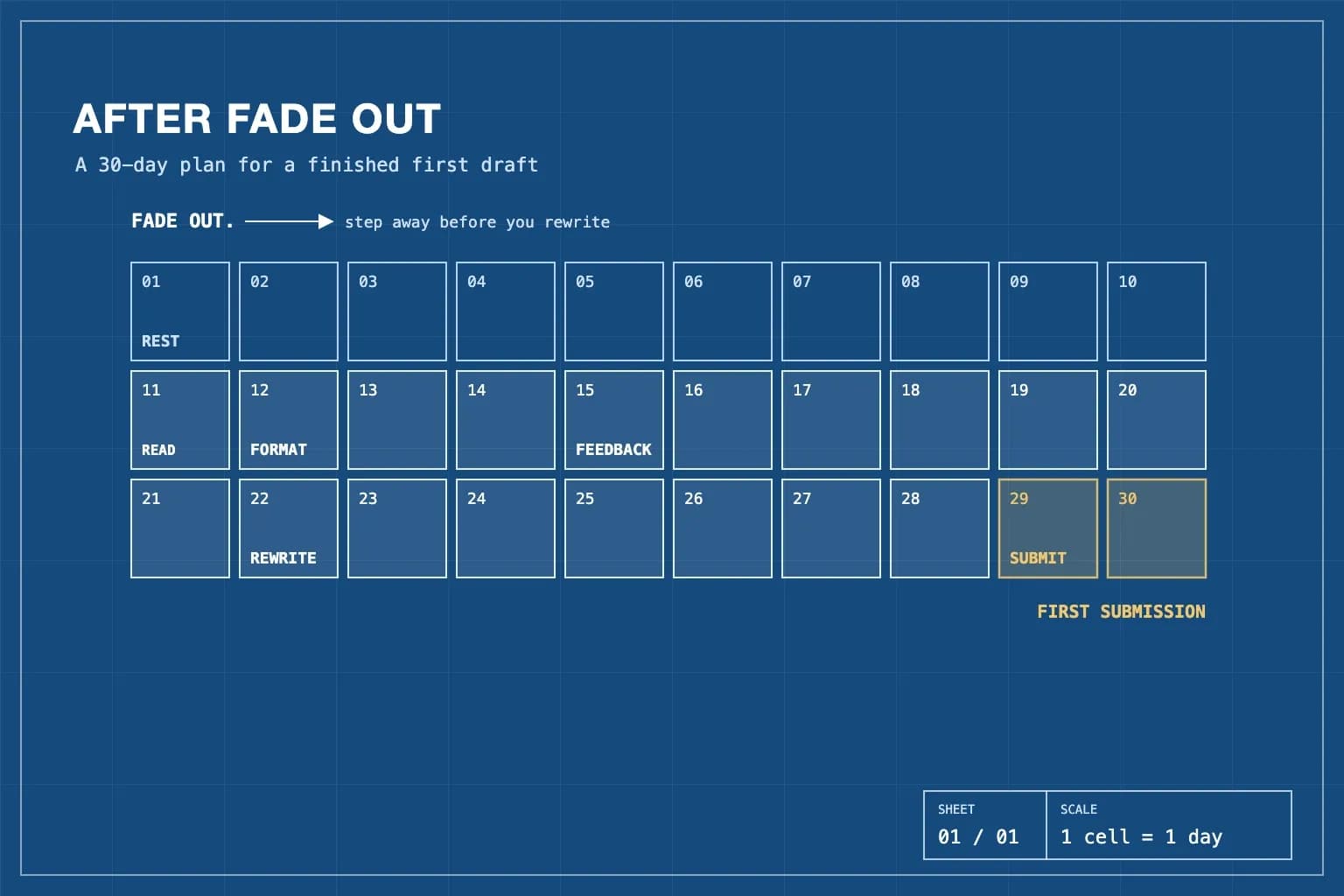
A simple 30-day plan
- Days 1–10: step away. Read produced scripts in your genre and start notes for your next idea.
- Day 11: read your draft in one sitting. Take notes; don't fix anything.
- Days 12–14: check format, consistency and page count. Hold a table read if you can.
- Days 15–21: collect feedback from trusted readers and a structured analysis or coverage.
- Days 22–28: write a rewrite plan and do the big structural fixes first.
- Days 29–30: write the logline, synopsis and bio, register the script and build your submission list.
Thirty days won't always be enough for a full rewrite, and that is fine. The goal is not speed; it is to make sure the first version anyone important reads is the best version you can write.
How many drafts does a screenplay need?
There is no fixed number. Some scripts are ready after two or three drafts, while others go through many rewrites and polishes before production, often with notes from producers, directors and actors along the way. A more useful question than "how many drafts?" is "does each draft fix something specific?" If you can name what the last draft improved, keep going. If you can't, it may be time to get outside eyes on the script.
Checklist: is your script ready to leave your desk?
- You have read it in one sitting after at least a week away
- You can state the story in one sentence and the protagonist's goal is clear
- The story starts by page 10–15 and the ending answers the opening question
- Format, names and page count are consistent and standard
- At least two outside readers or a structured analysis have read it
- You have rewritten based on patterns in the feedback, not single opinions
- Logline, synopsis and bio are ready
- The script is registered and you have a researched submission list
FAQ
How long should I wait after finishing a screenplay before rewriting?
At least a week, ideally two to four. The goal is to forget enough of what you meant that you can see what is actually on the page. Use the time to read other scripts or start a new idea.
Should I send my first draft to a contest?
Usually not. Contest readers see thousands of scripts, and most first drafts are not ready to compete. Rewrite at least once, ideally after outside feedback, and enter with your strongest draft.
Is it worth paying for script coverage?
It can be, if you use it to find problems before you submit. Coverage shows how your script reads to a stranger. Compare options by depth, turnaround and who is reading; an AI analysis such as Poetika gives a fast structured read you can combine with human feedback.
Do I need to register my screenplay before sending it out?
Copyright usually exists from the moment you write the script, but registration gives you dated proof of authorship. Many writers register before sending a script to people they don't know.
How do I know when my screenplay is finished?
When new drafts stop fixing specific problems, when outside readers' notes become matters of taste rather than confusion, and when you can pitch the story clearly in one sentence, the script is ready to send. Then start the next one.