What Is the “But and Therefore” Rule in Screenwriting?
Why some scripts drag even when every scene works, and how Trey Parker and Matt Stone's “therefore or but” test finds the weak joints in an outline.
May 12, 202612 min
Read Spoiler note: this post discusses the endings of Finding Nemo, Inside Out and Toy Story 3.
The "Pixar storytelling rules" are a list of 22 storytelling tips that former Pixar story artist Emma Coats posted on Twitter starting in 2011, drawn from what she learned working on Pixar films. They cover character (give your hero opinions and make them try), structure (cause and effect, earned endings, no lucky escapes), process (finish drafts, discard your first idea) and theme (know why you must tell this story). They are not an official studio rulebook, but they compress a working studio's habits into advice any screenwriter can use.
From Toy Story (1995) to Inside Out (2015), Pixar films have reached audiences of every age and culture, which is why writers keep reaching for this list. The tips are useful precisely because they are not a formula. They are practical principles built on three ideas: we follow characters we can empathize with, stories move through cause and effect, and emotional honesty makes even a talking fish believable.
Emma Coats was a story artist at Pixar, where she worked on Brave (2012). In 2011 she began tweeting short "story basics" she had picked up from directors and colleagues at the studio, from listening to writers, and from trial and error in her own work. In 2012 the tips were collected into a single list and spread across blogs and magazines as "Pixar's 22 Rules of Storytelling."
That label stuck, but it overstates things. Coats shared them as personal lessons, not as house rules, and she has pointed out that they came from many sources. Keep that in mind when you use them: they are tools a working story artist found helpful, not commandments that guarantee a hit.
Pixar's development process itself is closer to the spirit of the list than any rule. In his book Creativity, Inc. (2014), Pixar co-founder Ed Catmull describes the Braintrust, a group of filmmakers who watch a film in progress and give its director candid notes, and he is frank that every Pixar film starts out in bad shape. The tips are what that process looks like from the inside: constant testing and rewriting until the story works.
Here is a paraphrased summary, grouped by theme rather than by number. The numbers follow the order in which the tips are usually published.
Audiences bond with effort, not results. In WALL-E (2008), the little robot fails again and again, from his first clumsy attempts to impress EVE to his struggle to follow her across space, and that persistence is why we care. In Ratatouille (2007), Remy is a rat who wants to cook in a Paris restaurant, a goal so unlikely that every attempt carries tension. For more on what makes a lead worth following, see the anatomy of a great protagonist.
Coats warns that a passive, agreeable character may feel likeable while you write, but it drains the audience's interest. Woody in Toy Story has strong views about how Andy's room should run, and when Buzz Lightyear arrives convinced he is a real space ranger, the clash of two opinionated characters drives the whole film.
Ask what your character is good at and comfortable with, then build a story that takes it away. Marlin in Finding Nemo (2003) is a clownfish whose comfort is the safety of his anemone and his control over his son. The story sends him across the open ocean with a forgetful companion, Dory, where he can control nothing. This is the engine of a character arc: the story tests exactly the trait the character must change.
The most famous tip is a fill-in-the-blanks structure: once upon a time there was a character; every day they did something; one day something changed; because of that, something happened; because of that, something else happened; until finally the story resolved. Coats did not invent it. The Story Spine was created by improv teacher Kenn Adams as an exercise for improvisers, and it spread through improv classes, including ones taught to writers at Pixar.
Applied to Finding Nemo, it looks like this:
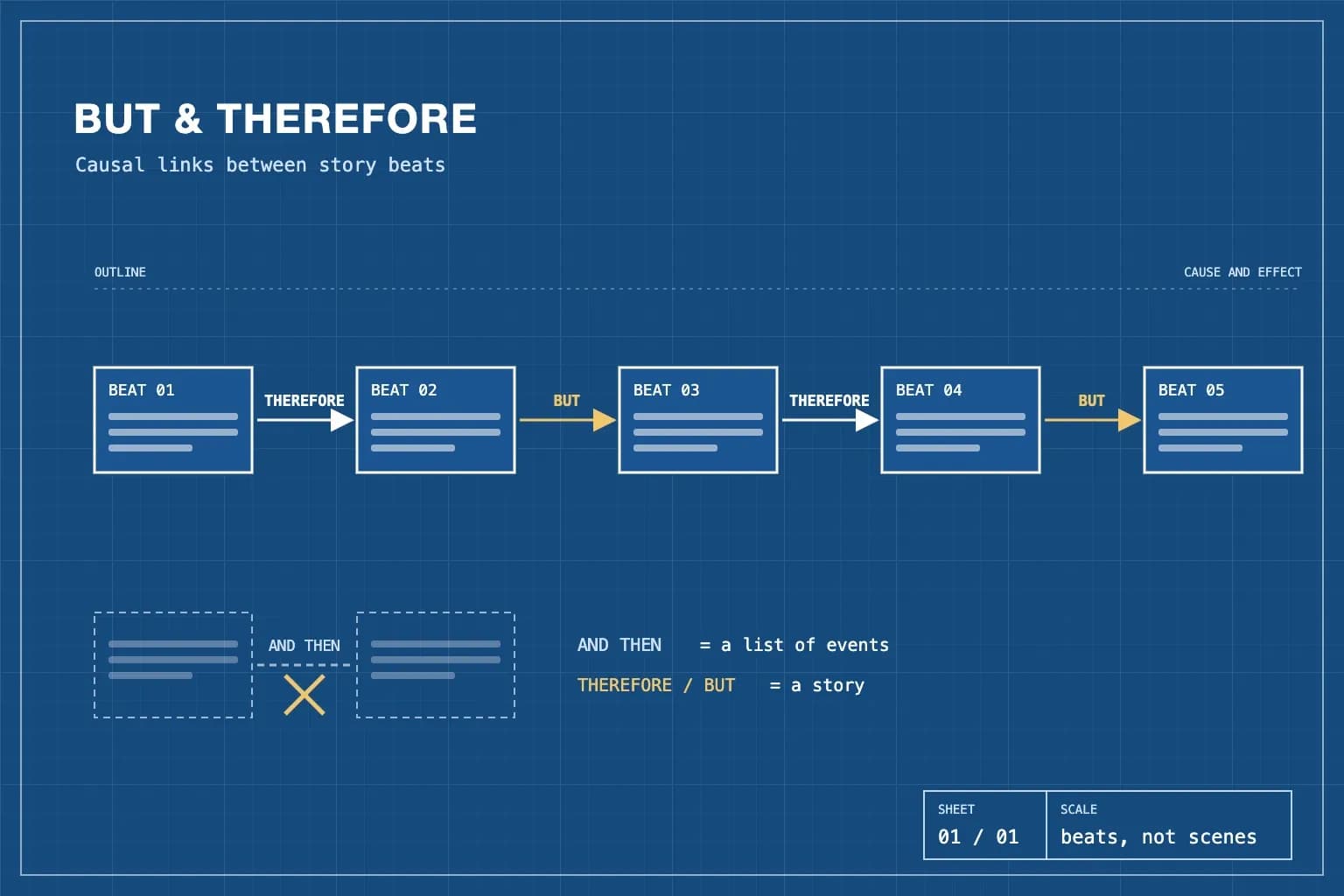
The "one day" line is your inciting incident. The repeated "because of that" lines are the real lesson: each event must cause the next. It is the same principle as the "but and therefore" rule that Trey Parker and Matt Stone describe: scenes linked by "and then" feel like a list, while scenes linked by "therefore" feel like a story.
Chance is a fair way to start a problem and a cheat when it ends one. In Up (2009), it is pure accident that the young Wilderness Explorer Russell is standing on Carl's porch when the house lifts off, and the audience accepts it because it makes things worse for Carl. In Bong Joon-ho's Parasite (2019), a sudden rainstorm cuts the Park family's camping trip short and sends them home while the Kim family is still in the house, a coincidence that only deepens the trouble.
Reverse the direction and the audience feels robbed. A rescue that comes from nowhere is the classic deus ex machina. When a film does use outside help, it works best when it was set up earlier. In Toy Story 3 (2010), the claw that saves the toys at the incinerator works because the aliens' devotion to "the claw" goes back to the first film and they are shown slipping away toward the crane earlier in the sequence.
Coats's advice is blunt: endings are hard, so get yours working early. Knowing where the story lands tells you what to plant along the way, which scenes earn their place, and which threads are detours. We look at why this is so difficult in why endings are the hardest thing to write.
What is fun to write is not always interesting to watch. Read your pages as a viewer would and ask whether each moment pulls you forward.
An idea that stays in your head stays perfect, which is why it never gets shared. Coats pairs two tips here: putting a story on paper is what lets you start fixing it, and finishing a draft, even an imperfect one, matters more than polishing the first act forever. Most of a screenplay's quality is made in revision, which is why rewriting makes a screenplay better. You can only rewrite what exists.
The first solution that comes to mind is usually the first that comes to everyone's mind. Coats suggests discarding the first, second and third ideas too, until you surprise yourself. A practical version: when a scene needs a turn, write five possible turns before picking one. Rule 9 is a companion tool for when you are stuck: list what wouldn't happen next, and the right answer often appears by contrast.
Rule 14 asks what belief burning inside you the story feeds on. Rule 3 adds a realistic warning: you may not know what the story is truly about until you reach the end of a draft, and then you rewrite with that knowledge. Theme is not a slogan; it is the conviction that decides which scenes stay.
Inside Out shows how far this can go. Joy spends the film trying to keep Sadness away from Riley's memories, and the resolution comes when Joy accepts that Sadness has a role: Riley can only reconnect with her parents once she is allowed to be sad. The structure and the theme are the same thing.
If you were your character, in this situation, how would you feel? Coats argues that honest answers lend credibility to unbelievable situations, and Pixar's worlds are full of them: talking toys, emotions with faces, a house carried by balloons. The opening of Up, which follows Carl and Ellie's marriage from first meeting to her death almost without dialogue, works because every moment is emotionally true.
The tips are most useful as diagnostic questions on a finished draft. Read your script and check:
A second pair of eyes helps here, because writers read what they meant rather than what is on the page. Alongside trusted readers, you can get a structured analysis of your screenplay with Poetika, which reports on structure, character and dialogue and shows where a story loses causality or a protagonist goes passive.
The 22 tips will not write your screenplay, but they will help you ask better questions of the one you have.
No. The list comes from tweets by Emma Coats, a former Pixar story artist, beginning in 2011. She shared them as lessons learned from colleagues, directors and her own work, and blogs later collected them as "Pixar's 22 Rules of Storytelling." They reflect how people at the studio think about story, but they are not an official company document.
It is the structure behind rule 4: once upon a time, every day, one day, because of that, because of that, until finally. It was created by improv teacher Kenn Adams as an improv exercise and later reached Pixar through improv training. Its main value is testing causality: if your events cannot be linked with "because of that," the story probably needs work.
Many writers point to rule 19, about coincidence, and rule 13, about giving characters opinions, because they fix the most common draft problems: lucky escapes and passive protagonists. Rule 4 is also valuable as a quick test of cause and effect. The right answer depends on what your current draft is missing.
Yes. None of the tips are specific to animation. They deal with character, causality, stakes, theme and process, which apply to any screenplay. Thrillers, dramas and comedies all benefit from opinionated protagonists, earned endings and clear stakes, and the same rules can be seen at work in films far from Pixar.
Why some scripts drag even when every scene works, and how Trey Parker and Matt Stone's “therefore or but” test finds the weak joints in an outline.
Think of a film that stayed with you long after the credits rolled. Not because of its plot twists or visual effects, but because of what happened to the person at its center. The way they started as one thing and ended as something else or the way the story made you desperately wish they had. That experience has a name: character arc. And it is the single most important structural element separating characters who feel alive from characters who merely function.

Great films are often remembered through their protagonists. We speak of Michael Corleone rather than the structure of The Godfather, Travis Bickle rather than the plot of Taxi Driver, Charles Foster Kane rather than the investigative framework of Citizen Kane. This is not because character is more important than story, but because story is often experienced through character.
Explore a complete sample analysis and understand the feedback format.