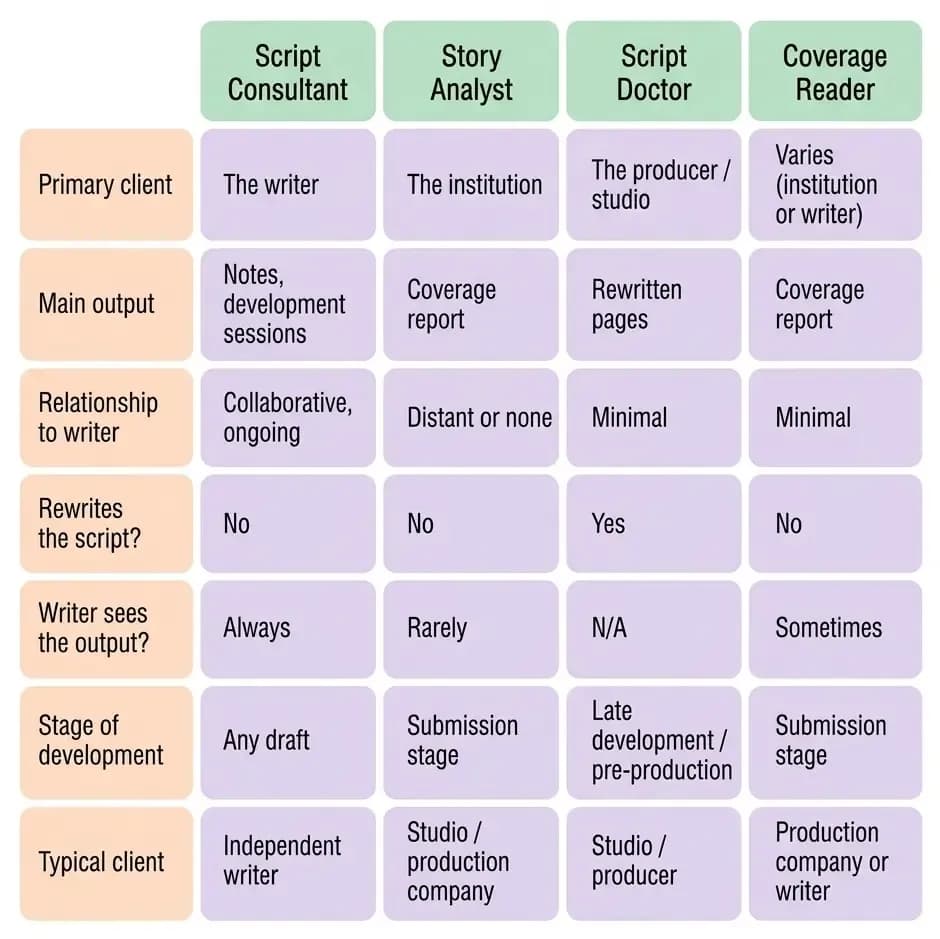
If you have spent any time trying to get feedback on your screenplay, you have encountered a confusing array of titles. Script consultant. Story analyst. Script doctor. Coverage reader. They all, in some sense, read scripts for a living. They all offer some form of feedback or evaluation. And they all cost different amounts of money for reasons that are not always clearly explained.
The confusion is understandable. The industry uses these terms inconsistently, and the roles do genuinely overlap at their edges. But they are not the same thing, and hiring the wrong one for the wrong purpose is a waste of time and money for everyone involved.
Here is what each role actually does.
How Poetika Works?
Explore a complete sample analysis and understand the feedback format.
The Script Consultant
A script consultant works directly with a writer to develop and improve a screenplay. The relationship is collaborative and ongoing: a consultant reads your script, identifies what is and is not working, and works with you — usually across multiple drafts — to help you solve the problems they find.
The emphasis is on the writer's growth as much as the script's improvement. A good script consultant does not rewrite your screenplay for you. They ask questions, offer perspective, and help you find your own solutions. They might point out that your second act loses momentum around page sixty, or that your protagonist's motivation is unclear, or that the thematic thread you set up in the opening does not pay off in the third act — and then work with you to understand why, and what you might do about it.
Script consultants typically work with writers at any stage of development: early drafts, mid-development, or final polish before submission. They are the most writer-focused of the four roles, and the most likely to build a long-term working relationship with the writers they serve.
The Story Analyst
A story analyst — sometimes called a reader — is primarily an industry professional rather than a creative collaborator. Story analysts work for production companies, studios, agencies, and competitions, reading submitted material and producing coverage: a standardized report that evaluates the screenplay for whoever commissioned the read.
The story analyst's primary client is not the writer. It is the development executive, producer, or competition director who needs to know whether a script is worth their time. Coverage typically includes a logline, a synopsis, an evaluation of the script's key elements, and a recommendation — Pass, Consider, or Recommend.
Most writers never see the coverage written on their scripts. It is an internal document, produced for the institution, not the author. A story analyst may write fifty pieces of coverage in a week, which means their relationship to any individual script is fundamentally different from that of a consultant working closely with a single writer over several months.
Some story analysts also work independently, offering coverage as a paid service to writers who want an industry-style evaluation of their material before submitting it elsewhere. In this context, the document they produce is similar to studio coverage but written with the writer as the intended reader.
The Script Doctor
A script doctor is brought in when a screenplay already exists and needs significant repair — usually under time pressure, usually on a project that is already in development or approaching production. The script doctor's job is not to advise the original writer but to fix specific problems in the text, often without credit and often without any ongoing relationship with the project.
This is the most interventionist of the four roles. A script doctor may rewrite entire acts, restructure the narrative, punch up dialogue, or solve a specific story problem that has resisted the original writer's attempts to address it. They are hired for their speed and their craft, not for their pedagogical relationship with the writer.
Script doctoring is common in Hollywood but rarely acknowledged publicly. Many produced films have been touched by multiple uncredited writers brought in at different stages to solve specific problems. The work is often well-paid and largely invisible — the script doctor's goal is to make the film work, not to leave their fingerprints on it.
Script doctors are typically experienced, produced writers rather than consultants or analysts. They are hired by producers or studios, not by the original writer, and their involvement usually signals that the development process has reached a critical point.
The Coverage Reader
Coverage readers occupy a specific and often misunderstood niche. Like story analysts, they produce written evaluations of screenplays. Unlike story analysts, who typically work within institutions, coverage readers often work freelance — hired on a per-script basis by production companies, agencies, competitions, or individual writers seeking feedback.
The coverage a freelance reader produces is structurally similar to studio coverage: logline, synopsis, character breakdown, element-by-element evaluation, overall recommendation. The difference is the context. A freelance coverage reader working for a writer is producing a document intended to be read by that writer. A story analyst working for a studio is producing a document that the writer will never see.
Coverage readers are often the first professional eyes on an unsolicited submission. They are skilled at rapid assessment — reading a script, identifying its strengths and weaknesses, and communicating that assessment in a standardized format efficiently. What they typically do not do is enter into an ongoing developmental relationship with the writer or offer the kind of detailed, iterative feedback that a script consultant provides.
Which One Do You Actually Need?
The answer depends on where you are in the process and what you are trying to achieve.
If you are developing a screenplay and want a creative partner to help you make it better across multiple drafts, you need a script consultant. This is the most appropriate choice for writers who are still in the development phase and who want to grow through the process rather than simply receive a verdict on the current draft.
If you want to know how your script would be evaluated by an industry reader before you submit it, you need coverage— either from a freelance coverage reader or from a service that provides writer-facing coverage. This gives you an industry-style assessment of where the script currently stands.
If your script has already been submitted and you want to understand why it received a Pass, or if you want to benchmark it against industry expectations, a story analyst offering independent coverage services can provide that perspective.
If your script is already in development with a producer or production company and has a specific, identified problem that the existing team has not been able to solve, a script doctor may be brought in — but this is typically a decision made by the producer, not the writer.
A Note on Overlap
These roles are cleaner in theory than in practice. Many working professionals move between them depending on the project. A script consultant may also offer coverage as a standalone service. A story analyst may also do freelance consulting. A produced writer may take occasional script doctoring work while also consulting with emerging writers.
What matters is not the title but the specific service being offered and whether it matches what you actually need. Before hiring anyone to read your screenplay, it is worth asking: what will I receive, who is it written for, and what happens after the read is done? The answers to those three questions will tell you more than any job title.