There is a moment in Billy Wilder's Double Indemnity when Walter Neff, sitting alone in a darkened office, bleeding out from a gunshot wound, dictates his confession into a recording machine. He knows he is dying. He knows he has been played. And he tells the whole story anyway not because it will save him, but because there is a certain dignity in naming exactly how you destroyed yourself.
That moment is film noir. Not the shadows. Not the fedora. Not the cigarette smoke curling toward the ceiling. Those are furniture. The thing itself is the recognition that the world operates according to rules that have nothing to do with justice, that desire is the most dangerous force a person can carry, and that clarity real clarity about who you are and what you have done comes only when it is too late to matter. If you want to write film noir, this is where you start. Not with a visual style. With a worldview.
Analyze your script with Poetika
Get instant feedback on your screenplay in minutes.
What Film Noir Is And Where It Came From
The term "film noir" was not coined by the filmmakers who made these films. It was coined by French critics in 1946, when a wave of dark American films held back from European distribution during the war arrived in Paris all at once. Watching them in rapid succession, critics noticed something: these were not crime films in the conventional sense. They were something more unsettling. Something that required a new name.
The films had roots in several converging forces. German Expressionism, brought to Hollywood by directors fleeing the Nazi regime, contributed the visual language: extreme shadows, claustrophobic compositions, a sense that the physical world itself was distorted and threatening. Hard-boiled American literature Raymond Chandler, Dashiell Hammett, James M. Cain contributed the moral framework: a cynical, street-level view of American society in which corruption was not an aberration but a structural feature. And the psychological aftermath of World War II contributed the emotional temperature: a pervasive disillusionment, a suspicion that the ideals the war was supposedly fought to defend were not quite what they appeared.
The classic noir period runs roughly from 1941 (The Maltese Falcon) to 1958 (Touch of Evil). What followed — films that consciously drew on the tradition while operating in a changed cultural context — is generally called neo-noir. Chinatown (1974), Blade Runner (1982), L.A. Confidential (1997), Drive (2011): these are not classic noirs, but they are noir in their bones. The tradition is alive, and it keeps absorbing new contexts without losing its essential character.
Understanding this history matters for writers because it explains why noir is not a costume. You cannot put a trenchcoat on a conventional story and call it noir. The visual style emerged from the worldview, not the other way around.
The Essential Elements of Film Noir
Atmosphere and Visual Language
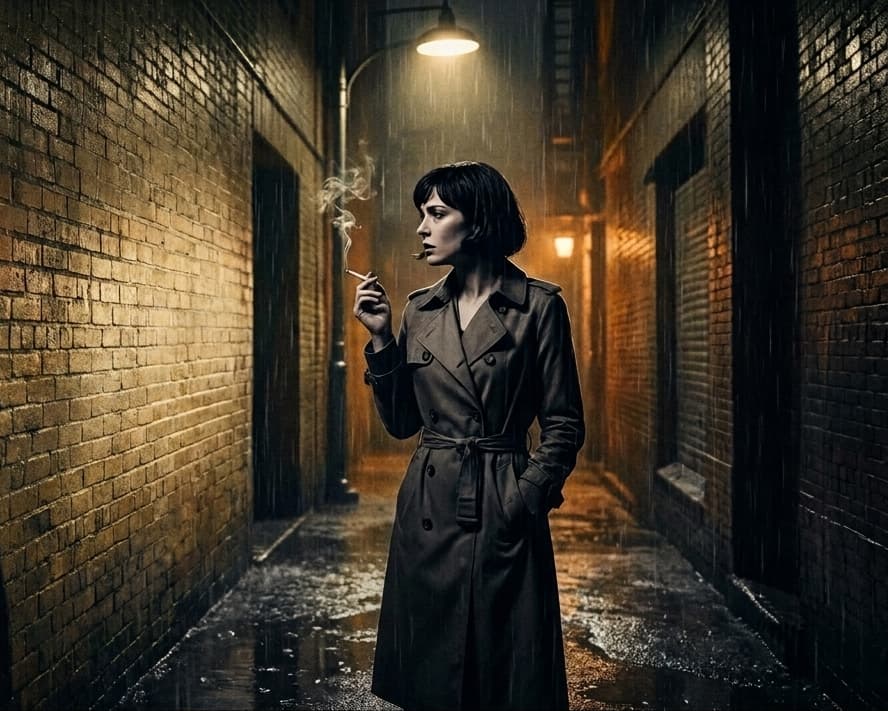
Noir has one of the most distinctive visual identities in cinema: high-contrast lighting, deep shadows, rain-slicked streets, venetian blind patterns across a face, smoke-filled rooms, the city at night. As a screenwriter, you do not control the cinematography. But you control what the camera is pointed at, and what the page tells the director the world looks like.
Writing atmosphere in a noir screenplay means choosing locations, times of day, and physical details that do the emotional work before anyone speaks. A scene set in a lawyer's office at noon in bright sunlight is a different scene from the same scene at midnight with a single desk lamp and rain on the window — even if the dialogue is identical. The page should make that distinction visible.
This does not mean over-writing description. It means choosing specific, evocative details that carry the tone efficiently. "The office is dark except for a single lamp" is more effective than a paragraph describing the room's dimensions. The reader's imagination fills in the noir atmosphere; your job is to trigger it.
Moral Ambiguity
This is the philosophical core of noir, and the element most often misunderstood by writers new to the genre.
Moral ambiguity in noir does not mean that everyone is equally bad, or that the story has no values. It means that the categories of good and bad do not map cleanly onto people. The protagonist may commit crimes. The antagonist may have understandable motivations. The institutions that are supposed to enforce justice — the police, the courts, the government — are revealed as corrupt or indifferent. And the choices characters make are shaped as much by desperation and desire as by anything resembling free will.
In a conventional crime story, the moral universe is essentially stable: crime disrupts order, the hero restores it. In noir, order is revealed to have always been a fiction. The crime does not disrupt a functional system; it reveals the dysfunction that was already there.
For a screenwriter, this means your protagonist should never be entirely sympathetic, and your antagonist should never be entirely monstrous. The more your characters occupy morally complicated middle ground — where their choices are understandable but not defensible — the more genuinely noir your story will feel.
The Femme Fatale
The femme fatale is film noir's most iconic and most misunderstood character type. Written poorly, she is a cliché: a beautiful woman who uses her sexuality to manipulate men, exists primarily as a threat to the male protagonist, and is punished by the narrative for her transgressions. Written well, she is something far more interesting.
The femme fatale works as a character — not just as a genre trope — when she has her own interior logic. She is not dangerous because she is evil. She is dangerous because she is trapped, and she has found the only available means of agency in a world that has given her very few options. She wants something — freedom, money, survival, revenge — and she has learned to use the tools available to her.
Phyllis Dietrichson in Double Indemnity is not simply a predator. She is a woman in a loveless marriage to a man who controls her finances and her life, who sees in Walter Neff a possible exit. Her calculation is cold, but it is also comprehensible. That comprehensibility is what makes her genuinely frightening rather than simply villainous.
When you write a femme fatale, give her a full interior life. Give her a reason. Give her something she wants that has nothing to do with the protagonist. She should feel like a person who would exist even if he were not in the story.
The Flawed Hero
The noir protagonist — traditionally male, though this has expanded significantly in neo-noir — is defined by exhaustion. He has seen too much of how the world actually works. He has no illusions about institutions, about justice, about the possibility of a happy ending. And yet he keeps moving forward, driven by some combination of professional habit, personal code, and desire that he cannot fully explain or control.
What makes the noir hero compelling is not his toughness but his vulnerability. He is susceptible — to money, to beauty, to the one case that reminds him of something he has been trying to forget. This susceptibility is the engine of the plot: the world offers him something he wants or cannot resist, and the story is what happens when he reaches for it.
In neo-noir, this character type has expanded to include women, people of color, and protagonists whose exhaustion takes forms other than the classic hard-boiled detective's cynicism. What remains constant is the fundamental quality: a person who knows better and does it anyway.
Voice-Over and Narration
Film noir invented the confessional voice-over, and it remains one of the genre's most distinctive formal features. Walter Neff dictating his confession. Jake Gittes's clipped, world-weary observations. The narrator in Sunset Boulevard speaking from beyond death.
The noir voice-over works because it establishes, from the opening frame, that we are receiving a story from someone who has already lived through it. The narrator knows how it ends. This creates a specific kind of dramatic irony: the audience watches events unfold while already knowing, or suspecting, that they will end badly. The question is not what happens but how — and watching the protagonist walk into the trap they have already described is one of noir's most characteristic pleasures.
If you use voice-over in a noir screenplay, it should do more than describe what we see or recap plot events. It should carry the story's emotional weight — the protagonist's relationship to their own past, their understanding of what went wrong, the particular quality of their regret or resignation.
Noir Story Structures
Most noir narratives follow one of three basic structural patterns, and understanding them helps a writer find the spine of their story before getting lost in the atmosphere.
The Investigation: A detective or amateur investigator pursues a case that proves to be more complicated — and more personally implicating — than it first appears. The investigation structure allows for gradual revelation: each discovery changes the meaning of everything that came before it. Chinatown is the purest example of this structure, and its most devastating feature is that the investigation leads the protagonist not toward resolution but toward a truth that is worse than ignorance.
The investigation structure suits writers who want to build a story around gradually deepening mystery. The key is that each revelation should not just add information it should reframe everything the audience already knows.
The Trap: An ordinary person — not a detective, not a professional criminal — is drawn into a scheme that seems to offer an exit from their constrained life, and discovers too late that they have been set up, manipulated, or simply underestimated the consequences of what they are doing. Double Indemnity, The Postman Always Rings Twice, and Blood Simple all follow this structure.
The trap structure is built on dramatic irony: the audience often suspects, earlier than the protagonist, that things are not what they seem. The pleasure is watching the trap close — the protagonist's dawning awareness of what they have actually walked into.
The Descent: A character with some status professional, social, or moral — is gradually stripped of everything as a consequence of their own choices, desires, or the indifference of the world around them. Sunset Boulevard, A Simple Plan, and Nightcrawler all trace this arc. The descent structure is the most explicitly tragic of the three, and the most suited to stories where the protagonist's flaw is the primary driver of the narrative.
The descent works when the audience can see, clearly and early, exactly what is wrong with the protagonist — and then watches them refuse to see it themselves until it is too late.
Dialogue and Tone
Noir has its own language. The hard-boiled style that Chandler and Hammett developed in their fiction — spare, ironic, built on unexpected metaphors and a complete absence of sentiment — carries directly into the best noir screenplays.
The underlying principle is this: in a world where everyone is operating at some level of deception, direct speech is a form of vulnerability. Noir characters talk around things. They use metaphor and implication. They say what they mean only when they have nothing left to lose — which is why the confessional moment, when a character finally speaks plainly, carries so much weight.
Some qualities to aim for in noir dialogue:
Sentences are short. Paragraphs are not made. The rhythm is clipped, precise, and carries a sense of controlled emotion rather than expressed emotion.
Metaphor is used for things that cannot be said directly. "She had a face that belonged on a church ceiling and a voice that would get you excommunicated" this is not flowery language. It is the only precise way to say what the speaker means.
Irony is the dominant mode. Characters observe the world's corruption with a kind of weary detachment that is simultaneously armor and philosophy.
What to avoid: sentimentality, explicit statement of emotion, and exposition delivered through dialogue. Noir characters do not explain themselves. They reveal themselves through action and implication, and the audience does the work of understanding.
Classic and Contemporary Examples
Double Indemnity (1944) The purest expression of the trap structure, and the film that established many of noir's conventions. Wilder and Chandler's screenplay is a masterclass in how to write a protagonist who is both completely sympathetic and completely culpable. Walter Neff knows what he is doing. He does it anyway. And he narrates his own destruction with a clarity that is almost admirable.
Chinatown (1974) Robert Towne's screenplay is widely considered one of the greatest ever written, and for good reason: it takes the investigation structure and uses it to deliver a conclusion that is morally unbearable. The film's final line — "Forget it, Jake. It's Chinatown" — is the purest expression of noir's worldview. The hero uncovered the truth. It made everything worse. And the system that created the problem is entirely intact.
Blade Runner (1982) Neo-noir's most influential film, and proof that the genre can absorb new settings without losing its essential character. The existential questions Deckard confronts — what is memory, what is identity, what separates human from manufactured — are the same questions any noir protagonist faces, relocated to a dystopian future. The atmosphere is unmistakably noir; the philosophical content is unmistakably science fiction.
Drive (2011) A nearly wordless neo-noir that demonstrates how the genre functions without many of its traditional surface features. There is no hard-boiled dialogue, no voice-over, no femme fatale in the classic sense. But the moral universe is entirely noir: a man defined entirely by his professional skill, pulled toward something he cannot have, and destroyed by the collision between who he is and what he wants to be.
Common Mistakes and How to Avoid Them
Treating atmosphere as content: The most common error new noir writers make is believing that a visual style can substitute for a story. Dark locations, rain, and shadows are not a narrative. They are a container for one. If the story itself — the characters' desires, the moral dilemma, the structural trap — is not working, no amount of atmospheric description will save it.
Flattening the femme fatale: Writing the femme fatale as a purely predatory figure with no interiority, no motivation beyond manipulation, and no existence outside her relationship to the male protagonist is the fastest way to make your noir feel dated. She needs to be a full character — which means she needs to want something, to have a history, to make choices that follow their own logic.
Making the protagonist purely sympathetic: A noir protagonist who is simply a good person in a bad situation is not a noir protagonist. The genre requires that the hero be implicated — that their own desires, weaknesses, or choices have contributed to their predicament. The audience should feel the pull of what they want even while recognizing that wanting it will cost them.
Resolving the moral ambiguity: Noir endings are not happy, but more importantly, they are not clean. A story that resolves its moral complications where the guilty are punished, the innocent vindicated, and the system shown to function is a crime story, not a noir. If your ending provides genuine comfort, you may be writing the wrong genre.
Mistaking cynicism for depth: A story in which every character is simply corrupt, every institution simply rotten, and every outcome simply bad is not morally complex it is monotonous. The darkness of noir is most effective against something lighter: a protagonist who still wants to believe in something, a relationship that almost works, a moment of genuine feeling before the trap closes. Without some counterweight, the darkness loses its force.
A Practical Checklist for Writing Noir
Before you begin, or during revision, ask yourself these questions:
Does your protagonist want something that will cost them more than they are willing to acknowledge? The desire at the center of a noir story should be recognizable, understandable, and dangerous.
Is the world of your story structurally corrupt not randomly, but systematically? The corruption should feel like a feature of the system, not an accident within it.
Does your femme fatale (if you have one) have an interior life that exists independently of the protagonist? What does she want? What is she afraid of? What has the world given her to work with?
Is your protagonist implicated in their own downfall? The trap should close partly because of choices they made freely, not solely because of external forces.
Does your ending resist resolution? Can your characters walk away unchanged and unchastened? Or does the story make them and the audience confront something that cannot be taken back?
Is your visual world written into the page? Not over-described, but present: the specific details that tell a director what kind of film this is before the first location scout.
The Genre That Never Dies
Film noir has been declared dead several times. After the classic period ended in the late 1950s, critics assumed the genre was finished. Then Chinatown arrived. After neo-noir seemed to exhaust its possibilities in the 1990s, Drive and Parasiteand Wind River demonstrated that the form was still fully alive.
It keeps surviving because what it describes keeps being true. The world is not just. Desire is dangerous. Institutions protect themselves before they protect people. And clarity about your own situation — real, unsparing clarity — tends to arrive only when it is too late to help.
These are not comfortable ideas. They are not the ideas that most commercial entertainment is built on. But they are recognizable, and they are honest, and there is a specific kind of audience that responds to honesty about how the world actually works — even when that honesty is delivered in the form of a morally compromised detective standing in the rain at midnight, knowing everything has gone wrong and telling the story anyway.
That audience is yours. The question is whether you can give them a story worthy of what they already know.