What Is an Intimacy Coordinator? How Intimate Scenes Are Made Safely
Poetika Editor TeamMay 12, 20268 min read
An intimate scene, whether it is a kiss or a love scene with nudity, asks actors to be vulnerable in front of a crew, and it needs as much planning as a fight or a stunt. On many film and television sets today, that planning is handled by a specialist called an intimacy coordinator, who prepares the scene with the actors, the director and the production before the camera rolls. This article explains what an intimate scene is, what an intimacy coordinator does and how the practice developed, and it ends with what screenwriters can take from all this when they write such scenes.
What Is an Intimate Scene?
An intimate scene is any scene in which actors portray physical or emotional closeness in a way that exposes them: simulated sex, nudity, passionate kissing and similar moments. Industry guidelines use terms such as nudity, simulated sex and "hyper-exposed situations," and, according to SlashFilm, the role also covers scenes such as medical exams.
The key word is simulated. In a scripted film or series, the sex is acted, not real, and what the audience sees is made through camera angles, editing, wardrobe, barriers and choreography. What makes these scenes different from most others is that the actors' own bodies and boundaries are part of the work, which is why they need clear agreements and careful preparation.
What Is an Intimacy Coordinator?
An intimacy coordinator is a trained professional who helps a production plan and shoot intimate scenes so that performers give informed consent and feel safe, while the director's vision is still realized. The SAG-AFTRA standards for the role describe intimacy coordinators as "Professional Skilled Artists, with Broad Industry Knowledge, Skills and Training" who work with production staff to realize the director's vision while promoting adherence to safety-related terms and conditions.
The skills the standards list include consent, anti-harassment practice, movement coaching, the use of modesty garments and barriers, and mediation, and coordinators must also pass a state and federal background check. The role is sometimes compared to a fight or dance choreographer, because intimate scenes are also planned movement, though an intimacy coordinator's work includes agreements and communication as well as choreography.
Where the Role Came From
The role is newer to film and television than to the stage, where outside advisers and written guidelines for intimate scenes were already more common, including in professional theater and college programs. In the United Kingdom, intimacy coordinator Ita O'Brien developed the guidelines of her Intimacy on Set practice before the #MeToo movement, according to TheWrap.
In American television, one often-cited turning point involved The Deuce. TheWrap reports that actress Emily Meade asked HBO to add an intimacy coordinator to the show's second season, and HBO hired Alicia Rodis, a co-founder of Intimacy Directors International. HBO later used intimacy coordinators across its original scripted shows, and SAG-AFTRA partnered with Intimacy Directors International to standardize the role.
What an Intimacy Coordinator Does
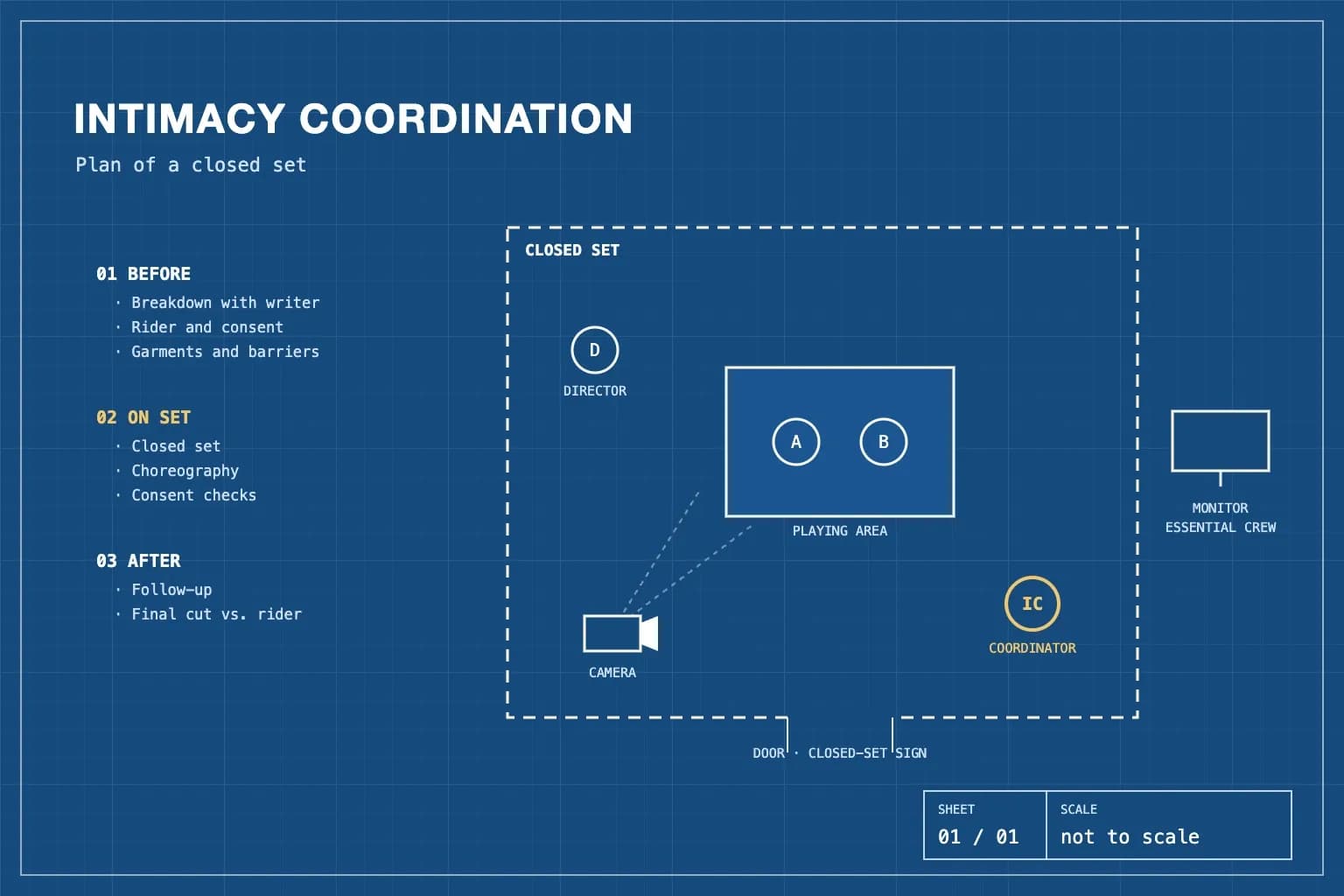
The work starts well before the day of shooting and continues after it, and the SAG-AFTRA standards divide it into three stages.
SlashFilm adds practical details: coordinators ideally join in pre-production, SAG-AFTRA requires at least 48 hours' notice before actors receive nudity riders, and intimate scenes are often scheduled early in the day and, for the main performers, after they have had time to get to know each other. The same article notes that the role is not limited to sex scenes, since it can also cover scenes such as medical exams and helping someone bathe. Its argument is that this preparation also improves the work, because performers who have agency do not spend the scene on high alert.
Consent, Closed Sets and Nudity Riders
Three practices appear again and again in industry guidance: written agreements, closed sets and consent that can be withdrawn. The details below come from SAG-AFTRA's quick guide for intimate scenes, which applies to productions under its agreements, so rules in other countries and under other contracts may differ.
Nudity riders and notice. Performers must be told about expected nudity or simulated sex before the audition if it is known, and a rider must be provided at least 48 hours before the call time on the day the scene is shot, unless the role was cast at very short notice. Performers must also be given the name and contact details of a representative who can answer questions about the rider.
Written, voluntary consent. Consent is conditioned on prior written consent, ideally in a rider attached to the contract, and performers should never be pressured to sign. A performer may withdraw consent at any time before footage is captured, even verbally, and if that happens the producer may use a double under the terms of the original rider.
Closed sets. The set is closed to everyone not essential to filming or rehearsing the scene. Monitors should be viewed only by essential production members, ideally in a private place, and personal recording devices are strictly prohibited.
The intimacy coordinator's job is to make these agreements work in practice: to explain them to everyone, to confirm them with each performer and to notice when a plan on paper no longer matches what is happening on set.
What Screenwriters Should Know
As a screenwriter, you rarely work with the intimacy coordinator directly, but your pages are where the process begins. The coordinator's first step is to review the script breakdown with the writer or executive producer and the director to decide how much nudity there is and what the simulated sex involves, so the way you write the scene shapes every conversation that follows.
Write what the scene is about. An intimate scene works like any other scene: someone wants something, something changes, and the audience learns something new about the characters. Ask what shifts between the characters, such as trust, power or distance, and write toward that.
Describe the moment, not the choreography. Choreography is built later with the actors, the director and the coordinator, and a page that prescribes every movement leaves them little room. A few precise action lines about what the characters do and how it feels usually say more than a long description.
Be clear about what is essential. If nudity matters to the story, make that visible in the scene's purpose, so the production can plan for it honestly. If it does not, you can leave it out without losing anything.
Keep the language professional. A script is read by actors, agents and crew before it is shot, and straightforward, non-graphic wording makes it easier for everyone to judge what the scene needs.
Think about other ways of telling it. Many memorable intimate scenes show the before or the after, a glance, a hand or a door closing, and let the audience feel what is implied.
Common Misunderstandings
"They only handle sex scenes." The role also covers nudity, other exposed situations and scenes such as medical exams, according to SlashFilm.
"They get in the director's way." The SAG-AFTRA standards describe the job as helping to realize the director's vision while promoting adherence to safety terms, and the coordinator advises on choreography and tries to keep the shoot moving.
"The role only protects performers." SlashFilm argues that it also produces better work, because performers who feel they have a say do not spend the scene on guard.
"It is a brand-new idea." The role has a longer history in theater, and film and television have only recently adopted it more widely.
Try It Yourself
Take an intimate or emotionally exposed scene from your own script, or write a new one in half a page, and answer these questions before you revise it.
What does each character want from the other in this scene?
What is different between them at the end of the scene, compared with the beginning?
Which lines of action are essential, and which only describe movement that actors and a director could find on their own?
Could the scene work if the audience saw less, such as the moments just before or after?
Is there anything in the scene you would need to explain to an actor before asking them to perform it?
Rewrite the scene with the answers in mind and compare the two versions.
FAQ
Is the sex in a film real? In scripted film and television, intimate scenes are simulated: they are acted and created with camera angles, wardrobe, barriers and choreography.
Does an intimacy coordinator decide what is in the script? No. The coordinator reviews the script breakdown with the writer or executive producer and the director and then helps the production carry out those decisions safely, but the creative decisions stay with the filmmakers.
Can an actor change their mind? Under SAG-AFTRA's guidance, a performer may withdraw written consent at any time before footage is captured, and may do so verbally. Rules on other productions depend on the country and the contract.
Is an intimacy coordinator needed for every kiss? There is no single rule that covers every production. Whether a coordinator is used depends on the scene, the contract and the production's own policies, and your producer or the relevant union can tell you what applies.
Should a screenwriter mention an intimacy coordinator in the script? No. Write the scene, and leave the production process to the production.
You have a script. You have a director. You might even have funding. And somewhere in the back of your mind, you are already thinking about the shoot. But before a single camera is set up, before a single actor is called, before anyone books a hotel room or rents a van, someone needs to sit down with that script and take it apart. Scene by scene, line by line. This is the script breakdown.
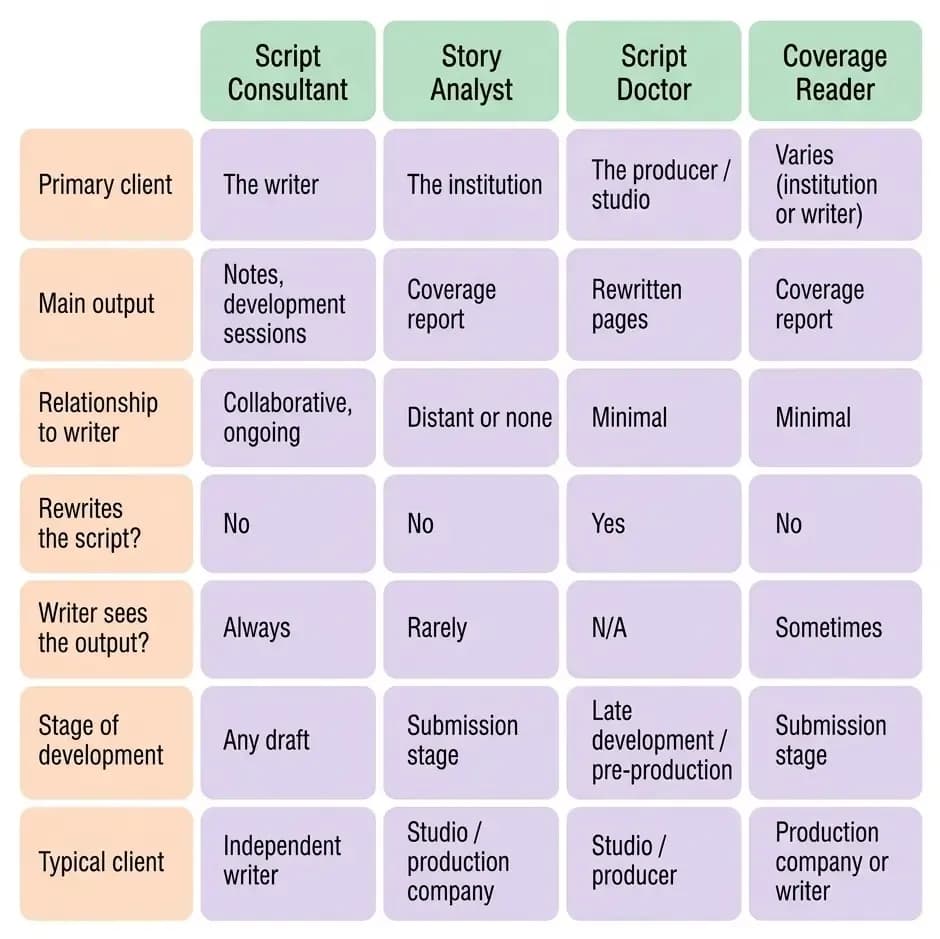
If you have spent any time trying to get feedback on your screenplay, you have encountered a confusing array of titles. Script consultant. Story analyst. Script doctor. Coverage reader. They all, in some sense, read scripts for a living. They all offer some form of feedback or evaluation. And they all cost different amounts of money for reasons that are not always clearly explained.
It is Monday morning. Over the weekend, twelve new scripts arrived. Nine more came in the week before. Somewhere in the inbox are scripts that have been waiting since last month, along with a few that have been there even longer. In two hours, the development meeting starts, and there is still a stack of material that nobody has had time to read.