Writer's block in screenwriting is the state in which a writer cannot move a script forward: the next scene won't come, every line feels wrong, or the blank page wins before a word is typed. It is rarely a lack of talent. Most of the time it is perfectionism, exhaustion or an unsolved story problem showing up as fear, and it responds better to specific techniques than to waiting for inspiration.
Every screenwriter meets the blinking cursor sooner or later, from first-time writers to Oscar winners. Charlie Kaufman turned his own struggle to adapt Susan Orlean's The Orchid Thief into the screenplay of Adaptation (2002). Federico Fellini built 8½ (1963) around a director who cannot find his next film. Being stuck is part of the job, and so is getting unstuck.
This guide explains what usually causes writer's block in screenwriting, then gives you 14 techniques in four groups: story fixes, pacing and environment, creative resets, and mindset. At the end there is a short diagnostic checklist to help you pick the right tool for the kind of block you have.
What causes writer's block in screenwriting?
"Writer's block" is a single name for several different problems. Before you pick a remedy, it helps to know which one you are facing:
- Perfectionism. You know roughly what happens next, but nothing you write is good enough, so you write nothing. The inner editor is running the drafting session.
- Exhaustion. You have been pushing for weeks, sleeping badly or writing around a full-time job. The tank is empty, and more willpower will not fill it.
- A structural problem. The story itself is broken somewhere upstream. A character wants the wrong thing, a scene has no purpose, or the second act has no engine. Your instinct refuses to write forward because forward leads nowhere.
- Fear of judgment. The script feels like a verdict on you as a writer. The closer you get to showing it to someone, the harder it is to continue.
- Loss of connection. You have lived with the project so long that you no longer remember why you wanted to write it.
Screenplays add their own pressure: the form is compressed, and it is tempting to polish page one forever instead of reaching page ninety.
The good news is that each of these causes has a practical answer. Some of the methods below attack the story, some attack the process, and some attack the mindset.
Story-driven fixes for writer's block (methods 1–4)
When the block comes from the story itself, no amount of discipline will help until you solve the narrative problem. These four techniques work on the script directly.
1. Write the bad version first
Give yourself explicit permission to write a terrible scene: flat dialogue, clumsy action lines, characters announcing exactly how they feel. The goal is to get from the start of the scene to the end so you can see its shape. A bad scene can be fixed; a missing one cannot.
2. Work backward from the scene's climax
If you don't know how a scene begins, decide how it must end. What has changed by the last line? Who has won, lost or learned something? Once you know the destination, trace the steps backward: what has to happen just before that moment, and just before that?
3. Change the character's choice
Writers often get stuck because a character is doing something they would never do, only because the plot needs it. Your instinct notices the lie even if you haven't named it. Try forcing the opposite decision: the character who was going to stay leaves, the one who was going to confess lies. Even if you go back to the original choice, the experiment usually shows you what the scene was missing. If the problem keeps coming back, look harder at character motivation: what does this person want, and why now?
4. Interview your protagonist
Step outside screenplay format and write a question-and-answer session with your main character. Ask what they want, what they are afraid of, what they would never admit, and what they think of the other characters. Write their answers in their voice, fast and without editing. This often uncovers the hidden need that drives a character arc, and it gets words on the page without the pressure of scene headings and page counts.
Pacing and environment shifts (methods 5–8)
Sometimes the story is fine and the problem is momentum. These techniques lower the cost of starting and make it easier to keep going.
5. Do a 15-minute micro-sprint
The Pomodoro Technique, developed by Francesco Cirillo, breaks work into 25-minute blocks separated by short breaks. When you are blocked, go even shorter. Set a timer for 15 minutes, promise yourself you can stop when it rings, and write anything that belongs to the script. Starting is usually the hardest part; once the timer is running, many writers keep going past the bell. If you are building a regular practice, see our guide to a daily screenwriting routine.
6. Switch to pen and paper
Move away from the screen. Writing longhand removes the blinking cursor, the formatting software and the temptation to delete every sentence as soon as it appears. It also slows you down just enough to think. You don't need to write in correct format. Scribble the scene as prose, or as a list of beats, and type it up later.
7. Change where you write
A different room, a library, a café or a park bench can break the association between your desk and the feeling of being stuck. Some writers keep one place for drafting and another for rewriting, so each location carries its own mode of work.
8. Stop mid-scene, when you know what comes next
In A Moveable Feast, Ernest Hemingway describes stopping his day's work at a point where he knew what would happen next. The idea is simple: never end a session at a dead end. Stop in the middle of a scene you understand, or leave yourself a two-line note about the next beat. Tomorrow's session then starts with a task you can do immediately instead of with a blank page.
Creative resets and subconscious mining (methods 9–11)
When your mind feels cluttered or empty, these techniques give it room to work on the problem in the background.
9. Do a brain dump
Freewriting, popularized by Peter Elbow in Writing Without Teachers, means writing continuously for a set time without stopping to judge. Julia Cameron's "morning pages" in The Artist's Way use a similar idea: three longhand pages first thing in the day. Spend ten minutes writing every thought, worry and half-idea in your head, including complaints about the script. You will often find the solution to your story problem buried somewhere in the middle of the mess.
10. Write a side scene or a short piece
Pause the main screenplay and write something small and unrelated: a one-page scene, a monologue, a character sketch for a different project. Because nothing depends on it, the pressure disappears, and you remember that you can write. The Coen brothers wrote Barton Fink (1991), a film about a blocked screenwriter, in about three weeks while struggling with the script of Miller's Crossing, then went back and finished it. They have resisted calling it writer's block, but the pattern is a useful one: a detour can restart the main road.
11. Feed yourself art outside cinema
If you only watch films and read scripts, your ideas start to come from the same narrow pool. Visit a gallery, listen to instrumental music, read poetry or a novel, walk through a neighborhood you don't know. Films about writing can help too; we gathered some in films about the writing life.
Mindset and physical well-being (methods 12–14)
Some blocks are not about the script at all. They are about how you treat yourself while writing it.
12. Separate the writer from the editor
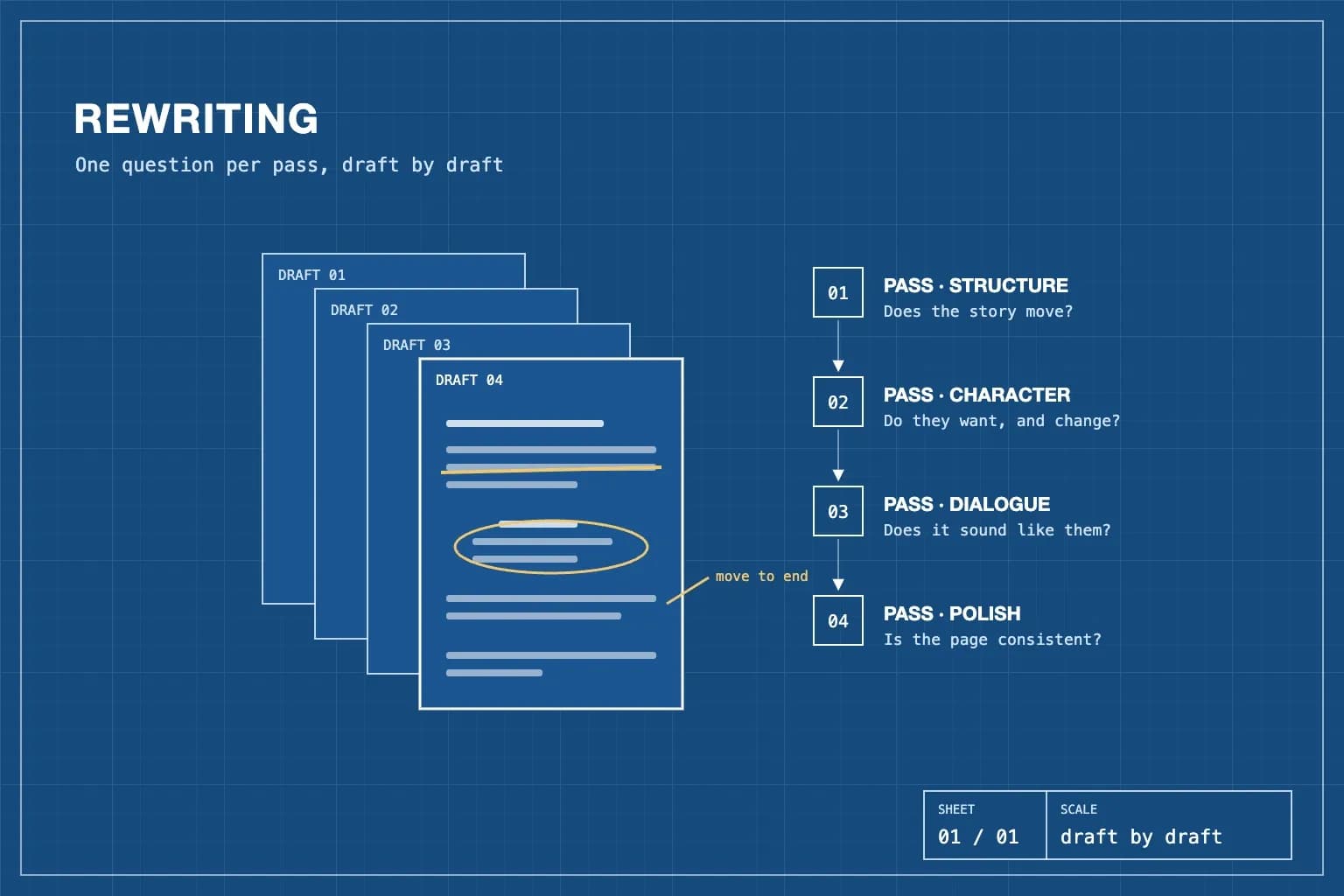
Drafting and editing use different muscles. The editor asks "Is this good?" while the writer needs to ask "What happens next?" If both run at the same time, the editor wins and the page stays blank. Give each a separate session: draft first, judge later. Knowing that rewriting is where a screenplay gets better makes it easier to accept a rough first pass.
13. Take a brisk walk
Movement is one of the oldest cures writers use, and there is some research behind it. In a 2014 Stanford study, Marily Oppezzo and Daniel Schwartz found that people generated more creative ideas while walking than while sitting, indoors or outdoors. The effect applied to brainstorming-style thinking rather than to problems with one right answer, which is exactly the kind of thinking a stuck plot needs. Take the problem with you, leave the phone in your pocket, and see what surfaces.
14. Go back to your original "why"
Re-read your logline, your first notes, or the scene that made you want to write the story. Ask what excited you about this idea and whether the current draft still contains it. If you can't state the story in one sentence, that is a sign the block may be structural; working on how to write a logline can clarify what the script is really about.
How to choose the right technique: a quick diagnostic
Match the method to the cause instead of trying all 14 at once:
- You know what happens but can't write it well enough: methods 1, 9 and 12.
- You don't know what happens next: methods 2, 3 and 4.
- You can't make yourself start: methods 5, 6 and 8.
- Everything feels stale: methods 7, 10 and 11.
- You are tired or anxious: methods 13 and 12, plus real rest.
- You no longer care about the story: method 14.
If you have tried several and nothing moves, the problem is probably bigger than one scene.
When writer's block is really a story problem
A common pattern: the writer pushes through the first act easily, slows down somewhere in the second, and stops completely before the midpoint. That is usually not a motivation problem. It means the story lacks a clear goal, rising stakes or a turning point to write toward, and your instinct knows it.
In that case, step back from pages and look at structure. Outline the remaining story in a few paragraphs, or write a short film treatment to test whether the whole arc holds. Ask an outside reader where they lost interest. You can also upload your draft to Poetika for a structured analysis of structure, character, dialogue and pacing; seeing where the story loses momentum on paper often explains why you lost momentum at the keyboard.
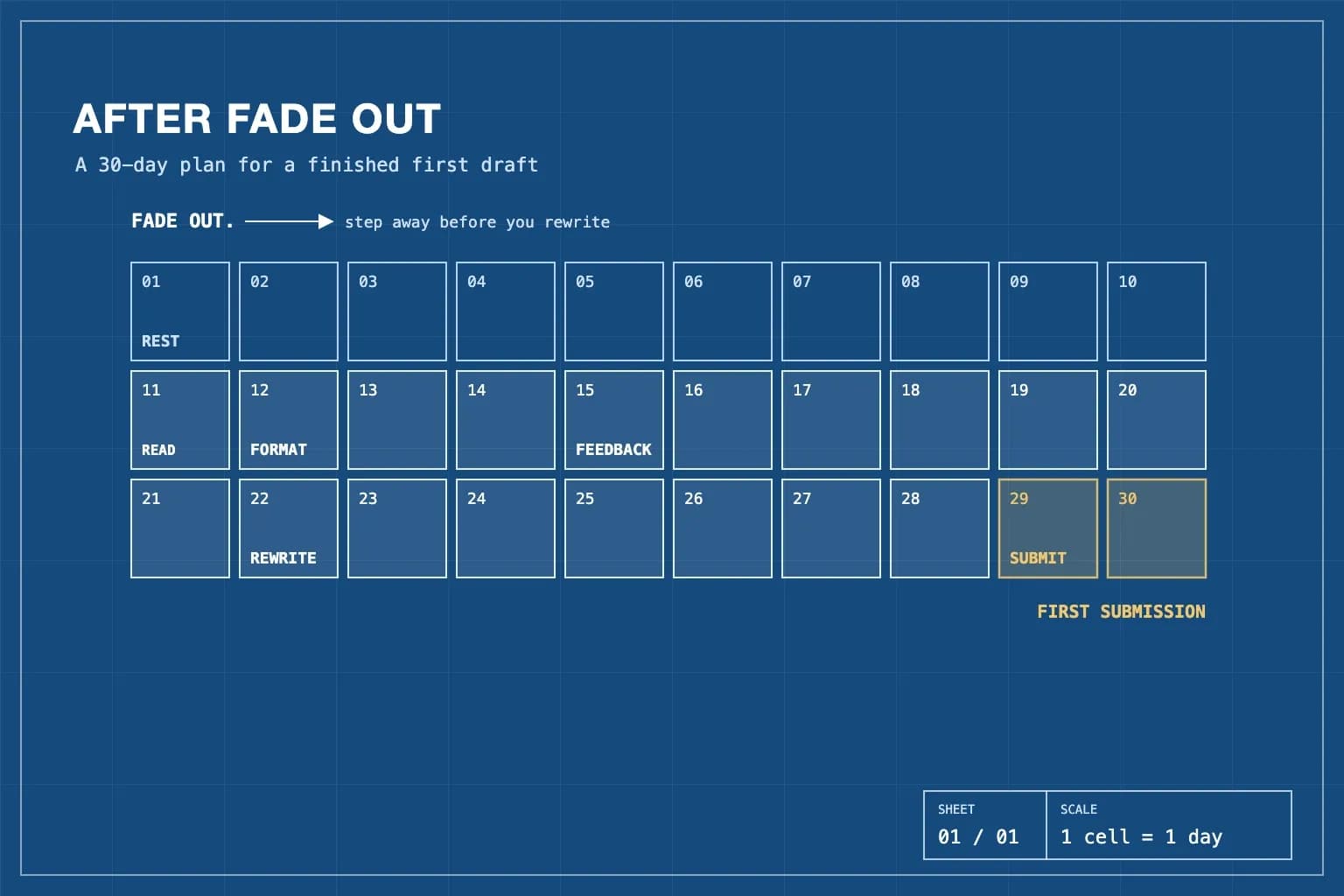
Even a half-finished draft can be diagnosed this way. And once you do reach the end, our guide to what to do after finishing a screenplay covers the next 30 days.
Getting unstuck is a skill, not luck
Writer's block is a signal, not a dead end. It tells you that something in your process or your story needs to change: the way you start, the place you work, the pressure you put on a first draft, or the logic of the plot itself. Professional writers get stuck as often as anyone. The difference is that they have a toolkit and use it without drama.
Discipline does not mean never getting stuck. It means knowing what to try when you do, and building habits that keep you writing over years rather than weeks. That long view is at the heart of building a sustainable screenwriting career.
Pick one method from this list today, try it for a single session, and keep the ones that work. When the pages start moving again and you want an outside view of the draft, Poetika can give you one.
FAQ
Is writer's block real?
Yes, in the sense that almost every writer experiences long stretches when they cannot move a project forward. It is not a medical condition or a sign of lost talent, though. It is usually a symptom of something specific, such as perfectionism, fatigue, fear of judgment or an unsolved story problem, and it responds to practical changes in process.
How long does writer's block last?
There is no fixed length. A block caused by tiredness may lift after a few days of rest, while one caused by a structural problem can last until the story issue is solved. If weeks pass without progress, stop waiting and change something concrete: the scene, the outline, the schedule or the place you write.
Should I stop writing when I have writer's block?
A short break can help, especially if you are exhausted. But a long pause often makes returning harder. A better approach is to keep a small daily commitment, such as a 15-minute sprint or a page of notes, so the project stays alive in your head while you work on the underlying problem.
How do professional screenwriters deal with writer's block?
Most rely on routine rather than inspiration: fixed writing hours, outlines before drafting, and permission to write rough first passes. Many work on more than one project, so they can switch when one stalls. Some, like the Coen brothers with Barton Fink, step briefly into a different script and then return.
Can feedback help with writer's block?
Often, yes. When a block comes from a story problem, an outside reader or a structured analysis can show where the script loses focus. Knowing what is wrong is usually easier than facing a vague sense that something is off, and it turns an open-ended block into a concrete rewriting task.