A screenwriting routine is a fixed, repeatable way of writing: a set time, a set place and a small daily target, such as two pages or 45 focused minutes, that you meet whether or not you feel inspired. It turns "write a movie" into a task you can finish today, and it is the main habit that separates writers who finish screenplays from writers who keep starting them.
Waiting for the muse is the fastest way to leave a script unfinished. Inspiration is real, but it is unreliable, and a feature screenplay asks for weeks or months of steady work. Professional writers treat writing more like a muscle than a lightning strike: it gets stronger with regular use and weaker with long breaks.
This guide explains how to build a screenwriting routine that lasts. The goal is not to produce brilliant pages every day. It is to create a sustainable rhythm, remove the friction that keeps you from starting, and respect the two different jobs of writing and rewriting.
Why professional screenwriters write on a schedule
The difference between an amateur and a professional is rarely talent. It is that the amateur writes when they feel like it and the professional writes when it is time to write. A staff writer in a TV room has deadlines every week; a screenwriter on assignment has a delivery date for each draft. They cannot wait for a good mood, so they build habits that produce pages on bad days too.
Anthony Trollope wrote in his Autobiography that he produced a fixed number of words every quarter of an hour, early in the morning, before going to his job at the Post Office. Stephen King says in On Writing that he aims for about ten pages a day. Raymond Chandler, who co-wrote the screenplay of Double Indemnity (1944) with Billy Wilder, advised in a 1949 letter that a writer should set aside a block of time each day in which he either writes or does nothing else at all. The routines differ; the principle is the same: show up at a known time and let the pages accumulate.
If you are still learning the craft itself, start with our step-by-step guide on how to write a screenplay. A routine is what carries that process from the first page to the last.
Focus on process, not outcome
Pages or minutes: choose a daily goal you can actually meet
There are two common ways to measure a writing day:
- Page count: a fixed number of script pages per day. Two pages a day sounds modest, but it adds up to a full first draft of about 110 pages in under two months.
- Time on task: a fixed block of focused time, such as 45 or 90 minutes, regardless of output.
Page goals suit the drafting phase, when the story is outlined and you need scenes on the page. Time goals suit outlining, research and rewriting, where a good day might produce only a page of notes or one fixed scene.
Whichever you choose, keep it small. A goal you miss three days out of four teaches you to fail. A small goal that you meet every day teaches you to finish, and on good days you will write well past it anyway.
Give yourself permission to write a bad first draft
Blank-page paralysis usually comes from trying to write the final version on the first attempt. Every line has to be good, so no line gets written. The cure is to separate the jobs: the first draft only needs to exist. As an old writers' saying puts it, you can fix a bad page, but you can't fix a blank one.
Anne Lamott's Bird by Bird (1994), one of the most loved books on writing, makes the same case with a famous chapter defending awful first drafts. Its title comes from a family story: her young brother, overwhelmed by a school report on birds, was told by their father to take it bird by bird. A screenplay is written the same way, scene by scene. We list more books like this in 5 books every screenwriter should read.
Track your progress
A visible record builds momentum. Keep a simple log: the date, pages or minutes, and one line about what you worked on. Some writers mark each writing day on a wall calendar and try not to break the chain of marks.
A log shows you that small daily amounts become a draft, reveals your real pace, and on discouraging days reminds you that you have done this before.
Protect your writing time and space
Find your sacred hour and guard it
Most writers have a time of day when their mind is sharpest. For many it is early morning, before email and other people's needs arrive. For others it is late at night, when the house is quiet. Experiment for a couple of weeks, note in your log when the pages came most easily, and then treat that hour as an appointment you cannot move.
If you have a day job, the hour may be short: before work, at lunch, or after the children are asleep. A protected 45 minutes every day beats a free Saturday that keeps getting cancelled. Our guide to building a sustainable screenwriting career looks at how working writers balance writing with paid work over years, not weeks.
Remove friction before you sit down
The hardest part of a writing session is often the first two minutes. Make them as easy as possible:
- Prepare the night before. Leave your screenwriting software open on the scene you will write, with your notes beside it.
- Silence your phone. Put it in another room, or at least switch off notifications during your writing hour.
- Block distractions. Use a focus app or your computer's focus mode to pause email, messaging and social media.
- Keep a dedicated space. A particular desk, chair or café table that you use only for writing helps your brain switch modes.
For a look at the software, research and organization tools that can support this, see the modern screenwriter's desk.
Build a ritual that starts the session
Many creative people use a small ritual to signal that work has begun. The choreographer Twyla Tharp describes in The Creative Habit (2003) how her day starts with the simple act of getting into a taxi to the gym before dawn; the ritual is the cab, not the workout. Dalton Trumbo famously wrote in the bathtub, a habit shown in the 2015 film Trumbo.
Your ritual can be ordinary: the same coffee, the same playlist, a timer, rereading your last page. Repeated often enough, it becomes a switch that puts you in writing mode without a fight.
Techniques that keep your momentum going
Stop when you know what happens next
In a 1935 Esquire piece, Ernest Hemingway advised writers to "stop when you are going good", while they still know what will happen next. Many writers push this further and stop in the middle of a scene, or even mid-sentence, so that the next session starts with something easy to finish.
Ending a session at the start of a scene you are excited about means you look forward to tomorrow instead of facing a blank slug line.
Separate drafting from editing
Drafting needs you to be generous and fast; editing needs you to be critical and slow. Doing both at once usually means you rewrite the first scene ten times and never reach the midpoint.
Keep the internal critic quiet during the first draft. If you spot a problem, leave a short note in the margin or in brackets and keep going. When the draft is complete, switch modes and start the rewrite, where most of a screenplay's improvement happens; we explain why in how rewriting makes a screenplay better. A structured outside read helps here: Poetika analyzes a finished draft and returns coverage-style notes on structure, character, dialogue and pacing, so your rewrite starts from a clear list rather than a vague feeling.
Plan tomorrow's scene before you stop
Spend the last five minutes of each session writing a few bullet points for the next scene: where it happens, who is in it, what the protagonist wants, and how it ends differently from how it began. You will never again sit down without knowing what to write.
How to handle burnout and resistance
The 15-minute rule for low-energy days
Some days you will be tired, distracted or simply unwilling. On those days, lower the goal instead of skipping it: commit to writing for just 15 minutes. Very often, once you start, momentum carries you further. And if it doesn't, you have still kept the habit alive, which matters more than any single day's pages.
The novelist Steven Pressfield, who spent years writing for Hollywood before his books were published, calls this force Resistance in The War of Art (2002): the inner pressure that grows strongest just before you sit down to do important work. Naming it helps. Resistance is a normal part of the job, not proof that you lack talent. If it hardens into weeks without writing, read our guide to writer's block in screenwriting.
Refill the creative well
A routine is not only time at the keyboard. Reading screenplays, watching films closely, walking, travelling and simply living all feed the work. Julia Cameron's The Artist's Way (1992) calls this filling the well and suggests a weekly solo outing purely for inspiration.
Make input part of the routine on purpose: read one produced screenplay a week in your genre, then watch the film to see how the page became the screen.
Forgive your off-days
Writing a screenplay is a marathon, and life will interrupt any routine. The danger is not the missed day; it is the guilt that turns one missed day into a missed month.
Make a simple rule: never miss twice. If you skip a day, the next day you write, even if only for 15 minutes. Don't try to make up the lost pages by doubling your goal, which only makes the next session harder to start.
A sample daily screenwriting routine
Here is one way to put these habits together. Adjust the times and amounts to your life:
- Prepare (5 minutes, the night before): open the file on tomorrow's scene and check your micro-outline.
- Start the ritual (5 minutes): make your coffee, put your phone in another room, start your timer.
- Draft (45 to 90 minutes): write toward your daily target without editing. Leave bracketed notes for problems.
- Stop while it's going well: end at a point where you know what happens next.
- Plan tomorrow (5 minutes): write three to five bullet points for the next scene.
- Log it (1 minute): record the date, pages or minutes, and one line about the session.
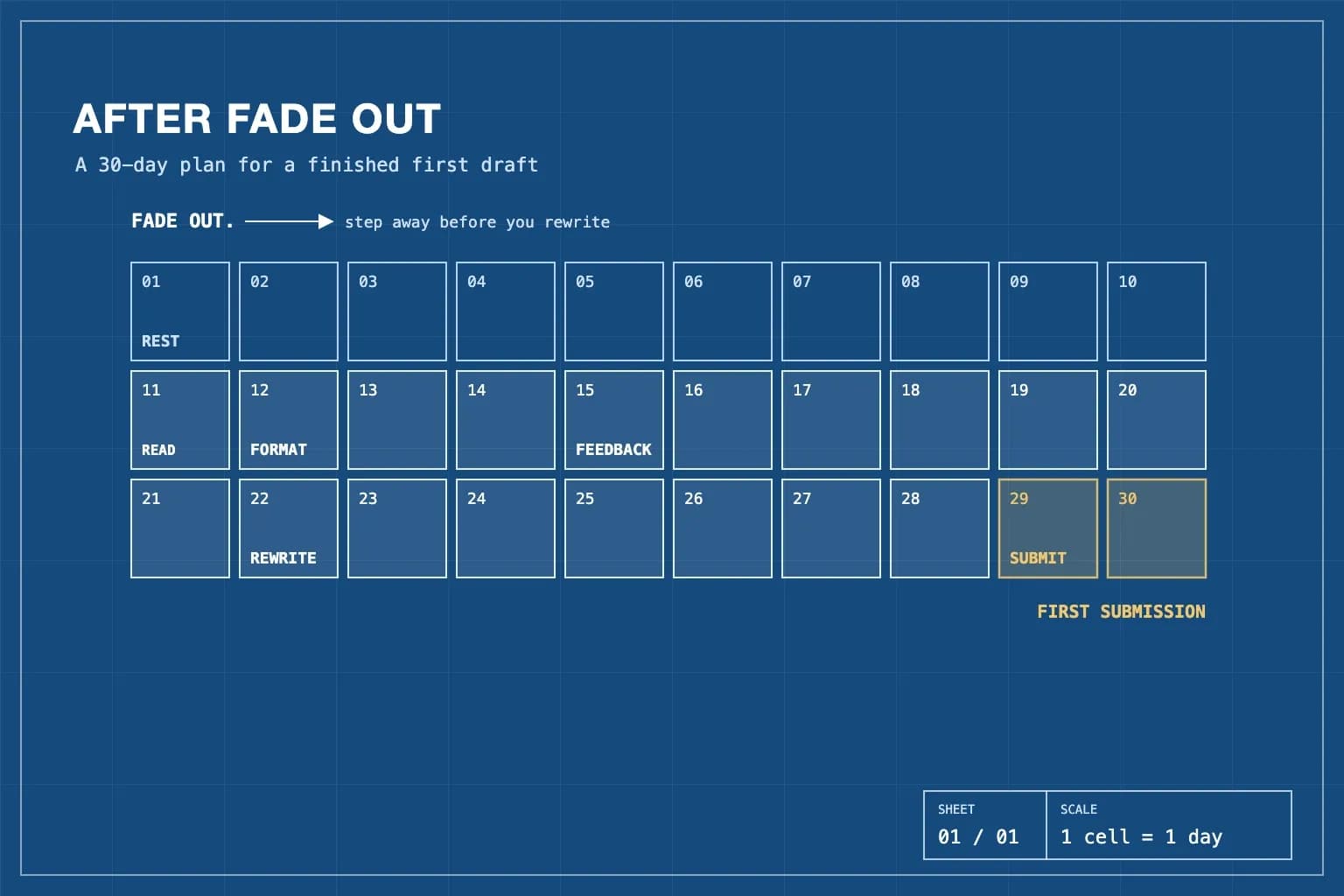
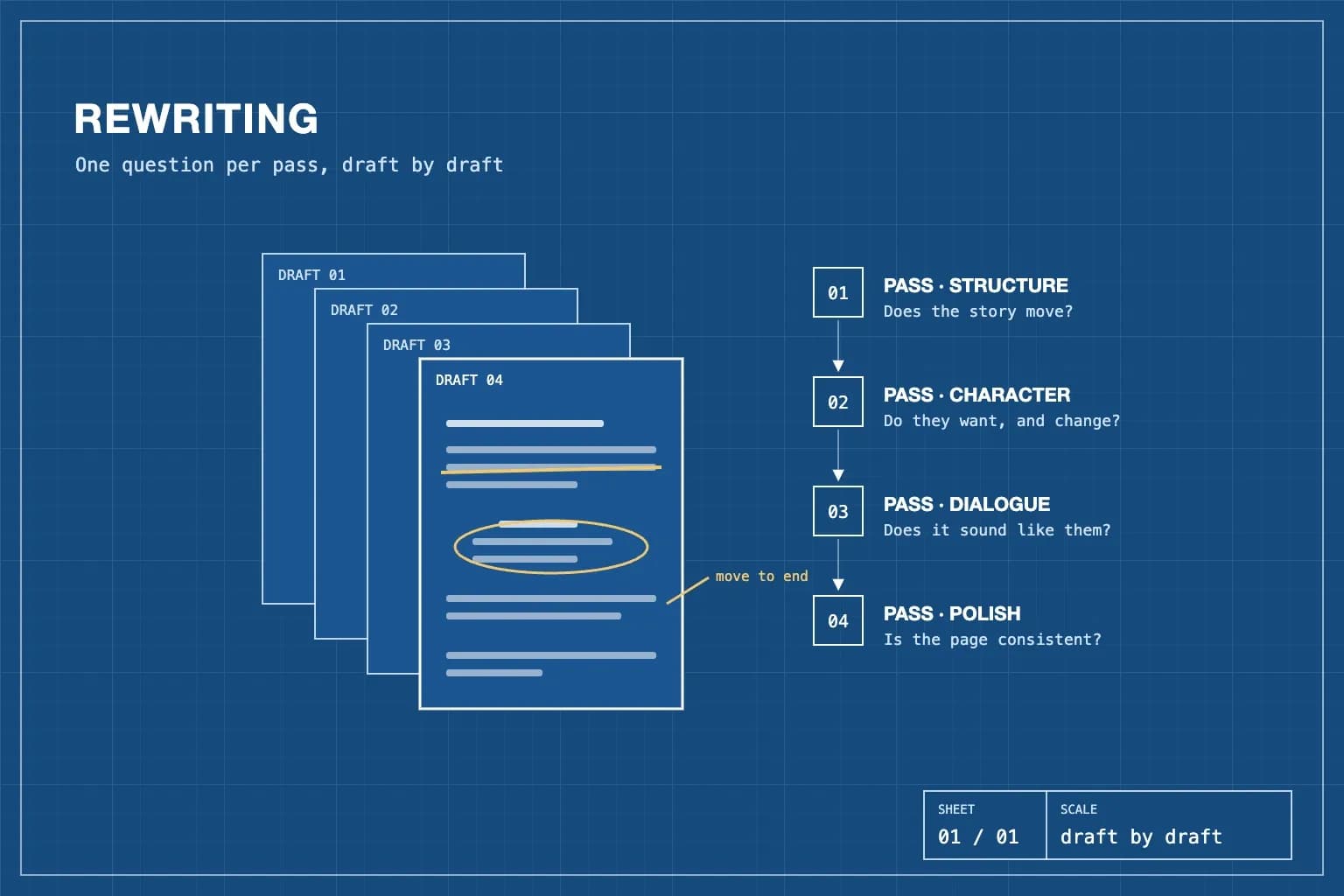
When the first draft is done, keep the same structure for rewriting, but switch to a time goal and work in passes: structure first, then character, then dialogue, then polish. When you finally type FADE OUT, our guide on what to do after finishing a screenplay walks you through the next 30 days.
Screenwriting routine checklist
- I have a small daily goal in pages or minutes
- My writing hour is fixed and protected in my calendar
- My phone and notifications are off while I write
- I have a short ritual that starts each session
- I stop when I know what happens next
- I write a micro-outline for tomorrow before I stop
- I log every session
- On low-energy days I write for 15 minutes instead of skipping
- I read at least one screenplay a week
- If I miss a day, I never miss two
A screenplay is built page by page, scene by scene, through ordinary days of steady work. Sit down at your usual time, open the file and write your two pages today. When the draft is finished, you can run it through Poetika to see where your rewrite should begin.
FAQ
How many pages a day should a screenwriter write?
There is no standard number, but one to three pages a day is a realistic target for most writers during the drafting phase. Two pages a day produces a feature-length first draft in under two months. Choose a number you can meet on an ordinary day, not your best day, and raise it only once the habit is stable.
Is it better to write in the morning or at night?
Neither is better in general. What matters is writing when your mind is sharpest and your time is least likely to be interrupted. Many writers prefer early mornings, before email and other obligations arrive, while others do their best work late at night. Test both for a few weeks and track which sessions produce the most usable pages.
How long does it take to write a screenplay with a daily routine?
With a solid outline and a goal of one to two pages a day, a first draft of a feature typically takes two to four months. Outlining before and rewriting after add more time, often more than the first draft itself. Professional writers on assignment may work faster, but a steady pace you can sustain matters more than speed.
What should I do if I miss several days of writing?
Restart small rather than trying to catch up. Write for 15 minutes the next day, reread your last scene and your notes, and rebuild the habit before raising your goal again. Missing days is normal for every writer; the routine only fails if a short break turns into abandoning the script altogether.
Should I write every day, including weekends?
Not necessarily. Many professional writers work a five-day week and treat weekends as rest or reading time. Consistency matters more than the number of days: a reliable schedule of five sessions a week beats an ambitious seven-day plan that collapses after a fortnight. Choose a schedule that fits your life and stick to it.