Spoiler note: the examples below discuss the structure and endings of Arrival and Rashomon.
To adapt a short story into a screenplay, you secure the right to use the story, identify its emotional core, and then rebuild that core as a sequence of visible actions, scenes and dialogue, adding or cutting material until it works as a film rather than as prose. The adaptation is not a transcription of the story. It is a new work that keeps what made the original matter and finds cinematic ways to express it.
Short stories have given cinema films such as Kurosawa's Rashomon, Ang Lee's Brokeback Mountain and Denis Villeneuve's Arrival. This guide walks through the process step by step, from the rights question to the rewrite.
Why short stories make good source material
Novels often have to be cut down to fit a film, which is why a great novel doesn't always make a great screenplay. Short stories usually work the other way. A story of twenty or thirty pages tends to have one central situation, a small cast and a single turning point, which is close to the shape of a film's core. The screenwriter's job is to build outward, not to amputate.
That gives you a clear center, with few subplots to hide the main conflict, and gaps that become room for your own scenes and images. The trade-off is that you will almost always need to create material the author never wrote, especially for a feature. That is where most of the craft lies.
Before you start: do you have the right to adapt it?
You can adapt anything for practice. But to submit, sell or produce the script, you need the legal right to use the story. Rules depend on country and on the work, so treat this as orientation, not legal advice.
Public domain stories
A story in the public domain can be adapted freely. Copyright terms differ by country: in many countries, including the EU member states and the UK, a work is generally protected until 70 years after the author's death, while in the United States works published more than 95 years ago have entered the public domain (as of 2026, those first published in 1930 or earlier). Ambrose Bierce's "An Occurrence at Owl Creek Bridge" (1890) and F. Scott Fitzgerald's "The Curious Case of Benjamin Button" (1922) are both old enough to be free in the United States.
Two traps to watch for: a translation can be protected even when the original text is not, and a story that is public domain in one country may still be protected in another where your film will be shown.
Stories under copyright
If the author is living or died recently, the story is almost certainly protected, and without permission you cannot legally exploit your script, however good it is. Producers will ask about the chain of title (who owns which rights) early.
Getting permission or optioning a story
The usual route is an option agreement: the rights holder grants you the exclusive right, for a set period, to develop the story and to buy the film rights if the project goes ahead. Contact the author's agent or publisher, who can usually tell you who controls film rights. Many writers of short fiction are open to a sincere approach, especially for a short film. Put any agreement in writing, ideally with an entertainment lawyer's help.
Step 1: Read the story closely and find its core
Read the story once for pleasure, then again with a pencil, asking:
- Whose story is it? Who wants something, and who changes?
- What is the central conflict? What stands between that character and what they want?
- What is the turning point? Where does the situation tip, and what does the character do about it?
- What is the feeling? What should an audience feel when the lights come up?
Try to write the story's core in one or two sentences, as if it were a logline. If you can't, the story's power may lie in its voice rather than its events, which makes it harder (not impossible) to adapt.
Step 2: Decide what to keep, change and cut
Make three lists: keep, change, cut. The "keep" list is usually short: the core, the ending or its spirit, and the few images that make the story unforgettable.
Everything else is negotiable. Adapters routinely change:
- Setting. Hitchcock's The Birds (1963) moved Daphne du Maurier's story from the English coast to Bodega Bay in California.
- Point of view and protagonist. Lee Chang-dong's Burning (2018) turns the married novelist who narrates Haruki Murakami's "Barn Burning" into a young, struggling aspiring writer, which shifts the story toward questions of class.
- Secondary characters. In Annie Proulx's "Brokeback Mountain", the two men's wives are barely seen; the 2005 film, written by Larry McMurtry and Diana Ossana, turns them into full characters and widens the story's emotional stakes.
Cut anything that exists only to explain, decorate or digress, however beautifully written.
Step 3: Rebuild the story as a visual structure
Prose can live inside a character's head and summarize years in a sentence. A screenplay can only show what a camera sees and a microphone hears.
From narration to action
Take each important passage of narration and ask: what would we see? A line telling us a marriage is cold becomes two people eating breakfast without speaking.
Voice-over can carry some of the narrator's voice, but use it deliberately, not as a way to read the story aloud over pictures. Learn how voice-over works in a screenplay before you rely on it.
From thoughts to behavior
Your screenplay must turn a character's inner life into behavior: choices, actions, hesitations, lies. Give them someone to argue with, so private thoughts become conflict. On screen, the audience watches change happen, which is how a character arc works.
Arrival (2016) shows how far this can go. Ted Chiang's "Story of Your Life" is told by a linguist addressing her daughter, mixing tenses in a way that only becomes fully clear by the end. Eric Heisserer's screenplay cannot use those tenses, so it builds the effect visually: we see scenes with the daughter that we take for memories and only later understand are glimpses of the future. The film also adds a global crisis that gives the linguistic puzzle a ticking clock.
Expanding a short story into a feature, or keeping it short
Decide early which form you are writing. A short story often maps naturally onto a short film. Robert Enrico's French short La Rivière du hibou (1962), adapted from Bierce's "An Occurrence at Owl Creek Bridge", stays close to the story and won the short film Palme d'Or at Cannes and an Academy Award for live-action short. If you go this way, check how many pages a short film script should be.
For a feature, you will need much more material, and there are three common ways to get it:
- Dramatize what the story summarizes. A sentence such as "they met every few years" can become several full scenes.
- Extend before or after. Show what led to the story's situation, or what follows it.
- Combine sources. Ryusuke Hamaguchi's Drive My Car (2021) builds a feature of around three hours from Murakami's short story of the same name, drawing in elements of other stories from the same collection and adding a rehearsal of Chekhov's Uncle Vanya. Kurosawa's Rashomon (1950) takes its plot from Ryūnosuke Akutagawa's "In a Grove" and its setting and title from his story "Rashōmon".
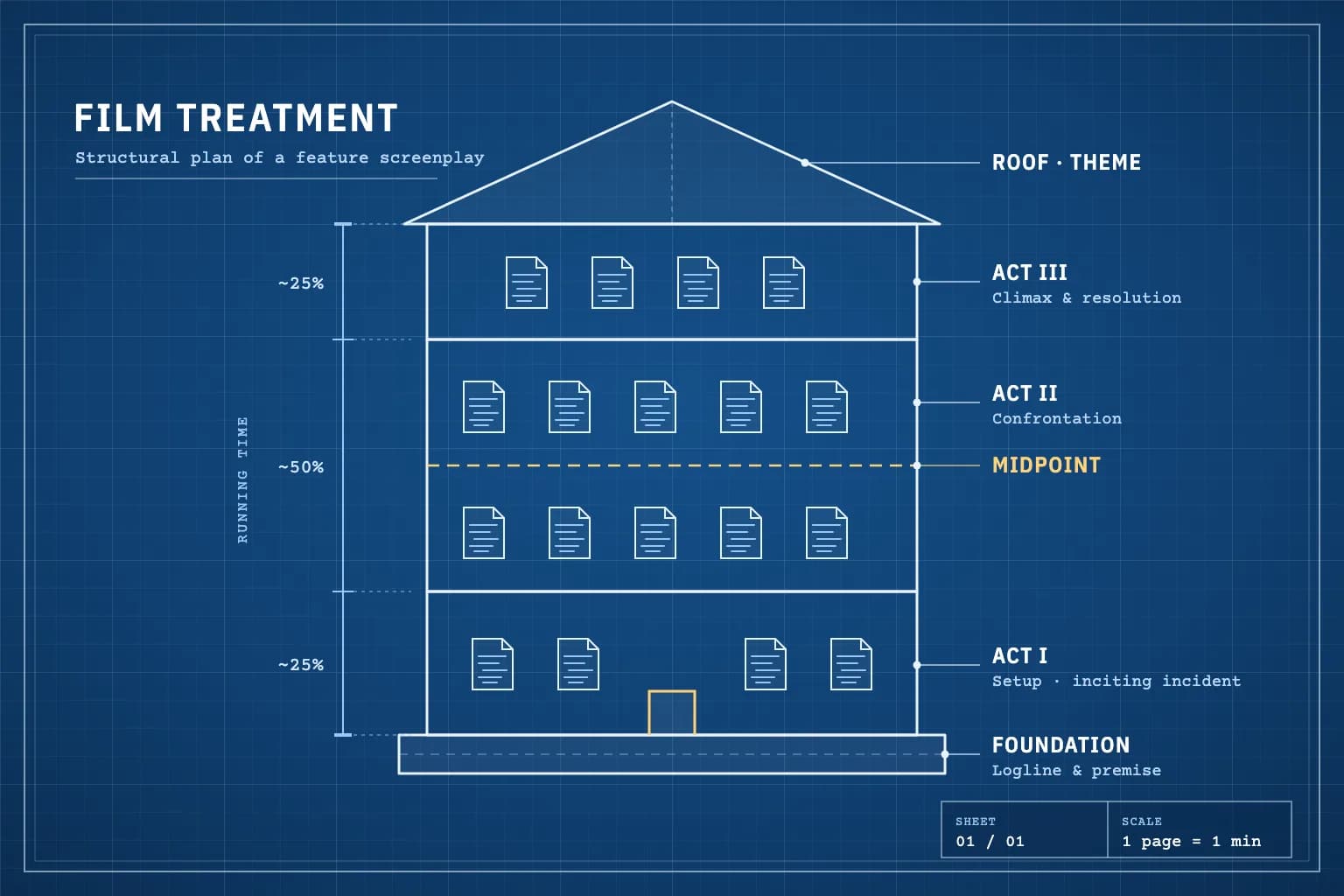
Whatever you add must serve the core, or the expansion will feel padded. A treatment lets you test the expanded structure before you commit to pages; see how to build a film treatment.
Step 4: Write the scenes and dialogue
Outline the screenplay scene by scene before writing. Each scene should change something: a character learns, decides, loses or gains. A useful test is to check that scenes connect through cause and effect rather than simple sequence, an idea explained in the "but and therefore" rule.
Resist lifting the story's dialogue wholesale. Lines that work on the page can sound stiff when spoken, and often carry exposition a scene should show instead. Keep the author's best lines, rewrite the rest for the ear, and let subtext do the work narration did.
Keep action lines lean, visual and in the present tense.
Step 5: Rewrite and check your adaptation against the original
Put the draft aside for a few days, then read it without the story beside you. Does it work for someone who has never read the original? Most of your audience won't have.
Then reread the story and compare:
- Is the core intact? Would the author recognize what the film is about, even if the events have changed?
- Did the feeling survive? Does the ending land with the same weight, or a deliberate new one?
- Is anything still prose? Look for passages of action that describe thoughts, backstory or feelings the camera cannot see.
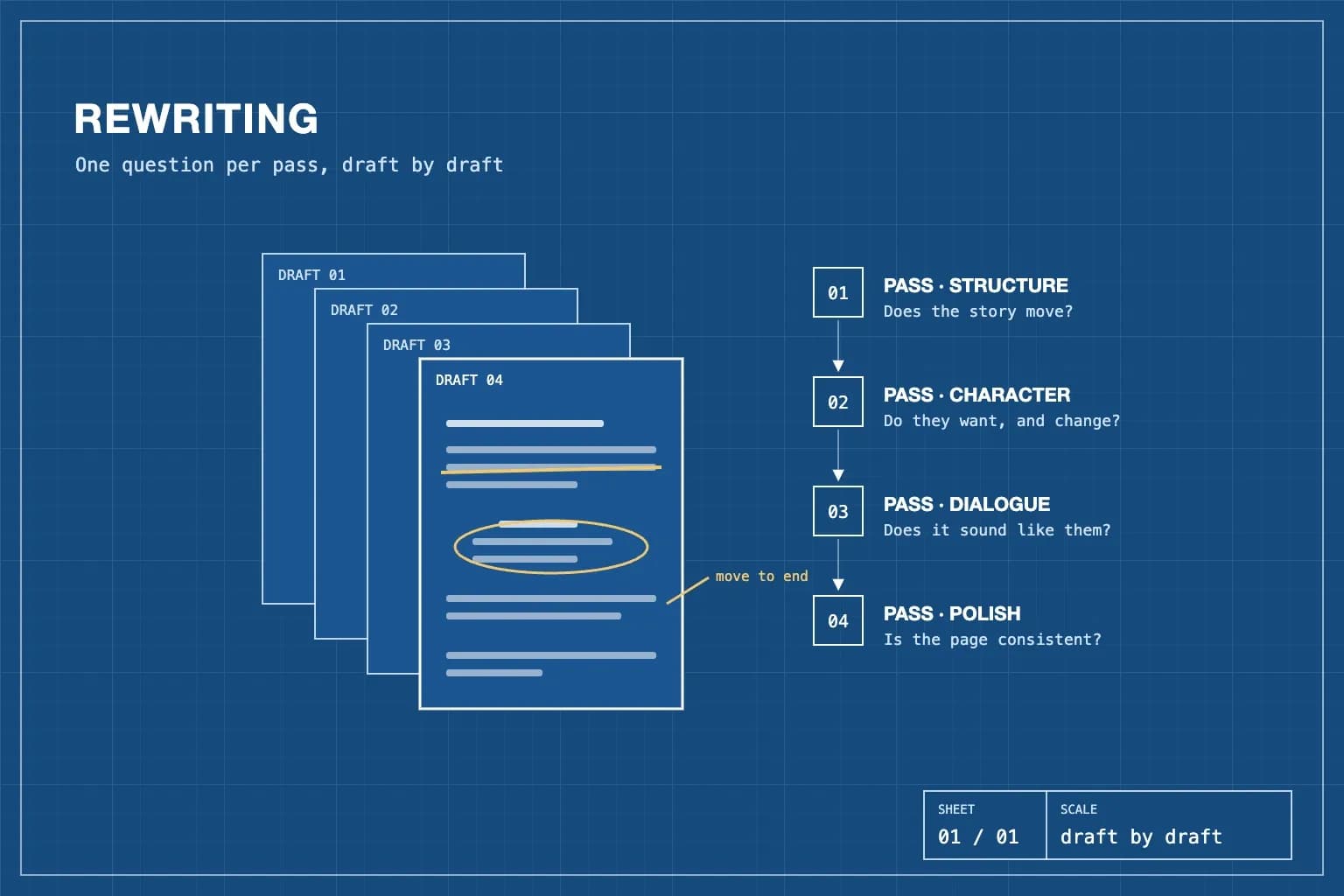
Rewriting is where adaptations find their own identity, which is why every draft matters. An outside read helps too: a structured analysis such as Poetika reports on structure, character, dialogue and pacing, which makes it easier to see whether your added scenes carry their weight or slow the story down.
Adaptation choices: faithful, loose or reimagined
Every adaptation sits somewhere on a spectrum. It helps to choose your position deliberately:
- Faithful: keeps the story's events, characters and setting, expanding only where film requires it. Enrico's La Rivière du hibou is close to this end.
- Loose: keeps the core and the main characters but changes setting, structure or emphasis. Brokeback Mountain and Arrival sit here.
- Reimagined: keeps a premise, an image or a mood and builds a largely new story around it. David Fincher's The Curious Case of Benjamin Button (2008) keeps Fitzgerald's idea of a man aging backward but changes almost everything else.
Fidelity to the spirit of the story usually matters more than fidelity to its events.
Examples of short story adaptations in film
- Rashomon (1950, Japan): combines two Akutagawa stories and adds the woodcutter's own version of events and a closing scene with an abandoned baby.
- Blow-Up (1966, UK/Italy): Michelangelo Antonioni moves Julio Cortázar's "Las babas del diablo" to swinging London.
- Brokeback Mountain (2005, USA): McMurtry and Ossana won the Academy Award for adapted screenplay.
- Arrival (2016, USA): restructured around a visual misdirection and a new external threat.
- Burning (2018, South Korea): an ambiguous Murakami story becomes a slow-burn mystery with a final act of its own.
- Drive My Car (2021, Japan): one story grows into a layered feature by combining sources.
Common mistakes when adapting a short story
- Copying the narration. Prose pasted into action lines or wall-to-wall voice-over makes the script read like a book.
- Keeping every scene. Loyalty to every event can leave a film with no shape.
- Explaining the character's thoughts. Action lines that tell us what someone feels, or characters announcing emotions, show the story hasn't yet become film.
- Padding instead of building. Extra incidents that don't serve the core make the expansion obvious.
- Ignoring the rights. A brilliant adaptation of a story you cannot license is a writing sample, not a project.
Many of the same principles apply when your source is real life rather than fiction; see how to adapt a true story into a screenplay.
Try it yourself
Pick a public domain short story you love and work through this checklist:
- Write the story's core in one or two sentences.
- List what you must keep, what you can change and what you will cut.
- Rewrite three passages of narration as visible action.
- Turn one character's inner thoughts into a scene of conflict with another character.
- Decide on a form: short film or feature, and how you will expand it.
- Outline the screenplay scene by scene, checking that every scene changes something.
- Write the draft, rest it, then compare it against the original.
FAQ
Do I need permission to adapt a short story?
You need permission if the story is still under copyright and you want to sell, submit or produce the screenplay. Writing an adaptation for practice is generally fine. Public domain stories can be adapted freely, but rules vary by country and translations may be protected separately, so check the specific work before you invest time.
How long should a screenplay adapted from a short story be?
It depends on the form you choose. Many short stories adapt naturally into short films, roughly a page per minute of screen time. A feature adaptation follows normal feature length, which means you will need to create substantial new material while keeping it tied to the story's central conflict and emotional point.
Can I change the ending of a short story when adapting it?
Yes, many adaptations change endings, but do it for a reason. The ending usually carries the story's meaning, so a new ending should express the same core idea in a way that works better on screen, or deliberately offer a new one. If you hold an option, check whether your agreement limits changes.
Should I use voice-over to keep the author's narration?
Use it only if it adds something the images cannot. Voice-over can preserve a distinctive narrative voice, but reading the story aloud over pictures usually makes a film feel static. Try first to express the narration through action, behavior and dialogue, and add voice-over afterward where it truly earns its place.
What makes a short story easy or hard to adapt?
Stories with a clear protagonist, a concrete conflict and strong visual moments adapt most easily. Stories whose power lies mainly in their language, interior monologue or ambiguity are harder, because those qualities have no direct screen equivalent. They can still become great films, but they demand more invention from the screenwriter.