Spoiler note: this post discusses the openings and twists of Sunset Boulevard, Fight Club and American Beauty.
Voice over in a screenplay is any speech the audience hears from a speaker who is not physically present in the scene, most often a narrator or a character's inner thoughts. On the page it is written as dialogue, with the extension (V.O.) after the character's name, so the reader knows the voice sits on top of the images rather than inside the scene. Used well, voice over gives a film a point of view no camera can supply on its own. Used badly, it explains what the pictures already show.
Some teachers tell beginners to avoid narration altogether, yet Goodfellas, The Shawshank Redemption and Amélie would be unthinkable without it. This guide explains what voice over is, the main types of narration, and how to write and format it so it earns its place in your script.
What is voice over narration?
Voice over (also spelled voice-over or voiceover, and abbreviated V.O.) is a recorded voice laid over the picture in post-production. The speaker may be a character in the story, an outside narrator, or a character's private thoughts. What defines it is not who speaks but where the voice comes from: it does not belong to the physical space of the scene, so the people on screen cannot hear it.
In a screenplay, voice over has two jobs. Technically, it tells the director, actors and sound department that the line is recorded separately and played over the images. Dramatically, it creates a relationship between a speaker and the audience: a narrator can confess, joke, mislead or remember, and that relationship becomes part of the story.
Voice over vs. narration vs. off-screen dialogue
- Voice over (V.O.): the speaker is not in the scene's physical space. Narration, inner thoughts, a remembered line, and often a voice heard through a phone when the caller is not shown.
- Narration: one use of voice over, in which a speaker tells or frames the story. Most film narration is voice over (the exception is a character speaking straight to camera), but not all voice over is narration: a single remembered line echoing in a character's head is V.O. without being narration.
- Off-screen dialogue (O.S.): the speaker is physically in the scene but outside the frame, such as someone shouting from the next room. The characters on screen can hear them.
The difference between V.O. and O.S. is the one that trips up most beginners, so we cover it in detail in our guide to V.O. vs. O.S. in a screenplay. The short test: if the characters in the scene could hear the voice, it is O.S.; if only the audience can, it is V.O.
Types of voice over narration
First-person narration
A character tells their own story, usually looking back. This is the most common form in feature films. Henry Hill in Goodfellas (1990) opens the film with "As far back as I can remember, I always wanted to be a gangster," and his voice guides us through decades of his life. Rocket narrates City of God (2002), the Brazilian film by Fernando Meirelles and Kátia Lund, as a witness who grows up surrounded by the violence he describes.
First-person narration does not have to come from the protagonist. In The Shawshank Redemption (1994), Red tells the story of Andy Dufresne, which keeps Andy a little mysterious and lets the ending surprise us. A first-person narrator can also be unreliable: in Fight Club (1999), the narrator's account turns out to hide the truth about Tyler Durden, and the twist reframes everything he has told us.
Third-person or omniscient narration
An outside voice tells the story with knowledge the characters lack. In Amélie (2001), André Dussollier's narrator lists characters' likes and dislikes with playful precision, setting the fairy-tale tone. In Barry Lyndon (1975), Michael Hordern's narrator often tells us what will happen before it does, which turns suspense into irony. The Royal Tenenbaums (2001) and the TV series Arrested Development (2003) use a detached narrator, voiced by Alec Baldwin and Ron Howard respectively, to add a deadpan, storybook distance.
Documentary narration
In nonfiction, the narrator explains and gives context. David Attenborough's narration of BBC natural history series such as Planet Earth (2006) is the classic example. It is usually written after the footage is cut, to supply what the images cannot: dates, names, causes, stakes.
Inner monologue
The audience hears a character's thoughts in the moment, not a later retelling. Travis Bickle's narration in Taxi Driver (1976) reads like entries from his diary and puts us uncomfortably inside his head. Inner monologue suits isolated characters and stories built on a gap between what someone thinks and what they say.
Benefits of voice over narration
Voice over solves specific problems:
- It gives a point of view. Narration tells us whose story this is and how they feel about it.
- It compresses time. A few lines can cover years, as the montage-heavy middle of Goodfellas shows.
- It creates irony. When the narration and the images disagree, the audience sees more than the narrator does, or more than the narrator admits.
- It sets tone. A dry narrator makes a comedy drier; a lyrical one, like the young Linda in Terrence Malick's Days of Heaven (1978), can make a film feel like memory.
- It frames the story. Narration can turn a film into a confession, a bedtime story or a testimony, which is a version of the framing device that holds a story within a story.
- It helps adaptations. Narration keeps some of a novel's interior voice, which is also why careless adaptations lean on it, as we explore in why a great novel doesn't always make a great screenplay.
Where voice over is used
Screenwriters meet voice over far beyond the feature film:
- Feature films and series: narration, inner monologue and framing voices. In TV, a narrator can become a show's signature, as with Mary Alice Young, who narrates Desperate Housewives (2004) after her death in the pilot.
- Documentaries: narration carries structure and information.
- Commercials, e-learning and explainers: the voice states the message and the visuals illustrate it.
- Video games: in Bastion (2011), a narrator voiced by Logan Cunningham comments on the player's actions as they happen.
- Audiobooks and podcasts: the voice is the whole medium, so it must carry setting and action without images.
Well-known examples in film
- Double Indemnity (1944): Walter Neff confesses the story into a dictaphone for his colleague Barton Keyes, so we know from the start that the scheme has gone wrong.
- Sunset Boulevard (1950): Billy Wilder's film is narrated by Joe Gillis, the writer whose body we see floating in a swimming pool in the opening minutes. A dead narrator gives every scene a fatal certainty.
- Blade Runner (1982): the theatrical cut's Deckard voice over was removed for the 1992 Director's Cut. Comparing the two versions is a useful study in what narration adds and takes away.
- American Beauty (1999): Lester Burnham tells us in the opening minutes that he will be dead within a year. The film becomes a story about how, not whether.
- Adaptation (2002): in a seminar scene, the screenwriting teacher Robert McKee, played by Brian Cox, warns writers against voice over, in a film that is itself full of it. The joke captures the whole debate.
None of these narrators simply describes what we are already watching.
Risks and common mistakes
Voice over is easy to misuse. These are the mistakes readers notice most often:
- Describing the picture. "I walked into the kitchen, angry" over a shot of an angry man walking into a kitchen adds nothing. If the image shows it, the narration should say something else.
- Explaining exposition. Using a narrator to dump backstory in the first pages is the most common misuse. Readers often see it as a sign that the writer has not found a way to dramatize the story, and it lands on many lists of common screenplay mistakes for that reason.
- Naming feelings the actor can play. "I had never been so scared" takes away the actor's job.
- Using it as a patch. If the story only makes sense with a narrator explaining it, the problem is in the structure.
- Appearing and disappearing. A narrator who speaks on page one and then vanishes until the end feels like an afterthought.
- Mixing up V.O. and flashback. Narration often introduces a flashback, but the two are different tools. If you use both, see our guide to writing a flashback in a screenplay so the timeline stays clear.
How to write voice over narration in a screenplay
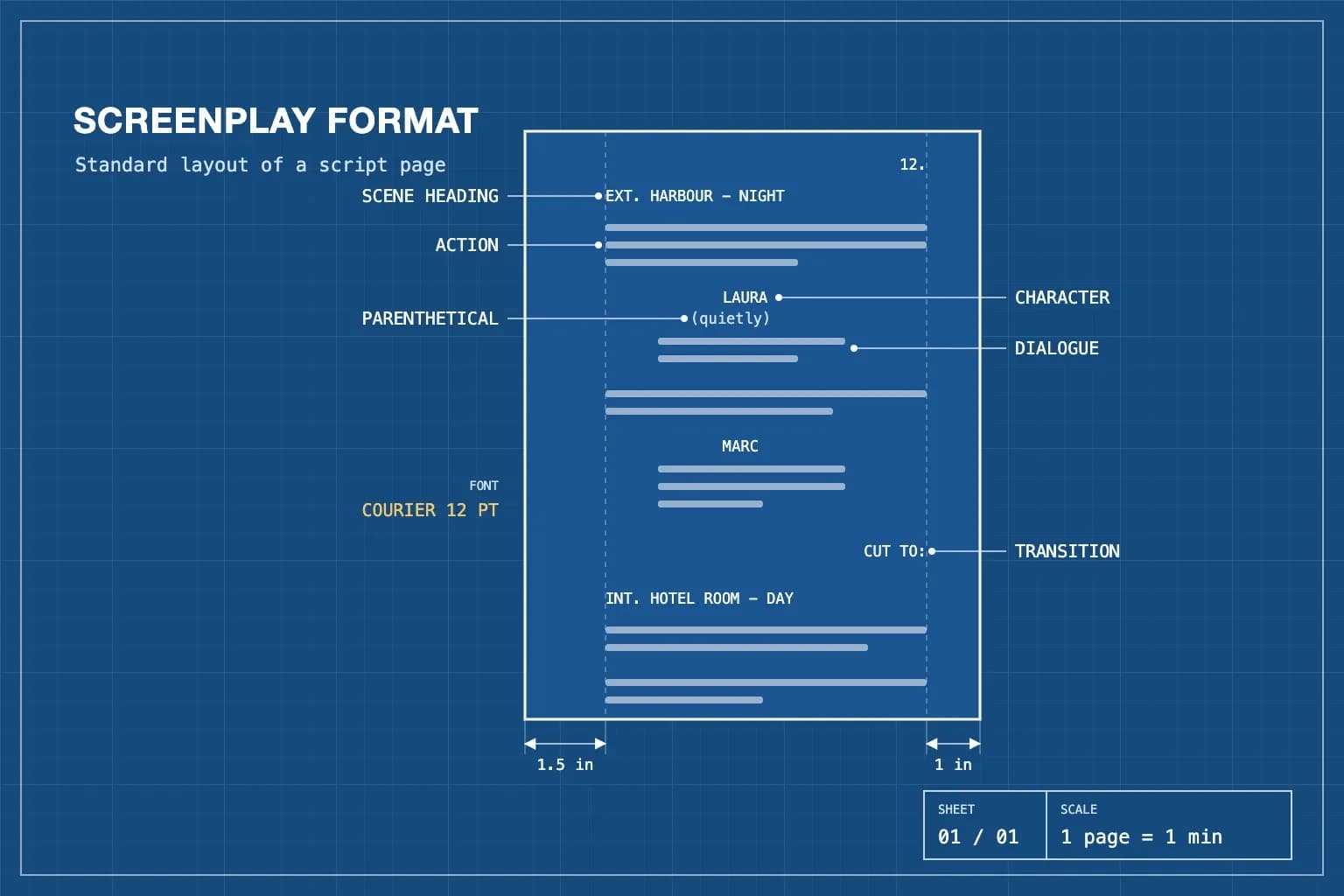
Voice over is formatted as dialogue. You write the character's name in capitals, centered above the line as usual, and add the extension (V.O.) after it. The line itself sits in the normal dialogue column, and the action lines around it describe what we see while the voice plays.
A simple example of how it reads on the page:
- Action line: Rain on the windows of an empty diner. MAYA (40s) wipes the same table for the third time.
- Character cue: MAYA (V.O.)
- Dialogue: That was the year I stopped waiting for him to come back.
A few formatting rules keep narration clean:
- Use (V.O.) every time the voice speaks. Each new block of narration gets the extension, even in the same scene.
- Name an outside narrator. If the narrator is not a character, use NARRATOR (V.O.). If the narrator is a character at a different age, make it clear, for example OLDER MAYA (V.O.), and introduce them in the action lines.
- Use CONT'D when narration is interrupted. If action lines break up a single stretch of narration in the same scene, the next block can read MAYA (V.O.) (CONT'D), following the same rule as regular dialogue.
- Let narration run over scene changes. Repeat the cue under each new scene heading where the voice speaks.
- Keep the action lines visual. The narration tells us one thing, the action shows another.
These conventions are part of standard American script format. For the full set of elements, from scene headings to transitions, see our complete guide to how to format a screenplay, and for why these conventions matter to readers in the first place, read why screenplay format matters.
Tips for effective voice over narration
- Decide why the narrator is talking. Is this a confession, a warning, a memory, a joke? Who is the narrator talking to, and when? Walter Neff talks to Keyes; Joe Gillis talks from beyond the grave. The situation shapes every line.
- Give the narrator a voice. Narration should sound like a person, with their vocabulary, humor and blind spots.
- Add, don't repeat. Every line should tell us something the images cannot: a thought, a judgment, a fact from the future, or a contradiction that creates irony.
- Keep it lean. Short, rhythmic lines play better than paragraphs. Read your narration aloud and cut anything that sounds like prose.
- Plan the shape. Decide where narration begins, falls silent and returns, so it feels designed rather than added.
- Test it by removing it. If nothing is lost without the narration, cut it. If the story falls apart, the structure may need work.
Voice over checklist
- Is every voice-over line marked (V.O.) and every in-scene, out-of-frame line marked (O.S.)?
- Does the narrator have a clear reason to speak and a clear listener?
- Does each line add something the images do not show?
- Is the narration established early and used consistently?
- Does the narration avoid naming emotions the actors can play?
- Would the story still make sense, structurally, without the narration?
An outside read is the quickest way to find out whether your narration helps or hides the story. When you analyze your screenplay with Poetika, the report looks at structure, character and dialogue, and points to pages where exposition is slowing the story down, which is often where a narrator is doing too much work.
FAQ
How do you write voice over in a screenplay?
Write it as dialogue. Put the speaker's name in capitals above the line and add (V.O.) after it, for example MAYA (V.O.). The narration goes in the normal dialogue column, while the action lines describe what we see on screen. Repeat the extension for each new block of narration, and use NARRATOR (V.O.) for an outside voice.
Is voice over bad in a screenplay?
No. Voice over has a bad reputation because it is often used to explain exposition or describe what the images already show. Films such as Double Indemnity, Goodfellas and Amélie prove that narration can be central to a film's style. The test is whether each line adds point of view, irony or information the pictures cannot give.
What is the difference between V.O. and O.S.?
V.O. (voice over) means the speaker is not in the physical space of the scene, so the characters cannot hear them; narration and inner thoughts are V.O. O.S. (off-screen) means the speaker is in the scene but outside the frame, like someone talking from the next room. If the characters can hear the voice, it is O.S.
Can the narrator be someone other than the protagonist?
Yes. In The Shawshank Redemption, Red narrates Andy Dufresne's story, and in many films an outside narrator, as in Amélie or The Royal Tenenbaums, tells the story from above. A narrator who watches the protagonist can keep them mysterious, add judgment, or reveal what the protagonist cannot see about themselves.
How much voice over is too much?
There is no page limit, but if narration carries information that scenes should dramatize, there is too much of it. Read the script without it: if the story still works and the narration only repeats it, cut it back. If the story collapses, the structure, not the narration, may need the rewrite.