Spoiler note: this post discusses the endings of Macbeth, Hamlet, The Godfather, Parasite and Breaking Bad.
The five-act structure is a way of dividing a story into five movements: exposition, rising action, a central climax or turning point, falling action, and a final resolution or catastrophe. Its best-known form is Freytag's pyramid, described by the German writer Gustav Freytag in 1863, which places the story's peak in the middle rather than near the end. The first half climbs toward a decisive event; the second half follows the consequences down to an ending that cannot be undone.
Most screenwriting manuals teach three acts, a model Syd Field made standard with Screenplay in 1979. The five-act shape is older. The Roman poet Horace advised in his Ars Poetica that a play should have exactly five acts, Renaissance playwrights worked within that convention, and editors have printed Shakespeare's plays in five acts for centuries. For screenwriters, it is less a rival to three acts than a closer look at the same story, one that gives the middle of a script its own peak.
What is the five-act structure?
The five-act structure organizes a story around a rise and a fall. In Die Technik des Dramas (The Technique of Drama), Freytag drew the movement of tragedy as a pyramid that climbs to a high point in the center, then descends. He named five parts:
- Exposition (introduction): the world, the characters and the situation before the conflict takes hold.
- Rising action: complications build as the protagonist pursues a goal and opposing forces push back.
- Climax: the high point of the action, where the hero's fortunes turn for better or worse.
- Falling action (return): the consequences of that turn unfold, often with reversals and new pressure.
- Catastrophe or resolution: the final outcome, which in tragedy is the hero's downfall.
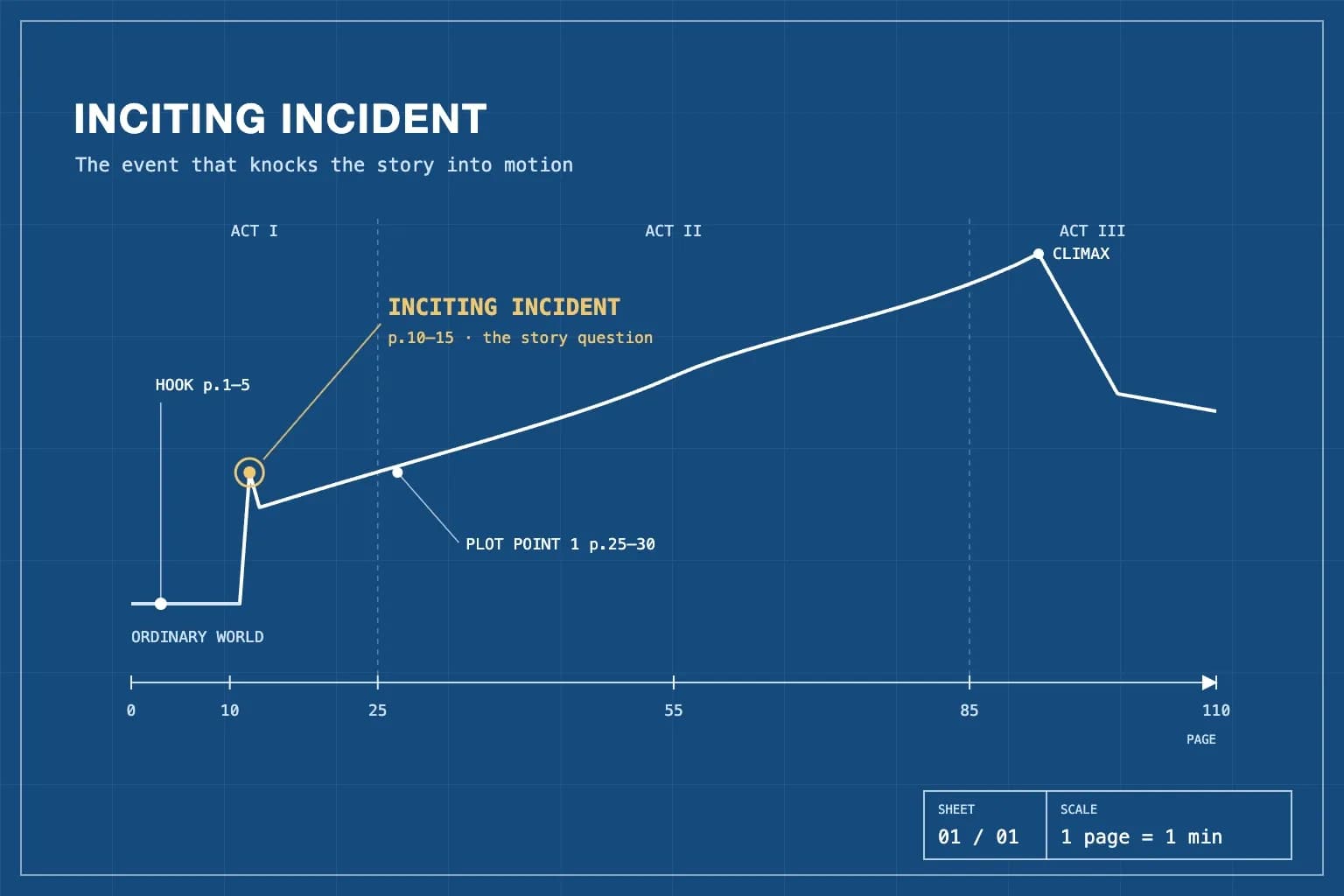
Freytag also described a few moments that connect these parts, most importantly an "exciting force" near the end of the exposition that starts the conflict. Screenwriters know it today as the inciting incident.
One point causes most of the confusion. In Freytag's sense, the climax is the turning point in the middle of the play. In modern film language, "climax" usually means the final confrontation near the end. When you read about five acts, keep the two meanings apart: Freytag's climax is closer to what screenwriting books call the midpoint.
Where the old vocabulary comes from
Five-act discussions often borrow from Aristotle's Poetics. Aristotle did not prescribe five acts, but his terms describe the engine well: hamartia (the hero's error), peripeteia (a reversal of fortune), anagnorisis (recognition, the moment a character sees the truth) and catharsis (the emotional release the ending gives the audience). We look at how those ideas still shape modern films in Homer's Odyssey, Aristotle's Poetics and Nolan.
The five acts, one by one
Act I: Exposition and the inciting incident
The first act establishes the status quo: who the protagonist is, what they want or lack, what flaw might undo them, and how the world works. It ends with a disturbance that breaks the balance. In a film this is usually the inciting incident and the protagonist's first response to it. If the protagonist's pride, loyalty or fear is going to matter in Act V, the audience should see it here.
Act II: Rising action and complication
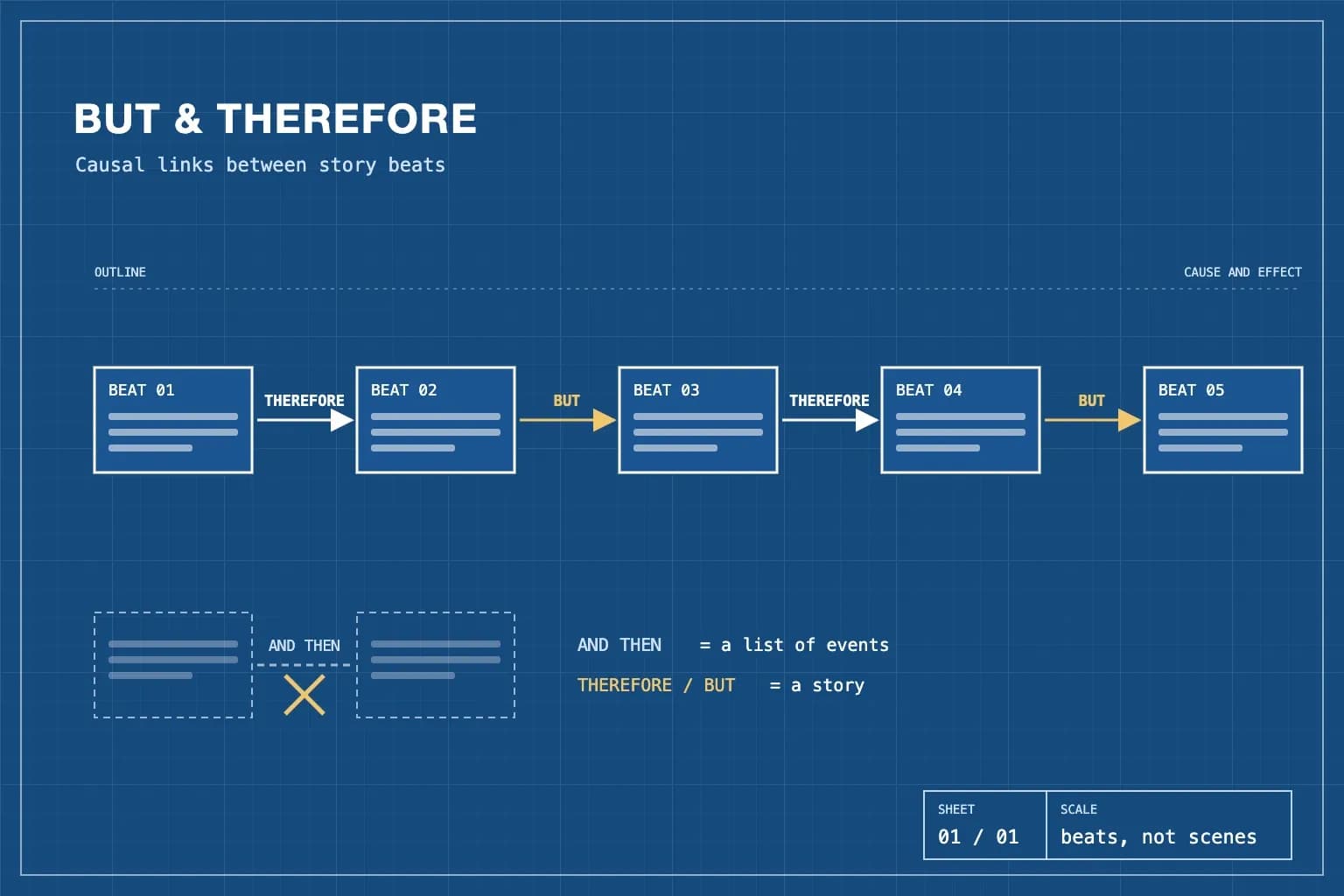
The protagonist takes active steps toward a goal, and every step meets resistance. Obstacles escalate and the character makes choices that commit them further. Here cause and effect does the heavy lifting: each scene should push the next, which is the principle behind the "but and therefore" rule.
Act III: The central turning point
In the five-act model, the third act is the peak. The protagonist reaches the height of their power or commits the act that cannot be taken back. Often both happen at once: a victory that contains the seed of ruin.
This is the clearest difference from a three-act reading: instead of a long stretch of complications, the middle becomes the most important event in the script.
Act IV: Falling action and reversal
The consequences of Act III arrive. Secrets come out, enemies regroup, allies fall away and the situation spirals. This is peripeteia: fortune reverses, and the plan that seemed to work starts to destroy the person who made it.
"Falling" does not mean slowing down. The tension comes from inevitability: the audience can see where things are heading and watches the character fight it. It is also where a character arc does much of its hardest work, because the protagonist must live with what they did.
Act V: Resolution or catastrophe
The final act brings the last confrontation, a moment of recognition and a new order that will not change back: the protagonist's destruction in tragedy, or a hard-won victory over the damage of Act IV. Either way, the ending should answer the question the inciting incident raised; for the craft of landing it, see why endings are the hardest thing to write. The quiet stretch after the final confrontation is the denouement.
Five-act vs. three-act structure
The two models do not contradict each other. A five-act reading takes the three-act screenplay and splits its long second act around the midpoint. A rough mapping:
- Three-act Act 1 = five-act Act I: setup, inciting incident, the decision to engage.
- First half of Act 2 (2A) = five-act Act II: pursuit of the goal, rising complications.
- Midpoint = five-act Act III: the central turning point, Freytag's climax.
- Second half of Act 2 (2B) = five-act Act IV: consequences, reversals, the slide toward the low point.
- Three-act Act 3 = five-act Act V: the final confrontation and resolution.
In a feature script of around 100 to 120 pages, this means the central turning point falls somewhere near the middle, roughly pages 50 to 60.
The soggy-middle problem
Act 2 is half the screenplay with no built-in landmark, so pages 30 to 90 can turn into a string of interchangeable obstacles: the "soggy" middle.
The five-act model answers this by giving the middle a destination. Act II has a goal (reach the turning point) and Act IV has a different job (pay for it). Later three-act methods reached a similar solution: Blake Snyder's beat sheet, which we cover in our guide to Save the Cat, also builds the middle around a midpoint where the stakes rise and the story changes direction.
Five-act structure examples
Macbeth and Hamlet
Shakespeare's tragedies are the classic case, although scholars doubt Shakespeare wrote in acts at all: the divisions largely come from the 1623 First Folio and later editors. Read in those divisions, the pattern is still striking.
In Macbeth, Act I brings the witches' prophecy and the decision to kill King Duncan, and Act II the murder itself. Act III holds the turning point: Macbeth, now king, has Banquo murdered, but Banquo's son Fleance escapes, and Banquo's ghost appears at the banquet. Macbeth has gone too far to turn back. In Act IV he consults the witches again and has Macduff's wife and children killed. Act V brings Lady Macbeth's sleepwalking and death, Birnam Wood coming to Dunsinane, and Macbeth's death at Macduff's hands. Akira Kurosawa moved the same arc to feudal Japan in Throne of Blood (1957).
In Hamlet, the third act contains the play within the play that confirms Claudius's guilt, the moment Hamlet finds Claudius praying and decides not to kill him, and Hamlet's killing of Polonius. Each choice shapes the second half: Hamlet is sent to England, Ophelia loses her mind, and Laertes returns for revenge. Act V ends with the duel and the deaths of almost every major character.
The Godfather (1972)
Francis Ford Coppola's film, written by Mario Puzo and Coppola from Puzo's novel, can be read in five clear movements:
- Act I: the wedding and Vito Corleone's refusal to back Sollozzo's narcotics deal. Michael is the outsider who tells Kay he is not like his family.
- Act II: Vito is shot. Michael protects his father at the hospital, is beaten by the corrupt police captain McCluskey, and proposes killing Sollozzo and McCluskey himself.
- Act III: at a Bronx restaurant, near the middle of the film, Michael retrieves a hidden gun and shoots both men. It is the point of no return: the outsider has become a killer.
- Act IV: Michael hides in Sicily and marries Apollonia, who is killed by a car bomb meant for him; in New York, Sonny is murdered. The consequences of the restaurant scene spread through the family.
- Act V: Michael returns, takes control, and after Vito's death has the heads of the rival families killed during his nephew's baptism. The film ends with a door closing on Kay.
The restaurant scene is the peak of Michael's agency and the start of his fall at once, which is exactly what Freytag's climax does.
Parasite (2019)
Bong Joon Ho's Parasite follows a similar rise and fall. The poor Kim family takes jobs in the wealthy Park household one by one, and their climb peaks as they drink in the Parks' living room while the owners are away. Then the doorbell rings: the former housekeeper has come back, with a secret hidden beneath the house. From there the falling action runs through the flood to the violent birthday party. The turning point sits in the middle; everything after it is consequence.
Breaking Bad and five-act television
Television makes act structure visible on the page. On ad-supported networks, one-hour dramas have traditionally used a teaser followed by four to six acts, each ending on a turn that brings the viewer back. We cover these formats in how to write a TV pilot.
The five-act lens also works across a whole series. Vince Gilligan has described Breaking Bad as turning Mr. Chips into Scarface, and its five seasons can be read as five movements: Walter White's first cook, his rise in the drug trade, his work for Gus Fring, which ends with a murder Walt orders to save himself, his war with Gus, and finally his empire and collapse. That is a reading, not the writers' stated plan, but it shows why long serialized stories need turning points.
Why screenwriters still use the five-act model
- Pacing control. Five landmarks instead of three show you which movement of the script is missing or stalled.
- Room for consequences. Act IV gives you a place to show what the protagonist's choice costs, which is where tragedies and character studies earn their weight.
- Television readiness. Hour-long scripts with act breaks map naturally onto five-act thinking, and streaming series still benefit from clear movements.
- A better question. "What is my central turning point?" is often more useful than "what happens in Act 2?"
How to apply the five-act structure to your script
- Name your central turning point first: the single event in the middle that changes the protagonist's direction for good.
- Build Act II toward it. Every complication should make that turn more likely, more costly or more surprising.
- List the consequences. Write down everything the turning point sets in motion. That list is your Act IV.
- Decide what the protagonist recognizes about themselves or their situation before the end.
- Check the ending against the beginning. Does Act V answer the question your inciting incident raised?
Once you have a draft, you can run your screenplay through Poetika for a structured analysis of story, structure and pacing, and see whether your middle reads as a turning point or as a stretch of interchangeable scenes.
Five-act structure checklist
- The inciting incident ends the exposition and gives the story its question
- Act II complications escalate and depend on the protagonist's choices
- There is one clear central turning point near the middle of the script
- Act IV shows the consequences of that turn instead of starting a new story
- The protagonist reaches a recognition before or during the final act
- The ending resolves the question raised in Act I and cannot be reversed
Master both models, then use the one that serves your story. Three acts tell you whether it is complete; five acts tell you whether its middle has a heart.
FAQ
Who created the five-act structure?
No single person invented it. Horace recommended five acts in his Ars Poetica, Renaissance drama adopted the convention, and later editors divided Shakespeare's plays into five acts. Gustav Freytag analyzed the pattern in 1863 and drew it as a pyramid with five parts, which is why the model is often called Freytag's pyramid.
Is the five-act structure better than the three-act structure?
Neither is better; they describe the same story at different levels of detail. Three acts give a simple frame for outlining and pitching. Five acts split the long second act around a central turning point, which helps with tragedies, character-driven stories and television episodes built around act breaks. Many writers use both at different stages.
Where is the climax in a five-act structure?
In Freytag's model the climax is the third act, the turning point in the middle of the story where the protagonist's fortunes change. This is different from modern film usage, where the climax usually means the final confrontation. In screenwriting terms, Freytag's climax is closest to the midpoint of a three-act script.
Do TV shows use five acts?
Many do. Episodes written for ad-supported networks are divided at commercial breaks, and one-hour dramas have traditionally used a teaser plus four to six acts, with five a common choice. Streaming series have no breaks, so formal acts are optional, but most writers still build episodes and seasons in distinct movements.
Can a movie with a happy ending use the five-act structure?
Yes. Freytag studied tragedy, so his fifth act is a catastrophe, but the same shape works for positive endings. The central turn can be a false victory or a costly decision, Act IV can bring the fallout, and Act V can show the protagonist overcoming it. The model is about rhythm, not about whether the ending is sad.