French screenplay format is the set of conventions French writers use for a continuité dialoguée, the full script with scenes and dialogue. Unlike the American format, it has no single official standard: French scripts are usually written on A4 paper, divided into numbered séquences with headings such as "1. INT. CUISINE – JOUR", and they often lay out dialogue more compactly than a Hollywood script. Just as important, the full script is only one stage in a chain of documents, from synopsis and note d'intention to treatment and séquencier.
If you write for French producers, apply to French funds or work on a co-production, you will meet both systems. This guide explains what a French script looks like, which documents come first, and what to send when you submit in France.
What is French screenplay format?
In French, a screenplay is a scénario, and the finished, dialogued version is a continuité dialoguée. When French writers and producers talk about "format", they usually mean two things:
- The page layout of the continuité dialoguée: headings, action, character names, dialogue.
- The development documents that precede and accompany it: synopsis, note d'intention, traitement, séquencier.
The second point matters more than many international writers expect. In France, projects are often read and funded before the full script exists, so the short documents carry real weight.
Is there an official French standard?
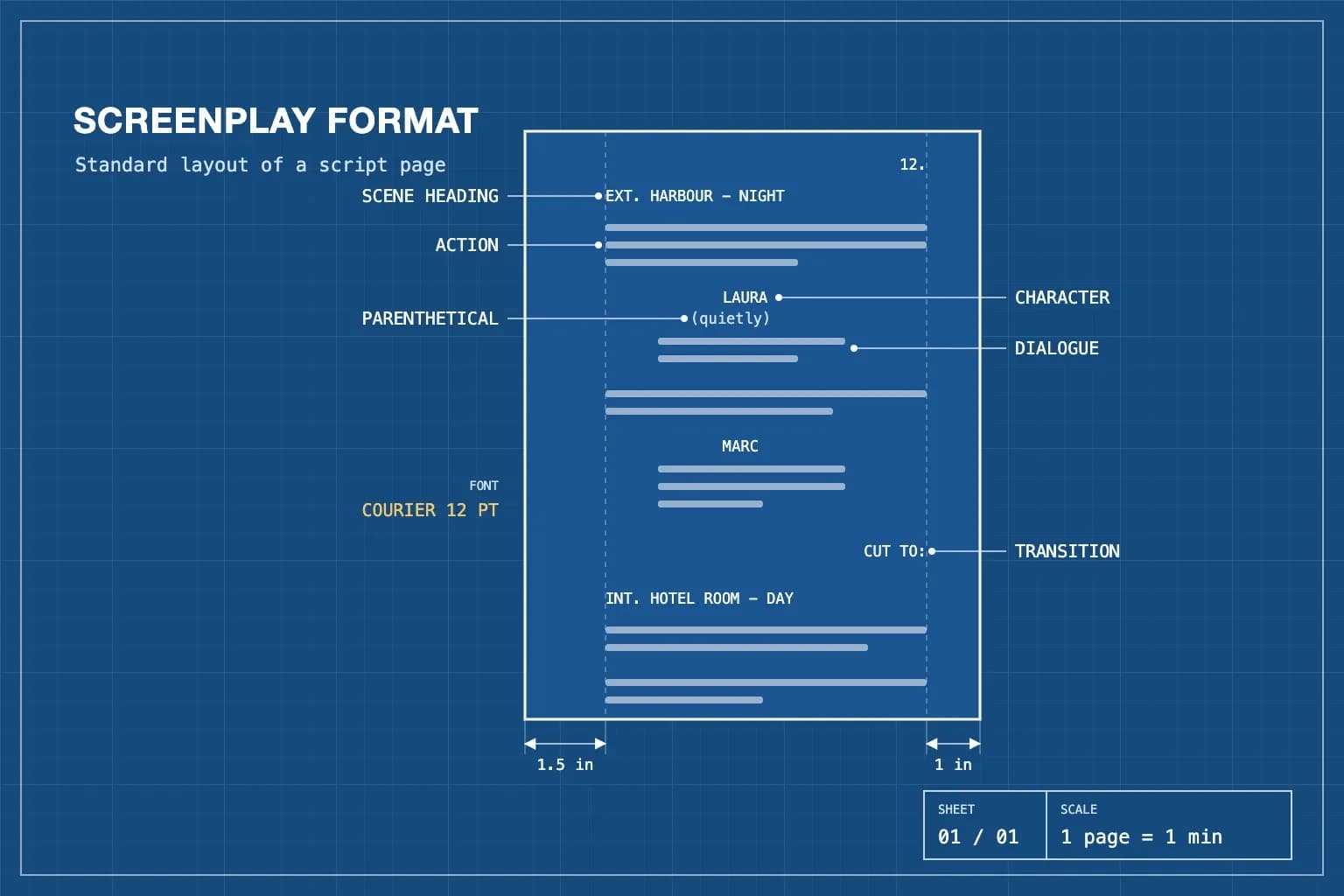
No. There is no French equivalent of the industry-wide consensus around the American format, with its fixed margins, Courier 12 and one page per minute of screen time. French scripts vary from writer to writer, school to school and production company to production company.
That said, most French scripts share the same habits: numbered sequences, scene headings with interior or exterior and time of day, character names in capitals and present-tense action. Many writers use screenwriting software with a layout close to the American one, set to A4; others use a denser layout. Both are accepted if the script is consistent and easy to read.
If you want the reasoning behind formatting rules in general, see why screenplay format matters; for the American standard element by element, see our guide on how to format a screenplay.
The stages of a French script
A French project typically moves through a series of documents. Not every project uses every stage, and the boundaries are not rigid, but this is the usual order.
Synopsis
The synopsis tells the whole story in prose, including the ending, usually in one to a few pages. It is often the first document a producer or a fund reads. A short version, sometimes called a résumé or pitch, sums up the project in a paragraph. The principles are the same as in English; our guide to the screenplay synopsis applies almost word for word.
Note d'intention
The note d'intention (statement of intent) is a very French document. Here the writer, and often the director, explains why they want to tell this story, what it means to them, and how they see it on screen: tone, point of view, visual approach, references. France has a strong tradition of writer-directors, and funds and commissions read this note to understand the vision behind the project, not only the plot.
A good note d'intention is personal and concrete: why this story, why you, why now?
Traitement
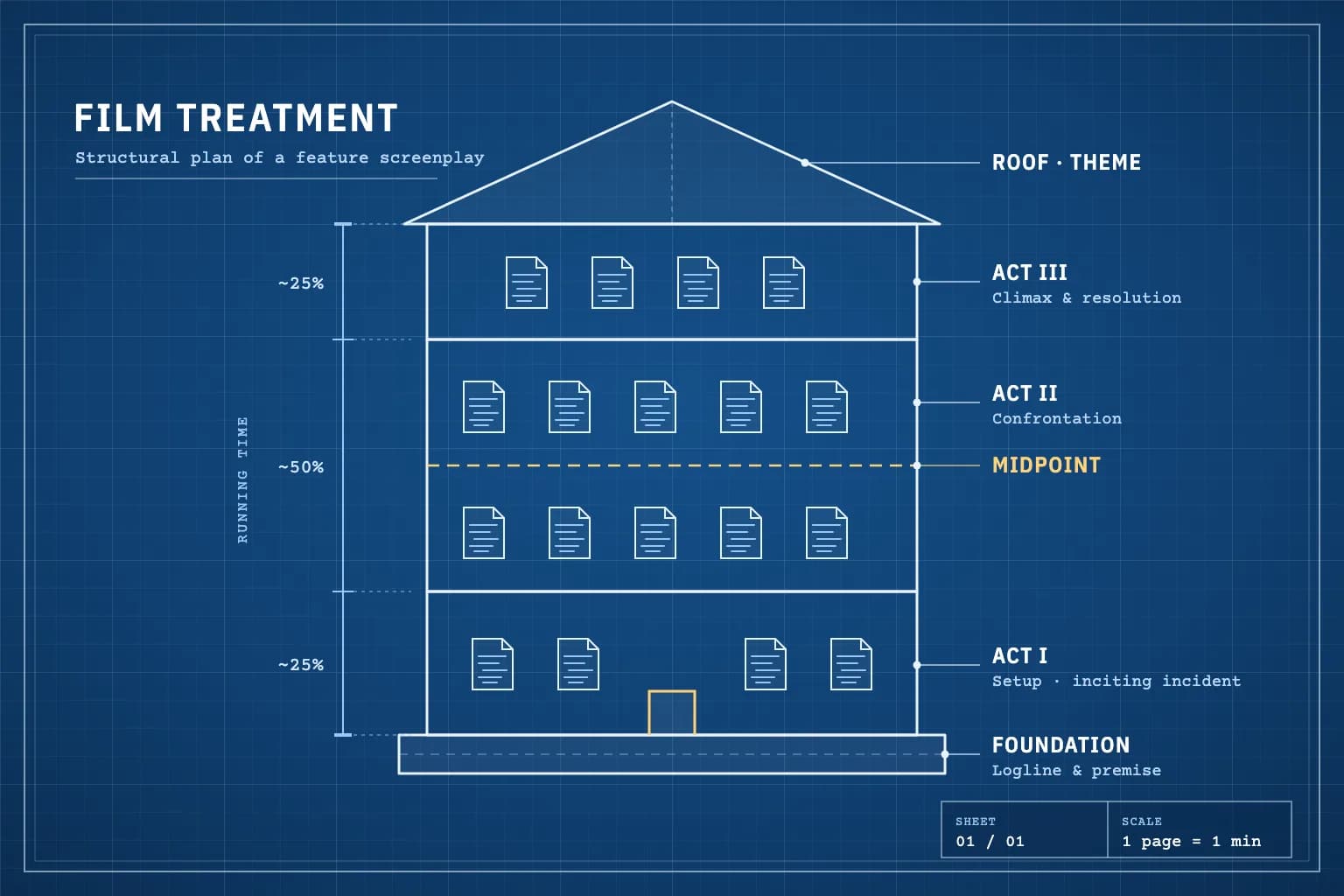
The traitement (treatment) tells the story in more detail, in present-tense prose, scene by scene or movement by movement, usually with little or no dialogue. The form is close to the English-language treatment, explained in the architecture of a film treatment.
Séquencier
The séquencier is a numbered list of every sequence in the film, each with its heading and a short paragraph describing what happens. It is the equivalent of a step outline or beat sheet in English. Writers and producers use it to check rhythm and structure before the dialogue exists.
Continuité dialoguée
The continuité dialoguée is the full screenplay, with every sequence written out in action and dialogue. This is the document most funds require for a feature at the production stage, and it is what international readers mean by "the script". Later, the director may turn it into a découpage technique, a shot-by-shot breakdown for the shoot, but that is a production document, not part of the writer's submission.
What a French script page usually looks like
There is no fixed template, but a typical continuité dialoguée page shares these features:
- Paper size: A4, the European standard, rather than US Letter.
- Font: often Courier or another monospaced font, though some French scripts use proportional fonts such as Times. The industry is less strict about this than in the US, where Courier is effectively mandatory. For the history behind the American choice, see font selection in screenwriting.
- Sequence numbers: almost always present, even in early drafts. In the US, scene numbers are usually added only in the shooting script.
- Action: written in the present tense, in short paragraphs, describing only what can be seen and heard.
- Character names: in capitals above the dialogue, either centered or set at a fixed indent.
- Dialogue: sometimes indented in a narrow column as in the US, sometimes running wider across the page.
- Pages: numbered, often with the title and draft date in a header or footer.
Because layouts vary, the rule that one page equals about one minute of screen time is less reliable for French scripts: a dense French page can hold noticeably more material.
Scene headings and dialogue in French scripts
The French scene heading, the en-tête or chapeau de séquence, carries the same information as the American slugline, sometimes in a different order. Common variants include:
- 1. INT. CUISINE – JOUR: number, interior or exterior, place, time of day. This is close to the American order.
- 1 – INT. JOUR – CUISINE: number, interior or exterior and time of day together, then the place.
- SÉQ. 1 – APPARTEMENT DE MARIE – INT. NUIT: the word séquence spelled out, with the place first.
The time of day is usually JOUR (day) or NUIT (night), sometimes refined as SOIR, AUBE or MATIN. Pick one pattern and use it throughout. Our guide to scene headings, INT., EXT. and INT./EXT. covers the American logic, which maps directly onto the French elements.
Dialogue abbreviations are where English-speaking writers trip up most, because they look familiar but mean different things:
- OFF in a French script usually marks a voice that does not belong to the visible scene, such as a narrator or voice-over. It corresponds to the American V.O.
- HC (hors champ, "off frame") marks a character who is present in the scene but not visible in the shot, like the American O.S.
- V.O. in France usually means version originale, the original-language version of a film, so avoid using it for voice-over in a French script.
- Parentheticals work as in English, for example (un temps) for a pause or (à voix basse) for "quietly".
If you are unsure how these devices work in the first place, see V.O. vs. O.S. in a screenplay.
French vs. American format: key differences
Here are the main differences side by side:
- Standard: the American format is a strong industry convention; the French format is a set of habits with no single standard.
- Paper: US Letter in the US; A4 in France.
- Font: Courier 12 is near-mandatory in the US; French scripts often use Courier but are more flexible.
- Scene numbers: usually only in American shooting scripts; present from the first draft in most French scripts.
- Scene heading order: fixed (INT./EXT., place, time) in the US; several accepted orders in France.
- Page timing: one page per minute is a reliable estimate in the US; it is only approximate in France.
- Voice abbreviations: V.O. and O.S. in the US; OFF and HC in France.
- What gets read first: usually the full script in the US; often the synopsis, note d'intention or treatment in France.
Writing a French-language script in American format
Many French writers now use a layout that is essentially the American format with French words, and many international co-productions prefer it because it is familiar to everyone on the project. If you go this route:
- Set the page to A4 and check that your margins still look balanced.
- Translate the element labels consistently: INT./EXT. stay as they are, but use JOUR and NUIT, and choose either the French (OFF, HC) or the American (V.O., O.S.) voice markers, not a mix.
- Number your sequences, because French readers expect it.
- Mark languages clearly if your characters speak more than one. Justine Triet and Arthur Harari's Anatomy of a Fall (2023), which won the Palme d'Or and the Academy Award for Best Original Screenplay, moves between French and English, and a multilingual script needs to show at a glance which lines are in which language.
The reverse also applies: before sending a French script to an American reader, convert it to US Letter, Courier 12 and standard indents. An unfamiliar-looking page is read with less patience.
Submitting a script in France: what funds and commissions ask for
French public funding is organized largely around the CNC (Centre national du cinéma et de l'image animée) and regional funds. Requirements change from session to session, so always check the current guidelines, but the pattern is consistent:
- CNC writing aid (aide à l'écriture): for projects still in development, presented as a synopsis, a detailed synopsis or a treatment, with a note d'intention and the writers' CVs. Sample dialogued sequences are optional but recommended.
- CNC rewriting aid (aide à la réécriture): for a feature that already exists as a continuité dialoguée but needs more work.
- Avance sur recettes before production: the selective advance for feature films. For fiction and animation, the project is presented as a continuité dialoguée, together with a synopsis, a note d'intention and the authors' CVs.
The CNC has announced a reform of these aids for projects examined in 2027, and its writing-aid page now asks for a signed note on any use of AI. Always read the official page for your session.
A few habits help in every submission:
- Write in French, and indicate which parts will be spoken in another language in the finished film.
- Make the synopsis tell the whole story, ending included.
- Protect your work before you send it. French writers commonly register scripts with the SACD (Société des auteurs et compositeurs dramatiques) or use the INPI's e-Soleau envelope as proof of date.
Before a submission, it is worth getting an outside read of the script itself. A structured analysis such as Poetika reads a screenplay in French or English and returns notes on structure, character, dialogue and market potential, which helps you catch problems before a commission does.
Common mistakes to avoid
- Retelling the plot in the note d'intention. The note explains the vision, not the story.
- Mixing conventions, such as JOUR in one heading and DAY in the next.
- Forgetting sequence numbers, which French readers expect from the first draft.
- Judging length by American standards. A dense French layout can hide a long film behind a modest page count.
- Ignoring format altogether. Even without an official standard, an inconsistent page signals an inexperienced writer, one of the common screenplay errors readers notice first.
French screenplay format checklist
- Page set to A4, with consistent margins and numbered pages
- Sequences numbered from the first draft
- One scene-heading pattern used throughout (for example "1. INT. CUISINE – JOUR")
- Character names in capitals, dialogue laid out the same way on every page
- OFF and HC (or V.O. and O.S.) used consistently, never mixed
- Languages clearly marked in a multilingual script
- Synopsis that tells the whole story, ending included
- Short, personal note d'intention that explains the vision
- Current fund guidelines checked for the session you are applying to
- Script registered before submission
FAQ
What is a continuité dialoguée?
A continuité dialoguée is the French term for the full screenplay: the story written sequence by sequence, with action and dialogue, in screen order. It comes after the synopsis, treatment and séquencier, and it is the document French funds usually require for a fiction feature at the production stage, for example for the CNC's avance sur recettes.
Do French screenplays use Courier?
Many do, because most screenwriting software defaults to Courier and it keeps pages consistent. But unlike in the US, where Courier 12 is effectively mandatory, French scripts are more flexible, and some writers use proportional fonts. What matters most to French readers is a clean, consistent, readable page on A4 paper.
What is the difference between a séquencier and a traitement?
A séquencier is a numbered list of every sequence, each with its heading and a short description, like a step outline. A traitement is a continuous prose telling of the story in more detail, with tone and atmosphere, usually without dialogue. Writers often write the treatment first and break it into a séquencier before writing scenes.
Can I submit an American-format script in France?
Usually yes. Many French producers read American-format scripts, especially for co-productions, but adapt the details: use A4, number your sequences, write in French for French funds, and prepare the synopsis and note d'intention that French readers expect. Always check the specific fund's guidelines, since requirements change between sessions.
What does OFF mean in a French script?
OFF marks a voice heard from outside the visible scene, such as a narrator or an inner voice, and corresponds to the American V.O. A character who is present but not in frame is marked HC, for hors champ, the equivalent of O.S. In France, V.O. usually means original-language version.
Ready to see how your script reads to someone else, in French or English? Upload it to Poetika for a structured analysis before you submit.