V.O. (voice-over) and O.S. (off-screen) are character extensions: short tags in parentheses after a character's name that tell the reader where a voice comes from when the speaker is not visible. Use (O.S.) when the character is physically present in the scene's location but outside the frame, such as in the next room or behind a door. Use (V.O.) when the voice comes from outside the scene's physical space altogether: narration, a character's inner thoughts, or a voice transmitted through a phone, radio or recording.
Both tags sit on the character cue, the line in capitals that names the speaker above every block of dialogue. This guide explains the difference between V.O. and O.S., the tricky cases in between, the other extensions you will meet, and the formatting rules that keep character cues clean from the first draft to the shooting script.
What is a character cue?
A character cue (also called the character name or character heading) is the name of the speaker, written in capitals, that appears directly above a line of dialogue. Before an actor says a single word, the script has to answer one question: who is talking? The cue answers it.
The standard rules are simple:
- All capitals. The cue is always in caps: SARAH, DETECTIVE RUIZ, OLD MAN.
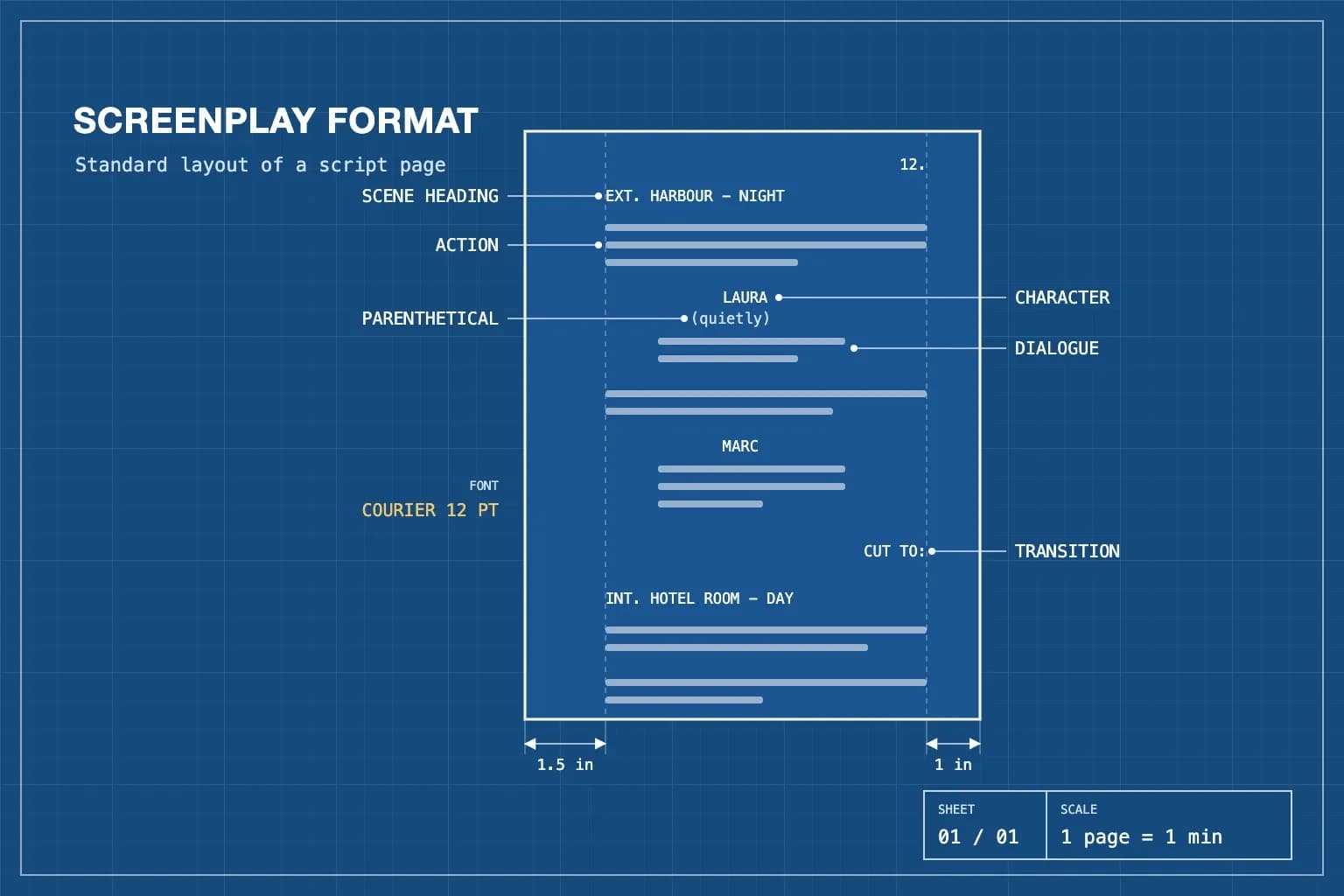
- Indented, not centered. In most templates the cue starts around 3.5 to 3.7 inches from the left edge of the page, so it sits over the dialogue block rather than in the true center of the page.
- Same font as the rest of the script. Like everything else, it is set in 12-point Courier or a close equivalent. Our article on why screenwriters use Courier explains where that tradition comes from.
- Directly above the dialogue. No blank line between the cue and the speech, and never a cue stranded at the bottom of a page with its dialogue on the next one.
- Extensions on the same line. Technical tags such as (V.O.) or (O.S.) follow the name on the same line, separated by a space.
A cue with dialogue looks like this on the page, written here in simplified form:
- SARAH
- We need to leave before the storm hits.
The character cue is different from a character's introduction in the action lines. The first time a character appears, their name is usually capitalized in the description ("SARAH VANCE, 30s, soaked to the bone, kicks the door shut"). After that, the name returns to normal case in action lines, while every cue above their dialogue stays in capitals. For the full set of page rules, from margins to transitions, see our complete guide on how to format a screenplay.
V.O. vs O.S.: what is the difference?
The two extensions answer the same question in different ways: where is this voice coming from?
- (O.S.) Off-screen: the speaker is physically in the scene's location, in the same space and the same moment, but the camera is not showing them. The other characters can hear them directly. A mother calling from the kitchen, a guard shouting from behind a wall, a voice on the other side of a door.
- (V.O.) Voice-over: the speaker is not physically in the scene's space. The voice is laid over the picture or arrives through a device. Narration, a character's thoughts, a voice on the radio, a recorded message, the person on the other end of a phone call we do not see.
A quick test: if the camera turned around, could it find the speaker in the room? If yes, the voice is O.S. If the speaker is somewhere else entirely, in another place, another time, inside someone's head, or on the far end of a phone line, it is V.O.
Put simply, O.S. is a staging note (the actor is on set, out of frame) and V.O. is a sound note (the line will usually be recorded separately and laid over the images).
When to use (V.O.)
Use the voice-over extension whenever the speaker's body is not in the scene's physical space. The most common cases:
- Narration. A character, or an outside narrator, tells the story over the images. Red (Morgan Freeman) narrates The Shawshank Redemption (1994); Henry Hill, and at times his wife Karen, narrate Goodfellas (1990); Rocket guides us through the favela in City of God (2002).
- Inner thoughts. We hear what a character thinks but does not say aloud. The other characters in the scene cannot hear it.
- Diaries, letters and journals. Travis Bickle's diary entries in Taxi Driver (1976) are heard as voice-over while we watch him drive through the city at night.
- Devices. A voice on the radio, a television newsreader, a voicemail, an announcement over a loudspeaker, a recording played back in the room. The device is present, but the speaker is not.
- Remembered or imagined voices. A line from the past echoing in a character's head, or a voice heard across a montage.
For the craft side of narration, see our guide to writing voice over in a screenplay. Narration also often opens a flashback, a separate tool with its own rules, covered in how to write a flashback in a screenplay.
Narrators can sit outside the story or inside it. Amélie (2001) uses an unseen narrator voiced by André Dussollier, while Badlands (1973) is narrated by Holly, the teenager at the center of the film. On the page, both are simply a name plus (V.O.): NARRATOR (V.O.) for an outside voice, the character's name for a narrator who is in the story.
When to use (O.S.)
Use the off-screen extension when the speaker is in the location but not in view. Typical cases:
- Another room. A character answers from the bathroom, the hallway or upstairs.
- Behind a door or wall. Someone knocks and speaks before the door opens.
- Outside the frame in the same space. In a crowded bar, a voice calls out from the far end before we cut to the speaker.
- Before an entrance. A character's line is heard a moment before they walk into the shot.
For example, a short exchange might read:
- LENA: Did anyone see my keys?
- MARCUS (O.S.): Kitchen table. Under the mail.
- Lena crosses into the kitchen. Marcus is at the stove, not looking up.
Once Marcus is visible, his next cue drops the extension. An (O.S.) tag applies only to the lines spoken while the speaker is out of view.
Television scripts, especially multi-camera sitcoms, often use (O.C.), off-camera, for the same thing. For a feature spec, (O.S.) is the more common choice; whichever you use, never mix the two.
Phone calls: V.O., O.S. or intercut?
Phone conversations cause more confusion than any other case, because the voice is both "in the room" (through the speaker) and somewhere else (where the caller is). Writers handle them in three main ways:
- We see only one side. The character we see speaks with a plain cue. The voice on the other end, heard through the phone, is usually marked (V.O.), because the speaker is not physically present. Some writers add a parenthetical such as (filtered) or (over phone) to make the sound clearer; conventions vary, so pick one and keep it.
- We see both sides. Write a scene heading for each location, then use an intercut ("INTERCUT - PHONE CONVERSATION" or similar) and let the dialogue run with plain cues. Because we can see both speakers, neither needs an extension. The full mechanics of intercut headings are in our guide to scene headings.
- We hear but don't see the caller, and they are nearby. If the character is in the same house and talking from the next room, it is not really a phone call on screen; it is (O.S.).
Other character extensions you will meet
V.O. and O.S. are the two essential extensions, but a few others are common enough to recognize:
- (CONT'D) Continued: added when the same character keeps speaking after an action line interrupts their dialogue in the same scene. Screenwriting software usually adds it automatically; many writers turn it off, and both choices are acceptable if consistent.
- (MORE) and (CONT'D) at page breaks: when one speech is split across two pages, (MORE) appears below the dialogue at the bottom of the first page, and the name returns with (CONT'D) at the top of the next.
- (PRE-LAP): dialogue from the next scene that starts before we cut to it, a sound bridge. The line is written at the end of the current scene, before the next scene heading, with the speaker's cue tagged (PRE-LAP).
- Combined tags: extensions can stack, for example MAYA (V.O.) (CONT'D) when narration continues after an action line.
If a note is not about where the voice comes from, it belongs in a parenthetical or the action lines, not in a new extension.
Extensions vs parentheticals
Writers sometimes confuse the two, but they do different jobs:
- Extension: a technical tag on the same line as the name, in capitals, describing the source of the voice. (V.O.), (O.S.), (CONT'D), (PRE-LAP).
- Parenthetical: a short note on its own line under the name, in lowercase, describing how the line is delivered or who it is directed at: (whispering), (to Marcus), (in Spanish).
A cue can carry both: an extension next to the name and a parenthetical under it. Keep parentheticals rare: a page full of "(angrily)" reads as if the writer doesn't trust the dialogue.
Naming consistency: why one character needs one name
The single most important cue rule has nothing to do with extensions: a character must keep the same cue name throughout the script. If the detective is DETECTIVE RUIZ on page 5, RUIZ on page 20 and ANA on page 60, readers have to stop and work out whether these are three people or one.
The problem grows once the script goes into production:
- Table reads. Actors follow their cue names. When a name changes, someone misses their line, and the read loses its rhythm. Hearing your script aloud is one of the best tests there is, as we explain in why your script isn't finished until it's spoken aloud, and inconsistent cues make that test harder.
- Breakdowns and scheduling. Production software counts each cue name as a separate character. RUIZ and DETECTIVE RUIZ become two roles in the cast list, which affects the script breakdown, the schedule and casting.
Practical rules for consistent names:
- Pick the name the audience will use. If everyone calls her Ana, the cue should probably be ANA, even if her action line introduction gives her full name and rank.
- Avoid names that look alike. JON and JOHN, or MARIA and MARIO, slow a reader down.
- Handle a reveal carefully. If a character is introduced as THE STRANGER and later revealed as DANIEL, change the cue at the reveal and make the change explicit in the action line ("THE STRANGER, whose name is DANIEL...") so nobody thinks a new character has entered.
- Different ages, different cues. A character at two ages, such as YOUNG MAYA and MAYA, should have clearly distinct cues, especially when one of them narrates.
Inconsistent names are one of the small details that make a script feel unprofessional, the kind of format slip we describe in why screenplay format matters.
Character cue checklist
- Is every cue in capitals, indented above its dialogue, with no blank line in between?
- Does each character keep the exact same cue name from start to finish?
- Is every in-scene, out-of-frame line marked (O.S.), and every narration, thought or device voice marked (V.O.)?
- Do extensions disappear once the speaker becomes visible?
- Are phone calls handled the same way every time, either one-sided with (V.O.) or intercut?
- Are (CONT'D), (MORE) and any (PRE-LAP) tags used consistently or switched off consistently?
- Are parentheticals rare, lowercase and on their own line?
For a second pass on the whole script, you can run your screenplay through Poetika, which reviews structure, characters and dialogue and points to scenes where the page is not doing its job.
FAQ
What does V.O. mean in a screenplay?
V.O. stands for voice-over. It is written after a character's name, for example MAYA (V.O.), when the speaker is not physically in the scene: a narrator, a character's inner thoughts, or a voice coming through a phone, radio, television or recording. The characters on screen usually cannot hear narration or thoughts; only the audience does.
What does O.S. mean in a screenplay?
O.S. stands for off-screen. It marks dialogue spoken by a character who is in the scene's location but outside the camera's view, such as someone calling from another room or behind a door. The other characters can hear them directly. Once the speaker becomes visible, the (O.S.) tag is dropped from their next cue.
Is a phone call V.O. or O.S.?
When we see only one side of a call, the voice on the other end is usually marked (V.O.), because that speaker is somewhere else. When we see both locations, writers use an intercut and plain cues with no extension. If the "caller" is actually nearby, such as in the next room, the line is (O.S.). Whatever you choose, stay consistent.
What is the difference between O.S. and O.C.?
They mean the same thing: the speaker is present but out of view. O.S. (off-screen) is the usual choice in feature screenplays, while O.C. (off-camera) appears more often in television, especially multi-camera sitcom scripts. Neither is wrong, but you should never mix the two in the same script.
Do I still need to use CONT'D?
No, it is optional. (CONT'D) shows that the same character keeps speaking after an action line, and most screenwriting software adds it automatically. Many writers turn it off within scenes to keep the page clean. The page-break version, (MORE) at the bottom and (CONT'D) at the top, is still standard when one speech is split across pages.