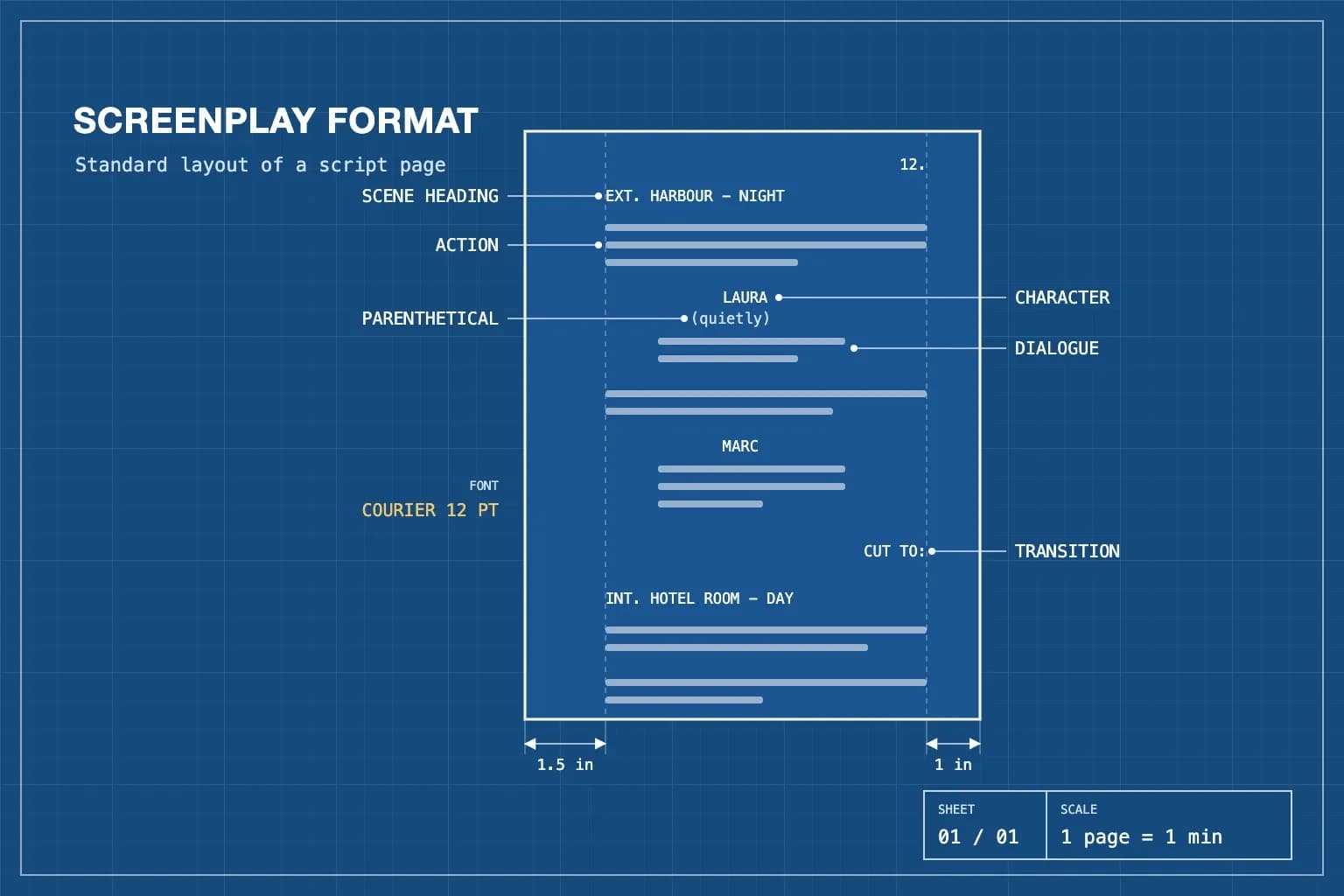
In a screenplay, INT. (interior) means a scene takes place indoors and EXT. (exterior) means it takes place outdoors. Together with a location and a time of day, they form the scene heading, also called the slugline: the capitalized line that opens every scene, such as INT. POLICE STATION - NIGHT or EXT. BEACH - DAY. When a scene moves between inside and outside, or plays inside a vehicle seen from outside, writers use INT./EXT. (or I/E).
Scene headings look like a small technical detail, but they tell the reader where they are, set the rhythm of the page and give the production team the first data it needs to schedule and budget the film. This guide explains how a heading is built, when to use INT., EXT. or INT./EXT., which times of day to use, how to handle tricky cases and which mistakes to avoid.
What does INT. and EXT. mean in a screenplay?
INT. and EXT. are abbreviations that describe where the camera is, from the audience's point of view, relative to the location:
- INT. (interior): the scene is inside a building, a room, a vehicle or any enclosed space. A kitchen, a submarine, a spaceship corridor and the back seat of a taxi are all interiors.
- EXT. (exterior): the scene is outdoors. A street, a forest, a rooftop, a stadium car park and open space are all exteriors.
- INT./EXT. or I/E: the scene moves between inside and outside in a single, continuous action, or it is shot from both inside and outside, as with a car driving down a road.
The heading describes the story location, not where the scene will actually be filmed. If a "forest" is built on a soundstage, the heading is still EXT. FOREST, because that is what the audience sees. If a car interior is shot against a screen in a studio, it is still INT. CAR. The production team decides how to shoot it; the writer describes the world.
How to write a scene heading
A standard scene heading has three parts, always in this order:
- INT. or EXT. (or INT./EXT.), followed by a period.
- The location, as specific as the story needs: KITCHEN, MARIA'S APARTMENT - KITCHEN or HIGHWAY 1 - CLIFFSIDE.
- The time of day, usually DAY or NIGHT, separated from the location by a hyphen with a space on each side.
Put together, it looks like this:
- INT. MARIA'S APARTMENT - KITCHEN - NIGHT
- EXT. CENTRAL PARK - BENCH BY THE LAKE - DAY
- INT./EXT. TAXI (MOVING) - NIGHT
The basic formatting rules are simple:
- All capitals. The whole heading is written in caps.
- Left-aligned at the action margin, on its own line, with a blank line before it.
- One heading per change. Write a new scene heading every time the location or the time changes, even if it is only from the hallway into the kitchen.
- Bold is optional. Some writers bold their scene headings to make them stand out, and many readers like it, but it is a stylistic choice, not a rule. Pick one style and use it throughout.
- No scene numbers in a spec script. Numbers are added to both sides of each heading only when the script becomes a shooting script.
Scene headings are one of six or so core screenplay elements, each with its own indent. For the full layout of the page, see our element-by-element guide on how to format a screenplay.
How to choose the location name
A few principles help with the location:
- Be as specific as the scene needs, and no more. INT. HOUSE is vague if the story has three houses. INT. GRANDMOTHER'S FARMHOUSE - ATTIC tells the reader exactly where they are.
- Go from general to specific. The larger place comes first and the smaller place after a hyphen: INT. HOSPITAL - ICU - NIGHT, not INT. ICU - HOSPITAL - NIGHT.
- Use the same name every time. If you call it JAKE'S APARTMENT on page 5, don't call it JAKE'S FLAT on page 40. Screenwriting software builds location lists from your headings, and an assistant director breaking down the script will treat two names as two sets.
- Name places by who they belong to or what they are. Bong Joon-ho's Parasite (2019) moves between two homes that define its story: the Kim family's cramped semi-basement and the Park family's architect-designed house on a hill. Headings like INT. KIM FAMILY APARTMENT and INT. PARK HOUSE - LIVING ROOM would tell a reader at once which world they are in.
- Keep it short. Atmosphere, weather and detail go in the action lines underneath.
Times of day: DAY, NIGHT and the rest
The safest choices are DAY and NIGHT. They are what the production schedule cares about, because a night scene needs different lighting, crew hours and often a different shooting day.
Other times are acceptable when they matter to the story:
- DAWN, DUSK, SUNSET, MORNING, EVENING: use them only when the light itself is part of the scene, such as a sunrise the characters watch.
- CONTINUOUS: the action flows straight from the previous scene with no time jump, typically when a character walks from one room into another.
- LATER or MOMENTS LATER: a short jump in time within the same location.
- SAME: used by some writers when two locations share the same moment, as in an intercut.
Avoid times that cannot be filmed, such as "3:47 P.M." or "THE NEXT DAY". If the exact time matters, show it in the action: a wall clock, a phone screen, a line of dialogue.
INT./EXT. and I/E: when to use them
INT./EXT. covers scenes that are inside and outside at the same time, or that cross the threshold in one movement. Common cases:
- Vehicles. A conversation in a moving car is often written INT./EXT. CAR - NIGHT, because the scene may show both the characters inside and the car on the road. Many writers simply use INT. CAR (MOVING) when the camera stays inside. Steven Knight's Locke (2013), set almost entirely inside one car on one night drive, shows how much drama an interior that keeps moving can hold.
- Doorways and thresholds. A character arguing on a doorstep with someone inside the house, or stepping out of a shop onto the street in one continuous shot.
Some writers reverse the order to EXT./INT. when the scene starts outside and moves in. Both versions are understood. What matters is that you use INT./EXT. for genuine in-and-out action, not as a way to avoid deciding where a scene takes place.
Why INT. and EXT. matter for production
For the writer, a scene heading is a signpost. For the production team, it is data. When a script is greenlit, the assistant director or producer breaks it down scene by scene, and the heading is the first thing recorded on each breakdown sheet. Our guide to script breakdown in film production shows that process in detail.
INT. and EXT. tell the crew different things:
- Lighting and weather. Interiors can be lit and controlled; exteriors depend on the sun, clouds, rain and season. Exterior scenes are often scheduled with an interior "cover set" ready in case the weather turns.
- Sound. Exteriors bring traffic, wind and aircraft noise that can force retakes.
- Permits. A street scene may need city permits, road closures and crowd control.
- Night shoots. EXT. ... NIGHT is among the most demanding combinations, needing large lighting setups and crews working overnight.
- Scheduling. Production stripboards traditionally sort scenes by interior or exterior and day or night, and in a common color scheme each combination gets its own strip color.
Even in a spec script, headings give a producer an instant sense of scale: a script full of crowded EXT. CITY STREET - NIGHT scenes reads as a bigger film than one built on interiors. Sidney Lumet's 12 Angry Men (1957), which plays almost entirely in a single jury room, and Wolfgang Petersen's Das Boot (1981), set largely inside a submarine, show how a story built on interiors can turn one confined space into pressure.
How INT. and EXT. shape the story
INT. and EXT. are not only logistics. The rhythm of interiors and exteriors is part of how a story feels.
Interiors tend to contain characters: closed doors, confessions, interrogations. Exteriors open the world up: journeys, chases, crowds. Tom Tykwer's Run Lola Run (1998) is built almost entirely on exteriors, with Lola sprinting through the streets of Berlin, and the sense of constant motion comes partly from that choice. Alfred Hitchcock's Rear Window (1954) does the opposite: the camera stays in one apartment and looks out at the courtyard, and the confinement becomes the point of view.
Headings also control pace. Every new heading is a cut: a run of short scenes reads fast, while a long scene under one heading slows the reader down. Our guide to how many pages a screenplay should be explains why page rhythm and screen time are so closely linked.
Special cases: secondary headings, intercuts, flashbacks and montages
Some scenes don't fit the three-part formula neatly. These are the standard solutions:
- Secondary headings (mini-sluglines). Once a master location is established, such as INT. MANSION - NIGHT, you can follow a character through it with short headings like KITCHEN or MAIN STAIRCASE on their own lines. Use them for continuous movement through one place, not to avoid full headings for genuinely new scenes.
- Intercuts. For a phone call between two places, write a full heading for each location once, then INTERCUT - PHONE CONVERSATION (or similar), and let the dialogue run without repeating headings for every line.
- Flashbacks and dream sequences. Mark them in the heading or right after it, such as INT. FARMHOUSE - KITCHEN - DAY (FLASHBACK) or a line like FLASHBACK - 1985, and close them clearly. Our guide to how to write a flashback in a screenplay covers the options.
- Montages and series of shots. Use a heading like MONTAGE - SARAH PREPARES FOR THE RACE, followed by short lettered or bulleted beats, then END MONTAGE.
Common scene heading mistakes
Most heading problems fall into a few patterns:
- Missing INT. or EXT. A heading that starts with the location alone looks unfinished to a reader and is impossible to schedule.
- Inconsistent location names. COFFEE SHOP, CAFÉ and DINER for the same place confuse readers and break software reports.
- Description in the heading. INT. DARK, CREEPY BASEMENT WHERE THE KILLER WAITS - NIGHT belongs in action lines.
- A new location without a new heading. If a character "walks out to the garden" in an action line and the scene continues there, the scene needs an EXT. heading.
Slips like these rarely sink a strong story, but they add up. Our guide to why screenplay format matters explains how readers react to them.
Scene heading checklist
Before you send your script, check every scene heading against this list:
- Every scene starts with INT., EXT. or INT./EXT.
- The heading is in capitals, on its own line, at the left margin
- The location goes from general to specific, separated by hyphens
- Each location has exactly one name throughout the script
- The time of day is DAY or NIGHT unless another time matters to the story
- CONTINUOUS and LATER are used only for real continuity or short jumps
- There is a new heading every time the location or time changes
- No description, camera angles or scene numbers in the headings of a spec draft
- Flashbacks, intercuts and montages are clearly marked and clearly closed
A structured outside read catches small errors you no longer see after twenty drafts. When you run your screenplay through Poetika, the analysis looks at format alongside story, structure and character, and points out where inconsistencies are likely to distract a reader. Clean headings won't sell a script by themselves, but they let the story be read on its own terms.
FAQ
What does INT. mean in a screenplay?
INT. stands for "interior" and means the scene takes place indoors or in an enclosed space, such as a room, a building, a vehicle or a spaceship. It is the first part of a scene heading, followed by the location and the time of day, as in INT. HOSPITAL - ICU - NIGHT. It describes the story location, not where the scene is filmed.
What does EXT. mean in a screenplay?
EXT. stands for "exterior" and means the scene takes place outdoors, such as a street, a forest, a beach or a rooftop. It tells the reader where they are and tells the production team that the scene may depend on daylight, weather, outdoor sound and location permits, which affects how and when it is scheduled.
When should I use INT./EXT. or I/E?
Use INT./EXT. (or I/E) when a single scene moves between inside and outside, or is seen from both sides, such as a conversation in a moving car or an argument across a doorway. If the camera stays inside the car throughout, many writers simply use INT. CAR (MOVING). Don't use INT./EXT. to avoid choosing a location.
Should scene headings be bold?
Bold scene headings are optional. Some writers and readers prefer them because they make each new scene easy to spot when skimming, while others keep headings in plain capitals. Either is acceptable in a spec script. What matters is consistency: use the same style for every heading, and keep them in capitals at the left margin.
Can I write a specific time like 3 P.M. in a scene heading?
It is better not to. Headings normally use DAY or NIGHT, plus a few story-driven options like DAWN, DUSK, CONTINUOUS or LATER. A specific clock time cannot be seen by the audience unless you show it, so put it in the action instead: a wall clock, a phone screen or a line of dialogue.