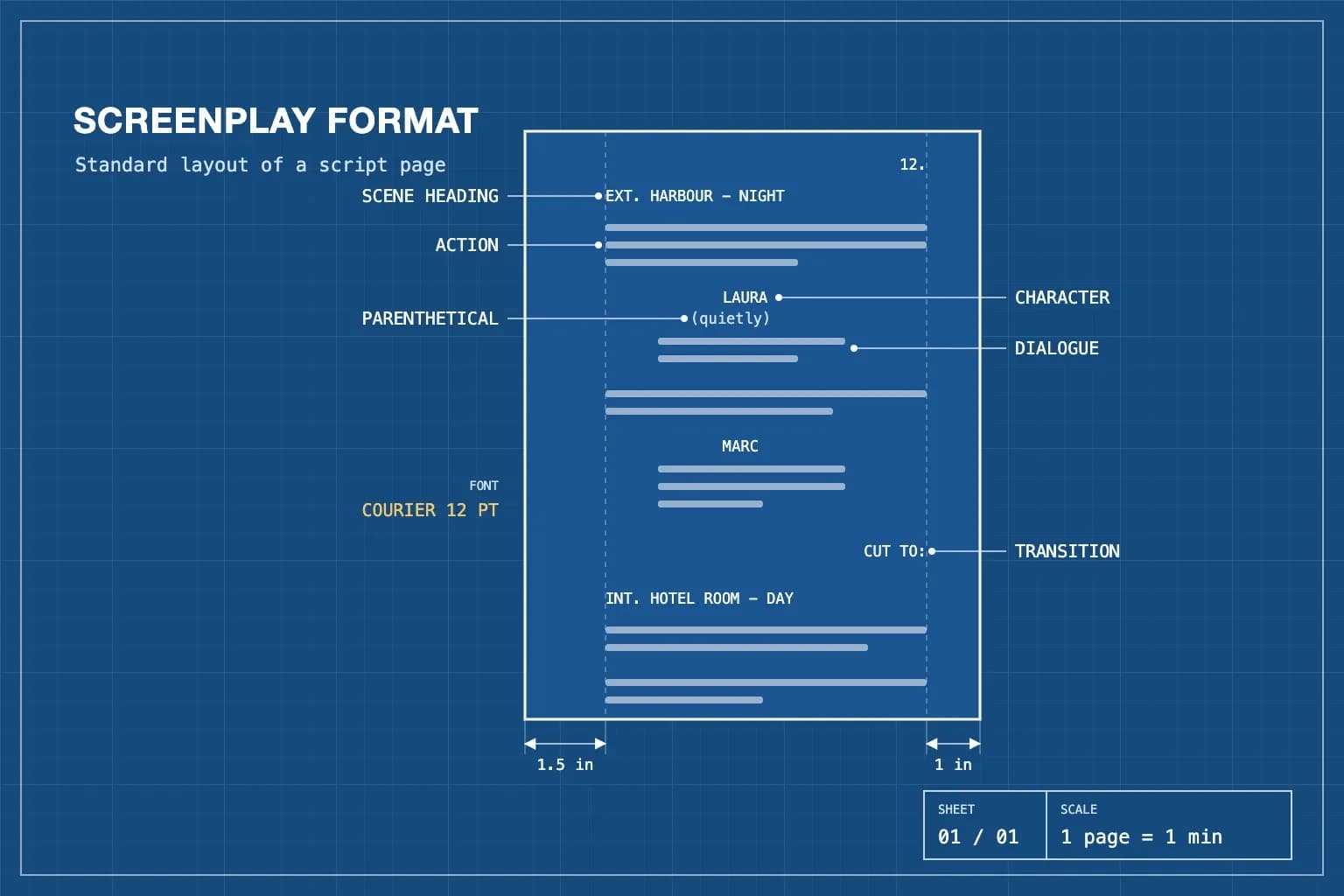
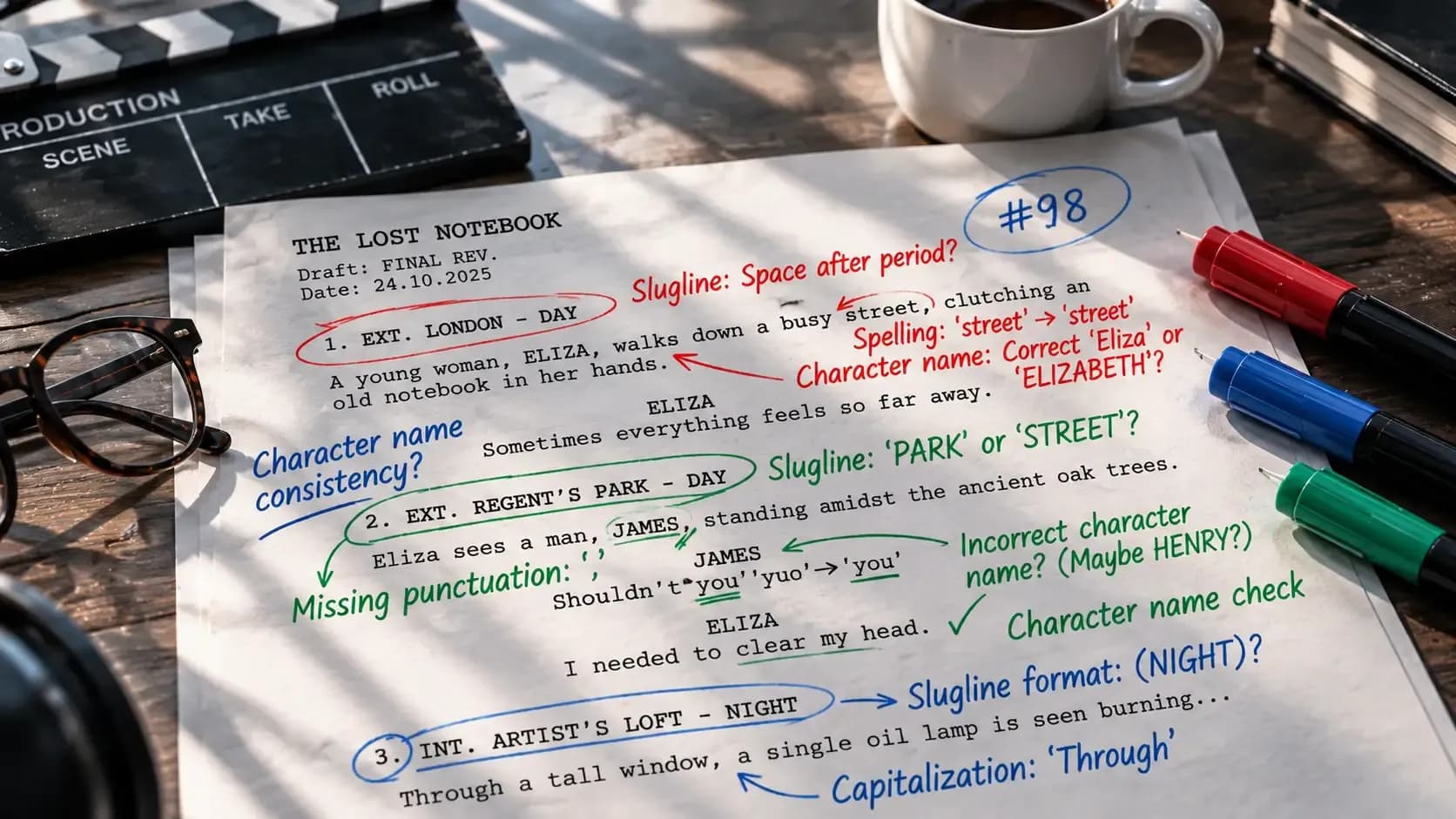
An insert shot in a screenplay is a close, isolated view of a specific detail, usually an object, a piece of writing or a screen, that the audience must see clearly to follow the story. On the page it is written as a capitalized line such as INSERT - THE LETTER, followed by a short description of what we see, and it usually ends with BACK TO SCENE to return to the wider action. The insert tells the reader: of everything in this room, look at this.
Film is a visual medium, and some of its most important information is tiny. A name on an envelope, a text message, a fuel gauge dropping toward empty, a photograph in a drawer. A screenwriter cannot frame shots, but they do decide what the audience must notice. The INSERT is the tool for that.
This guide explains what an insert shot is, how it differs from a close-up or a cutaway, the two common ways to format one, the situations where inserts earn their place, and the mistakes that make a script read like a shot list.
What is an insert shot in screenwriting?
In production, an insert is a shot of a detail that is cut into a scene: a hand turning a key, a gun in a drawer, the words on a note. Inserts are often filmed separately, sometimes by a second unit or with a hand double.
In a screenplay, an INSERT is the writer's way of saying that a particular detail matters enough to fill the screen. The difference is one of focus:
- General action: "A clock ticks on the wall." The reader pictures a room with a clock in it.
- Insert: the clock fills the frame, and the second hand hits twelve. The reader understands that the time itself is the point.
Action lines describe a scene; an insert isolates one piece of information from it. If the audience could miss the detail in a wide view and the story would suffer, you may need an insert. If not, you probably don't.
Insert vs. close-up vs. cutaway
These terms are often used loosely, even in produced scripts. In general:
- Insert: a close view of an object or detail that belongs to the scene, such as a letter in a character's hand, a phone screen, a lock being picked.
- Close-up: a tight shot of a person, usually a face, to show a reaction or emotion. Screenwriters rarely write "CLOSE-UP" in a spec script; they describe the reaction and let the director choose the framing.
- Cutaway: a shot of something outside the main action, such as a dog asleep in the corner or a crowd outside the window, that the edit cuts to and then back from.
How to format an insert in a screenplay
There are two common ways to write an insert. Both are acceptable in a spec script; which you choose depends on how much the detail matters and how much text it carries.
Method 1: the formal INSERT line
The traditional method treats the insert almost like a scene heading. You write INSERT in capitals at the left margin, followed by a dash and the object, then describe what we see in a normal action line. When the insert is over, BACK TO SCENE returns us to the wider view. A simple example:
John reaches into his pocket and pulls out an old photograph.
INSERT - PHOTOGRAPH
A faded image of two young boys standing in front of a burning house.
BACK TO SCENE
John's hands tremble as he tucks it away.
A few rules make this method read cleanly:
- Capitalize the INSERT line and keep it short: INSERT - PHOTOGRAPH, INSERT - THE LETTER, INSERT - JOHN'S PHONE.
- Describe only what fills the frame. The action line under the insert is about the object, not the room.
- Close the insert with BACK TO SCENE when the action returns to the wider view. Some writers skip it when a new scene heading follows immediately, since the heading makes the change clear.
- Quote text exactly. If the insert shows writing, put the words in quotation marks or set them apart so the reader sees exactly what the audience will read.
This version suits text that must be read word for word, such as a letter or a headline.
Method 2: the action-line insert
Many contemporary writers avoid the INSERT tag and build the focus into the action itself. They capitalize the key object, give it its own short paragraph, and let the rhythm of the page do the framing:
John pulls an old PHOTOGRAPH from his pocket.
Two young boys, faded almost to white, stand in front of a burning house.
His hands tremble as he tucks it away.
No camera language appears, yet a director reading it knows exactly where the shot is. The isolated line acts as the insert. This method keeps the read fast and avoids the impression that the writer is directing, which matters in a spec script. It works best for objects whose meaning is visual rather than textual.
A good rule of thumb: use the formal INSERT line when the audience must read something precisely, and the action-line method when they only need to notice something. For the wider rules on capitals, white space and paragraph length, see our guide to writing action lines in a screenplay.
How to write text messages and screens in a script
Phones, laptops and other screens are now the most common reason writers reach for an insert. A text that ends a relationship or an email that exposes a lie needs to be legible to the reader, and a block of dialogue doesn't work because nobody is speaking.
There is no single official format, but these approaches are widely used:
- The formal insert: INSERT - MAYA'S PHONE, followed by the message in quotation marks, then BACK TO SCENE. Clear and safe when the message is short and occasional.
- "On screen" in the action line: "Her phone lights up. ON SCREEN: 'Don't come home tonight.'" Lighter, and good for quick exchanges.
- A described exchange: for a back-and-forth conversation, some writers set each message on its own line with the sender's name, so the reader can follow who wrote what.
Whatever you choose, use it consistently. A reader learns any reasonable convention in a page; a format that changes from scene to scene is what confuses them.
The filmed result may look nothing like a classic insert. The BBC series Sherlock (2010) displayed text messages as floating words beside the characters instead of cutting to the phone, and Searching (2018) told its whole story through computer and phone screens. In a spec script, your job is only to make clear what the message says and why it matters.
When to use an insert: common situations
Inserts earn their place when a detail changes what the audience knows or feels. Most fall into a few categories.
Clues and revealed information
Mysteries and thrillers live on details. A name in a hotel register, a hidden key, a line crossed out on a document: the audience must see it, and often must see it before the characters understand its significance. An insert plants the detail so that it can pay off later, which is the principle behind Chekhov's gun.
Christopher Nolan's Memento (2000) is built on this kind of detail. Leonard Shelby cannot form new memories, so he relies on Polaroid photographs, handwritten notes and tattoos. The film keeps returning to the writing on those objects, because for Leonard, and for the audience, they are the only reliable information available.
Ticking clocks and rising stakes
An insert can make a deadline physical. A timer counting down, a fuel gauge dropping, a clock nearing the hour: each shot reminds the audience how little time is left. In Fred Zinnemann's High Noon (1952), Marshal Will Kane waits for an outlaw's arrival on the noon train, and the film keeps returning to clocks as the hour approaches. In Tom Tykwer's Run Lola Run (1998), from Germany, clocks mark the twenty minutes Lola has to save her boyfriend.
Objects that carry emotion or temptation
Some inserts show what a character cannot stop looking at. In Alfred Hitchcock's Psycho (1960), Marion Crane packs her suitcase while the envelope of stolen cash lies on the bed, and the camera keeps going back to it. The envelope tells us what she is thinking without a word of dialogue.
Details that reveal character
An insert can also say who a person is. Jean-Pierre Jeunet's Amélie (2001), from France, introduces its characters through tiny pleasures shown in close detail: Amélie likes to plunge her hand into a sack of grain, crack the crust of a crème brûlée with a spoon and skip stones on the canal. The details stand in for pages of backstory.
The golden rules of writing inserts
Don't overuse them
Every INSERT line is a small interruption. Used once or twice in a sequence, it creates emphasis; used on every page, it turns the script into a shot list and slows the read. Script readers notice heavy camera direction quickly, and it often suggests a writer who is directing on the page rather than telling a story. Directing on the page is one of the common screenplay errors that readers flag.
If you find many inserts in a draft, ask of each one: would the audience miss this detail without it? If not, cut the insert and keep the detail in the action.
Tie the insert to the character
The strongest inserts show us what a character sees, wants or fears. The envelope in Psycho matters because Marion keeps looking at it. A detail that has no connection to anyone in the scene reads as decoration, and readers skim decoration. Ask what the insert reveals: a plan, a lie, a memory, a deadline.
Write for the reader first
A screenplay is read long before it is shot, and its first audience is a producer, a reader or a contest judge. Choose the format that keeps the story moving and the information clear. When the action can imply the shot, let it. Save the formal INSERT for the moments that need it.
Inserts in a spec script vs. a shooting script
In a spec script, the version you write to sell or submit, inserts should be rare and purposeful. You are telling the story, not planning the coverage.
In a shooting script, the director may add many more inserts, along with scene numbers and camera directions. When you study produced scripts, check which kind you are reading: a shooting draft full of INSERT lines is not a model for a spec submission. Our guide on how to format a screenplay explains the wider differences between the two.
Checklist: before you keep an insert
- The detail changes what the audience knows, fears or expects.
- The audience could miss it in a wider view.
- It is tied to a character's point of view or goal.
- The INSERT line is short and capitalized, or the object stands alone in its own action paragraph.
- Any text on screen is quoted exactly.
- BACK TO SCENE, or a new scene heading, returns the reader to the wider action.
- Screens and messages use one consistent format throughout the script.
Format choices like these are easier to judge with fresh eyes. Poetika reads your uploaded screenplay and returns structured notes on story, structure, character, dialogue and format, so you can see whether your inserts sharpen a scene or slow it down. For why these choices matter to the people reading your script, see why screenplay format matters.
An insert is a precision tool. Used sparingly, it guides the reader's eye like a camera would, while the page still reads like a story. Upload your draft to Poetika to see how it reads.
FAQ
How do you write an insert in a screenplay?
Write INSERT in capitals at the left margin, followed by a dash and the object, for example INSERT - THE LETTER. Below it, describe in an action line what fills the frame, quoting any text exactly. When the moment ends, write BACK TO SCENE to return to the wider view, or start a new scene heading if the location changes.
Is it okay to use INSERT in a spec script?
Yes, but sparingly. An insert is a camera direction, and spec scripts should keep those to a minimum. Use it when the audience must read or notice a detail that the story depends on, such as a letter, a clue or a message. For everything else, describe the object in the action and let the director decide the shot.
What does BACK TO SCENE mean in a script?
BACK TO SCENE tells the reader that the insert or the special shot has ended and the action has returned to the wider scene. It is written in capitals at the left margin. If a new scene heading follows the insert immediately, many writers leave BACK TO SCENE out, because the new heading already signals the change.
How do you format text messages in a screenplay?
There is no single rule. Common options are a formal INSERT on the phone with the message in quotation marks, an "ON SCREEN" note in the action line, or a short exchange with each sender named. Pick one method, introduce it clearly the first time, and use it consistently for every text and screen in the script.
What is the difference between an insert and a close-up?
A close-up usually frames a person, most often a face, to show emotion or reaction. An insert frames an object or detail, such as a letter, a key or a screen, to give the audience information. Screenwriters rarely write either as camera directions, but INSERT is more common because it marks information the story depends on.