Action lines in a screenplay are the lines of description, written in the present tense, that tell the reader what the audience will see and hear: who is in the scene, what they do and what happens around them. They are everything on the page that is not a scene heading, a character name, dialogue, a parenthetical or a transition. The strongest action lines are written in active voice, with a clear subject doing a specific thing: "Maria slams the door," not "The door is slammed by Maria."
Action lines, also called description or simply "action", take up more of the page than writers expect. If they are slow, vague or passive, the whole script feels slow, even when the story is good. This guide covers the basic rules, explains active and passive voice in plain terms, shows how to spot passive sentences, and walks through before-and-after rewrites, including the cases where passive voice is the better choice.
What are action lines in a screenplay?
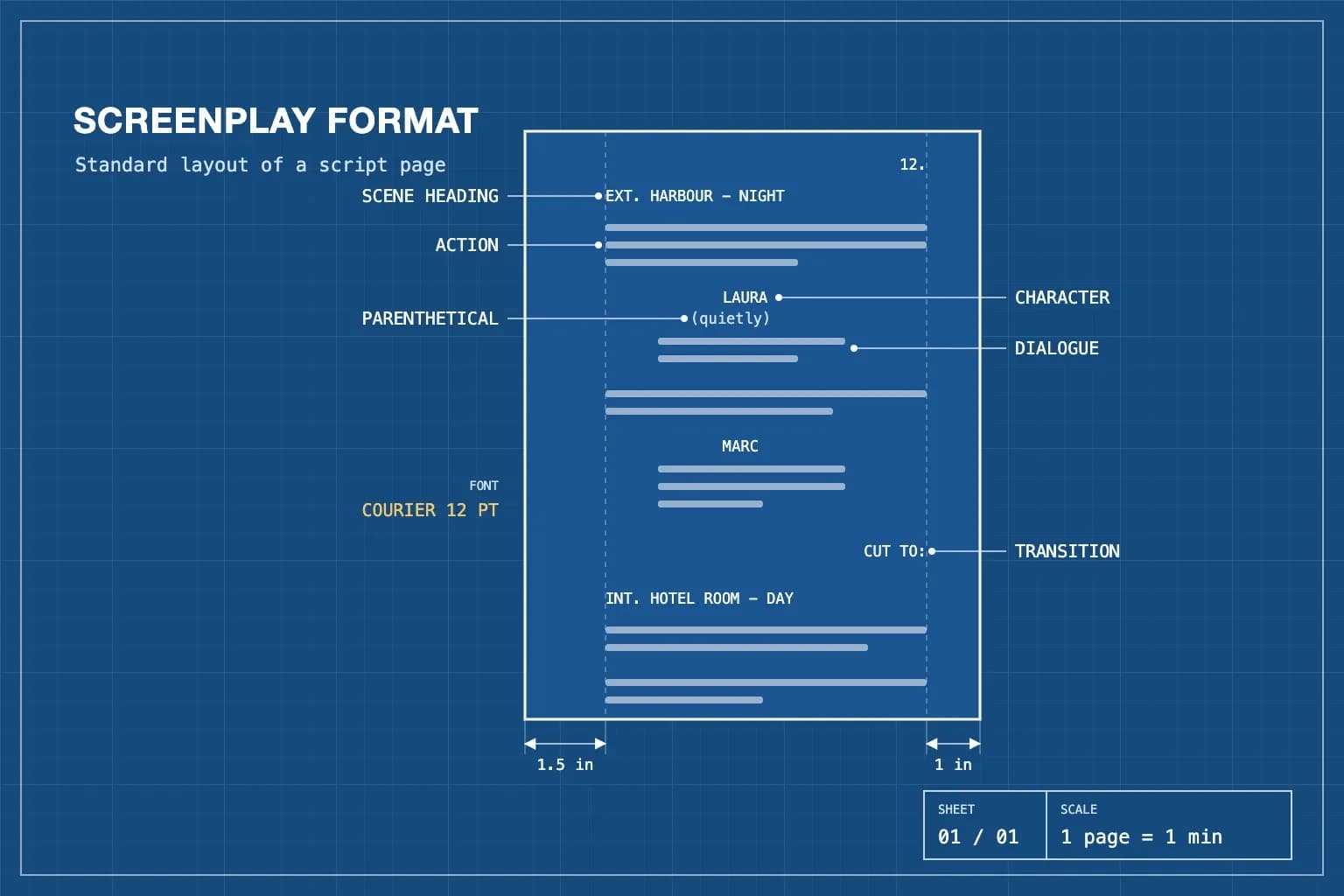
In standard American format, action lines start at the left margin and run the full width of the page, below the scene heading. They describe the setting, introduce characters, and record every visible movement and audible sound in the scene. The page-by-page layout of each element is covered in our guide on how to format a screenplay.
A few rules apply to almost every action line:
- Present tense. The film is happening now, so the description is too: "She opens the drawer," not "She opened the drawer."
- Only what can be seen or heard. A camera cannot film a memory, a motive or a backstory. If something matters, show it through behavior, an object or a line of dialogue.
- Short paragraphs. Three or four lines per paragraph is a common ceiling. Each paragraph should hold one image or one beat of action, so the eye moves quickly down the page.
- Capitals for first appearances. When a speaking character appears for the first time, their name goes in capitals, usually with a brief description: "DEV (30s), a night-shift nurse running on vending-machine coffee, counts pills into a cup."
- Sparing emphasis. Some writers capitalize key sounds or props ("A GUNSHOT. Glass rains down."). This is a style choice, not a rule. Used rarely, it guides the eye; used everywhere, it shouts.
- No camera directions. In a spec script, shot calls like "CLOSE ON" are usually left out. Good description suggests the shot without naming it.
These rules keep one page close to one minute of screen time, which is part of why screenplay format matters.
What are active and passive voice?
Voice describes the relationship between the subject of a sentence and its verb. For screenwriters it is really a question of clarity: who is doing what to whom.
Active voice explained
In an active sentence, the subject performs the action. The doer comes first, the verb comes next, and the thing being acted on comes last.
- "Kenji grabs the knife."
- "The dog drags the blanket across the floor."
- "Rain hammers the windshield."
Each sentence reads like a small piece of film: the doer, then the action, then the result.
Passive voice explained
In a passive sentence, the subject receives the action. The thing acted on comes first, and the doer moves to the end of the sentence or disappears altogether.
- "The knife is grabbed by Kenji."
- "The blanket is dragged across the floor."
- "The windshield is hammered by rain."
The information is the same, but the energy is gone, and the second example hides the doer entirely. Who drags the blanket?
Active vs. passive voice: the key differences
- Who comes first: in active voice, the doer; in passive voice, the thing acted on.
- Verb form: active uses a single verb ("grabs"); passive uses a form of "to be" plus a past participle ("is grabbed").
- Length: active sentences are usually shorter.
- Clarity: active voice always names the doer; passive voice can drop it.
- Feel on the page: active reads as motion; passive reads as a report of something that already happened.
How to spot passive voice in your action lines
Passive voice is easy to miss in your own draft, because you already know who does what. Two tests help.
The "to be" plus past participle pattern
Look for a form of "to be" (is, are, was, were, been, being) followed by a past participle, which is usually a verb ending in -ed or an irregular form like "thrown", "broken" or "seen". "The window is broken." "The money was taken." "A scream is heard."
Be careful: "to be" followed by an adjective is not passive. "The door is open" describes a state; "The door is opened" is passive. Both are static, but only the second one hides an action and its doer.
The "by zombies" test
A trick that many teachers share: if you can add "by zombies" after the verb and the sentence still makes grammatical sense, it is passive. "The door is kicked in (by zombies)" works, so it is passive. "Zombies kick the door in" is active, and adding the phrase makes nonsense.
Passive sentences tend to cluster in moments of violence and discovery, exactly where you need energy most.
Why passive voice weakens a scene description
It slows the read
Passive constructions add words without adding information. "The briefcase is opened by Hana" takes six words to do what "Hana opens the briefcase" does in four. Across a hundred pages, that adds up to a script that feels heavier than it is.
It blurs who does what
Screen stories are built on characters making choices. When your action lines say "the gun is fired", the character responsible slips out of the sentence, and with it the drama.
It feels like the past
Passive voice often reads as a report. "The car has been stolen" is information. "A teenager in a hoodie slides into the driver's seat and peels away" is an event.
When passive voice is the better choice
Active voice is the default, not a law. Passive voice earns its place when the doer is unknown, irrelevant or deliberately hidden.
- Mystery. "The lock has been forced from the inside." You want the reader to wonder who did it, so naming the doer would ruin the beat.
- Aftermath. "The apartment has been stripped bare." The point is the state of the room, not the movers who emptied it.
- Focus on the person acted on. "Lena is thrown against the wall" can be right in a horror scene where the force is invisible and the audience should feel the victim's helplessness.
The test is intent. If you chose passive voice to hide something, keep it. If you used it because it was the first sentence that came out, rewrite it.
Before and after: rewriting passive action lines
Here is how a handful of typical first-draft lines change when the doer moves to the front and the verb gets more specific.
- Before: "The vase is knocked off the table." After: "The cat swipes the vase off the table."
- Before: "A gunshot is heard from the stairwell." After: "A GUNSHOT cracks up the stairwell."
- Before: "The letter is read by Anna, and tears are seen in her eyes." After: "Anna reads the letter. Her eyes fill."
- Before: "The car is driven at high speed through the market by Tomas." After: "Tomas guns the car through the market. Fruit stalls scatter."
- Before: "The body is discovered by two kids at dawn." After: "Dawn. Two kids on bikes skid to a stop. A body lies in the reeds."
- Before: "It is noticed by Jae that the safe has been opened." After: "Jae freezes. The safe door hangs open."
The last rewrite keeps the open safe as a visible state, so the mystery of who opened it survives while Jae acts in the line. Most rewrites are also shorter, and several split one sentence into two, which gives the page a rhythm that feels like editing.
Other habits that make action lines stronger
- Choose specific verbs. "Walks" is active but tells us little. "Shuffles", "strides", "limps" and "creeps" each describe a different person. One precise verb usually beats a verb plus an adverb.
- Cut "begins to" and "starts to". "He starts to run" is almost always just "He runs." Things on screen happen; they rarely begin to happen.
- Watch "there is". "There is a man at the door" becomes "A man waits at the door."
- Use white space. Break long blocks into one beat per paragraph. Dense ten-line paragraphs appear on most lists of common screenplay mistakes.
- Let objects do work. Isolate a key detail on its own line or with an insert shot.
- Keep scene headings clean. Weather and mood belong in the action, not in INT. and EXT. scene headings.
What produced screenplays teach about action lines
Produced scripts show how much room there is for personal style within the rules.
- Alien (1979): the draft rewritten by Walter Hill and David Giler is famous for its stripped-down description, with short fragments stacked down the page almost like verse. Every line is a single image, and the white space builds tension on its own.
- Lethal Weapon (1987): Shane Black's script is known for action lines that talk to the reader, with jokes and asides mixed into the description. The voice is loud, but the verbs underneath are active and precise.
- Fargo (1996): the Coen brothers' scripts are often cited for dry, deadpan description that sets the film's tone without commenting on it.
These styles differ, but they share present tense, a clear subject in almost every sentence, and short paragraphs. Personality works on top of clarity, not instead of it.
Active voice in dialogue
Everything above applies to action lines, not dialogue. Characters can speak however they like, and people often use passive voice for revealing reasons: a teenager says "the car got scratched" instead of "I scratched the car." In dialogue, passive voice can show evasion or guilt, so don't correct your characters' grammar. To check whether lines sound like speech, try reading your script aloud.
Common mistakes when fixing passive voice
Confusing passive voice with past tense
"Maria slammed the door" is active but in the past tense; it breaks the tense rule, not the voice rule. "The door was slammed" is both past and passive. Fix the two separately.
Removing every passive sentence
A draft scrubbed of all passive voice can feel mechanical and lose deliberate mysteries. Decide case by case.
Weak verbs that look active but say little
"He is in the kitchen." "She has a gun." These sentences are active, yet nothing happens in them. Find the verb that shows behavior.
Try it yourself
Pick the first ten pages of your current draft, the pages that carry the most weight with readers, as explained in our guide to the first ten pages of a screenplay. Then work through this checklist.
- Highlight every "is", "are", "was" and "were" followed by a past participle.
- For each one, ask whether the doer is hidden on purpose. If not, rewrite it in active voice.
- Replace "begins to", "starts to" and most "there is" constructions.
- Swap generic verbs like "walks", "looks" and "goes" for specific ones where it helps.
- Break any paragraph longer than four lines into separate beats.
- Check that everything in the action lines can be seen or heard.
- Confirm the whole page is in the present tense.
A passive-voice pass often trims length without cutting anything that matters, which makes it one of the cheapest improvements in any screenplay rewrite.
It also helps to see how the pages read to someone who doesn't know the story. When you upload your screenplay to Poetika, the analysis covers story, structure, character and dialogue, and flags presentation issues a reader would notice in the opening pages.
FAQ
Should action lines always be in active voice?
Almost always, but not without exception. Active voice is the default because it is shorter and shows who does what. Passive voice is the better choice when the doer is unknown or hidden on purpose, as in a mystery beat ("the lock has been forced"), or when the scene should focus on the person being acted on.
What tense are action lines written in?
Action lines are written in the present tense, because the audience experiences the film as it happens. "She opens the door," not "She opened the door." Flashbacks follow the same rule: the scene heading marks the shift in time, and the action inside the flashback is still written in the present tense.
How long should an action line paragraph be?
Most writers keep action paragraphs to three or four lines, with one image or one beat per paragraph. Short paragraphs keep the eye moving and help the page read at roughly the speed the scene will play. A long block of description is one of the quickest ways to make a reader skim.
Is "we see" wrong in a screenplay?
No. Some professional writers use "we see" and "we hear", and it is not a format error. In most cases, though, the phrase can be cut and the image described directly, which saves space and keeps the reader closer to the action. Use it when it adds emphasis or rhythm, not by default.
What is the difference between action lines and stage directions?
Stage directions are a theater term for instructions about movement and staging in a play. In screenplays, the equivalent element is called action, description or action lines. They describe what the audience sees and hears on screen, are written in the present tense, and avoid directing the camera or the actors' performances.
Strong action lines are invisible: the reader stops noticing the words and starts seeing the film. Revise your description, then get a structured read of your script with Poetika.