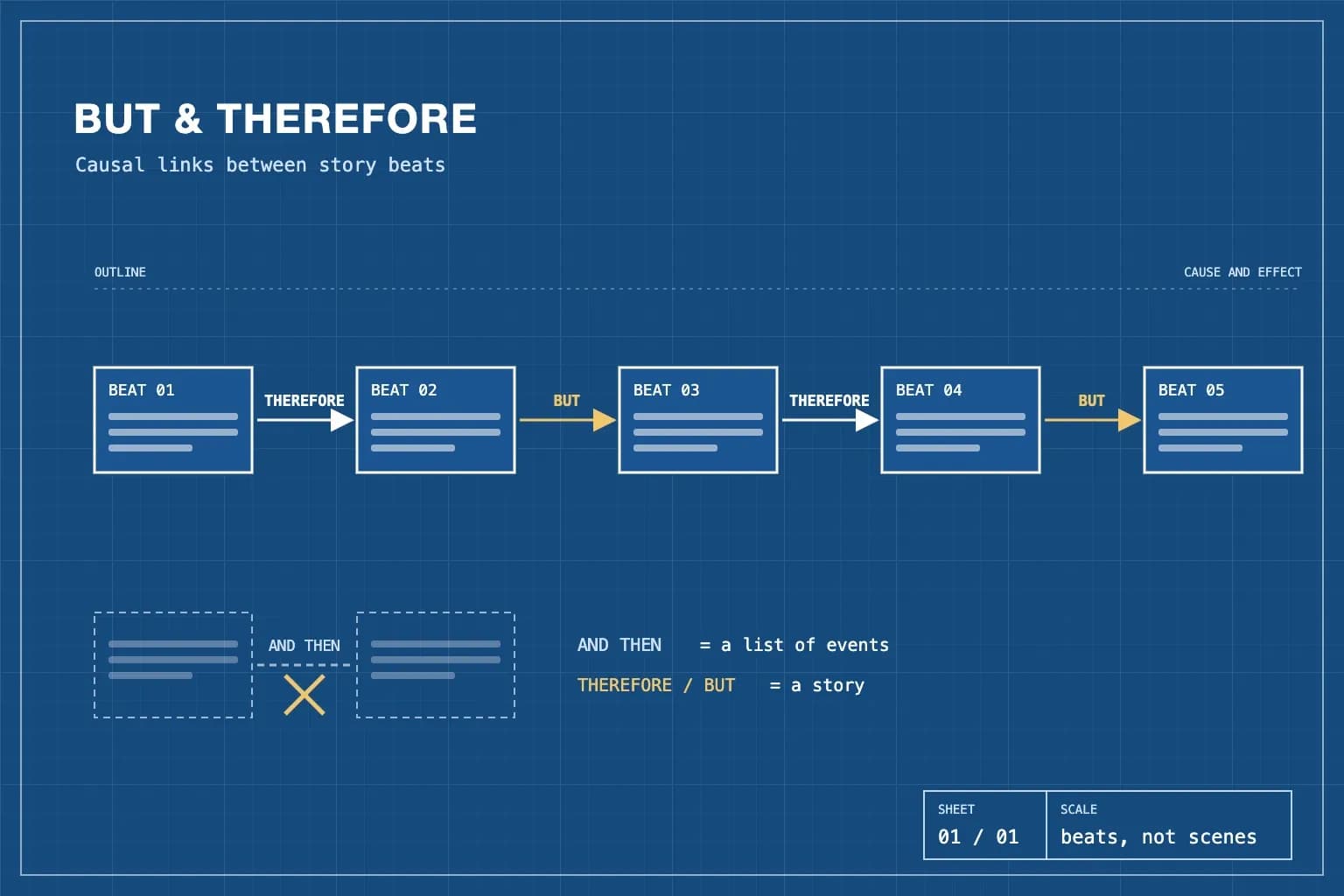
What Is the “But and Therefore” Rule in Screenwriting?
Why some scripts drag even when every scene works, and how Trey Parker and Matt Stone's “therefore or but” test finds the weak joints in an outline.
May 12, 202612 min
Read Spoiler note: this post discusses the structure of Pulp Fiction and Oedipus Rex, including key plot turns.
Story is everything that happens in a narrative, in the order it happens. Plot is the way those events are selected, arranged and connected by cause and effect, in the order the audience experiences them. The story of a film is its raw material: the full timeline of characters and events, including what happens off screen. The plot is the design: which of those events the writer shows, where they appear, what is held back, and how each one leads to the next.
The most famous illustration comes from the novelist E. M. Forster. In Aspects of the Novel (1927) he offered two sentences. "The king died and then the queen died" is a story. "The king died, and then the queen died of grief" is a plot. Same events, same order; the second adds a cause. Story asks "and then?"; plot asks "why?"
Writers often use the two words interchangeably. On the page, the difference matters: many screenplays that feel slow, confusing or flat have a perfectly good story underneath; what they lack is a plot that turns those events into tension. This guide explains what each term means, where the distinction comes from, how it plays out in well-known films, and how to use it when you write and rewrite.
Story is the complete sequence of events in the world of your narrative, told in chronological order. It includes everything that happened, whether or not it ever appears on screen: a character's childhood, the war that ended ten years before the film begins, the argument that happened between two scenes.
Imagine your film's events laid out on a single timeline, from the earliest moment that matters to the last. That timeline is the story. It contains:
Story is about what happens. "A police chief who is afraid of the water has to hunt a shark" describes a story.
Plot is the writer's arrangement of that story for an audience. It decides which events are dramatized, which are only implied, in what order the audience meets them, and how they are linked. Where story is a timeline, plot is an architecture.
Three things define a plot:
Plot is about how and why it happens on screen. One story can produce many plots; the writer's job is to choose the one that makes the audience feel the most.
A side-by-side summary to keep next to your outline:
That last point matters. Audiences never watch a story directly: they watch a plot and assemble the story from it, filling gaps and putting scenes back in order. A good plot makes that work feel like pleasure.
The idea is much older than Forster. In the Poetics, Aristotle uses the Greek word mythos, usually translated as "plot", to mean the arrangement of incidents. He ranks it as the most important element of tragedy, ahead of character, and calls it the soul of the form. He also asks that the incidents follow one another by probability or necessity, and he criticizes episodic plots, in which scenes simply follow without a reason. Our post on Aristotle's Poetics and the Odyssey looks at how those ideas still shape storytelling today.
Aristotle's favourite example shows the gap between story and plot clearly. The story of Oedipus spans decades: a baby abandoned, a man killed at a crossroads, a riddle solved, a marriage, a plague. Sophocles' play Oedipus Rex dramatizes only the last part, the investigation into the plague, and lets the earlier events surface one by one until Oedipus learns that he killed his father and married his mother. The story is a life; the plot is a single day of discovery.
In the 1920s, Russian Formalist critics such as Viktor Shklovsky and Boris Tomashevsky gave the distinction the names many scholars still use: fabula for the chronological events and syuzhet for the way the work presents them. Film studies borrowed the same pair. David Bordwell and Kristin Thompson's textbook Film Art describes story as all the events of a narrative, including those the viewer infers, and plot as everything actually seen and heard in the film.
The story of Charles Foster Kane runs from a boyhood in Colorado to his death in his mansion, Xanadu. The plot starts with that death and his final word, "Rosebud", then follows a reporter interviewing the people who knew Kane, a classic framing device. His life arrives in overlapping flashbacks, each shaped by the person telling it. The plot turns a biography into a mystery.
In Akira Kurosawa's film, a samurai has been killed and his wife assaulted in a forest. That is nearly all the story we can be sure of. The plot is a set of conflicting testimonies, from the bandit, the wife, the dead man speaking through a medium and a woodcutter, recounted by men sheltering from the rain at a ruined city gate. Each version rearranges the same events, and the audience never receives a single reliable story.
Quentin Tarantino's film is built from several interlocking stories told out of order. The diner robbery that opens the film is not resolved until the final scene. Hitman Vincent Vega is killed in the middle section, then appears alive in the last one, because that section takes place earlier in the story. In chronological order, the same events would make a looser, less surprising film.
Christopher Nolan's thriller follows Leonard, a man who cannot form new memories and is hunting the man who attacked his wife. The plot presents the colour scenes in reverse order, so each scene ends where the previous one began, while a black-and-white strand moves forward until the two meet. Because the audience, like Leonard, never knows what just happened, the plot recreates his condition.
Alejandro González Iñárritu's debut, written by Guillermo Arriaga, opens with a car crash in Mexico City and then tells three stories connected by it: a young man in the dogfighting world, a model whose career collapses, and an old hitman. The crash returns from different points of view. The story is three lives in one city; the plot makes a single moment the hinge of all of them.
Bong Joon-ho's film runs largely in chronological order, which shows that plot is not only about breaking time. Its strength is causality and information: each lie the Kim family tells creates the next problem. When three of them hide under a living-room table while the wealthy Parks lie on the sofa above, the audience knows exactly what is at stake and the Parks do not. That suspense is a plot decision.
A screenplay with plenty of story but a weak plot reads like a list: this happened, then this, then this. The fix is rarely to add more events. It is to connect the ones you have, so that each scene is caused by the last and causes the next. When an ending depends on luck instead of cause and effect, the problem gets worse; that is the trap described in our guide to deus ex machina.
Alfred Hitchcock, in his interviews with François Truffaut, described a bomb hidden under a table. If it simply explodes, the audience gets a moment of surprise. If they see it being planted and know when it will go off, an ordinary conversation becomes minutes of suspense. The story is the same in both versions. Only the plot, meaning what the audience knows and when, changes. The same choice drives dramatic irony, where the audience knows something a character does not.
Your story may begin decades before your screenplay does. The plot starts where the dramatic question begins, usually close to the inciting incident, the event that knocks the protagonist's life off balance. Everything earlier is backstory, to be revealed only when the plot needs it. Scripts that confuse the two often open with pages of history nobody cares about yet.
A synopsis usually retells the story in order, so that a reader can follow it quickly; our guide to the screenplay synopsis covers how. The screenplay delivers the plot, with its reveals and reversals in place. If your synopsis is confusing, you may be summarizing the plot instead of the story.
A quick checklist before your next draft:
Writers know their own story too well to notice what the plot leaves out, so an outside read helps. When you run your screenplay through Poetika, the analysis looks at structure, causality and pacing, and points to the places where scenes stop driving the story forward.
Story gives your screenplay its content: the people, the events and what they mean. Plot gives it shape and momentum. Get both right and readers will not just know what happened; they will need to find out what happens next.
Story is what happens, in chronological order. Plot is how the writer presents those events: which ones are shown, in what order and how they cause one another. E. M. Forster's example sums it up. "The king died and then the queen died" is a story; adding "of grief" turns it into a plot, because it introduces a cause.
Yes. A film can have compelling characters and events but arrange them poorly: the key conflict starts too late, scenes do not cause one another or information is revealed in the least interesting order. Readers often describe such scripts as slow or unfocused. Restructuring the plot, rather than changing the story, is usually the fix.
They are closely related but not identical. Plot is the specific chain of events and reveals in your film. Structure is the larger shape that organizes it, such as three acts, five acts or a sequence approach. Structure is the frame; plot is what you build inside it, scene by scene.
They are terms from the Russian Formalist critics of the 1920s. Fabula is the chronological sequence of events, roughly what screenwriters call story. Syuzhet is the way the work presents those events, roughly what screenwriters call plot. Film scholars such as David Bordwell later applied the pair to cinema.
No. Many great films, from Jaws to Parasite, tell their story mostly in chronological order. Plot is not about scrambling time; it is about selection, causality and the control of information. A linear film still has a plot, because the writer chooses what to show, what to skip and when the audience learns each fact.
Why some scripts drag even when every scene works, and how Trey Parker and Matt Stone's “therefore or but” test finds the weak joints in an outline.
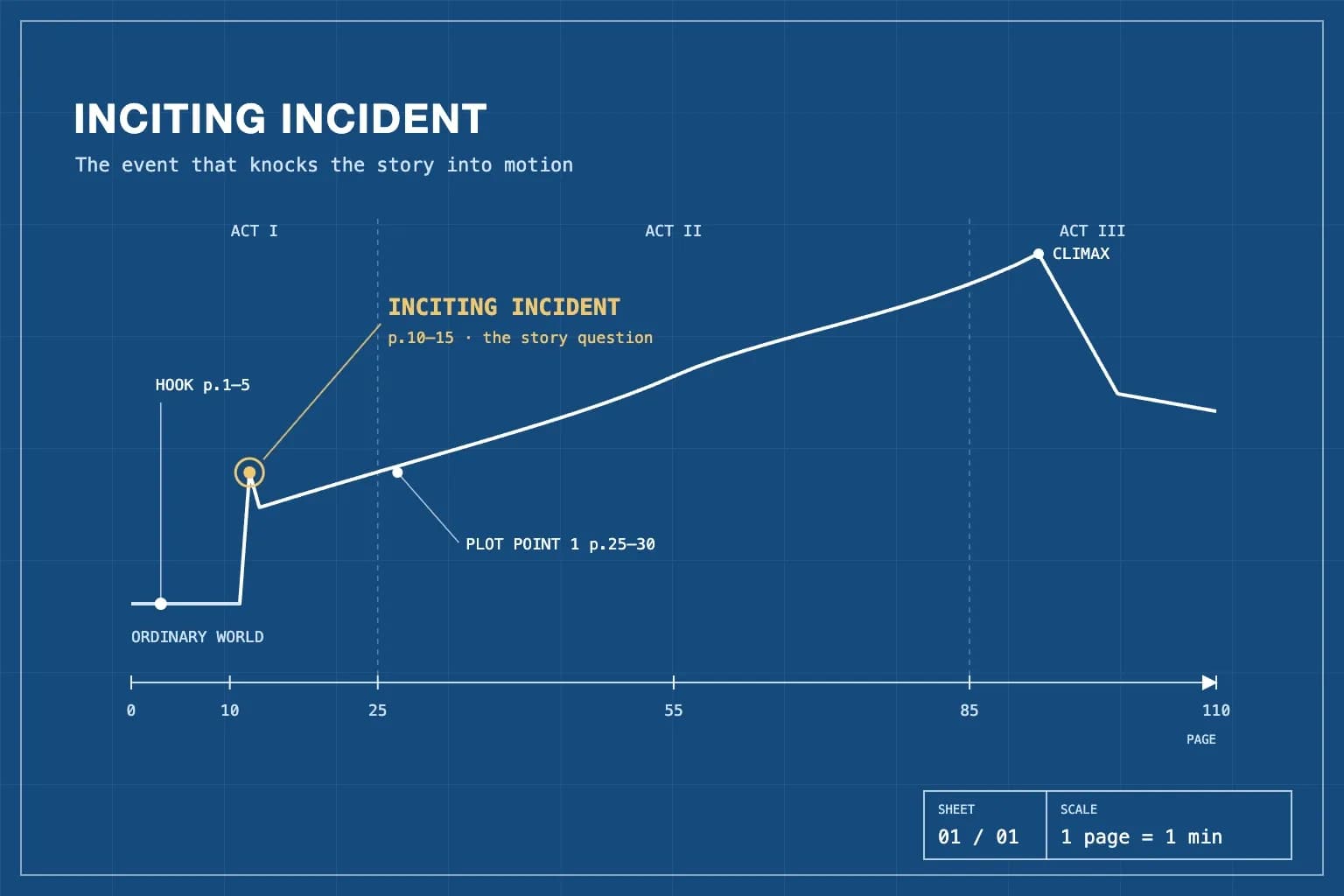
The inciting incident is the event that knocks your protagonist's life off balance and starts the story. Here is what it is, where it goes, and how to write one that works.
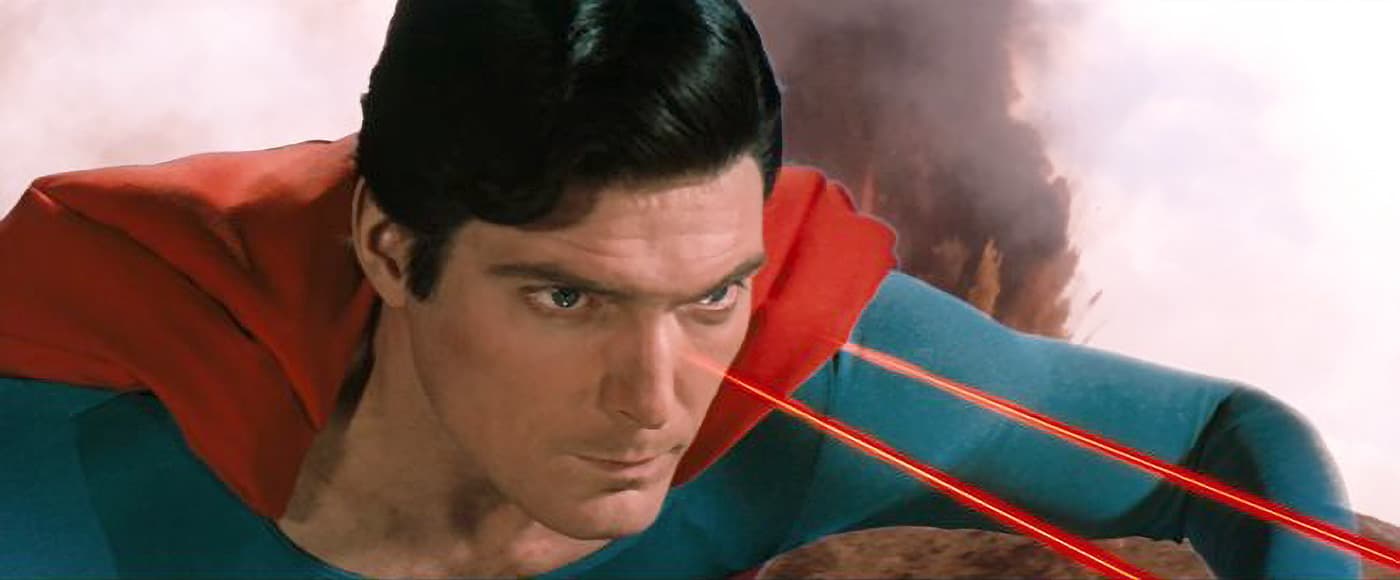
There is a familiar feeling every viewer recognizes, even if they do not have a name for it. A film is nearing its final act. The characters are trapped. The story has tightened itself into a corner. The outcome seems inevitable. And then suddenly something happens. An event, a revelation, a character, or a force arrives from outside the logic of the narrative and resolves what the story itself has not resolved.
Explore a complete sample analysis and understand the feedback format.