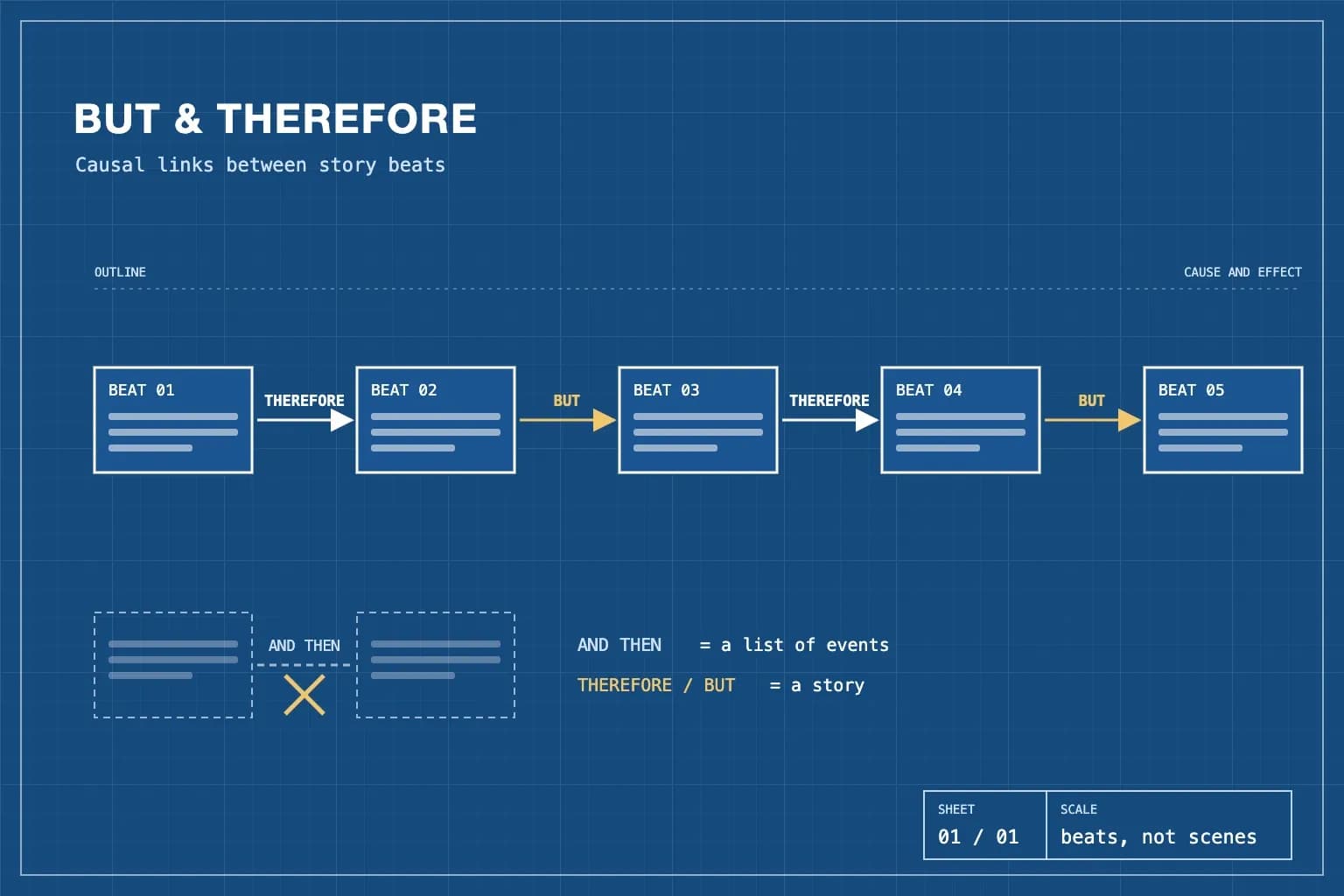
What Is the “But and Therefore” Rule in Screenwriting?
Why some scripts drag even when every scene works, and how Trey Parker and Matt Stone's “therefore or but” test finds the weak joints in an outline.
May 12, 202612 min
Read The seven basic plots are the story patterns described by the British writer Christopher Booker in his 2004 book The Seven Basic Plots: Why We Tell Stories: Overcoming the Monster, Rags to Riches, the Quest, Voyage and Return, Comedy, Tragedy and Rebirth. Booker's claim is that almost every story ever told, from ancient myths to Hollywood blockbusters, is built on one of these seven shapes or a mix of them.
Spoiler note: this post discusses the endings of several films, including The Godfather, Groundhog Day and Throne of Blood.
Booker is not the only writer to try to count stories. Some lists have three plots, some have twenty, one famous French catalog has thirty-six. The numbers disagree because each writer is measuring something different. This guide explains what each of Booker's seven plots looks like on screen, how his book compares with the other plot catalogs a screenwriter will meet, and how to use any of them without letting them write your script for you.
A screenplay is a short, tightly built form where every scene has to push the story forward. Knowing the familiar shapes of stories helps you see, early, what kind of story you are telling and what the audience will expect from it.
Plot patterns help in three ways:
None of this replaces the scene-by-scene logic that makes a plot move. The but and therefore rule still decides whether one scene leads to the next; a plot pattern only shows the overall shape those scenes are building.
Booker's book is the best known of the plot catalogs, but it sits in a long line of attempts to count and classify stories.
The lists are not competing answers to the same question. They work at different scales, so pick the one that matches what you need right now.
Booker gives each plot a typical sequence of stages, usually moving through a call or threat, early success, a crisis and a resolution. The film examples below are ours.
A community or a hero is threatened by a powerful, destructive force, and the hero must confront and defeat it. Booker's examples range from Beowulf to Dracula and Jaws. The monster can be a creature, a villain, a system or a natural force; what matters is that it is far stronger than the hero at the start.
On screen: Jaws (1975), Alien (1979) and Bong Joon-ho's The Host (2006), in which a South Korean family fights a creature that emerges from the Han River. The writing challenge is to keep the threat escalating, so each encounter costs the hero more than the last.
A modest or overlooked character rises to wealth, love or status, loses it all in a central crisis, and then wins it back by showing their true worth. Cinderella, Aladdin and Jane Eyre are the classic models. The crisis is the key element: a rise without a fall is wish fulfilment, not drama.
On screen: Slumdog Millionaire (2008), where Jamal's progress on a quiz show is interrupted by accusations of cheating, and Rocky (1976), where the real riches are self-respect rather than the title belt.
The hero sets out, usually with companions, to reach a distant goal or recover something precious, facing temptations and obstacles on the way. The Lord of the Rings is the model Booker returns to often. The goal must be concrete enough that the audience always knows how far the hero still has to go.
On screen: Raiders of the Lost Ark (1981), The Lord of the Rings: The Fellowship of the Ring (2001) and Walter Salles's Central Station (1998), in which a retired teacher and a boy travel across Brazil to find his father.
The hero is thrown into a strange world, enjoys it at first, finds it growing threatening, and finally escapes back home, changed by the experience. Alice's Adventures in Wonderland and The Wizard of Oz are the textbook cases. Unlike the Quest, the goal is usually simply to get back.
On screen: The Wizard of Oz (1939), Back to the Future (1985) and Hayao Miyazaki's Spirited Away (2001), where Chihiro must survive in a world of spirits to rescue her parents and return.
In Booker's sense, Comedy does not mean jokes. It is a plot of confusion: characters are kept apart by misunderstanding, disguise or social barriers until the truth comes out and everyone is united, often in marriage. Shakespeare's comedies are the model.
On screen: Some Like It Hot (1959), with its disguises and mistaken identities, and 10 Things I Hate About You (1999), a teen version of The Taming of the Shrew. The resolution must come from the confusion being cleared, not from a coincidence.
A hero is tempted into a dark path, enjoys a period of success, then loses control as things go wrong, and is finally destroyed. Macbeth is Booker's central example. A good tragedy makes the audience understand, even share, the desire that ruins the hero.
On screen: Akira Kurosawa's Throne of Blood (1957), a retelling of Macbeth in feudal Japan that ends with Washizu killed by his own soldiers' arrows, and The Godfather (1972), where Michael Corleone wins power and loses the man he was. Tragic endings are among the hardest to land; see why endings are the hardest thing to write.
A character falls under a dark power or a living death, which seems to triumph, until an act of love or a moment of insight releases them. Booker's examples include Sleeping Beauty and Dickens's A Christmas Carol.
On screen: Groundhog Day (1993), where Phil Connors escapes the repeating day only after he becomes a better person, and Kurosawa's Ikiru (1952), in which a dying bureaucrat finds meaning by getting a small park built for his neighborhood.
Booker also discusses two more patterns outside the seven: Rebellion Against "The One", where a hero resists an all-powerful authority, and the Mystery, built around solving a puzzle such as a crime.
A plot pattern is most useful before and after you write, not during.
Few films follow one pattern purely. Star Wars (1977) works as Overcoming the Monster (destroy the Death Star), a Quest (rescue the princess) and a Rags to Riches story (a farm boy becomes a hero) at once. Back to the Future is a Voyage and Return wrapped around a Comedy of mistaken romance.
Mixing works best when one pattern leads and the others serve it. Choose the pattern that governs the main plot and the ending, and let a second pattern shape a subplot or a character arc.
Breaking a pattern on purpose can be powerful, but only if the audience senses the pattern first. A story that sets up a Rags to Riches rise and then refuses the final triumph makes a statement; a story with no shape just feels unfinished.
Plot catalogs are tools for thinking, not laws. Keep their limits in mind:
When your draft is done, check whether its structure delivers what its pattern promises. Run your screenplay through Poetika for a structured read of its story, structure and characters.
They are the seven story patterns described by Christopher Booker in his 2004 book The Seven Basic Plots: Overcoming the Monster, Rags to Riches, the Quest, Voyage and Return, Comedy, Tragedy and Rebirth. Booker argued that nearly every story is built on one of them or a combination, and also discussed two further plots, Rebellion and Mystery.
It depends on how you count. Booker's seven are broad patterns, while Polti listed thirty-six dramatic situations and Tobias twenty master plots. Each list measures a different level of story, from overall shape to individual conflicts. The useful lesson is not the number but the recurring structures audiences recognize and expect.
The seven basic plots classify whole stories by their overall shape and ending. The hero's journey, from Joseph Campbell and Christopher Vogler, describes a sequence of stages a hero passes through, such as the call to adventure and the return. Many Quest and Voyage and Return stories fit both models.
Use them as a check, not a template. Naming your story's pattern helps you clarify the premise, the central crisis and the ending audiences will expect. But a script succeeds on its scenes, characters and dialogue, so let the pattern guide the shape while the details come from your own story.
Why some scripts drag even when every scene works, and how Trey Parker and Matt Stone's “therefore or but” test finds the weak joints in an outline.
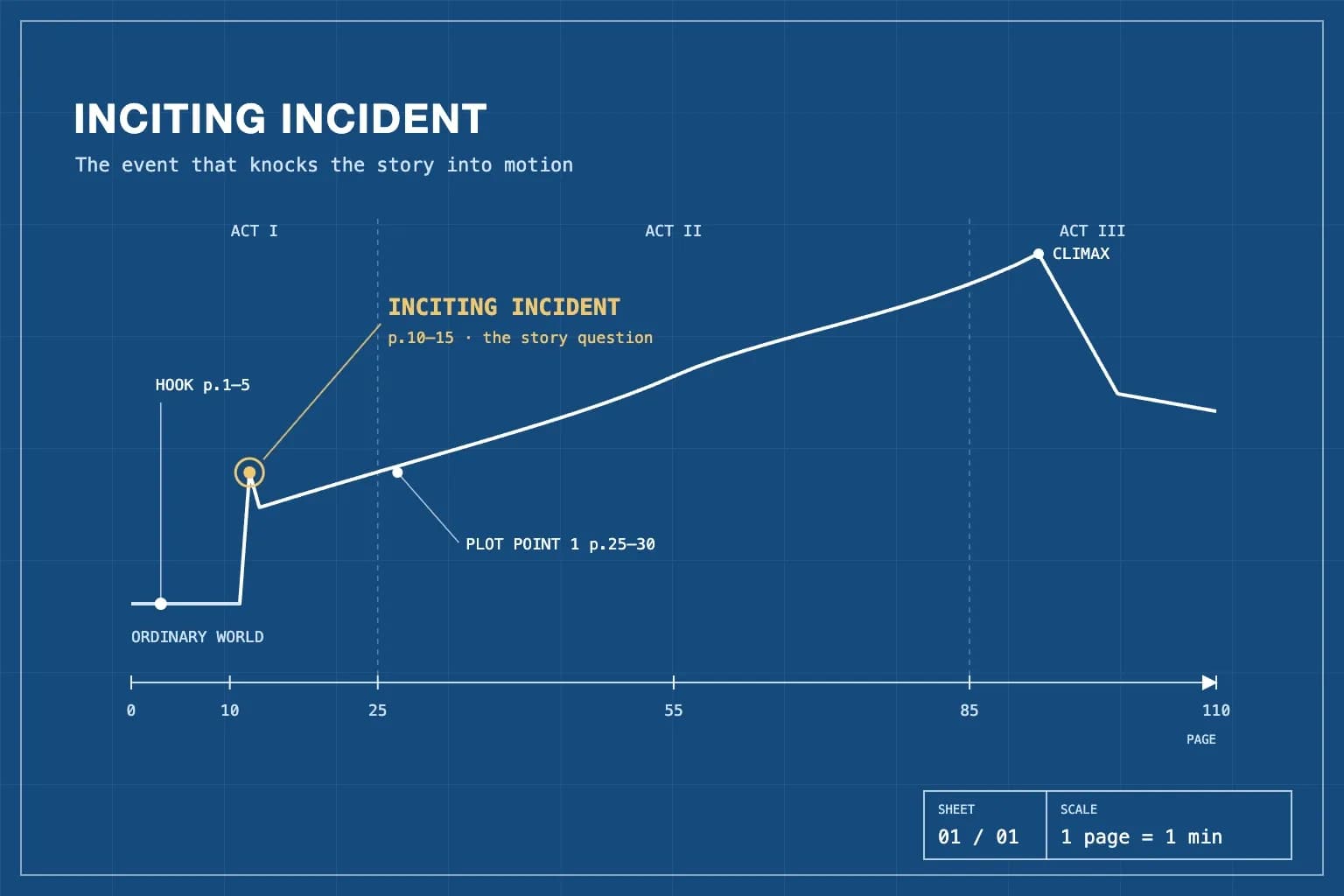
The inciting incident is the event that knocks your protagonist's life off balance and starts the story. Here is what it is, where it goes, and how to write one that works.
How long does it take for you to decide whether you care about a character? Not whether you find them interesting. Not whether you want to know what happens to them. Whether you genuinely "care" the kind of care that makes you lean forward in your seat, that makes the stakes feel real, that keeps you invested for two hours even when the plot gets complicated.
Explore a complete sample analysis and understand the feedback format.