Spoiler note: this post discusses the endings of The Godfather, Groundhog Day, Ikiru, Rain Man and The Shawshank Redemption.
A dynamic character is a character who changes in a significant, lasting way over the course of a story: their beliefs, values or behavior at the end are different from what they were at the beginning. A static character is one who stays essentially the same from first scene to last. The difference is not about how interesting or complex a character is, but about whether the story transforms them.
Most screen protagonists are dynamic, because a feature film is often the story of how someone becomes a different person. But static characters are not a weakness: many memorable figures never change, and their refusal is what forces everyone around them to. This guide compares both types, walks through film and literature examples, and shows how to put change, or its absence, on the page.
What are static and dynamic characters?
The terms come from literary criticism and measure one thing: whether a character changes inside during the story.
- A dynamic character goes through a real transformation. Something in who they are shifts, usually under the pressure of the plot, and the shift sticks.
- A static character keeps the same core personality, beliefs and goals throughout. Events happen to them and around them, but they meet the end of the story as the same person who met the beginning.
Change here means inner change. A character who gets rich or moves to another city has had their circumstances change, which alone does not make them dynamic. The question is whether the way they see or act in the world is different by the final scene.
Static characters explained
A static character has a fixed set of traits, values and desires. That does not make them thin: a static character can be witty, contradictory and deeply drawn. They just don't evolve.
Static characters often play one of these roles:
- The moral anchor, whose steady values the story measures others against.
- The force of nature, usually an antagonist, who cannot be reasoned with or redeemed.
- The series lead, whose consistency lets an audience return episode after episode.
Dynamic characters explained
A dynamic character is left altered by the plot. Usually the story shows a belief, habit or wound that limits them, then applies pressure that forces a choice. By the end, they act in a way they would not have at the start.
That path is a character arc, and it runs in two directions:
- Positive change: the character overcomes a flaw or false belief and grows.
- Negative change: the character gives in to a flaw, abandons their values or is corrupted.
The engine of dynamic change is almost always a character's flaw or need. A protagonist with no limitation has nothing to overcome, which is why character flaws and dynamic arcs are so closely linked.
Static vs dynamic characters: the key differences
- Inner change: a dynamic character's beliefs or behavior shift by the end; a static character's do not.
- Typical role: dynamic characters are usually protagonists; static characters are often mentors, antagonists, foils, sidekicks or series leads.
- What the audience follows: with a dynamic character, the audience watches a transformation; with a static character, it watches the world react to someone who will not bend.
- Source of drama: inner conflict for dynamic characters; the pressure they put on others for static ones.
- Risk when written badly: a dynamic character's change can feel unearned or rushed; a static character can feel flat or dull.
Why writers use dynamic characters
Audiences go to stories partly to watch people change. A dynamic protagonist raises a second question beside will they win?: who will they be when it is over?
Dynamic characters also make theme visible. If a film is about the cost of ambition, the clearest way to dramatize it is a character who learns that lesson, or fails to, through their choices.
When readers say a script has no arc, they usually mean the protagonist is the same person on the last page as on the first, and nothing suggests that was intended.
Why writers use static characters
Static characters are often mistaken for lazy writing. In fact, they do jobs a dynamic character cannot.
Static characters as a fixed point the story turns around
A static character can be the still center others move around. Mary Poppins (1964) is the same brisk, unflappable figure when she leaves as when she arrives. The person who changes is George Banks, the rigid banker who ends the film flying a kite with his children. Her constancy is what makes his change possible.
Static characters as foils
A foil throws another character's traits into relief, and static characters make strong foils because they give a dynamic character something fixed to push against. In Rain Man (1988), Charlie Babbitt (Tom Cruise) begins as a selfish hustler trying to claim his father's estate, while his autistic savant brother Raymond (Dustin Hoffman) remains himself throughout. Raymond's routines do not soften; Charlie does. Many foils are secondary characters, which is part of why they can afford to stay still.
Static characters in series and franchises
Episodic storytelling often depends on a lead who stays the same. Sherlock Holmes and Lieutenant Columbo return in each new story with the same personality; the audience comes back for that consistency, and the change happens in the guest characters and the cases.
Examples of static and dynamic characters in film
A dynamic character who grows
In Groundhog Day (1993), Phil Connors (Bill Murray) is an arrogant TV weatherman forced to relive the same February day in Punxsutawney. He exploits the loop, despairs of it, and eventually uses it to learn piano, help strangers and become someone worth knowing. Only when he truly changes does the day end.
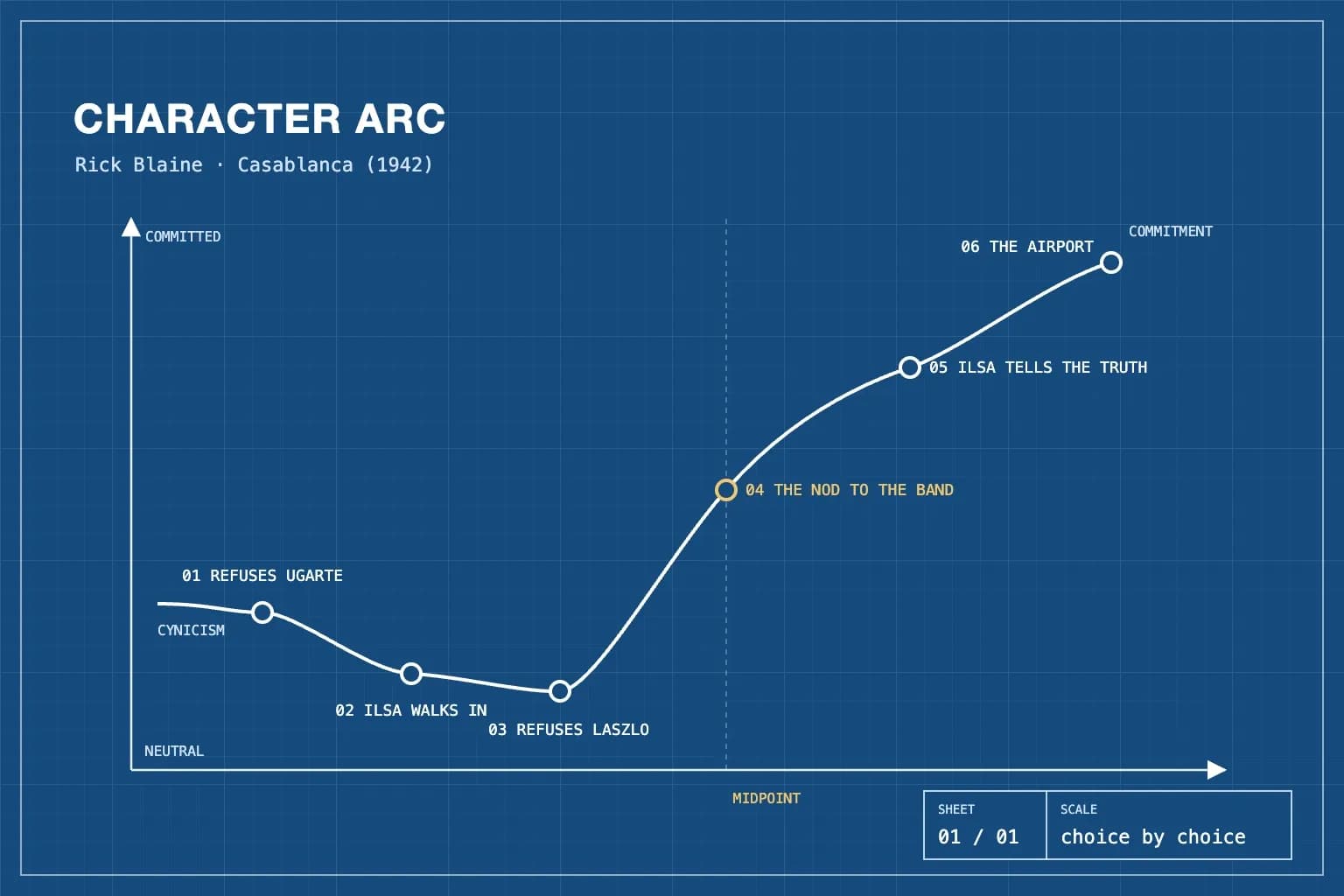
Akira Kurosawa's Ikiru (1952) is quieter. Kanji Watanabe (Takashi Shimura), a city bureaucrat who has spent decades doing nothing, learns he has terminal cancer and spends his last months pushing a small playground through the bureaucracy he once embodied, and he dies on a swing in the finished park. Rick Blaine in Casablanca (1942), who moves from cynical neutrality to commitment, is another classic positive arc, covered in detail in our analysis of Rick Blaine's character arc.
A dynamic character who falls
Michael Corleone in The Godfather (1972) begins as the son who wants no part of the family business: a war veteran who tells his girlfriend Kay that the family is not who he is. Over the film he moves from protecting his father to killing his father's enemies to becoming the new don. In the final scene he lies to Kay, and a door closes between her and the world he now runs. It is a negative arc: a complete, believable change for the worse.
A static character who changes the world around them
In The Shawshank Redemption (1994), Andy Dufresne (Tim Robbins) enters prison quietly convinced that hope is worth keeping, and he never stops believing it. The character who changes is Red (Morgan Freeman), the narrator, who begins by calling hope dangerous and ends the film on his way to find Andy in Mexico.
Antagonists work the same way. The Joker in The Dark Knight (2008) has no arc; he exists to test everyone else, while Harvey Dent falls from the city's hope into vengeance. More on that split in protagonist and antagonist. If you want more film arcs mapped scene by scene, our collection of character arc examples goes through many of them.
Examples in literature
The terms began in literary study, and the classic examples are still useful for screenwriters:
- Ebenezer Scrooge in Charles Dickens's A Christmas Carol (1843) is the textbook dynamic character, changed in a single night from miser to benefactor.
- Sherlock Holmes in Arthur Conan Doyle's stories is a model static character, the same brilliant and difficult detective from case to case.
- Atticus Finch in Harper Lee's To Kill a Mockingbird (1960) is a static moral anchor; the character who grows is his daughter Scout, who narrates.
Round vs flat, static vs dynamic: what is the difference?
These two pairs are often confused, but they measure different things.
Flat and round come from E. M. Forster's Aspects of the Novel (1927). A flat character is built around a single idea or trait and can be summed up in a sentence. A round character is complex enough to surprise the reader in a way that still feels true. This pair measures depth.
Static and dynamic measure change. The two scales are independent, so any combination is possible:
- Round and dynamic: a complex character who transforms, such as Michael Corleone.
- Round and static: a complex character who stays the same, such as Sherlock Holmes.
- Flat and static: a simple character who does not change, such as many comic side characters.
- Flat and dynamic: rare, since a single-trait character who suddenly changes rarely convinces.
If depth is your concern rather than change, our guide to one-dimensional vs three-dimensional characters covers that axis in detail.
How screenwriters show change (or the lack of it) on the page
A novelist can describe thoughts; a screenwriter can only show what the camera sees and the microphone hears. Change has to be dramatized through action.
Changing choices
The clearest evidence of change is a choice the character could not have made at the start. Try the mirrored scene: a similar situation early and late, with a different choice. Rick Blaine refuses to stick his neck out for anyone early in Casablanca; by the end he risks everything for others.
Changing behavior under pressure
Show how your character reacts to pressure in the first act, then raise it later and show a different reaction. If they lie when cornered on page 20 and tell a costly truth on page 95, the reader sees the arc without being told.
Changing relationships
Change shows in how a character treats others. Phil Connors moves from contempt to care for the people of Punxsutawney. Track one key relationship and let it shift as the character does.
A character who refuses to change
A static character also needs to be visible on the page. Give them moments where change is offered and refused: a temptation declined, a value kept at a cost. Each refusal shows their stillness is a choice.
Common mistakes with static and dynamic characters
- Change that is not earned. A character who announces they have learned their lesson has not changed on screen; change must come from choices under pressure.
- A static character who is only dull. Static does not mean inert; they still need a clear point of view, strong wants and an effect on the story.
- Change that happens too fast. A cynic who becomes generous in one scene feels false. Plant the doubt early, let it grow through setbacks and save the decisive shift for the climax.
- A protagonist who is static by accident. If your lead ends where they began and you did not intend it, the script lacks an arc rather than making a point.
Spotting these problems in your own draft is hard, because you know what you meant. Poetika analyzes a screenplay's characters alongside its structure and dialogue, showing whether your protagonist's change reads clearly on the page and where it might feel rushed or missing. Fixing it is then a job for the next draft, which is where rewriting makes a screenplay better.
Try it yourself
Take your current script, or a film you know well, and work through this checklist:
- Name every major character and mark each one as static or dynamic.
- For each dynamic character, write one sentence on who they are at the start and one on who they are at the end.
- Find the scene where the decisive change happens. Is it a choice, or does it just happen to them?
- For each static character, write down what they make the others feel or do.
- Look for one mirrored pair of scenes that shows the protagonist's change without dialogue explaining it.
FAQ
Can a protagonist be a static character?
Yes. Detectives, action heroes and comic leads are often static, and some dramas center on a protagonist whose integrity never wavers. In these stories the drama comes from how the world and other characters respond to them. Andy Dufresne and Mary Poppins are good examples: neither changes, but both transform the people around them.
Is a static character the same as a flat character?
No. Static and flat measure different things. Static means a character does not change over the story; flat means a character has only one or two traits and little depth. A static character can be complex and surprising, like Sherlock Holmes, while a flat character might, rarely, undergo a change.
Should my antagonist be static or dynamic?
Either can work. A static antagonist, like the Joker in The Dark Knight, is a fixed force that tests the protagonist's limits. A dynamic antagonist, like Harvey Dent in the same film, can be tragic, because the audience watches someone fall. Choose based on what your protagonist's arc needs to push against.
How do you know if a character is dynamic?
Compare the character's first and last choices. If they would now act in a way they would have refused at the start, and the story shows the pressure that changed them, they are dynamic. A change in circumstances alone, such as becoming rich or famous, does not count unless their values or behavior shift too.
Do all main characters need a character arc?
Not all of them. Most feature protagonists have an arc because audiences expect to watch transformation, but supporting characters, mentors and series leads are often static by design. What matters is intent: every character who stays the same should do so for a reason that serves the story.
To see how your characters read to someone new, analyze your screenplay with Poetika before you send it out.