Spoiler note: this post discusses the endings of all fourteen films, including Casablanca, The Godfather, A Separation, Bicycle Thieves, Thelma & Louise and Victoria.
A character arc is the inner change a character goes through over a story: who they are at the end compared with who they were at the start. The best way to understand it is to watch it happen. The character arc examples below come from fourteen films made across seven decades and several countries, and each one shows a different shape of change: a cynic who commits, a son who becomes a monster, a child who finds her courage, a man who never quite moves at all.
This page is the hub of our character arc series. Each section gives a short summary of one character, names the type of arc they follow and links to the full analysis, where we break the arc down beat by beat: starting point, want and need, inciting incident, turning points, midpoint, point of no return and final state. If you want the theory first, start with our guide to understanding character arc, which defines the term and its main types in detail.
What is a character arc, in short?
A character arc is the path between a character's starting state and their final state, driven by the pressure of the plot. Most arcs rest on three building blocks:
- A starting point. A belief, flaw or way of living that the story will test. Rick Blaine trusts no one; Chihiro hides behind her parents.
- Pressure. Events that make the old way of living cost more than it used to. The plot exists, in part, to apply this pressure.
- A final state. The character has changed, refused to change, or changed for the worse, and the change shows in a choice, not a speech.
Not every memorable character changes. The difference between characters who transform and characters who hold steady is covered in our post on static vs dynamic characters.
The main types of character arc in this series
A quick map of the arc types the films illustrate:
- Positive change arc: the character overcomes a flaw or false belief and ends better than they began (Rick, Chihiro, Amélie).
- Fall arc: the character gains power or survives, but loses something essential in the process (Michael Corleone, Maria Braun).
- Tragic fall: a decent person is pushed by circumstances into an act that betrays who they are (Antonio Ricci).
- Flat or tested arc: the character mostly holds their position while pressure builds around them (Nader).
- Quiet arc: the change is so small it fits into a single look (Rosetta).
- Redemption arc: a character who served something harmful turns against it (Gerd Wiesler).
- Underdog arc: an overlooked person rises to a challenge by redefining what winning means (Rocky).
- Liberation arc: a character breaks the rules that kept them small (Thelma).
- No classic arc: characters whose power on screen comes from something other than inner change (Hans Landa, Lola, Victoria).
Positive change arcs
Rick Blaine in Casablanca (1942)
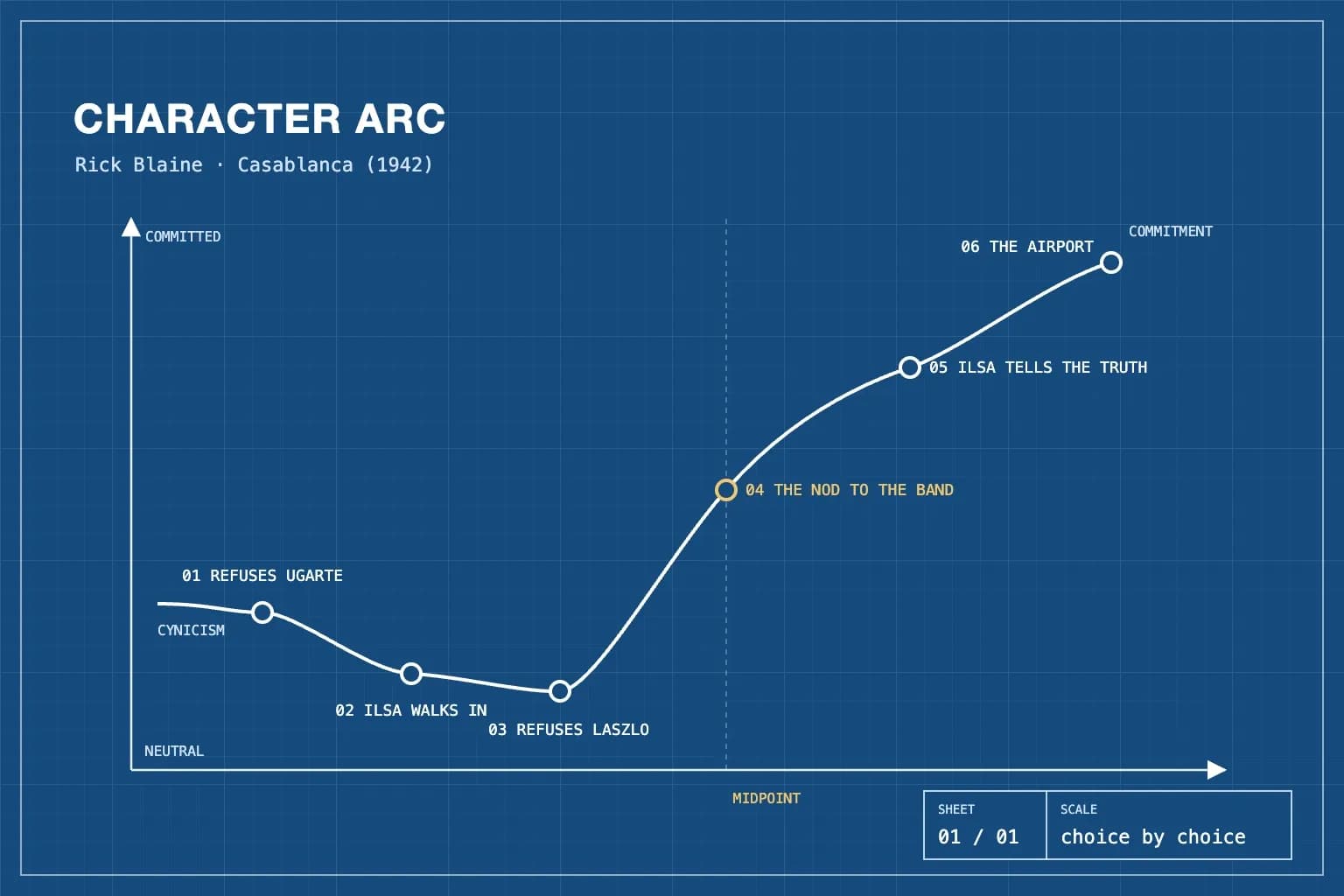
Rick runs a nightclub in wartime Casablanca and tells everyone he sticks his neck out for nobody. When Ilsa, the woman who left him in Paris, walks in with her husband Victor Laszlo, a resistance leader, Rick's neutrality is tested until he gives away the letters of transit that could have saved him and chooses the fight over the woman. It is a textbook positive change arc, from cynicism to commitment. Read the full breakdown: Rick Blaine's character arc in Casablanca.
Chihiro in Spirited Away (2001)
Hayao Miyazaki's heroine begins as a sulky ten-year-old who clings to her mother's arm and complains about moving house. After her parents are turned into pigs, she has to work in a bathhouse for spirits under a new name, Sen, and keep hold of her real one. Chihiro's growth arc shows change almost entirely through action rather than dialogue. See Chihiro's character arc in Spirited Away.
Amélie Poulain in Amélie (2001)
Amélie is a shy Parisian waitress who lives mostly inside her imagination. When she finds a box of childhood treasures hidden behind a bathroom tile and returns it to its owner, she starts secretly improving other people's lives, while avoiding her own chance at love. Her arc is a positive change arc with a clever twist: the flaw is hidden inside a virtue, since helping others is how she hides from risk. Read Amélie Poulain's character arc.
Fall arcs and tragic falls
Michael Corleone in The Godfather (1972)
Michael starts as the family outsider, a war veteran who tells his girlfriend Kay that the family business is not his. The attack on his father pulls him in, and step by step he becomes the most ruthless Corleone of all, ending the film by lying to Kay as a door closes on her. It is the defining fall arc in American cinema: Michael gets everything he fights for and loses himself. See Michael Corleone's character arc in The Godfather.
Maria Braun in The Marriage of Maria Braun (1979)
Rainer Werner Fassbinder's film opens with Maria marrying Hermann during an air raid; he is sent to the front and later reported dead. To survive postwar Germany, Maria turns her loyalty to Hermann into a cold talent for control, rising in business while telling herself it is all for him. Her fall arc is built on love, which makes the hardening harder to judge, and the film invites a reading of Maria as postwar West Germany itself. Read Maria Braun's character arc.
Antonio Ricci in Bicycle Thieves (1948)
In Vittorio De Sica's neorealist classic, Antonio finally gets a job pasting posters in Rome, but only if he has a bicycle. When the bicycle is stolen on his first day, his search with his young son Bruno ends with Antonio trying to steal a bicycle himself and being caught in front of the boy. This tragic fall has no villain: poverty and indifference push a good man into the act he despises. See Antonio Ricci's character arc analysis.
Flat, tested and quiet arcs
Nader in A Separation (2011)
In Asghar Farhadi's Iranian drama, Nader refuses to leave the country with his wife Simin because he will not abandon his father, who has Alzheimer's. After a confrontation with Razieh, the caregiver he hires, ends in a miscarriage and a court case, Nader holds his ground, and the arc becomes a question of how much a man can protect his pride without losing his daughter's trust. Whether Nader changes at all is open to debate, which is exactly why his arc rewards study. Read Nader's character arc in A Separation.
Rosetta in Rosetta (1999)
The Dardenne brothers' heroine is a teenager living in a trailer park with her alcoholic mother, consumed by the need for a job. To get one, she betrays Riquet, the only person who has offered her friendship. Her change comes at the very end, in a single look when Riquet helps her to her feet, which makes Rosetta a model of the quiet arc: the change is real but nearly wordless. See Rosetta's character arc.
Redemption, underdog and liberation arcs
Gerd Wiesler in The Lives of Others (2006)
Wiesler is a Stasi captain in 1980s East Berlin, assigned to bug the apartment of the playwright Georg Dreyman. The more he listens to Dreyman's life, his music, books and love, the more he protects the man he was sent to destroy, quietly falsifying his reports at great cost to his career. It is a redemption arc carried by a character who barely speaks, with an ending built on recognition rather than reunion. Read how The Lives of Others turns a Stasi captain into a conscience.
Rocky Balboa in Rocky (1976)
Rocky is a small-time club fighter in Philadelphia who collects debts for a loan shark, until the world champion Apollo Creed picks him as an opponent for a publicity fight. The key to his underdog arc is a redefinition of the goal: on the eve of the fight he decides that going the distance, not winning, will prove he is not just another bum. He loses on points and wins the arc. See Rocky Balboa's character arc analysis.
Thelma in Thelma & Louise (1991)
Thelma starts as a wife so afraid of her controlling husband that she cannot bring herself to tell him she is going away for the weekend. After the trip turns violent and she and Louise go on the run, Thelma discovers a boldness she never knew she had, and she ends up leading as often as she follows. Callie Khouri's Oscar-winning screenplay shows how a liberation arc can be positive even when the ending is tragic. Read Thelma's character arc in Thelma & Louise.
Character studies without a classic arc
The last three posts in the series are character analyses rather than arc breakdowns. Each looks at a character whose impact on screen does not depend on the usual change from flaw to growth.
Hans Landa in Inglourious Basterds (2009)
Quentin Tarantino's SS colonel barely changes at all, and that is the point. Landa is charming, multilingual and brilliant at reading people, and he uses those gifts to terrify, beginning with the long farmhouse interrogation that opens the film. His only real turn is opportunism, when he betrays his own side for a deal, which shows how a static antagonist can drive a story by forcing every protagonist and antagonist around him to change. See the character analysis of Hans Landa.
Lola in Run Lola Run (1998)
Tom Tykwer's Lola has twenty minutes to find the money her boyfriend Manni has lost, and the film runs her story three times with different results. Lola does not grow in the usual sense; instead, small differences in her choices change everything around her. She is a study in pure agency, a reminder that a character's will can be as gripping as their inner change. Read the character analysis of Lola in Run Lola Run.
Victoria in Victoria (2015)
Sebastian Schipper's film follows Victoria, a young Spanish woman new to Berlin, through a single night shot in one continuous take. She goes from a lonely outsider who agrees to tag along with a group of strangers to an accomplice in a bank robbery and, finally, a survivor who walks away alone. Because the camera never cuts, her change happens in real time, which makes Victoria a rare example of an arc compressed into a couple of hours of screen time. See the character analysis of Victoria.
What these character arc examples have in common
The fourteen films share a handful of techniques you can borrow:
- The starting point is specific. Rick's neutrality, Thelma's need for permission and Wiesler's loyalty to the system are visible in their first scenes, so the audience can measure the change later.
- Want and need pull in different directions. Michael wants to protect his family; what that requires destroys the man he wanted to be. Amélie wants to fix other people's lives; she needs to risk her own.
- Change is proven by a choice. Rick hands over the letters of transit, Antonio reaches for the bicycle, Rosetta looks at Riquet. None of them explains the change in dialogue.
- Pressure escalates. Each arc moves through turning points that raise the cost of staying the same, a pattern that starts with a strong inciting incident.
- The ending answers the arc. The final image tells us what the character has become, which is one reason endings are the hardest thing to write.
How to test the arc in your own screenplay
A few questions to ask of your own protagonist:
- Can you describe their starting state in one sentence?
- Do you know what they want and, separately, what they need?
- Does each act put more pressure on their flaw or belief?
- Is there a point of no return, a choice they cannot undo?
- Does the final change show in an action, not a line of dialogue?
- If they do not change, is that a deliberate choice that the story makes meaningful?
An outside read can tell you whether the change you intend is the change readers actually see. When you run your screenplay through Poetika, the analysis lists your characters and how often they appear, and reviews narrative structure, conflict and dialogue, which shows whether the pressure on your protagonist builds where you think it does.
FAQ
What are the main types of character arcs?
The three broad types are the positive change arc, where the character overcomes a flaw; the negative or fall arc, where they end worse; and the flat arc, where they hold their beliefs while the world around them changes. Redemption, underdog, liberation and tragic arcs are variations on these shapes, as the films in this series show.
What is a good example of a character arc in film?
Michael Corleone in The Godfather is one of the most cited examples, because his fall from outsider to ruthless don is so clear and so complete. For a positive arc, Rick Blaine in Casablanca is the classic case: a cynic who ends the film by giving up the woman he loves for a larger cause.
Does every main character need an arc?
No. Many films have a protagonist who changes, but some of the strongest characters stay the same and change the people around them, like Hans Landa in Inglourious Basterds. What every main character needs is pressure, and a clear position the story tests, whether or not they end up moving from it.
How do you show a character arc without dialogue?
Show it through choices and repeated situations. Put the character in a similar position at the start and the end and let them act differently. Chihiro learns to stand on her own, Rosetta answers a kindness with a look, and Rick gives up the letters of transit. Audiences believe what characters do more than what they say.