Spoiler note: this guide discusses the endings of Citizen Kane, The Usual Suspects and The Godfather Part II.
To write a flashback in a screenplay, you interrupt the present-day story with a scene or sequence set in the past, mark the jump clearly on the page (usually with FLASHBACK in the scene heading and BACK TO PRESENT when it ends), and make sure the scene earns its place: it should reveal something the audience needs right now, something that changes how they read the present. A flashback that only explains backstory slows the film down; a flashback that recontextualizes a choice, a relationship or a mystery drives it forward.
Literary critics call the device analepsis. This guide covers what flashbacks are for, how to format them, how great films use them, common mistakes, and a checklist.
What is a flashback in a screenplay?
A flashback is a scene or sequence that breaks the forward flow of the story to show events that happened earlier. It can be a single image that lasts a second, a full scene, a sequence that runs for several minutes, or a structure that carries most of the film.
It helps to separate the flashback from its neighbors:
- Flashback: a jump back from the present story to an earlier time, after which the story returns to the present.
- Flash-forward: a jump ahead to events that have not happened yet.
- Framing device: a present-day situation that wraps the whole story, such as someone telling a tale. The story inside the frame is often one long flashback. We cover this structure in the story within the story: the framing device.
- Non-linear structure: a film built from several timelines or out-of-order pieces, where there is no single "present" to return to.
- Voice-over: narration laid over images, often paired with flashbacks but not the same thing. See how to use voice-over in a screenplay.
What flashbacks are for: the dramatic functions
A flashback should do a job the present-day scenes cannot do on their own. The strongest ones usually do at least one of these.
Reveal the wound behind the flaw
Many protagonists act from an old injury: a betrayal, a loss, a mistake they cannot forgive themselves for. In Aristotle's terms this sits close to hamartia, the error or flaw that drives a tragic figure. A well-placed flashback shows the audience where the wound came from, so behavior that looked cold or irrational suddenly makes sense. It lands hardest after we have seen the flaw in action, and it makes the character arc that follows easier to measure.
Trigger a recognition
Aristotle's anagnorisis is the moment a character, or the audience, moves from ignorance to knowledge. Flashbacks are a natural tool for it. Hold back a piece of the past, let the present build on a false assumption, then show what really happened. The flashback becomes a turning point rather than an explanation.
Create dramatic irony
If the audience sees a past event that some characters on screen do not know about, every present-day scene with those characters gains tension. We watch them walk toward a truth we already hold. This is one of the most efficient uses of a flashback, and it connects to the broader technique in dramatic irony.
Control pacing and tension
A flashback changes rhythm. It can give the audience a breath after an intense sequence, or delay a payoff to raise the stakes before a climax: the interruption itself builds anticipation.
Flashback examples from great films
These examples come from different decades and countries, and each uses flashbacks for a different reason.
Citizen Kane (1941): many witnesses, one life
Orson Welles and Herman J. Mankiewicz built Citizen Kane almost entirely from flashbacks. After Charles Foster Kane dies whispering "Rosebud," a newsreel reporter, Thompson, interviews the people who knew him and reads the memoir of his guardian. Each account opens a new flashback, and the accounts overlap: we see some events, such as Susan's opera debut, from more than one point of view.
The lesson is structural. The flashbacks show that no single witness can explain Kane. When the final shot reveals that Rosebud was the sled from his childhood, the audience learns something none of the witnesses ever knew.
Rashomon (1950): flashbacks that disagree
Akira Kurosawa's Rashomon frames its story at a ruined city gate in the rain, where men discuss a killing in the forest. We see the crime in flashback four times, told by the bandit, the wife, the dead samurai speaking through a medium, and a woodcutter. The versions contradict each other: a flashback is always someone's account, and the audience trusts it unless given a reason not to.
Casablanca (1942): the wound behind the cynic
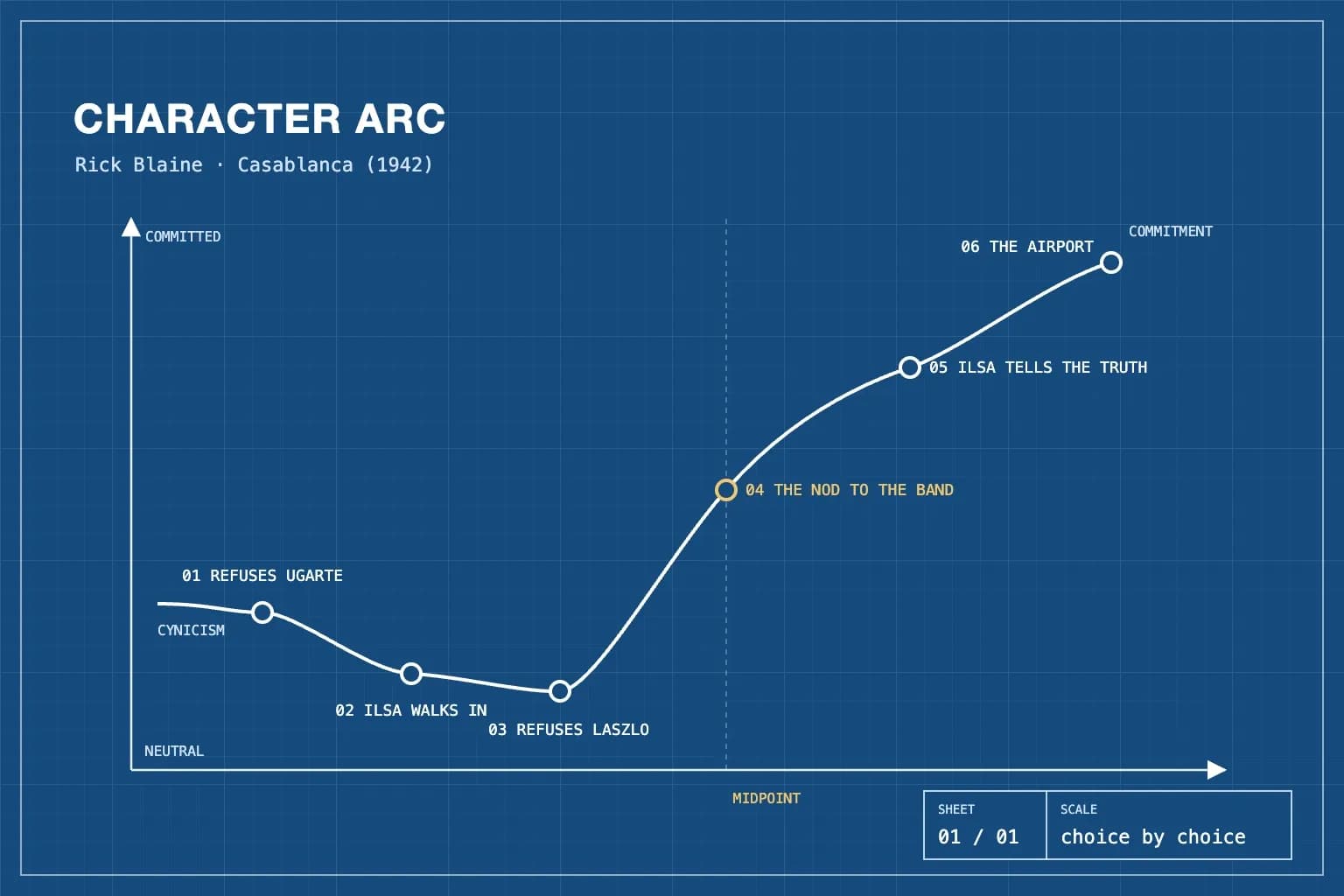
In Casablanca, Rick drinks alone after Ilsa walks back into his life, and asks Sam to play the song she asked for. The film dissolves to Paris: the love affair, the German army approaching, and Rick at the station in the rain, reading her farewell note. The flashback comes after we have spent half an hour with Rick's hard shell, so it lands as an explanation we have been waiting for. We analyze the whole arc in Rick Blaine's character arc in Casablanca.
Wild Strawberries (1957): stepping into memory
In Ingmar Bergman's Wild Strawberries, the elderly professor Isak Borg drives to Lund to receive an honorary degree. When he stops at his family's old summer house, he watches scenes from his youth, but he appears in them as the old man he is now, standing at the edge of his own memories. The point is not the past itself but what remembering does to Isak.
The Godfather Part II (1974): two timelines in argument
Francis Ford Coppola and Mario Puzo intercut Michael Corleone's story in the late 1950s with the young Vito's rise in early twentieth-century Sicily and New York. The Vito sections work as a second timeline that argues with the first: the father builds a family, the son destroys his. The film ends with a short flashback to a family gathering in December 1941, before Michael's transformation began, followed by a shot of Michael alone in the present. The cut makes the cost of his choices visible without a word.
The Usual Suspects (1995): the lying flashback
In Christopher McQuarrie's screenplay, most of the film is Verbal Kint's account of events, told to a customs agent and shown in flashback. At the end, the agent realizes that Verbal built much of the story from names and details on the office wall. The flashbacks were never objective. Alfred Hitchcock tried a lying flashback in Stage Fright (1950) and later told François Truffaut he regretted it, which shows how risky the move is when the payoff is not strong enough.
Slumdog Millionaire (2008): the present asks, the past answers
In Simon Beaufoy's screenplay, Jamal is accused of cheating on a TV quiz show. Each question he answers triggers a flashback that shows how his life taught him the answer. Every jump back is prompted by a question in the present, so the audience always knows why we are going there.
Oppenheimer (2023): two kinds of truth
Christopher Nolan's Oppenheimer moves between the 1954 security hearing, the 1959 Senate confirmation hearing of Lewis Strauss, and Oppenheimer's earlier life. The color sequences follow Oppenheimer's subjective experience; the black-and-white sequences follow Strauss and a more objective view. Nolan has said he wrote the color sections in the first person. When you jump through time often, you need a clear rule like this so the audience never gets lost.
How to format a flashback in a screenplay
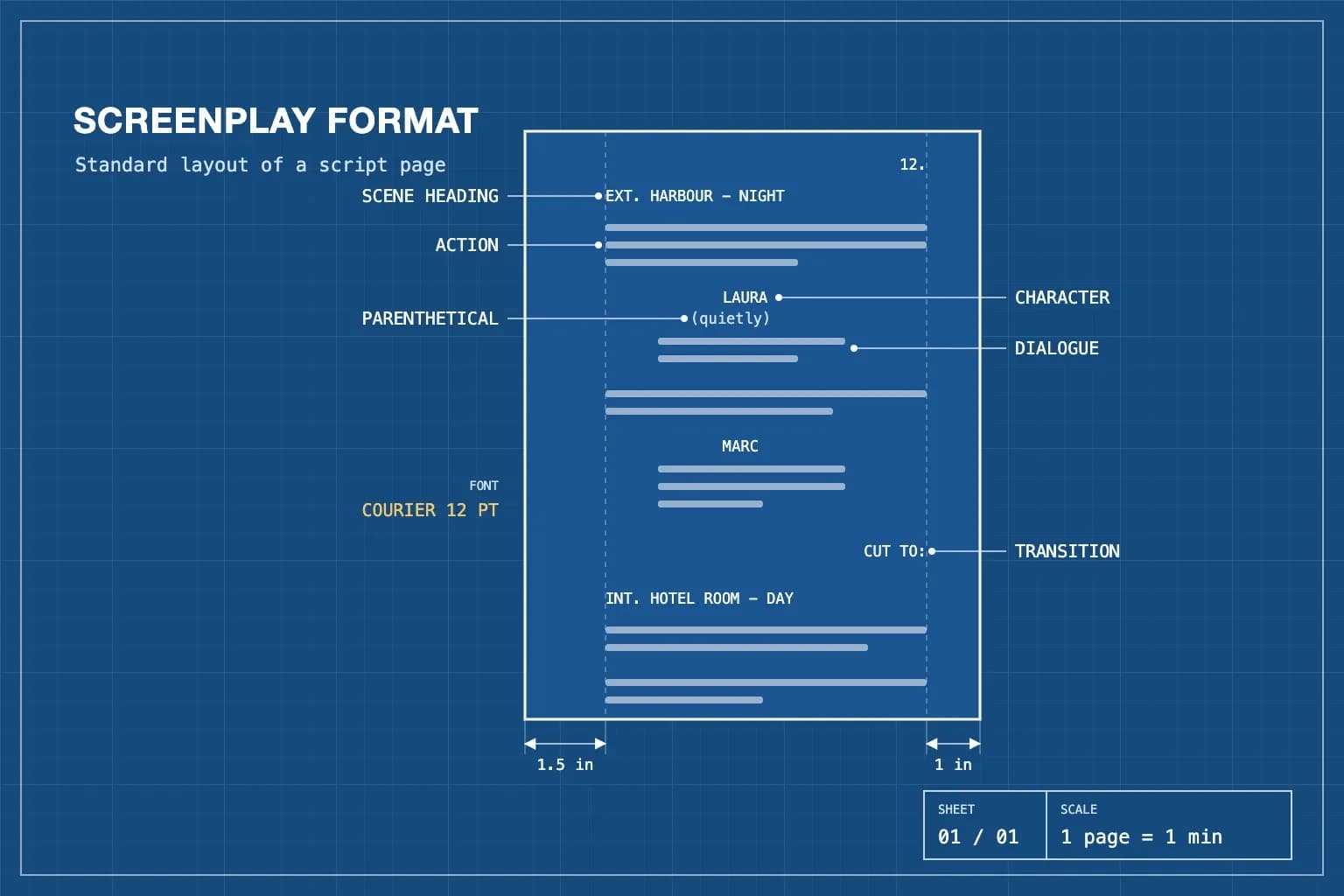
There is no single official format, but readers expect the jump to be clear at a glance. Whatever convention you choose, use it consistently. For the bigger picture, see why screenplay format matters and our full guide on how to format a screenplay.
Single flashback scene
The simplest method puts the word in the scene heading and closes the flashback with a transition-style line:
- Scene heading: INT. SARAH'S BEDROOM - NIGHT (FLASHBACK)
- Optional time marker: add the year if it matters, for example INT. SARAH'S BEDROOM - NIGHT (FLASHBACK - 1998), or put SUPER: 1998 in the action lines.
- Return: BACK TO PRESENT, or simply a new scene heading with (PRESENT) or the present-day location.
Some writers put FLASHBACK: on its own line before the heading instead. Either works if you are consistent.
Flashback sequence
When several past scenes run back to back, mark the start and the end of the whole block instead of tagging every heading:
- Start: BEGIN FLASHBACK SEQUENCE (or FLASHBACK SEQUENCE:), followed by normal scene headings.
- End: END FLASHBACK SEQUENCE, then BACK TO PRESENT or the next present-day heading.
Brief flash cuts
For an image that lasts a second or two, such as a gunshot, a face or a sound, many writers use FLASH CUT: or FLASH ON: followed by one short action line, then BACK TO SCENE. Keep these very short; a flash cut that runs half a page is really a flashback.
Intercutting past and present
If you cut rapidly between two times, set up both locations once and write INTERCUT instead of repeating full headings. Make sure the reader can tell which time each line belongs to.
Dreams, memories and fantasies
A dream or imagined scene is not a flashback. Label it DREAM SEQUENCE or FANTASY so the reader does not think it happened.
Casting the past
If a character appears at a different age, give the younger version a clear name the first time, such as YOUNG SARAH (16), and keep it consistent. Readers lose track of characters faster than they lose track of time.
Common flashback mistakes
Script readers see the same flashback problems again and again:
- The exposition dump. The flashback exists only to explain facts that could be shown in the present or left out. If the scene has no conflict of its own, it is a lecture.
- Too early. A flashback in the first ten pages interrupts a story we have not yet started to care about. The audience needs to want the past before you show it.
- No trigger. The jump comes from nowhere. Strong flashbacks are prompted by something in the present: an object, a question, a line of dialogue, a place.
- Repeating what we already know. If we know the father left, the flashback must add how, why, or what the child saw.
- Killing momentum at the climax. A long flashback in the middle of the final confrontation can drain the tension you have built. If you must use one, keep it short and make it change the outcome.
- Unclear time. The reader cannot tell when the scene happens or who the younger characters are. This is the easiest problem to fix.
How to write a flashback that works: a checklist
Run each flashback in your draft through these questions:
- Does the flashback reveal something the audience needs now, not just something that is true?
- Does it change how we read a present-day choice, relationship or mystery?
- Is it triggered by something specific in the present scene?
- Does the audience want this information before they get it?
- Does the flashback scene have its own conflict, or is it only information?
- Is the jump clear on the page, with a consistent format and a clear return?
- If there are several flashbacks, do they follow one rule (whose memory, which visual treatment, what order)?
- After the flashback, does the present-day story move faster or with higher stakes?
If a flashback fails most of these, cut it and reread the scene. Often the present is stronger when the audience has to infer the past.
When you are deep in a draft, it is hard to judge whether a flashback clarifies the story or stalls it. An outside read helps. Poetika reads your screenplay and gives structured notes on structure, pacing, character and format, which can show where a jump in time slows the story or where the audience may lose track of when they are.
FAQ
How do you indicate a flashback in a screenplay?
Most writers add FLASHBACK to the scene heading, for example INT. KITCHEN - NIGHT (FLASHBACK), and end it with BACK TO PRESENT. For several past scenes in a row, mark the block with BEGIN FLASHBACK SEQUENCE and END FLASHBACK SEQUENCE. Add the year in the heading or as a SUPER if the timing matters.
Are flashbacks bad in screenwriting?
No. Flashbacks get a bad reputation because many drafts use them to dump exposition. Films such as Citizen Kane, Casablanca and The Godfather Part II show how powerful they can be. The test is purpose: a good flashback changes how the audience understands the present, rather than repeating or explaining it.
How long should a flashback be in a screenplay?
It should be as short as the job allows. A flash cut may last one line, a single flashback scene often runs one to three pages, and longer sequences need their own dramatic shape. If a flashback grows long, consider whether it is really a second timeline that deserves to be built as one.
What is the difference between a flashback and a flash cut?
A flashback is a full scene or sequence set in the past, with its own heading and action. A flash cut is a very brief image or sound, usually a second or two, that cuts into a present scene and then returns. Write flash cuts with FLASH CUT: or FLASH ON: and keep them to one or two lines.
Where should the first flashback go in a screenplay?
Usually after the audience cares about the present story and wants to know more about the past. That is rarely in the first ten pages. Exceptions exist, such as films that open in the present and immediately jump back to set up a frame, but those flashbacks are part of the structure, not a backstory insert.