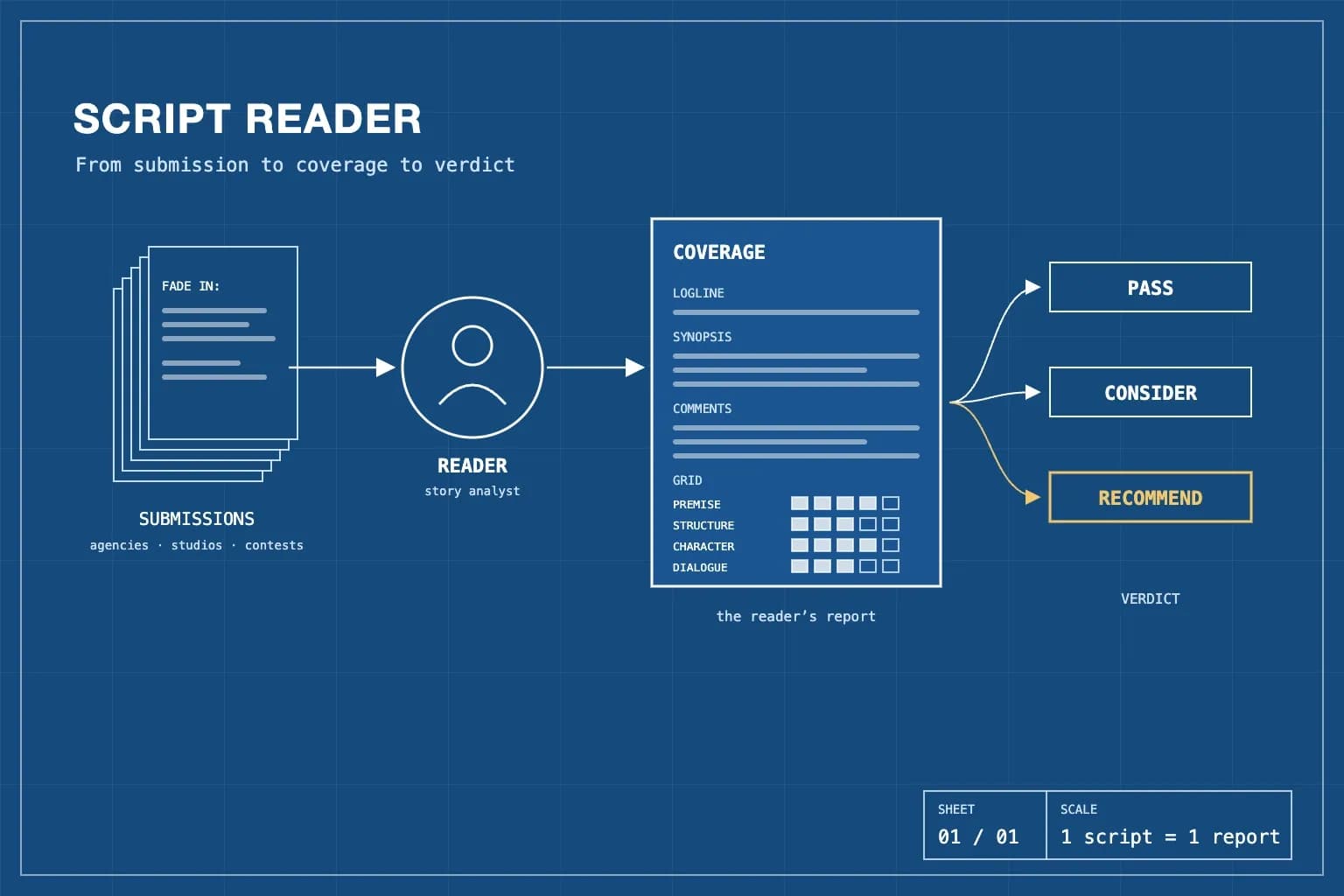
AI script coverage is a screenplay evaluation produced by an AI model instead of a human reader: you upload your script and receive a structured report, usually with a logline, a synopsis and notes on structure, character, dialogue and market fit, in minutes rather than days. It follows the format of traditional coverage, the reports that readers write for producers, agents and contests, but it is built for the writer who wants to see how a draft reads before anyone with power reads it.
Poetika is one of these tools. This guide explains what a Poetika analysis contains, how it works, who it is useful for and who should choose something else. It also covers how it compares with human coverage and how to get the most out of a report. The short version: AI coverage is a fast, consistent first read that helps you find problems early. It does not replace an experienced human reader, and it is most useful when you treat it as one voice among several.
What is AI script coverage?
Traditional coverage is a document a script reader writes after reading a screenplay. It typically includes a logline, a synopsis of a page or two, comments on the script's strengths and weaknesses, and a verdict for the person who will decide whether to read it themselves. Our guide to the different types of script coverage explains the formats, and what a script reader does explains who writes them and what they look for.
AI script coverage uses the same building blocks, but a language model reads the script. The model is given a set of specific questions (what is the logline, who is the protagonist, where does the pacing slow down, which scene headings break format) and answers each one from the uploaded pages. The result is a report organized into the same categories a human reader would cover, often with more mechanical detail than a human has time to write.
What you get in a Poetika analysis
A Poetika report is a coverage-style analysis organized into sections. Depending on your screenplay, it covers:
- The basics: the title, the credited writer, the script's language, its page count, scene count and an estimated running time.
- Story summary: a logline, a short synopsis and a longer narrative summary of the full story from beginning to end.
- Structure and dramaturgy: how the story is built, where the turning points fall, how conflict develops and whether the narrative logic holds together.
- Character: a list of characters with how often each appears, plus notes on development and dynamics between them.
- Dialogue, pacing and tone: how the dialogue works, where the story speeds up or drags, and the tone and emotional movement across the script.
- Format and errors: typographical, spelling, formatting and style problems, with the page and a suggested correction for each.
- Production view: a list of locations with interior and exterior counts and time of day, useful for budgeting and scheduling conversations.
- Market notes: genre, target audience, an audience profile, similar films and an estimated age rating.
- Originality checks: notes on originality and flags for passages that resemble existing works or read as possibly machine-generated.
- Suggestions: constructive recommendations for the next draft.
When the analysis is finished, you receive the report as a PDF by email, and every report stays in your dashboard, where you can read it online or download it again. Reports are available in six languages: English, Turkish, German, French, Italian and Spanish. You choose the report language when you upload, and it does not have to match the language of the script.
How it works
The process takes a few steps:
- Create an account and upload your screenplay for analysis. Poetika accepts PDF, DOCX, DOC and TXT files up to 10 MB.
- Choose your report language. Pick one of the six languages above.
- Wait for the analysis. Most analyses finish within about 15 minutes, depending on the length and complexity of the script.
- Read the report. It arrives by email as a PDF and is saved in your dashboard.
Before the full analysis runs, Poetika checks whether the file actually looks like a screenplay. If you upload a novel chapter, an article or a document with no screenplay features, it stops and tells you instead of producing a report that would not mean much.
Who Poetika coverage is for
First-time screenwriters
If you have just finished your first script and don't have a network of experienced readers, an AI analysis gives you a structured outside view. It tells you whether the story you think you wrote comes through on the page. If the logline it generates doesn't match the one in your head, that is a useful signal. Pair it with our guide on what to do after finishing a screenplay.
Writers between drafts
Many writers use coverage as a checkpoint: read the notes, rewrite, then check whether the new draft fixed what it was supposed to fix. Because the report is fast and uses the same categories every time, it is easy to compare drafts. Rewriting is where most of the improvement happens, as we explain in how rewriting makes a screenplay better.
Students and film schools
For students, a structured report is a way to learn what readers look at: structure, character, conflict, format. Seeing your own script broken down into those categories teaches the vocabulary of coverage faster than reading about it. Students and educators can also look at the academic program.
Independent filmmakers planning a production
If you plan to shoot your own script, the production-facing sections help early conversations: how many locations the script uses, the balance of interior and exterior scenes, day and night, and an estimated running time. These are not a replacement for a line producer's breakdown, but they show where the script will be expensive before you start budgeting.
Producers and readers screening scripts
Producers, development executives and readers who receive more scripts than they can read can use AI coverage as a first pass to decide which scripts to read in full. It does not decide for them; it helps them prioritize. Our guide on how professional script analysis is done explains what to look for in any analysis.
When Poetika coverage is not the right choice
Being honest about limits matters more than selling a tool. Choose something else, or something in addition, when:
- You need a verdict from the industry. A human reader at a company or contest can recommend your script to someone. An AI report cannot open doors.
- You want notes on taste, voice or market timing. An experienced reader knows what buyers have been passing on this year and whether your voice stands out. A model reads what is on the page, not what is happening in the market this month.
- You want a long conversation. A consultant can talk through your notes, challenge your choices and help you plan a rewrite. If that is what you need, see the difference between a script consultant, story analyst and coverage reader.
- You are writing a full TV season. Poetika is designed for feature screenplays and works for standalone TV episodes, but it does not analyze a full season as one story.
- Your script is an outline or a treatment. The analysis needs screenplay pages to work with.
Poetika coverage vs. human coverage
The two approaches have different strengths:
- Speed: an AI analysis is ready in minutes; human coverage usually takes days.
- Consistency: AI coverage asks the same questions of every script, so drafts are easy to compare. Human readers vary from person to person and day to day.
- Mechanical detail: AI is thorough with counts and checks, such as scenes, locations, character appearances and format errors, that a human reader rarely lists in full.
- Judgment and taste: human readers bring experience of what works in the room and in the market, and they notice when an unusual choice is deliberate.
- Context: a human reader can know who will read the script next and tailor notes to that person. AI coverage reads the script on its own terms.
- Accountability: a human reader can explain and defend a note in conversation. With AI coverage, you weigh each note yourself.
Neither is simply better. They answer different questions, which is why many writers use both. For a wider look at whether paid coverage pays off, see is script coverage worth it.
Using Poetika alongside human feedback
A practical order for most writers:
- Run an AI analysis on your finished draft. Fix the clear problems first: format errors, confusing character names, scenes that don't move the story.
- Rewrite. Then run the new draft to check that the fixes worked and nothing new broke.
- Send the stronger draft to human readers. Their time and attention are limited, so they should see your best version, not problems a machine could have caught.
- Compare notes. When AI coverage and a human reader point at the same scene, that scene almost certainly needs work. When they disagree, the human note usually deserves more weight on questions of taste and market.
Your script and your privacy
Writers are right to ask what happens to a script after upload. With Poetika, your screenplay is used only to run the analysis. It is processed by our AI infrastructure provider and deleted when the analysis is finished. What stays in your account is the report, so you can come back to it, and you can delete a report at any time; deleting it removes the report and its PDF. Poetika does not use your scripts to train AI models and does not sell or share them. You keep full ownership of your work, and no person at Poetika reads your script.
How to get the most out of your analysis
- Upload a finished draft. The analysis is most useful on a complete story. A half-written script will get notes about problems you already know about.
- Write your own logline first. Compare it with the logline in the report. A gap between them shows where the page and your intention differ.
- Read the whole report before changing anything. Look for patterns across sections. A pacing note and a conflict note about the same act are probably one problem.
- Treat notes as questions, not orders. Ask "is this true of my script?" for each one. Some notes will be wrong for your story, and that is fine.
- Fix big problems before small ones. Structure and character come before dialogue polish and typos.
- Keep reports from each draft. Comparing them shows whether your rewrite moved the script forward.
- Use the market notes as a starting point. Similar films and target audience help when you write a logline that gets your script read or a query letter, but check them against your own research.
A look at a sample analysis
The best way to decide whether this kind of report fits your work is to see one. After you create a free account, a sample report is available in your dashboard under Resources. It shows every section of a full analysis, so you can check the level of detail, the tone of the notes and the PDF layout before you analyze your own script.
When you read it, look at three things: whether the logline and synopsis would help you pitch, whether the structure and character notes point at specific pages and scenes, and whether the suggestions give you something to do in your next draft.
Getting started
Creating an account is free, and the sample report lets you see the format first. When your draft is ready, start your Poetika analysis and have a structured report in your inbox shortly after.
FAQ
Is AI script coverage accurate?
It is accurate on what can be read directly from the page: counts, format errors, who appears where and how the plot is built. It is less reliable on taste, humor and deliberate rule-breaking, where a human reader's experience matters. Read each note as a hypothesis to test against your script, and give the most weight to issues that several readers notice.
Can AI coverage replace a human script reader?
No. AI coverage is a fast, consistent first read that helps you find and fix problems before people read your script. A human reader brings industry judgment, knowledge of the market and the ability to recommend your script to someone. Most writers get the best results by using AI analysis between drafts and human feedback on the strongest draft.
What file formats does Poetika accept?
Poetika accepts screenplays as PDF, DOCX, DOC or TXT files up to 10 MB. It is designed for feature screenplays and also works for standalone TV episodes. Before the analysis runs, it checks that the file looks like a screenplay, so prose documents such as novel chapters or articles are stopped rather than analyzed.
Does Poetika keep or use my screenplay?
Your screenplay is used only to run the analysis and is deleted when the analysis is finished. Your report stays in your account until you delete it, and deleting it also removes its PDF. Poetika does not use scripts to train AI models, does not sell or share them, and no person at Poetika reads them.
Can I get my report in a language other than English?
Yes. Reports are available in English, Turkish, German, French, Italian and Spanish, and you choose the language when you upload. The report language does not have to match your script, so a writer with a script in one language can read notes in another, which is useful for international co-productions.