Spoiler note: this post describes the opening sequences of several films, including Up and Sunset Boulevard, whose openings reveal major story events.
To write an opening scene, show your protagonist doing something specific in a world with a clear tone, and end the scene with a question the reader needs answered. A strong opening scene does four jobs at once: it signals the genre and mood of the story, introduces the main character through action rather than explanation, gives just enough of the world to orient the reader, and creates tension or curiosity that pulls them into the next page. It is the first promise a screenplay makes, and everything that follows is judged against it.
Aristotle made the point in the Poetics more than two thousand years ago: a whole story has a beginning, a middle and an end, and the beginning is the part that does not need anything before it but sets everything after it in motion. That is still the best test of an opening. If a reader could skip your first scene and lose nothing, it is not a beginning yet. This guide covers what an opening scene must do, how famous films do it, and how to write your own.
What makes a strong opening scene?
An opening scene is the first scene of a film or screenplay, usually the first one to five pages. It is not the whole first act, and it is not always where the main plot starts. Its job is to make the reader trust the writer and want to keep going.
Good opening scenes tend to share a few qualities:
- They are specific. A particular person in a particular place doing a particular thing.
- They contain conflict. Something is wanted and something is in the way, even if the stakes are small.
- They establish tone. By the end of the scene, the reader knows whether to laugh, brace or lean in.
- They end on a turn or a question. The scene leaves something unresolved that the next scene picks up.
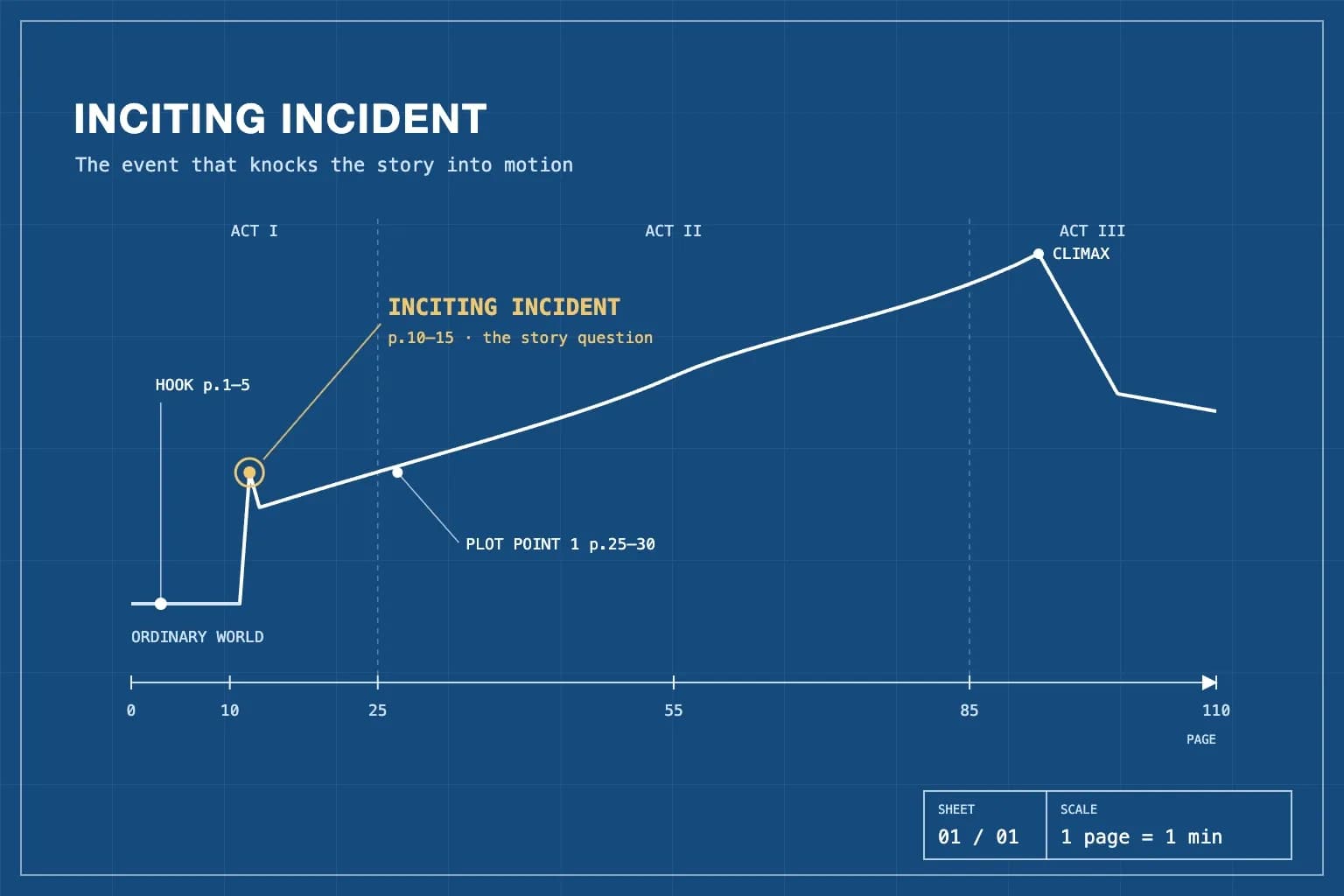
The opening scene hooks the reader; the inciting incident a few pages later gives the story its central problem. For the wider stretch where readers decide whether to continue, see our guide to the first ten pages of a screenplay.
Establish the narrative contract: tone and genre
The first scene is an unspoken contract with the audience: it tells them what kind of story this is and how to watch it. A thriller that opens like a sitcom has to work twice as hard later to win the audience back.
Consider how differently these films announce themselves:
- Raiders of the Lost Ark (1981): a title card reads "South America, 1936," and a hat-wearing adventurer leads a group through a jungle to a booby-trapped temple. Within minutes there are traps, a betrayal, a giant boulder and an escape by seaplane: a pulp adventure with a light touch.
- Amélie (2001): a playful narrator lists tiny, unrelated events happening across Paris at the moment of the heroine's conception, then introduces her parents through their small likes and dislikes. The voice-over promises a whimsical fairy tale told through detail.
- Saving Private Ryan (1998): after a brief prologue at a Normandy cemetery, the film drops the audience into the Omaha Beach landing for more than twenty minutes of chaos. This war film will not make combat look glorious.
None of these openings explains its genre; they demonstrate it through imagery, pacing and sound. On the page, you do this with your action lines: short, punchy sentences for a thriller, longer observational ones for a quiet drama, jokes in the description only if the film itself is funny.
Introduce your protagonist through action
The most common advice about opening scenes is also the most useful: show who the protagonist is by what they do, not by what other characters say about them.
The temple sequence in Raiders of the Lost Ark is a lesson in this. We learn that Indiana Jones is brave, resourceful and cool under pressure. We also learn that he is not invincible: his rival Belloq takes the idol from him, and when Indy reaches the plane and finds a snake in the cockpit, he panics. His fear of snakes is set up in a comic moment and paid off much later in the Well of Souls. One sequence gives us his skill, his flaw and his rival.
The Godfather (1972) does something quieter. It opens on an undertaker, Bonasera, telling an unseen listener, "I believe in America," before asking for justice the law denied him. The camera reveals Don Corleone, who grants the favor and makes clear it will be repaid. Outside, his daughter's wedding is in full swing. In one scene we understand the Don's power, the code he lives by and the double life of the family. Michael arrives in his Marine uniform and tells Kay, "That's my family, Kay, it's not me," the starting point of his arc.
Television pilots do this in even less time. The cold open of Breaking Bad (2008) shows a man in a gas mask and underwear driving an RV wildly through the desert, two men lying motionless in the back. He crashes, records a farewell message to his family and points a gun at the approaching sirens. We have no idea how a mild chemistry teacher got here, which is the point.
Whatever your protagonist's opening action is, make it reveal a want, a flaw or a contradiction. A character already in motion is what makes a later character arc feel earned.
Show the ordinary world and plant the spark
Before a story can disrupt a character's life, the audience needs to see that life. Screenwriting teachers call this the ordinary world or the status quo. The trick is to show it with tension, so the "before" is not a slow wait for the plot.
Parasite (2019) opens in the Kim family's semi-basement apartment. The adult children hold their phones up to the ceiling, hunting for a neighbor's wifi signal now that it has been password protected. The family folds pizza boxes for a delivery company and, when fumigators spray the street outside, leaves the window open to get free pest control. Nobody explains that the Kims are poor and clever; the scene shows both. When a friend arrives soon after with an offer to tutor a rich family's daughter, the ordinary world has already told us why the Kims will seize it.
That arrival is the spark. It often comes after the opening scene, but the opening should plant the conditions for it: show what your protagonist's ordinary world lacks. Blake Snyder's Save the Cat! calls the first beat the "opening image," a snapshot of the hero's world that a final image often mirrors; see our guide to the Save the Cat technique and to writing the ending of a screenplay.
Build the world without exposition dumps
The biggest temptation in an opening scene is to explain: to front-load backstory, history and rules. The reader wants to be oriented, not lectured.
A few techniques help:
- Let the world show its rules. In The Godfather, nobody explains that favors create debts; we watch it happen.
- Use conflict as a vehicle for information. Characters who argue, bargain or lie reveal facts naturally, because each one needs something from the other.
- Start late and trust the gaps. City of God (2002) opens on a chicken escaping a party in a Rio favela, chased through the streets by an armed gang, until the young narrator, Rocket, finds himself caught between the gang and the police. Then the film jumps back years to explain how he got there. We get the energy first and the context later.
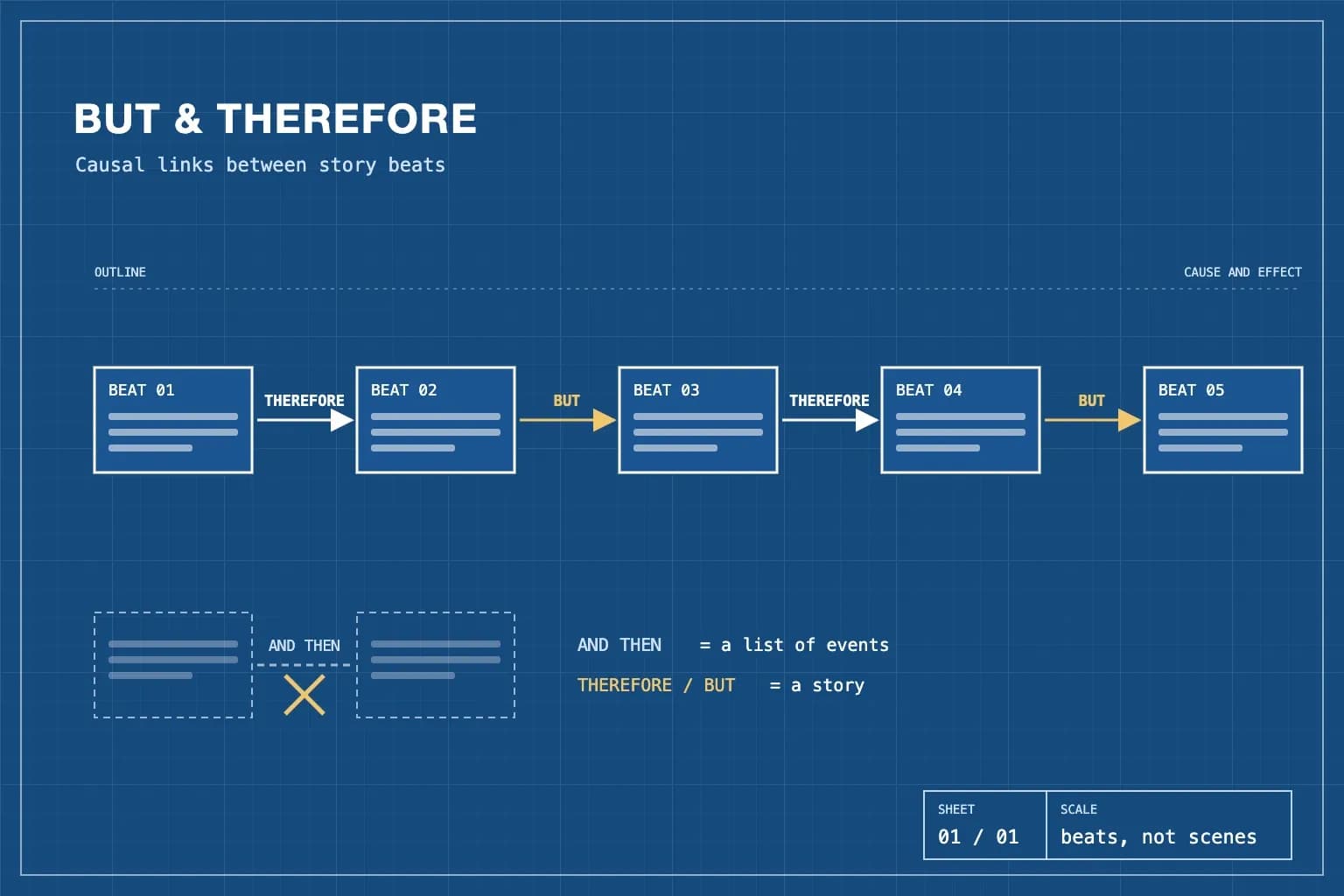
Give the reader only what they need to follow the current scene, plus one question they want answered. Backstory lands better once the audience is curious about it. Building scenes as a chain of causes rather than a list of facts, the logic behind the but and therefore rule, keeps information moving forward instead of piling up.
Raise questions and set the stakes
An opening scene earns the next page by making the reader wonder something: Who is this? What does she want? What happens if he fails? The question only has to be strong enough to carry the reader into the next scene.
Some of the most effective openings work through information the audience has and the characters do not. The first chapter of Inglourious Basterds (2009) takes place on a French dairy farm in 1941. SS Colonel Hans Landa arrives to question the farmer, Perrier LaPadite, about a missing Jewish family. The scene is long and outwardly polite. Its tension comes from what we learn partway through: the family is hiding under the floorboards. Alfred Hitchcock described this as the difference between surprise and suspense, a bomb under a table that the audience knows about and the characters do not. That technique, dramatic irony, can turn a quiet opening into one of the tensest scenes in a film.
Other openings raise the stakes by starting at the end. Sunset Boulevard (1950) opens with police cars arriving at a Hollywood mansion and a body floating in the pool, while the dead man himself narrates. The question becomes how it came to this. The opening montage of Up (2009) sets its stakes emotionally: in a few wordless minutes, Carl and Ellie meet, marry, keep postponing their dream trip, and lose their chance when Ellie dies. When Carl's house later rises on its balloons, we know what it means to him.
High stakes do not mean explosions; they mean the audience knows what the character could lose.
How to write an opening scene, step by step
- Decide what the scene must establish. Write down the tone, the protagonist's defining trait and the question the scene should leave open.
- Choose the moment, not the morning. Start at the point where something is already happening. If the scene begins with the character waking up, ask what the first moment of tension is and start there instead.
- Give the protagonist a want inside the scene. It can be small: get the idol, win the argument, find a wifi signal. A want creates obstacles, and obstacles create drama.
- Write action lines that carry the tone. Your description is the reader's first experience of the film's style. Keep it visual, present tense, and cut what a camera cannot see.
- End on a turn. The balance of the scene should shift by the last line: a reveal, a decision, a threat, a joke that lands differently than expected.
- Rewrite it last. Only after finishing the draft do you know what the first image should set up.
Common opening scene mistakes
- The alarm clock opening. A character wakes up, showers and eats breakfast. It is among the most familiar openings and rarely tells the reader anything new.
- The exposition dump. Characters tell each other things they both already know.
- No conflict. Atmosphere alone cannot carry the first pages. Something must be wanted and resisted.
- A tone the rest of the script does not deliver. An action-packed prologue attached to a quiet drama sets up the wrong expectations.
Many of these overlap with the common screenplay mistakes that send scripts to the bottom of a reader's pile.
Opening scene checklist
- Does the scene start at a moment of tension rather than routine?
- Can a reader name the genre and tone by the end of the first page?
- Is the protagonist introduced through an action that reveals a want, flaw or contradiction?
- Is every piece of exposition needed for this scene, right now?
- Does the scene end on a turn or an open question?
- Does the opening set up something the ending can echo or answer?
It is hard to judge your own opening, because you know everything the reader does not. When you run your screenplay through Poetika, the analysis looks at structure, pacing and character introductions, so you can see whether your first pages establish tone and stakes as clearly as you intended.
FAQ
How long should an opening scene be?
Most opening scenes run one to five pages, but there is no fixed rule. The first chapter of Inglourious Basterds runs around twenty minutes because its tension builds steadily throughout. What matters is that the scene keeps turning. If nothing has shifted after two or three pages, the scene is probably too long or starting too early.
Should a screenplay open with the protagonist?
Not always. Jaws opens with a victim, and The Godfather opens with Bonasera before we see Don Corleone, let alone Michael. Opening without the protagonist works when the scene establishes the world, the threat or the tone the hero will face. If you do this, introduce the protagonist soon after with an equally strong moment.
What is the difference between an opening scene and a cold open?
A cold open is a scene that plays before the title sequence, a device common in TV pilots and episodes, as in Breaking Bad. Every cold open is an opening scene, but not every opening scene is a cold open. In features, the term usually refers to a prologue-style sequence that hooks the audience before the main story begins.
Is it a good idea to start with a flash-forward?
It can be, if the flash-forward raises a question the story then answers, as in City of God or Sunset Boulevard. It becomes a crutch when it simply borrows excitement from later in the film to cover a slow first act. Ask whether the scene would still work if the story began in strict chronological order.
Should I write the opening scene first or last?
Write a working version first so you can start, but expect to rewrite it once the draft is finished. By then you know the story's themes, its ending and its protagonist's arc, which tells you what the first image needs to set up. Many strong openings are the product of the final rewrite, not the first draft.