The first ten pages of a screenplay are the opening ten minutes or so of the film on paper, and they have one job: to make a reader want to read page eleven. In those pages a script has to introduce its main character, show the world and the tone, hint at what the story is about and raise a question the reader needs answered. If they do, the reader leans in. If they don't, the reader may finish the script, but they will be reading for reasons to pass.
Syd Field's checklist asks whether the first ten pages introduce the main character, establish the dramatic premise and set up the dramatic situation; Blake Snyder's beat sheet treats pages 1 to 10 as the set-up. This guide explains what those pages must do, gives a page-by-page map and ends with a checklist for your own draft.
Why the first ten pages matter
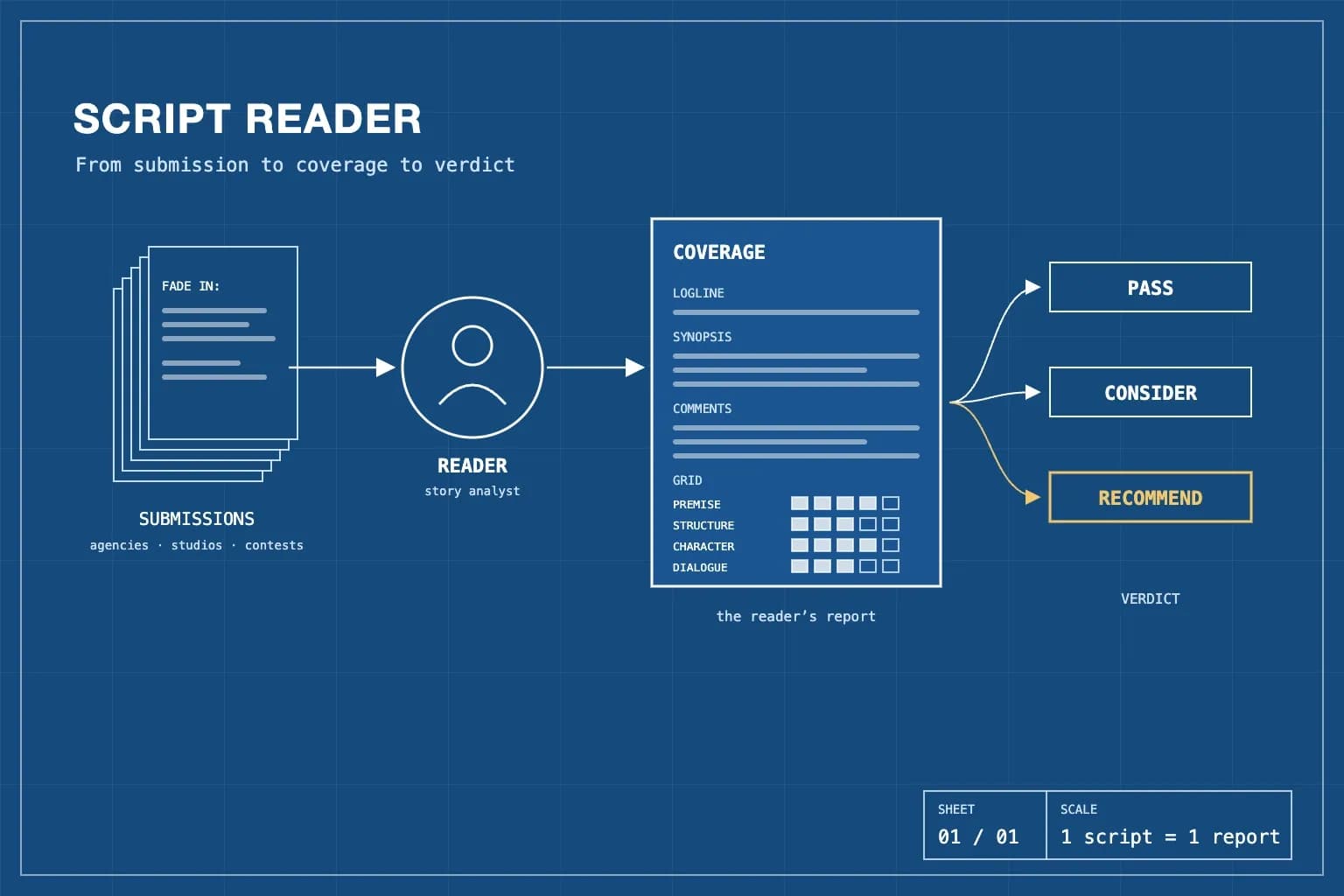
Most screenplays are first read by a script reader, an agency assistant or a first-round contest judge. Script readers often get through several scripts a day, and the opening pages are where they form their first opinion of the writer and the story.
With the rule of thumb that one page equals about a minute of screen time, ten pages are roughly the first ten minutes of the film. On the page, a reader decides even faster, because format errors and a vague protagonist are visible from page one.
The first ten pages also make a promise about genre, tone and the kind of question the story will answer. Everything after is judged against that promise.
What the first ten pages must do
Every opening is different, but by page ten a reader should be able to answer four questions:
- Who is this about? The protagonist should be on the page, doing something that shows who they are, and the reader should know whose story they are following.
- Where and in what kind of film are we? The world, the time, the rules and the tone should be clear enough that the reader knows whether to expect laughs, dread or heartbreak.
- What is this story about? Not the whole plot, but a sense of the central problem or desire: the thing the character lacks, wants or is about to lose.
- Why should I keep reading? A question, a tension or a mystery that the reader wants resolved.
Notice what is not on the list: full backstory, every supporting character, the theme spelled out in dialogue.
A page-by-page map of the first ten pages
There is no fixed formula, and great films break every rule below. But for a feature script of around 90 to 120 pages, this map describes what many effective openings do:
- Page 1: The opening image or scene. It sets tone and genre and gives the reader something to look at or wonder about.
- Pages 1-3: The protagonist appears, ideally in action, in a moment that reveals character. Some scripts delay this with a cold open that sets up the threat or the world first.
- Pages 3-5: The normal world. We see the protagonist's daily life, their relationships and the problem or flaw that will matter later.
- Pages 5-8: The story question takes shape. Something hints that this life is about to change: a rumour, a tension, an opportunity, a warning.
- Pages 8-12: In many scripts, the inciting incident arrives here or soon after. In others, it is clearly on the way.
Treat the map as a diagnostic, not a template: if your protagonist first appears on page nine, ask whether the delay is doing something useful.
Page one: the opening image or scene
Page one is the only page every reader is guaranteed to read. It should put a vivid image in the reader's head and signal what kind of film this is.
Jaws (1975) opens with a night swim that ends in a shark attack before the hero has even appeared. In one scene, the audience learns the genre, the threat and the setting. Children of Men (2006) opens with a crowd in a London café watching news that the youngest person in the world has died, and then a bomb goes off moments after the protagonist walks out. The world, the tone and the danger are all in place within the first minute.
You don't need an explosion. The Social Network (2010) opens with a fast bar conversation that ends with Mark Zuckerberg's girlfriend breaking up with him, establishing his intelligence, arrogance and wound through dialogue alone. For more on how to build this first scene, see our guide on how to write an opening scene.
Introducing your protagonist
Introduce your protagonist early and in action, doing something only they would do.
Raiders of the Lost Ark (1981) introduces Indiana Jones in a booby-trapped temple in South America, taking a golden idol, outrunning a giant boulder and then losing the prize to his rival Belloq. In a few minutes we learn that he is brave, resourceful, a little reckless and not always the winner. The Silence of the Lambs (1991) opens with Clarice Starling alone on an FBI Academy training course, then follows her through a world of men who look at her and doubt her. Before she meets Hannibal Lecter, we know what she wants and what stands in her way.
On first appearance, write the name in capitals and give a short description that suggests character as well as looks. For more, read the anatomy of a great protagonist.
Setting up the normal world
The normal world is the protagonist's life before the story disrupts it; the reader can only feel the disruption if they know what is being disrupted.
Parasite (2019) spends its opening in the Kim family's semi-basement apartment: the family hunts for a free wi-fi signal, folds pizza boxes for cash and watches a drunk man outside their window. By the time a friend offers Ki-woo a tutoring job with a wealthy family, we understand exactly what that opportunity means to them.
Keep the normal world short. Each scene should show something you will pay off later: a fear, a skill, a relationship, a lack. A normal world that only shows a character being normal reads as slow.
Establishing tone and genre
Tone is the emotional contract with the reader. By page ten, they should know whether to laugh, worry or brace themselves.
Get Out (2017) opens with a young Black man walking alone through a quiet suburb at night, being followed and then abducted. Only after that cold open does the film move to Chris and Rose. The opening tells the audience this is a horror film, so every polite smile at the family dinner later feels like a threat. Amélie (2001) does the opposite: a playful narrator lists tiny, specific details about the world and the characters, and the audience knows at once that this is a whimsical fable.
Action lines carry tone too: short, sharp lines read as tension. If you are unsure of your genre, it will show on page one; see what genre your film is and why it matters.
The inciting incident: when should it happen?
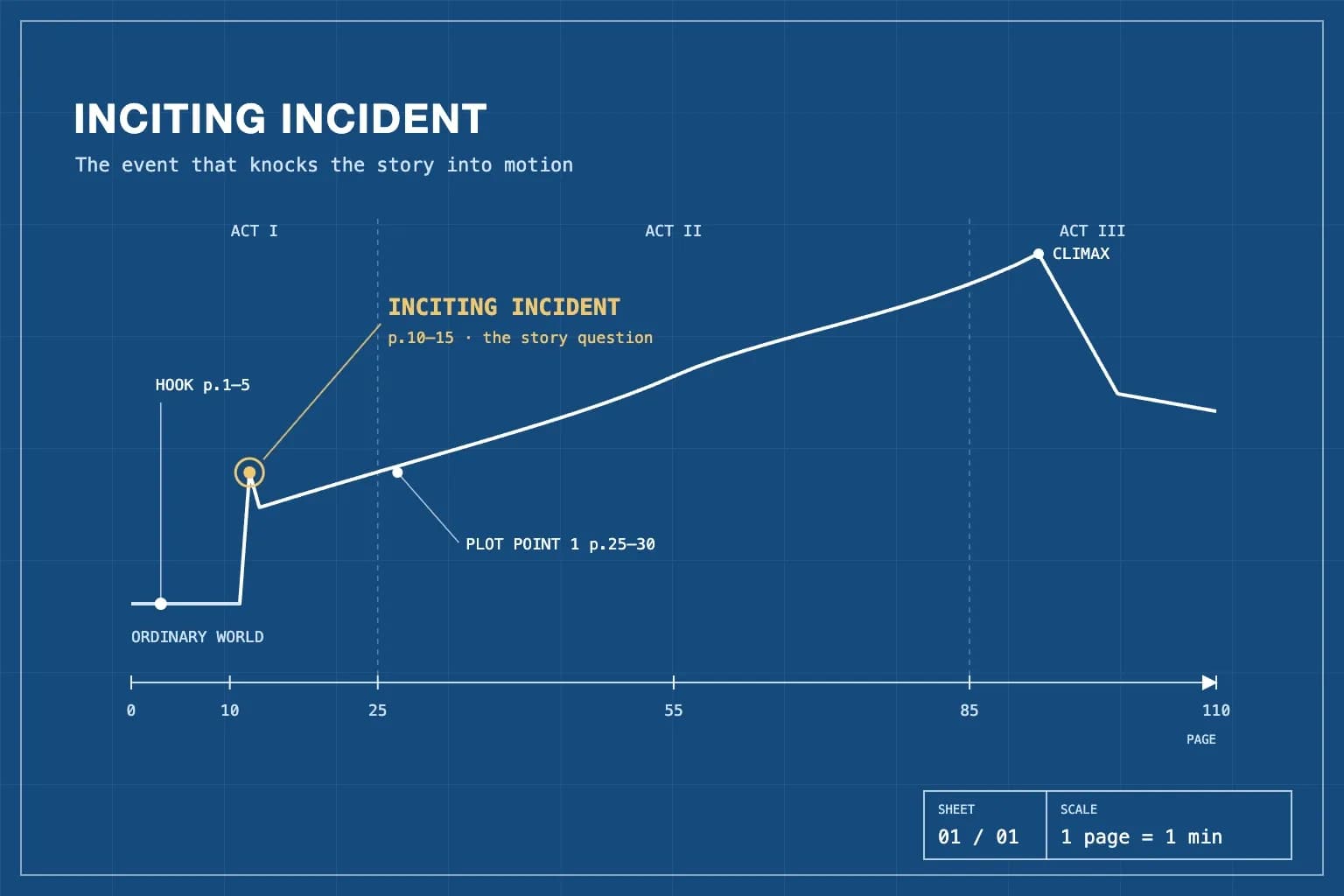
The inciting incident is the event that knocks the protagonist's life out of balance and starts the story. In many feature scripts it lands somewhere around page 10 to 15. Snyder's beat sheet places the catalyst on page 12 of a 110-page script.
It need not happen by page ten, but the first ten pages should make it feel inevitable. In Jaws it happens on the first pages; in The Silence of the Lambs, Crawford gives Clarice her assignment within the first few minutes. Slower dramas place it later but still build pressure towards it.
If yours arrives on page 25, the opening pages can often be cut or compressed.
Planting the story question
The story question keeps a reader turning pages: will she catch the killer, what is in the box? The first ten pages can plant smaller questions before the inciting incident raises the big one.
A strong opening often raises a question right away and answers it while raising a bigger one. City of God (2002) opens with a chicken escaping from a gang's party and ends the sequence with the narrator, Rocket, caught between the gang and the police. Then the film jumps back in time. The audience now has a question it can't put down: how did he end up there?
A mystery is a question the reader knows they are asking; confusion is one they can't put into words.
Common mistakes in the first ten pages
The same problems show up in many first drafts, and most of them appear in any list of common screenplay mistakes:
- Too much backstory. Flashbacks and explanatory dialogue slow the story before it starts. Reveal the past when the story needs it.
- Starting too slowly. Alarm clocks and drives to work are familiar openings. Start in the middle of something.
- Starting with a dream or a voice-over. A dream that ends with the hero waking up feels like a trick, because the reader invested in something that didn't happen. Voice-over can work, as Amélie shows, but when it explains what the images already show, it reads as a crutch. See our guide to voice-over in a screenplay.
- Too many characters at once. Introducing eight named characters in five pages leaves the reader unable to tell who matters. The Godfather (1972) manages a crowded wedding because it gives each key character a clear moment and keeps the focus on the family; most scripts should introduce fewer people, one at a time.
- Format errors that distract from the story. Wrong margins, camera directions, dense paragraphs of action and typos tell a reader the writer is new before the story has a chance. Learn why screenplay format matters and fix it before you send.
How the first ten pages differ by genre
- Thriller and horror: Often open with a cold open that shows the threat before the protagonist appears, as Jaws and Get Out do. The opening must create dread or suspense quickly.
- Comedy: The first pages need to be funny and show the protagonist's comic flaw.
- Drama: Can build more slowly, but the protagonist's inner conflict must be visible early.
- Action and adventure: Usually open with a set piece that shows the hero's skill, as Raiders of the Lost Ark does, before a quieter scene sets up the main plot.
- Science fiction and fantasy: Establish the rules of the world without long exposition, as the news report in Children of Men does.
- Romance: Introduces one or both leads and shows what is missing in their lives.
A checklist for your first ten pages
Read your first ten pages after a few days away and check:
- Page one has a vivid image or scene that sets the tone and genre.
- The protagonist appears early, in action, doing something that reveals character.
- The protagonist's name is in capitals on first appearance with a short, specific description.
- The normal world is clear, and each scene shows something that will pay off later.
- The reader can say what the story is about, or what is about to change.
- The inciting incident happens or clearly approaches.
- There is at least one question the reader wants answered.
- No more than a handful of named characters are introduced.
- There is no dream opening and no voice-over that repeats the images.
- The format is clean: no camera directions, no dense paragraphs, no typos.
Try it yourself
Read only the first ten pages of a produced screenplay in your genre and write down what you know about the protagonist, world, tone and story question. Then do the same with your own script, or ask someone who hasn't read it. The gaps show you what to rewrite.
A tool like Poetika gives you a structured analysis of the whole screenplay, including notes on structure, character and pacing, so you can see whether your opening sets up what the rest of the script pays off. Use it alongside human feedback.
FAQ
Do script readers really stop reading after ten pages?
Professional readers are usually expected to finish the script, especially when writing coverage. But the first ten pages shape their opinion. A reader who is engaged by page ten reads with goodwill; one who is bored or confused reads looking for reasons to pass. Some contest and agency readers may stop early when the opening is weak.
Should the inciting incident happen in the first ten pages?
Not always. In many feature scripts it lands around page 10 to 15, and slower dramas may place it later. What matters is that the first ten pages build towards it, so the reader senses change coming. If it arrives very late, check whether earlier scenes can be cut or compressed.
Is it okay to open with a flashback or a flash-forward?
Yes, if it raises a question the rest of the story answers. City of God opens near a later moment and then jumps back. A flash-forward used only to add excitement to a slow opening rarely works. Ask whether the story would be stronger if it simply started closer to the action.
How many characters should I introduce in the first ten pages?
There is no fixed number, but keep it as low as the story allows. Give the protagonist clear focus and introduce supporting characters one at a time, each with a moment that makes them memorable. If a reader can't remember who someone is on page twenty, they were introduced too quickly.
Do TV pilots follow the same rules?
Broadly, yes. A pilot's opening pages must introduce the lead, the world and the tone, and give a reason to keep reading. TV scripts are often structured in acts with a teaser or cold open, so the pacing differs, but the core job of the opening is the same.