Spoiler note: this post discusses the whole plot of The Godfather (1972), including its ending.
Michael Corleone's character arc in The Godfather is a fall arc: a decent, independent young man is drawn into his family's criminal world to protect his father, and by the end he has become its most ruthless leader. He wins every battle he fights and loses the person he was at the start. The film measures the change in choices, not speeches: Michael goes from telling his girlfriend Kay that the family business is not his to lying to her face while a door closes on her.
Francis Ford Coppola directed the film from a screenplay he wrote with Mario Puzo, based on Puzo's 1969 novel, and the script won the Academy Award for Best Adapted Screenplay. This post is part of our character arc examples series. Below we break Michael's arc down beat by beat, along with the techniques the screenplay uses to make his transformation feel inevitable.
What is a character arc, and what is a fall arc?
A character arc is the inner change a character goes through over the course of a story, measured by the gap between who they are at the start and who they are at the end. The most familiar shape is the positive change arc, in which a character overcomes a flaw and ends better than they began; our guide to understanding character arc covers the others.
A fall arc runs the other way. The character starts with something worth keeping, such as a conscience, an ideal or a relationship, and loses it under pressure. Often the fall looks like success from the outside; what makes it a fall is the price. Michael is the classic case because every step down seems justified when he takes it.
Michael Corleone at a glance
- Film: The Godfather (1972), directed by Francis Ford Coppola, screenplay by Mario Puzo and Francis Ford Coppola.
- Played by: Al Pacino.
- Arc type: fall arc, also called a negative change arc.
- Starting point: a decorated war veteran who keeps his distance from the family business.
- Want: to protect his father and his family.
- What it costs: his independence, his marriage's honesty and his moral self.
- Final state: the new Don Corleone, feared, obeyed and alone.
Starting point: the outsider in the family
The film opens at the wedding of Michael's sister Connie, and the screenplay makes his outsider status visible at once. While the men of the family take turns asking Vito Corleone for favors in his dark study, Michael arrives in his Marine uniform with Kay Adams, a young woman from New Hampshire with no ties to the family's world. He sits with her at a table in the garden, apart from the family business.
When Kay asks about a frightening guest, Michael tells her the story of how his father made a bandleader an offer he could not refuse, then reassures her that this is his family, not him. It is a direct statement of his starting belief: he can belong to the Corleones by blood without belonging to them by deed.
Vito, too, has kept Michael out of the business on purpose, hoping he will become a senator or a governor. The opening sets a clear baseline: the audience can only measure how far Michael falls if they know where he stood.
What Michael wants vs. what it costs him
Michael's want is simple and sympathetic: keep his father alive and his family safe. He never decides to become a criminal for money or power; he decides, again and again, to protect the people he loves.
The cost is hidden inside the want. Protecting the family, in the world the Corleones inhabit, means doing what the family does. Each act of protection takes a little more violence and leaves a little less of the young man from the wedding. The gap between what a character wants and what the story makes them pay for it is the engine of character motivation, and here it drives the arc downward.
The inciting incident: the attack on Vito
The arc is set in motion when Vito refuses to finance the drug trade of Virgil Sollozzo and is shot in the street outside a fruit stand. Michael is in New York with Kay and learns about it from a newspaper headline. It is a textbook inciting incident: an event outside the character's control that knocks his life off balance and gives the story its question. Will Michael stay outside the family, or will he step in? At first he steps in only as a son, still treated by his brothers as a civilian who should keep his hands clean.
Key turning points
Michael's fall is built from a sequence of choices, each one harder to walk back than the last:
- The hospital. Visiting his father at night, Michael finds that the guards have been sent away. He moves Vito to another room, posts himself at the entrance with a nervous baker named Enzo, and bluffs off a car of gunmen. When he lights Enzo's cigarette, Enzo's hands shake and his own do not. Moments later, the corrupt police captain McCluskey breaks his jaw.
- The proposal. Back at the family compound, Michael proposes that he himself should kill Sollozzo and McCluskey at the meeting Sollozzo has asked for. His brother Sonny laughs at the college boy. Michael insists that it is not personal, only business, borrowing the family's own language for the first time.
- The restaurant. At a small Italian restaurant in the Bronx, Michael retrieves a gun hidden in the restroom and shoots both men.
- Sicily. In exile, Michael falls in love with and marries Apollonia, a young woman from a nearby village. She is killed by a car bomb meant for him, and in the same stretch of the story Sonny is murdered at a toll booth back in New York.
- The return. Michael comes home, finds Kay and asks her to marry him, promising that the family business will be legitimate within five years.
- The baptism. After Vito's death, Michael settles every score at once.
The midpoint shift
The restaurant scene is the hinge of the film. Before it, Michael reacts: he protects his father, absorbs a beating and argues with his brothers. After it, he acts. He has killed two men, one of them a police captain, and he can no longer pretend to be a civilian.
Sollozzo talks in Italian, a train roars past, and the audience watches Michael's face while he decides. The midpoint turns the story's question from "Will Michael get involved?" into "What will being involved make of him?" Exile in Sicily, where he lives under the protection of bodyguards, shows the answer starting to form.
The point of no return
Sicily offers Michael a different life for a short time, a marriage far from the business. Apollonia's death takes it away. When he returns to America, he does not return to the outsider's table.
The true point of no return comes with the baptism sequence near the end of the film. Michael stands in church as godfather to Connie's son and renounces Satan, while the editing cuts between the ceremony and the killings he has ordered: the heads of the rival families, the casino owner Moe Greene and others. Then he has the traitor Tessio taken away and has Carlo, Connie's husband, killed for helping to set up Sonny's murder. After this, there is no version of Michael that can become a senator or go back to the young man at the wedding. He has chosen to be the Don.
The final transformation
The last scene completes the arc by echoing the first. Connie bursts into Michael's office and accuses him of killing her husband. Kay, shaken, asks whether it is true. Michael tells her not to ask about his business, then allows her one question. She asks, and he answers: "No."
Relieved, Kay leaves the room. Through the doorway she sees Michael's men greet him as Don Corleone and kiss his hand. Then the door closes on her. At the wedding, Michael told Kay the truth about his family to keep himself separate from it. At the end, he lies to her to keep her separate from what he has become. The reversal tells us everything without a word of explanation.
How the screenplay shows the fall
Michael rarely talks about who he is becoming. The screenplay and the film show it through structure and image:
- Mirrored scenes. The film opens in Vito's study, with a man asking the Don for justice, and ends in Michael's office, with men paying respect to the new Don. The bookends make the arc visible: the son has taken the father's place.
- Kay as a measuring stick. Every scene between Michael and Kay marks a stage of the fall, from the honest story at the wedding, to the promise of legitimacy, to the lie at the end.
- Shrinking speech. Early Michael explains himself; late Michael says less and less, and his silence becomes power.
- Space and light. Michael moves from the sunny garden at the wedding into dark rooms where business is done. Gordon Willis's famously dark cinematography gives the world of the family its shadows, and Michael ends the film inside them.
- Cross-cutting. The baptism sequence states the theme through editing alone: a sacred promise and a series of murders carried out at the same moment, by the same man.
For more on the genre these choices helped define, see our history of writing the gangster film.
Fall arc vs. positive arc: Michael and Rick
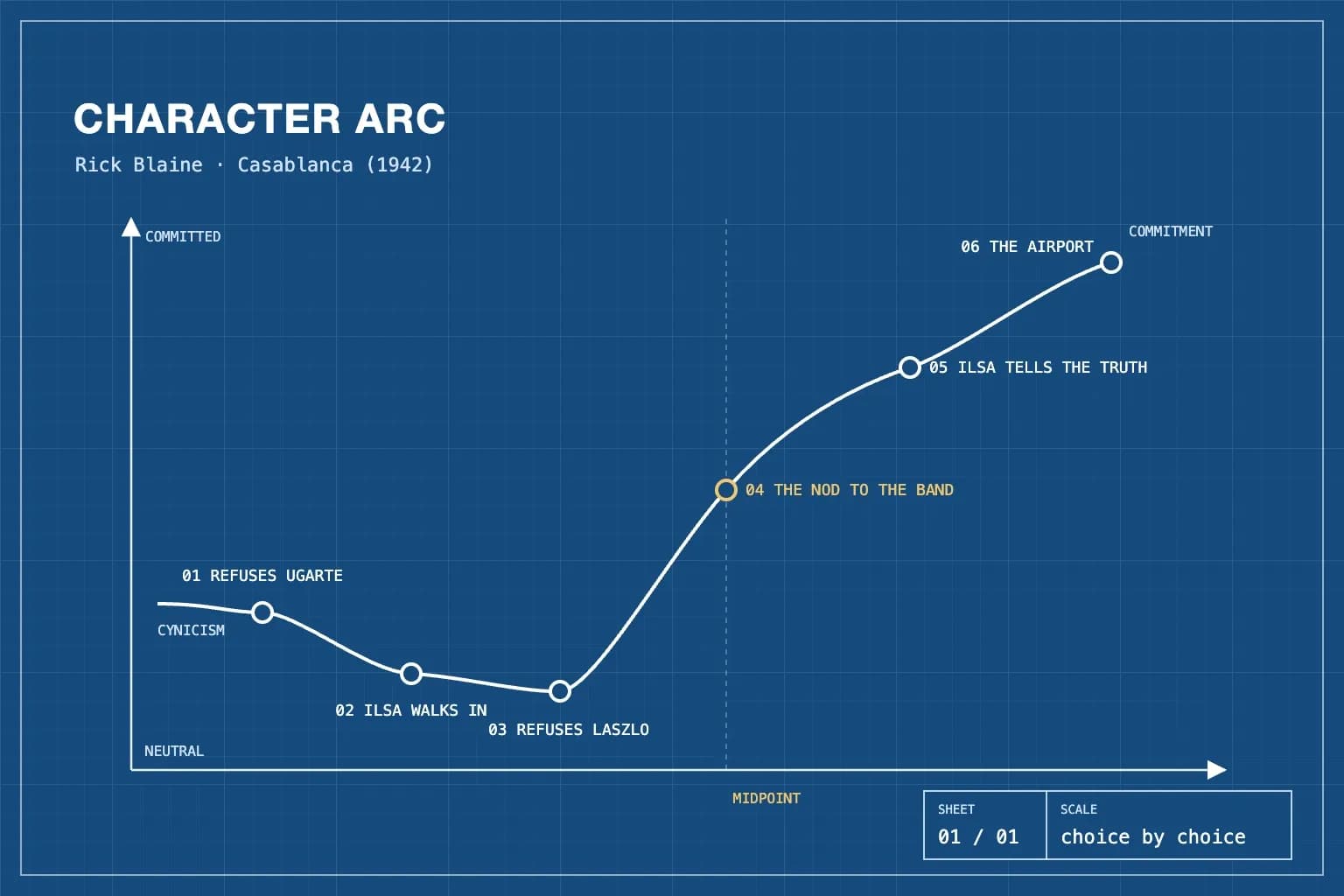
Set Michael beside Rick Blaine in Casablanca and the two arcs read like mirror images:
- Starting point: Rick begins cynical and detached, sticking his neck out for nobody. Michael begins idealistic and detached, wanting no part of his family's world.
- The pressure: both are drawn in by people they love. For Rick it is Ilsa; for Michael it is his father.
- The decisive choice: Rick gives something away, the letters of transit and the woman he loves, for a cause larger than himself. Michael takes, eliminating everyone who stands between his family and power.
- The final state: Rick ends committed and freer than he began. Michael ends powerful and more trapped than he began.
Both arcs work for the same reason: the change is proven by an action in the final act. Compare the beats in our breakdown of Rick Blaine's character arc in Casablanca.
What screenwriters can learn from Michael Corleone
- Make the fall sympathetic. Each step answers a threat to people he loves, so the audience follows him down instead of judging him from a distance.
- Establish a clear baseline. The wedding shows exactly who Michael is before the story starts working on him.
- Use a witness character. Kay lets the audience see Michael from the outside. A fall arc often needs someone who remembers who the character used to be.
- Escalate through irreversible choices. The hospital, the restaurant and the baptism each close a door.
- Let the ending answer the opening. A final scene that mirrors the first one lets the audience measure the arc for themselves.
When you are writing a fall arc of your own, it helps to check whether readers actually see the change you intend. A screenplay analysis with Poetika reviews your characters, conflict and narrative structure, which shows whether the pressure on your protagonist builds where you think it does.
Try it yourself: a fall arc exercise
Pick a protagonist from a script you are working on, or invent one, and answer these questions:
- What does your character believe about themselves at the start? Write it in one sentence, the way Michael believes his family's business is not his.
- What do they want that is sympathetic and could justify crossing a line?
- What is the first small compromise that protecting that want requires?
- What is the choice they cannot undo, the equivalent of the restaurant?
- Who in the story remembers who they used to be?
- How does the final scene echo the opening, so the audience can measure the fall?
Next in the series
For another fall arc built on love and survival, read Maria Braun's character arc, and for a protagonist whose change is far harder to pin down, see Nader's character arc in A Separation.
Want to see how your own protagonist's arc reads to an outside eye? Analyze your screenplay with Poetika.
FAQ
What type of character arc does Michael Corleone have?
Michael Corleone has a fall arc, also called a negative change arc. He begins The Godfather as a war hero who keeps his distance from the family business and ends it as the ruthless head of the family. He gains power and loses his moral independence, and his honesty with Kay, along the way.
When does Michael Corleone change in The Godfather?
There is no single moment, but the restaurant scene, where Michael kills Sollozzo and McCluskey, is the clearest turning point. Before it he reacts to events; after it he acts. The baptism sequence near the end, when he orders the killing of the family's enemies, marks the point where the change can no longer be undone.
Why does Michael Corleone lie to Kay at the end?
When Kay asks whether he had Carlo killed, Michael says no to keep her outside the world he now leads. The lie reverses the opening, where he told her the truth about his family to separate himself from it. The closing door that follows shows that the separation is now between Michael and Kay.
Does Michael Corleone's arc continue after the first film?
Yes. The Godfather Part II (1974) follows Michael as he consolidates power and grows more isolated, and The Godfather Part III (1990) shows an older Michael trying to make the family legitimate. The first film, however, contains a complete fall arc on its own, from outsider to Don.