Spoiler note: this post discusses the openings of Up, Scream, Finding Nemo and Pan's Labyrinth, including character deaths, and the ending of Romeo and Juliet.
A prologue in a screenplay is a self-contained opening sequence set apart from the main story, usually earlier in time, in another place or with other characters, that gives the audience context the story needs before Act One begins. It might show an ancient war, a childhood loss or a crime the hero knows nothing about. When the prologue ends, the film cuts to the main timeline and the protagonist's story properly starts.
The word comes from the Greek prologos, from pro ("before") and logos ("speech" or "word"). In his Poetics, Aristotle defined the prologue as the whole part of a tragedy that comes before the chorus first enters. Today's prologue is a sequence of images rather than a speech, and a good one is not a backstory dump: it hooks the audience, sets the rules of the world and plants the theme. This guide covers what a prologue does, its types, famous examples, how it differs from a cold open or flashback, and how to format it.
What does a prologue do in a screenplay?
A prologue earns its pages only when it does a job the main story cannot do as well. Most strong prologues do one or more of these four things.
Establish the world's rules and scale
Epic fantasy, science fiction and historical drama often need the audience to understand a world before they can care about a character in it. A prologue shows who holds power and how big the stakes are, so Act One can focus on people rather than lore.
Plant the wound that drives the protagonist
Aristotle used the word hamartia for the error or flaw that brings about a tragic hero's fall. Many prologues show the past event behind the hero's present flaw: a loss, a mistake, a trauma. This links directly to the character arc the story will trace, because the prologue shows where the arc begins.
Create dramatic irony
A prologue can give the audience information the characters do not have. That gap between what we know and what the characters know is dramatic irony, and a prologue is one of the most efficient ways to create it.
Set tone and genre
The first minutes teach the audience how to watch the film. A brutal prologue tells them nobody is safe; a playful one tells them they are in a fable. That contract lets the main story start quietly without losing the audience.
Types of prologue
- The historical or mythic prologue: shows events from long before the story, often with narration. Common in fantasy and epics.
- The backstory prologue: shows a key moment from the protagonist's past, often childhood, that explains who they are now.
- The threat prologue: shows the villain, the monster or the crime before the hero is involved. Common in horror and thrillers.
- The text prologue: a title card or crawl that gives context in a few lines of on-screen text.
- The narrated prologue: a voice tells the audience what they need to know over images. If you use narration, the craft of writing voice-over in a screenplay applies.
Iconic prologue examples in film
The Lord of the Rings: The Fellowship of the Ring (2001)
The film opens with Galadriel, played by Cate Blanchett, narrating the forging of the Rings of Power, Sauron's defeat by the Last Alliance, Isildur's failure to destroy the One Ring and its long path to Gollum and then to Bilbo. In a few minutes, the screenplay by Fran Walsh, Philippa Boyens and Peter Jackson covers thousands of years of history, and when the story moves to the Shire, the audience knows what the hobbits do not: Bilbo's ring is the most dangerous object in the world.
Up (2009)
After a short opening in which young Carl meets Ellie, Pixar's film plays the wordless "Married Life" montage: their wedding, their home, the child they cannot have, the savings jar they keep breaking into, and finally Ellie's death. It works as a backstory prologue: every stubborn decision old Carl Fredricksen makes afterward, including tying balloons to his house, comes from those minutes, so the film never has to explain his grief in dialogue.
Scream (1996)
Kevin Williamson's screenplay, directed by Wes Craven, opens with Casey Becker, played by Drew Barrymore, home alone and answering a phone call that turns into a horror-movie quiz. The sequence is a complete micro-thriller. Because Barrymore was one of the best-known names in the cast, killing her character in the opening told audiences the film would break the rules of the genre.
Finding Nemo (2003)
The opening of Andrew Stanton's film shows Marlin and Coral admiring their new home and their eggs, until a barracuda attack leaves Marlin with a single surviving egg. In a few minutes it explains the protagonist's flaw: Marlin's overprotectiveness, which drives Nemo to rebel, is not a quirk but a wound.
Star Wars (1977)
George Lucas's film opens with the line "A long time ago in a galaxy far, far away...." and a text crawl that begins "It is a period of civil war." A few lines set up the Rebellion, the Empire and the stolen Death Star plans, so the film can cut straight to a Star Destroyer chasing a rebel ship instead of spending Act One on politics.
Pan's Labyrinth (2006)
Guillermo del Toro's film opens on a wounded girl, Ofelia, as a narrator tells the fairy tale of an underworld princess who escaped to the surface. A title card then places the story in Spain in 1944, after the Civil War. The prologue frames the film as both fairy tale and war story, and the image of Ofelia returns at the end: a prologue can carry the theme, not just the backstory.
Prologues outside film: theater and literature
The device is much older than cinema. Greek tragedians often opened with an expository speech; in Euripides' Hippolytus, the goddess Aphrodite explains her plan for revenge before any mortal appears.
The most famous dramatic prologue in English is the Chorus's sonnet at the start of Romeo and Juliet, which begins "Two households, both alike in dignity." In fourteen lines, Shakespeare tells the audience that the "star-cross'd lovers" will die. The suspense lies not in what happens but in how.
Novels use the same idea. The first chapter of Harry Potter and the Philosopher's Stone (published in the US as Harry Potter and the Sorcerer's Stone) shows Dumbledore, McGonagall and Hagrid leaving the baby Harry with the Dursleys. The next chapter jumps nearly ten years ahead, so readers know Harry's secret long before he does.
Prologue vs. cold open, flashback, opening scene and framing device
These terms overlap, but the distinctions help:
- Prologue: a self-contained sequence set apart from the main story in time, place or point of view, placed before Act One.
- Cold open: a scene that plays before the opening titles. In TV it is standard; in features, a cold open can be a prologue or simply the first scene of the main story.
- Opening scene: the first scene of the main story, usually featuring the protagonist. The temple raid that opens Raiders of the Lost Ark (1981) is a self-contained set piece but not a prologue, because it follows Indiana Jones in the main timeline. For what any opening has to achieve, see how to write an opening scene.
- Flashback: a jump back from an established present. A prologue comes first, so there is no present to jump back from yet. If you interrupt the story later to show the past, follow the conventions in how to write a flashback in a screenplay.
- Framing device: a present-day story that wraps the whole film and returns at the end, such as an old man telling his tale. A prologue does not need to come back; a frame does. See the framing device.
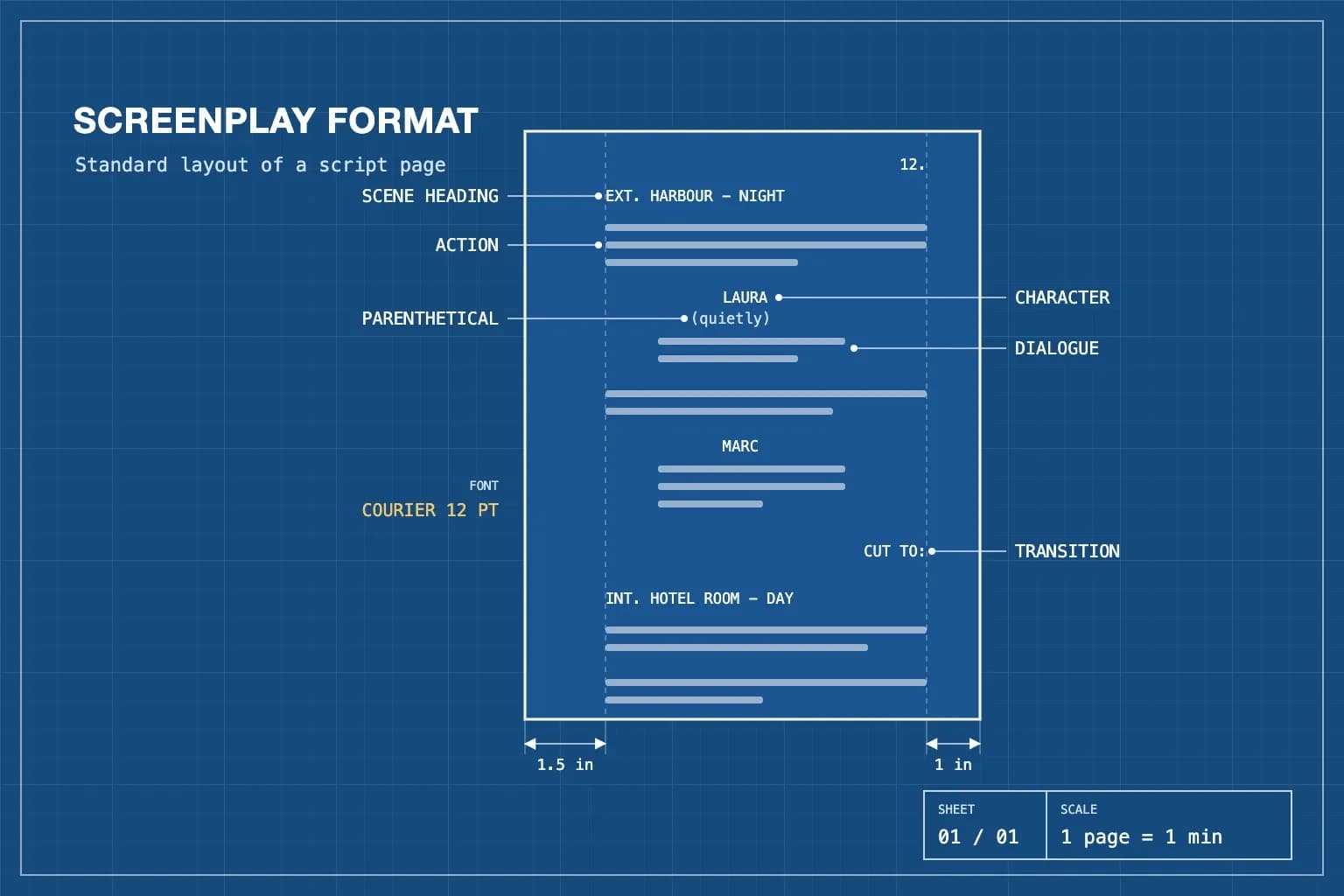
How to format a prologue in a screenplay
There is no single official format for a prologue. What readers expect is clarity: they should know at a glance when and where the prologue happens and when the main story begins. Here are the common options. Pick one and use it consistently.
Option 1: No label, just a clear time marker
The cleanest approach is to write the prologue as ordinary scenes and let a scene heading and a SUPER do the work:
- Scene heading: EXT. CASTLE WALLS - NIGHT
- Time marker: SUPER: "Bohemia, 1450." on its own line in the action
- Transition to the main story: a new scene heading, followed by SUPER: "Prague. Present day."
This keeps the page clean and reads exactly like the film will play.
Option 2: A PROLOGUE label
Some writers mark the sequence explicitly:
- Opening label: PROLOGUE, typed flush left or centered on its own line above the first scene heading
- First scene: EXT. CASTLE WALLS - NIGHT (1450)
- Closing label: END OF PROLOGUE, followed by the first scene heading of the main story, for example INT. APARTMENT - DAY (PRESENT DAY)
If the word will appear on screen, write it as action instead: Title card: PROLOGUE.
Option 3: Text on screen
For a crawl or a title card, describe it in the action lines and give the text exactly as it will appear. Keep it short.
Formatting details readers notice
- Character introductions: introduce characters in capitals on first appearance, as anywhere else in the script. If someone appears as a child in the prologue, name them clearly, for example YOUNG CARL, so the reader connects them to the adult later.
- No "FLASHBACK" label: the prologue is not a flashback, because no present has been established yet.
For the reasoning behind these conventions, read why screenplay format matters; for every element in detail, see our guide on how to format a screenplay.
Common prologue mistakes
Readers are often wary of prologues because many drafts use them badly. The usual problems:
- The backstory dump. The prologue explains history the audience would happily discover later, or never needs at all.
- Two openings. The prologue has its own hook, then the main story starts over with a second, slower hook. The script feels like it begins twice.
- The wrong tone. An explosive action prologue attached to a quiet drama promises a film the script does not deliver.
- The misleading protagonist. The prologue follows a character so closely that the reader invests in them, then drops them. As a deliberate shock, as in Scream, this works; by accident, it confuses.
- Too long. If it runs much longer than a few pages, it may be Act One in disguise.
- No payoff. Nothing in the main story depends on what the prologue showed. If you can cut it and the film still makes sense, the prologue was decoration.
- Unclear time and place. The reader does not know when the prologue happens or when it ends. This is the easiest problem here to fix.
Does your screenplay need a prologue? A checklist
Before you keep a prologue, test it:
- Does it show something the audience must know before Act One, not just something that is true?
- Does it create a question, a threat or dramatic irony that pulls us into the main story?
- Does something in the main story depend on it, ideally a payoff near the end?
- Is it short enough that the protagonist still appears early?
- Could the same information come out naturally in the main story instead?
- Is the jump in time or place clear on the page, with a consistent format?
If a prologue fails most of these questions, try cutting it and reading the script from the first scene of the main story.
You know everything your prologue explains, so it is hard to judge objectively. Poetika analyzes your screenplay and gives structured notes on structure, pacing, character and format, which can show whether your prologue hooks the reader or delays the story.
FAQ
Should a screenplay have a prologue?
Only if it does a job the main story cannot. Many great films have no prologue at all. Use one when the audience needs context, a threat or a wound before Act One, and the story would be weaker if that information came out later. If the prologue only explains backstory, cutting it usually makes the script tighter.
How long should a prologue be in a screenplay?
There is no fixed rule, but the most effective film prologues tend to run only a few pages. A screenplay page is roughly a minute of screen time, so a long prologue pushes the protagonist's entrance deep into the film. If yours is long, check whether it is really part of Act One.
What is the difference between a prologue and a cold open?
A cold open is defined by position: it plays before the opening titles. A prologue is defined by content: it stands apart from the main story in time, place or point of view. A cold open can be a prologue, as in a threat scene before the titles, or it can simply be the main story's first scene.
How do you write "Prologue" in a screenplay?
You can type PROLOGUE on its own line above the first scene heading and END OF PROLOGUE before the main story begins. Many writers skip the label and use a scene heading plus a SUPER for the time and place instead. If the word should appear on screen, describe it as a title card in the action.
Is a prologue the same as a flashback?
No. A flashback jumps back from a present the audience already knows. A prologue comes first, before any present exists, so it should not be labeled FLASHBACK. If your film opens in the present and later shows the past, that later sequence is a flashback, not a prologue.