Spoiler note: this analysis discusses the full plots and endings of Rocky (1976) and Bicycle Thieves (1948).
Rocky Balboa's character arc in Rocky is an underdog arc: a small-time club fighter who has stopped believing in himself gets a one-in-a-million shot at the heavyweight champion, and the change he goes through is not from loser to winner but from a man who thinks he is nobody to a man who proves, to himself, that he is somebody. He loses the fight on a split decision. He wins the arc, because before the bell he redefines what victory means.
Rocky was written by Sylvester Stallone, who also played the title role, and directed by John G. Avildsen. Talia Shire plays Adrian, Burgess Meredith plays the trainer Mickey, Burt Young plays Paulie and Carl Weathers plays the champion, Apollo Creed. Released in 1976, it won Oscars for Best Picture, Best Director and Best Film Editing. Its plot is simple; almost everything that matters happens inside one man.
What is a character arc, and what is an underdog arc?
A character arc is the inner change a character goes through over a story: in what they believe, what they want, or who they think they are. Our guide to understanding character arc covers the main types, and the series overview, character arc examples from 14 films, shows how each film in this series fits them.
An underdog arc is a positive arc built around an overlooked person who rises to a challenge everyone expects them to fail. The trap is making the arc depend on winning, which turns the story into one about luck. The best underdog arcs, and Rocky is the model, locate the change in the character's sense of worth.
Rocky Balboa at a glance
- Film: Rocky, United States, 1976, written by Sylvester Stallone, directed by John G. Avildsen.
- Role in the story: protagonist; a small-time boxer and debt collector in Philadelphia.
- External goal: survive a title fight against the world heavyweight champion.
- Internal need: to believe that his life has not been wasted, and that he is more than a bum.
- Arc type: underdog arc, a positive arc driven by a redefinition of the goal.
- Timeline: about five weeks, from late November 1975 to New Year's Day 1976.
Starting point: a club fighter nobody takes seriously
The film opens with Rocky winning a scrappy bout in a converted church hall for a tiny purse. Nobody seems to care, including Rocky. He collects debts for a loan shark, Tony Gazzo, but is too soft to do the job properly: told to break a man's thumb, he lets the man off with a warning.
The clearest image of where Rocky stands comes the next day at Mickey's gym. His locker has been given to a younger fighter, and his things hang in a bag on a hook. Mickey tells him bluntly that he had talent and threw it away to become a leg-breaker for a cheap loan shark. Rocky does not argue.
Stallone fills the first act with small kindnesses no one rewards. Rocky talks to his turtles, walks a teenage girl home to lecture her about the company she keeps, and keeps stopping by the pet shop to tell bad jokes to Adrian, a painfully shy clerk who barely looks at him. He is kind, lonely and stuck, and the audience likes him before the world gives him any reason to like himself.
What Rocky wants vs. what he needs
At the start, Rocky wants little beyond Adrian's attention and his locker back. Once the title fight arrives, his want becomes concrete: do not get humiliated by Apollo Creed in front of the whole country. Underneath lies his need: to stop measuring himself the way the neighbourhood measures him, and to find one moment that proves he could have been somebody all along.
- Want: a respectable showing in the ring, and Adrian's love.
- Need: self-respect that does not depend on anyone else's verdict.
- Flaw: a resignation so deep that he has stopped trying, dressed up as easy-going humour.
As our guide to character motivation explains, the visible goal drives the scenes while the invisible need gives them meaning.
The inciting incident: the chance to fight Apollo Creed
Apollo Creed has a Bicentennial title fight booked in Philadelphia for New Year's Day. Five weeks out, his opponent is injured, and no other contender is available. Apollo turns the setback into a publicity stunt, giving an unknown local fighter a shot at the title, and picks Rocky mostly for his nickname, the Italian Stallion.
The inciting incident is pure chance: Rocky is chosen as a prop in somebody else's show. When the promoter calls him in, he first assumes he is being offered work as a sparring partner and turns it down. His self-image is so low that he cannot imagine being offered the main event.
Key turning points
Adrian says yes
On Thanksgiving, Paulie drags Rocky home to take his sister out. Adrian refuses, then agrees to each small step only because Rocky keeps asking. He talks his way into a deserted ice rink after closing, and while she skates and he jogs alongside, he opens up about himself. Back at his apartment, they share a first kiss. For the first time, someone sees Rocky the way he hopes to be seen.
Mickey comes to the apartment
Mickey, who had dismissed him for years, comes to Rocky's apartment to ask to be his manager. Rocky explodes, shouting at the closed door about all the years Mickey never helped him. Then he goes after the old man and, in a long shot we cannot hear, shakes his hand. For the first time, Rocky accepts help and takes himself seriously.
The midpoint shift
Rocky trains on raw eggs, dawn runs and frozen sides of beef in the meatpacking plant where Paulie works. The midpoint of his arc is a pair of images in one location, the steps of the Philadelphia Museum of Art. Early on, he staggers up them, out of breath, and stands at the top bent over and alone. Later, after weeks of work, he sprints up the steps, turns, and raises his arms over the city.
Between those two runs, Rocky shifts from a man going through the motions to a man who believes the work means something. Nothing external has changed, which is why the change is shown in a repeated image rather than a line of dialogue.
The lowest point
The night before the fight, Rocky walks into the empty arena. The poster above the ring shows him in the wrong colours, and when he points it out, the promoter shrugs that it does not really matter. To the people running the show, he is interchangeable, and he understands that he cannot win.
He goes home and tells Adrian the truth in the dark: he is not even in the champion's league. This is the arc's lowest point. Nothing has been taken from him; what collapses is the fantasy that hard work alone will carry him to victory.
The final transformation: going the distance
Out of that admission comes the decision that defines the whole film. Rocky tells Adrian that it does not matter if he loses, or if his head gets opened up. What matters is going the distance: nobody has ever lasted fifteen rounds with Apollo. If he is still standing at the final bell, he says, he will know for the first time that he was not "just another bum from the neighborhood."
Rocky knocks Apollo down in the first round, the first time the champion has ever been floored, and the fight turns into a war. His eye swells shut and has to be cut so he can see, and late in the fight he drags himself up from the canvas against Mickey's pleas to stay down. At the final bell, Apollo says there will be no rematch; Rocky says he does not want one.
The announcer reads a split decision for Apollo, which Rocky barely hears. He is shouting for Adrian, who pushes through the crowd into the ring. The film ends on their embrace, not on the scorecards.
Redefining the goal: why Rocky does not have to win
The genius of the script lies in placing that redefinition before the fight, not after it. Because Rocky names his new goal in advance, the audience watches with his measure of success, not the scoreboard's. When the decision goes against him, it cannot undo his arc.
If Rocky had won, the film would be a fantasy; if he had lost without redefining the goal, a tragedy. Shifting the goal from winning to enduring makes the arc honest and triumphant at once. Our piece on why endings are the hardest thing to write argues that the best endings answer the question the story raised. Rocky asks whether this man is somebody, and answers yes, regardless of the result.
Adrian and Mickey: the relationships that carry the arc
- Adrian goes through her own arc, from a woman who hides behind glasses and silence to one who stands up to her brother and walks into a boxing ring in front of a crowd. Her growth runs parallel to Rocky's.
- Mickey represents Rocky's past and the judgement he internalised. Their reconciliation is Rocky forgiving the world for ignoring him, and an old man getting one last chance to matter.
- Paulie shows the alternative path: bitter, jealous and stuck, he resents Rocky's rise. He is what Rocky could become if he let the chance pass.
These characters work because each one serves the protagonist's arc while having wants of their own, a balance our guide to secondary characters explores in detail.
How the screenplay shows the change
Stallone dramatises the arc through behaviour and images rather than speeches.
- The locker: a precise, small humiliation that tells us Rocky's status in one beat.
- The steps: the same location used twice, once to show failure and once to show transformation.
- The confession in the dark: Rocky states his need aloud only at his lowest point.
- The final shout: Rocky calling for Adrian instead of listening for the verdict proves the redefinition worked.
Two working-class men, two directions: Rocky and Antonio Ricci
Rocky makes a revealing pair with Antonio Ricci in Vittorio De Sica's Bicycle Thieves: two poor men in a big city who each get one chance.
- The chance: Antonio gets a job that depends on a bicycle; Rocky gets a fight that depends on his body.
- The system: both are treated as interchangeable by the people in charge, the police for Antonio, the promoters for Rocky.
- The witness: Antonio falls in front of his son, Bruno; Rocky rises with Adrian in his corner.
- The direction: Antonio's arc is a tragic fall driven by circumstance; Rocky's is a rise driven by a choice about how to measure himself.
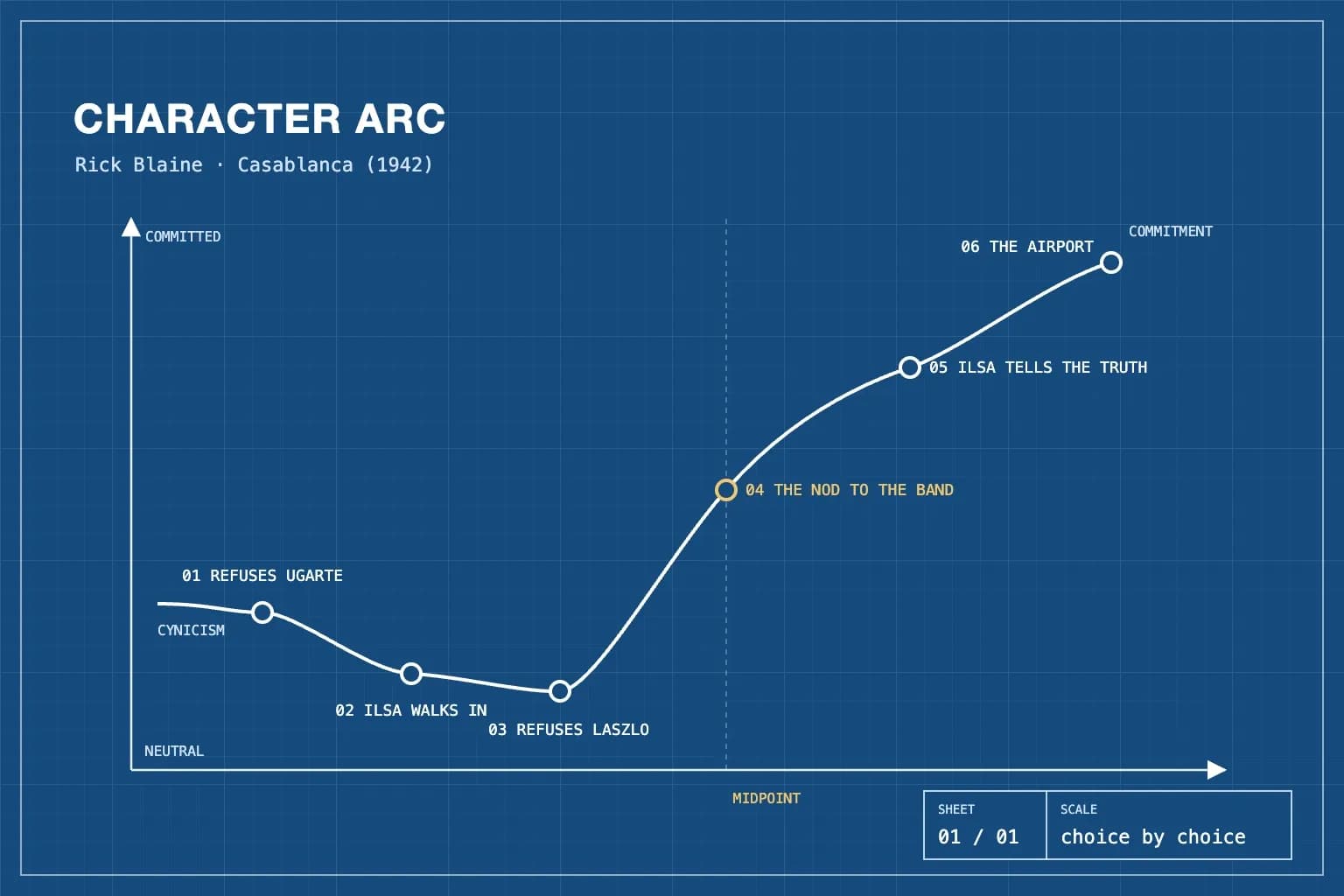
The same starting conditions produce opposite arcs. Our analysis of Antonio Ricci's character arc traces the fall in detail, and for another positive arc built on a hard choice, see Rick Blaine's arc in Casablanca.
What screenwriters can learn
- Make the audience love the character before the world does. Unrewarded kindness builds sympathy fast.
- Let the inciting incident be unearned. A chance the character did not deserve forces them to prove they deserve it.
- Show the inner change in repeated images. A location revisited, like the steps, tells the audience how far a character has come.
- Put the lowest point inside the character. The darkest moment can be an admission rather than a loss.
- Redefine the goal before the climax. If the character names a new measure of success in advance, the ending can be honest and still satisfying.
If you want to check whether your own protagonist's turning points read clearly on the page, you can run your screenplay through Poetika for a structured analysis of character, structure and stakes.
Try it yourself: redefine your character's victory
- Write down your protagonist's external goal in one sentence
- Identify the inner need underneath the goal: what would achieving it prove to them?
- Find a moment before the climax where they can name a new, smaller, truer measure of success
- Write the climax so the audience judges it by that new measure
Next in the series
This post is part of our series on character arcs in world cinema. Read Antonio Ricci's fall in Bicycle Thieves next, or return to the series overview of character arc examples.
FAQ
What type of character arc does Rocky Balboa have?
Rocky has a positive underdog arc. He starts as a resigned club fighter who believes he is a bum, and ends as a man who has proved his worth to himself by going fifteen rounds with the champion. The change is internal: he loses the fight, but his sense of who he is transforms completely.
Why does Rocky lose the fight at the end?
Rocky loses on a split decision because the story is not about winning. The night before the fight, he redefines his goal as going the distance. By surviving all fifteen rounds he achieves exactly what he set out to do, so the loss keeps the ending honest without undermining his transformation or the audience's sense of triumph.
What is the turning point in Rocky's character arc?
The decisive turning point is the night before the fight, when Rocky admits to Adrian that he cannot beat Apollo and decides that going the distance will be his victory. Earlier turning points, such as accepting Mickey's help and the second run up the museum steps, prepare him for that redefinition.
How does Adrian change in Rocky?
Adrian goes from a shy, overlooked pet shop clerk who can barely speak to Rocky to a woman who stands up to her brother and walks into the ring in front of a crowd. Her arc mirrors Rocky's: both are people the world ignored who find the courage to be seen through each other.