Spoiler note: this post breaks down key scenes from The Dark Knight and Inglourious Basterds, including a major twist in The Dark Knight.
A beat in a screenplay is the smallest unit of dramatic change: a single action and the reaction it provokes, after which something in the scene is different. A character tries a tactic, it succeeds or fails, and the balance of power, emotion or information shifts. Robert McKee puts it compactly in Story: a beat is "an exchange of behavior in action/reaction." Beats build scenes, scenes build sequences, and the turns between beats are what readers feel as rhythm.
When readers praise a script's momentum, they are rarely talking about the dialogue alone. They are reacting to beats: the steady stream of small turns that keeps every scene moving. This guide explains what a story beat is, how it differs from a scene and from the beats of a beat sheet, the main types of beats, and how three well-known scenes are built beat by beat.
What is a story beat?
A story beat is a moment in which something changes. Before the beat, a character wants something and tries to get it one way; after the beat, they have to try another way, because the situation is no longer the same. That change is called a turn.
A turn can be tiny: a suspect who was lying starts telling the truth, a lover who was flirting goes cold. What matters is that the scene's direction shifts, even slightly, and that the shift comes from behavior we can see or hear: a line, a gesture, a silence, a choice.
Beats are tied to action, not plot summary. "They argue about money" is a topic. "She asks for the loan, he jokes it away, she mentions his father, he stops laughing" is four beats, and each one changes what happens next. In this sense the beat is a practical version of what Aristotle, in the Poetics, called praxis: drama as the imitation of action. Abstract plot movement only becomes visible on screen when it is broken down into concrete actions and reactions.
Beat vs. scene vs. sequence
The easiest way to understand a beat is by scale:
- Beat: one action and one reaction that change the state of the scene. A few lines, sometimes a single look.
- Scene: a continuous action in one time and place, made of several beats, that turns the situation by its end. If the scene ends exactly where it began, it is not doing its job.
- Sequence: a group of scenes that builds to a larger turn, such as a heist, a chase or a first date.
- Act: a group of sequences that ends with a major reversal in the protagonist's situation.
McKee describes this same ladder, with each level turning on a bigger change than the one below it. A good scene is a chain of beats that arrives somewhere new.
Three meanings of "beat" in screenwriting
Screenwriters use the word in at least three ways:
- A pause. In dialogue, (beat) as a parenthetical means a short pause. Use it sparingly; many readers see it as directing the actor.
- A dramatic beat. The action/reaction unit described above, the building block of a scene. This is what most craft books mean by a story beat.
- A structural beat. A major plot point in an outline or beat sheet, such as the catalyst, the midpoint or the climax. These are big turns that span whole sequences.
All three share the same idea: a beat marks a moment where something shifts. If you are new to the vocabulary, our screenwriter's glossary of essential terms covers the related words, from slug line to set-up and payoff.
The main types of story beats
Not every beat looks the same. Most fall into one of three families, and good scenes mix them.
Action beats
An action beat is a physical event or obstacle that forces an immediate response. A car cuts the protagonist off. A door is locked. A gun is drawn. A timer starts ticking. Action beats change the situation from the outside and are the easiest to see on the page. Even in a quiet drama, a character leaving the room can be a beat if it changes what the other person has to do.
Realization beats
A realization beat is a moment in which a character learns something and their understanding of the situation changes. Aristotle's name for the big version of this is anagnorisis, recognition: the shift from ignorance to knowledge. In a scene, it can be small, such as noticing that a story does not add up, or seismic, like discovering who the real enemy is.
Emotional and relational beats
These are the subtle shifts in power, trust or intimacy between characters: a compliment that lands as a threat, a confession, a refusal to answer, a shared glance that says the two of them are now on the same side. The words may stay polite while power quietly changes hands, and that gap is where subtext lives.
Beats in action: three scenes broken down
The best way to learn beats is to watch a great scene and mark every moment where the direction changes. Here are three.
The interrogation in The Dark Knight (2008)
In Christopher Nolan's The Dark Knight, the Joker sits in a police interrogation room while Gordon questions him. The scene is built as a contest of power, and it flips several times:
- Gordon gets nowhere. The Joker deflects every question. Gordon leaves, and the lights come on to reveal Batman standing behind the Joker. Power seems to shift to the police.
- Batman uses force. He slams the Joker's head against the table. The Joker shrugs it off with a joke. Physical dominance gets Batman nothing.
- The Joker takes control of the conversation. He talks about rules, about how the city will turn on Batman, and about how the two of them need each other. The interrogator has become the audience.
- The reveal. The Joker lets slip that Rachel has been taken as well as Harvey Dent, and that Batman will only have time to save one of them. This is a realization beat for Batman, and it changes the scene's stakes completely.
- Batman escalates. He jams a chair under the door handle to keep Gordon out and throws the Joker around the room. The Joker laughs: there is nothing Batman can threaten him with.
- The Joker gives up the addresses, but on his own terms, because Batman now has to choose. Only later do we learn he swapped them: when Batman reaches the address he was given for Rachel, he finds Harvey.
Each time Batman tries a tactic, the Joker makes it useless. Batman is physically stronger in every beat, yet the Joker wins the scene: the outcome comes from the turns, not from who shouts loudest.
The farmhouse opening of Inglourious Basterds (2009)
Quentin Tarantino's Inglourious Basterds opens in occupied France in 1941, when SS colonel Hans Landa visits the dairy farmer Perrier LaPadite. Almost nothing violent happens for most of the scene. It is built entirely out of small, polite conversational beats:
- Courtesy. Landa arrives with manners, asks permission to come in, and asks for a glass of milk, which he drinks and praises. The threat is in the politeness.
- A change of language. Landa says his French has run out and asks to continue in English. It seems like a minor courtesy; we only understand its real purpose at the end.
- Paperwork. He takes out his notes on the missing Dreyfus family and asks LaPadite to confirm their names and ages. LaPadite repeats the rumor that they fled.
- The pipe. LaPadite lights his pipe; Landa produces a much larger one of his own. A visual, wordless beat about who is in charge.
- The rats speech. Landa explains why he is good at his job, comparing his targets to rats. The pressure becomes almost unbearable.
- The question. He asks directly whether LaPadite is sheltering enemies of the state. LaPadite breaks and points to the floor.
- The switch back. Landa returns to French, the language the family hiding below the floorboards can understand, calls in his soldiers, and the hiding place is fired upon. Shosanna escapes.
Each beat tightens the trap by one notch, and Landa never raises his voice. If you want to go deeper into how the scene defines its villain, see our Hans Landa character analysis.
"La Marseillaise" in Casablanca (1942)
The beats of a scene do not have to belong to one character. In Casablanca, a single musical moment in Rick's café turns on several characters in quick succession:
- The Germans sing. Major Strasser's officers gather at the piano and sing "Die Wacht am Rhein", taking over the room.
- Laszlo answers. Victor Laszlo goes to the band and tells them to play "La Marseillaise".
- The band looks to Rick. Rick nods. It is a small gesture, and a turn in his arc: the man who sticks his neck out for nobody has picked a side.
- The room joins in. The café sings until the Germans are drowned out. Yvonne, who arrived on a German officer's arm, ends in tears, crying "Vive la France!"
- The consequence. Strasser orders the club closed, and Captain Renault announces he is shocked to find gambling there, just as he is handed his winnings.
Five beats, five turns, and the last one releases the tension with a laugh. We trace how moments like Rick's nod add up across the film in Rick Blaine's character arc in Casablanca.
Why screenwriters need to master beats
Beats control pacing
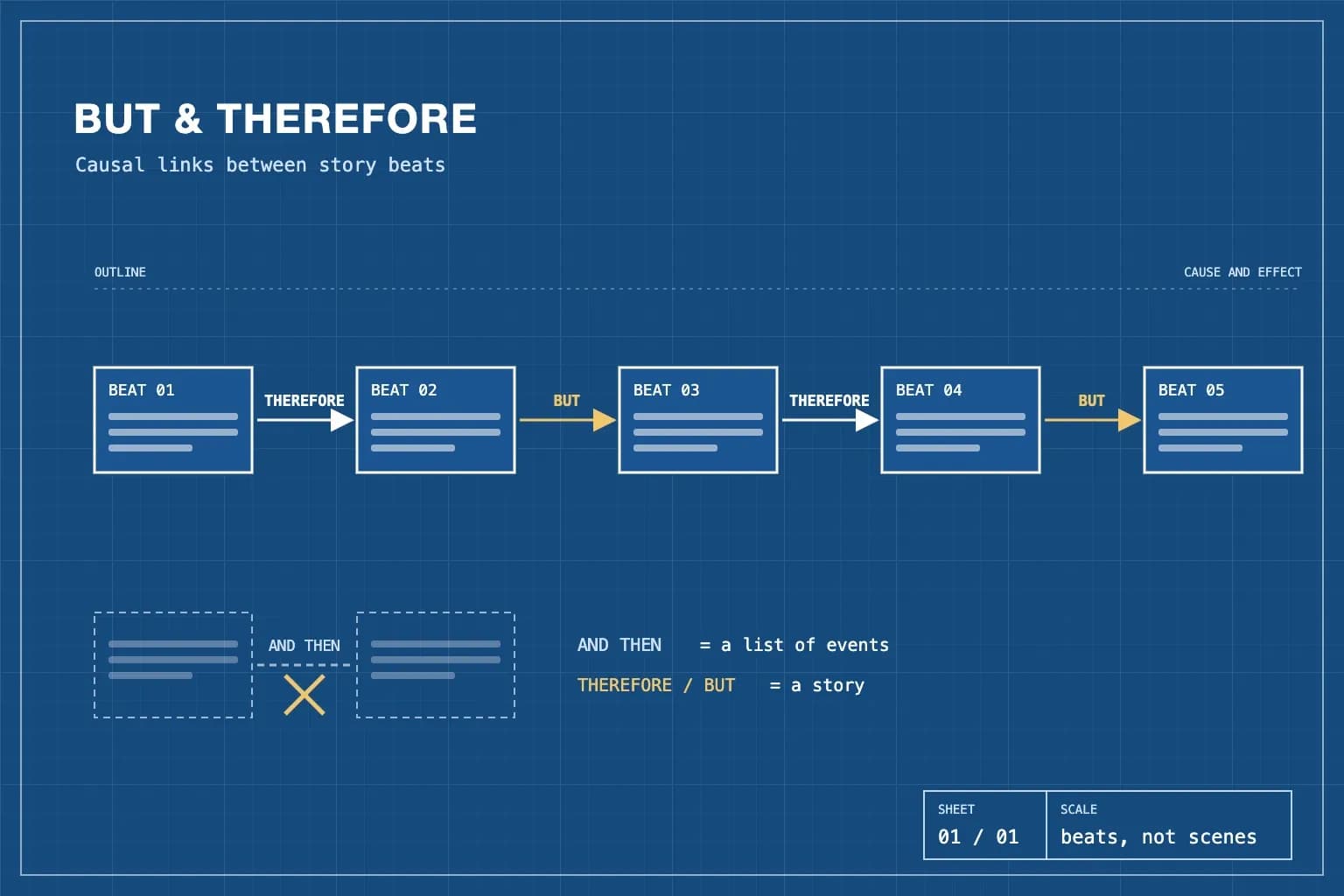
A scene feels slow when pages pass without a turn: characters exchange information, agree, or repeat what we already know. The fix is to find the beats and make sure each one changes something. The same logic applies at story level, which is why the "but and therefore" rule works so well: every beat should either complicate the situation or cause the next one, never simply follow it.
Beats prevent talking heads
Dialogue scenes become "talking heads" when only the characters' mouths move. Behavioral beats break the pattern: someone stands up, refuses a drink, looks away at the wrong moment. Landa's milk and pipe are not decoration; they are beats that carry subtext the dialogue never states.
Beats make the beat sheet work
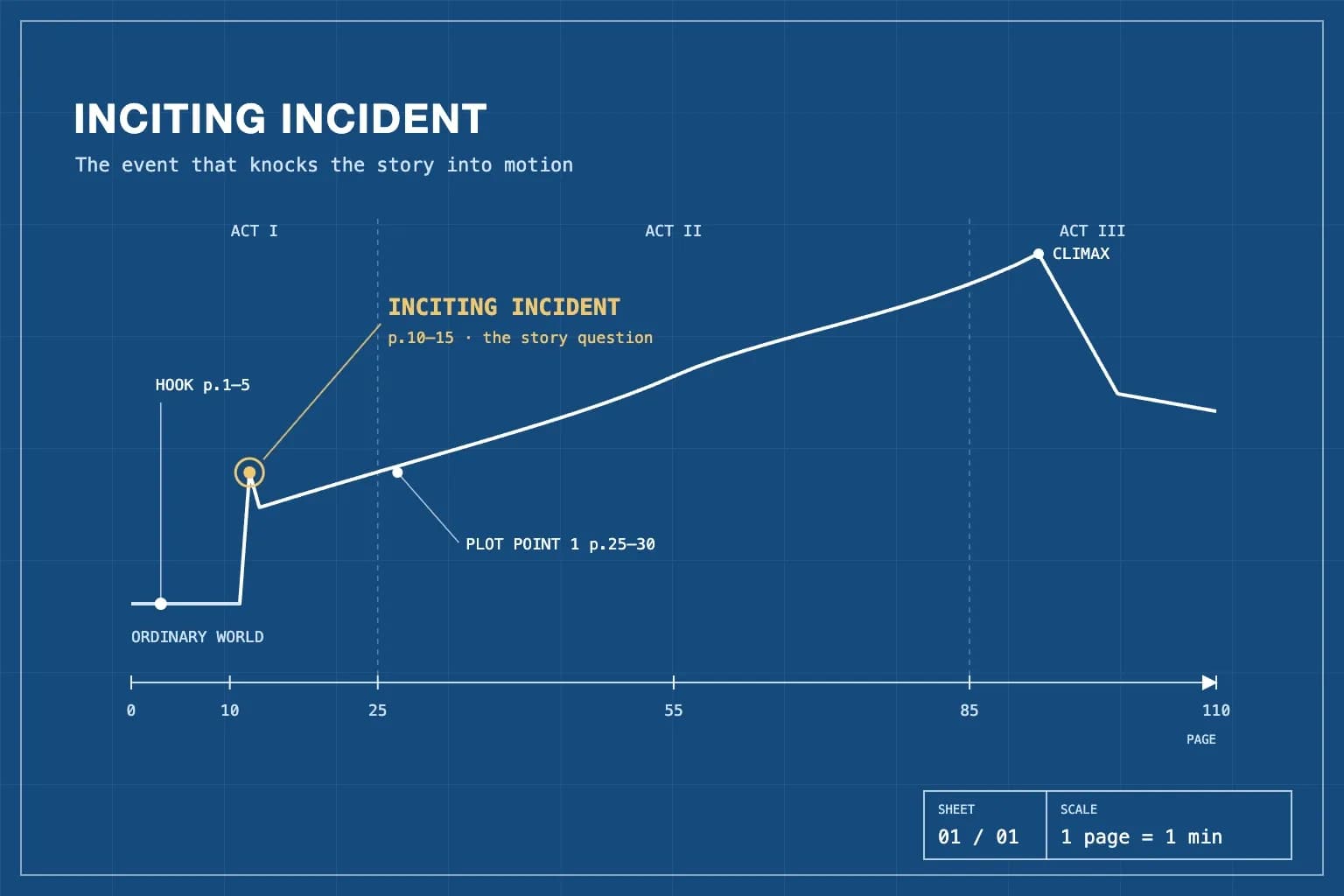
Blake Snyder's Save the Cat! gave screenwriters a 15-point beat sheet, from the opening image through the catalyst and the midpoint to the final image. Those are structural beats, and they only land if the scenes beneath them are built from strong dramatic beats. A catalyst that arrives in a scene with no turns will not feel like a catalyst. Our guide to the Save the Cat technique explains the macro structure; the beats inside each scene are what make it play. The biggest single turn in act one, the inciting incident, is itself a beat: one event, one reaction, and a life that cannot go back to normal.
How to find and fix the beats in your own scenes
Pick a scene that feels flat and work through it with a pencil:
- Mark every turn. Draw a line each time the direction of the scene changes. If you have long stretches without a line, those are the soft spots.
- Name each character's tactic. In every beat, what is each person doing to get what they want: charming, threatening, lying, pleading, stalling?
- Check that tactics fail or succeed. A new beat begins when a tactic stops working. If a character keeps doing the same thing with the same result, the beat has stalled.
- Compare the first and last beat. The situation at the end of the scene should be different from the beginning, in power, knowledge or emotion.
- Cut repeated beats. Two beats that make the same turn are one beat too many.
This kind of beat check matters most in the opening pages, where readers decide how much patience to give a script. Our guide to the first ten pages of a screenplay shows what readers expect to see there.
An outside view of pacing helps too. A structured analysis, such as the one you get when you upload your screenplay to Poetika, looks at structure and pacing across the whole draft and points to sections where the story stops turning, which is usually where the beats need work.
FAQ
What is a beat in a screenplay?
A beat is the smallest unit of dramatic change in a screenplay: an action and the reaction it causes, after which the scene has shifted in power, emotion or information. Several beats make a scene. In dialogue, a (beat) parenthetical has a narrower meaning, a short pause, and outlines also use "beats" for major plot points.
How many beats are in a scene?
There is no fixed number. A short transition scene might have one or two beats, while a long confrontation like the interrogation in The Dark Knight can contain six or more. The rule is not a count but a test: every beat should change something, and the scene should end in a different place from where it began.
What is the difference between a beat and a beat sheet?
A dramatic beat is a small turn inside a scene. A beat sheet, such as the one in Blake Snyder's Save the Cat!, lists the major structural turns of a whole film, like the catalyst, midpoint and climax. Beat sheets describe the large shape of a story; dramatic beats are what make each scene within that shape work.
What does "(beat)" mean in dialogue?
In a screenplay, (beat) as a parenthetical tells the reader and actor to take a brief pause before the next line, usually because the character is reacting or thinking. Use it rarely. Too many pauses written into dialogue slow the read and can look like the writer is directing the performance.