Not All Heroes Are Good. Not All Villains Are Evil. Understanding Protagonist and Antagonist
A writer's guide to the two forces that drive every story — and why most people misunderstand both.
June 11, 202411 min
Read Spoiler note: this post discusses the ending of Inglourious Basterds (2009), including Hans Landa's fate.
Hans Landa, the SS colonel at the center of Quentin Tarantino's Inglourious Basterds (2009), is a villain who frightens through courtesy rather than rage. A Hans Landa character analysis comes down to one idea: he weaponizes charm, intelligence and language, controlling every conversation so completely that his victims feel the trap closing long before he raises a hand. He is not driven by fanaticism but by vanity and self-interest, which is why he can hunt people with delight in one chapter and sell out his own side in the last.
Forget the screaming, scowling Nazi officers of older war films. Landa asks for a glass of milk, compliments his hosts, speaks four languages with ease and smiles while he sends a family to its death. Christoph Waltz's performance won him the Best Actor prize at Cannes in 2009 and the Academy Award for Best Supporting Actor, and Tarantino has said he was ready to abandon the project if he could not find the right actor for the part.
For screenwriters, Landa is more than a great performance. He is a lesson in character design: how to build menace out of dialogue, how to let the audience know more than the victim, and how to give an antagonist an inner logic that makes his final move feel inevitable.
Landa is an SS Standartenführer (colonel) assigned to find Jews hiding in occupied France. He has earned the nickname "the Jew Hunter" and is openly proud of it. Across the film's chapters, he appears in four major sequences: the interrogation at Perrier LaPadite's dairy farm in 1941, a strudel-and-milk conversation with Shosanna Dreyfus in Paris in 1944, the premiere of a German propaganda film where he exposes the actress and double agent Bridget von Hammersmark, and a final negotiation in which he trades the war's ending for his own future.
In the film's structure, he is the main antagonist, but he is not the obstacle for a single hero. He threatens Shosanna, the Basterds and Bridget in turn, and that is part of his power: he is the one force that connects storylines that otherwise run in parallel.
The most important choice Tarantino makes is to separate Landa's cruelty from conviction. The film never presents him as a true believer. What drives him is his reputation, his intellect and the pleasure of being better at the game than anyone else in the room.
Landa treats his work like detective work. He is interested in deduction, in reading people and in being proved right. In the farmhouse he explains, almost with pride, that he succeeds where other soldiers fail because he understands how the hunted think. The horror of his job is real, but to him it is a puzzle, and solving it is a source of vanity.
A fanatic will die for the cause; a pragmatist switches sides the moment the odds change. Landa's lack of ideology is the hidden setup for his ending, and it is the core of his character motivation: he wants to win, and he wants to be admired for winning.
Landa's politeness is not a contrast to his cruelty; it is how his cruelty works. He asks permission to enter, praises the farmer's milk, apologizes for the intrusion and keeps his tone warm. The courtesy forces his victims to play along, because refusing a polite request from an SS officer is itself suspicious. Every pleasantry tightens the trap.
Landa takes out a large curved pipe during the farmhouse scene, a prop many viewers read as a nod to Sherlock Holmes. He gathers small details, waits for an inconsistency and closes in. The difference is the purpose: Holmes uses deduction to protect people, Landa uses it to destroy them. That inversion of a familiar archetype is part of what makes him feel original rather than generic.
The first chapter, titled "Once Upon a Time... in Nazi-Occupied France", runs close to twenty minutes and consists mostly of two men talking at a kitchen table. It is one of the most studied dialogue scenes of its era because almost nothing violent happens until the very end.
Landa arrives at the LaPadite farm with a small escort. We do not yet know what he wants, but we soon learn something he does not seem to know: the Dreyfus family is hiding under the floorboards. This is suspense in its purest form. The audience knows where the bomb is, and the only question is when, or whether, it will go off.
Landa establishes control in small steps, each one a separate beat in the scene:
The switch to English turns out to be the trap's mechanism: the family below speaks French and cannot follow the conversation. Once the confession is made, Landa returns to French, calls in his soldiers and the floorboards are fired upon.
Shosanna escapes across the field. Landa raises his pistol, then lowers it and calls after her, "Au revoir, Shosanna!" The choice is chilling because it is a performance of mercy that is really a performance of power: he lets her go because he can. It also plants the question that drives the rest of the film: will they meet again?
The lesson is structural: delay violence as long as possible, load every line with subtext, and let the audience do the work of fear.
Landa speaks German, French, English and Italian, and language in his hands is never neutral. Choosing a language is choosing who is allowed to understand. In this film, mistakes of language get people killed, and Landa controls that rule better than anyone.
In Paris, in 1944, Shosanna is running a cinema under the name Emmanuelle Mimieux. When the propaganda premiere is moved to her theater, Landa joins her at a restaurant table to discuss security. He orders strudel for both of them and, without asking, a glass of milk for her, an echo of the farmhouse that the audience notices immediately. He tells her to wait for the cream, asks routine questions, then leaves without arresting her.
The film never confirms whether he recognizes her. That ambiguity is the engine of the scene. The audience fears he knows; Shosanna has to act as if he does not; and Landa gives nothing away. When he leaves, she finally breaks down, and the release tells us how much pressure the conversation held.
At the premiere, Landa greets the Basterds, who are posing as Italian filmmakers, in rapid, fluent Italian, exposing how thin their cover is while appearing delighted to meet them. Then he takes Bridget von Hammersmark into a private room and produces the shoe she left at the tavern shootout. He asks her to put her foot in his lap and slips it on, a grim reversal of Cinderella, before strangling her.
Landa collects evidence quietly, lets his target perform innocence and enjoys the revelation as much as the result. The audience knows the danger from the moment he looks at her bandaged ankle; the characters do not see the trap until it closes.
Landa's last chapter is where the character pays off. Having uncovered the plot to blow up the cinema, he does not stop it. Instead, he arrests Aldo Raine and one of his men and negotiates by radio with an American commander. In exchange for letting the attack go ahead, he demands immunity, a pension, citizenship, a medal and property on Nantucket. The man who hunted people for the Reich now helps end it, because he has calculated that the war is lost.
This is not a reversal of character. It is the clearest expression of who he always was. That makes Landa a strong example of a static character: his values do not change at all. What changes is what the audience understands about him. The film's arc belongs to the people around him; Landa's role is to reveal himself fully.
Landa's betrayal works dramatically because it was planted. A man whose loyalty is to his own cleverness will always choose himself. The farmhouse "offer" to LaPadite, the mercy shown to Shosanna and the deal at the end are all the same move: he negotiates from strength and always keeps the winning hand for himself.
Landa gets his deal, but not on his terms. When he reaches the American lines, Aldo kills his radio operator and carves a swastika into Landa's forehead so he can never hide what he was. The film ends on Aldo's line, "This might just be my masterpiece," a wink at Tarantino himself. For a character obsessed with image and reputation, the punishment is precise: he keeps his life but loses the polished mask that made him so dangerous.
Landa is a useful model because his menace comes from writing choices, not only from performance. When you design your own antagonist, check these:
The difference between a forgettable villain and a memorable one is often dimension: contradictions that make the character feel real. If your antagonist only does villainous things, see our guide to one-dimensional vs. three-dimensional characters. For a wider range of models, from Hannibal Lecter to Hans Gruber, our list of iconic movie villains breaks down what each one teaches.
A structured outside read can show whether your own antagonist is landing. With Poetika, you can upload a screenplay and get coverage-style notes on character, structure and dialogue, including whether your villain's motivation reads clearly and whether their scenes build tension or simply repeat it.
Landa endures because he shows that evil is not always loud: sometimes it is patient, articulate and charming, and harder to see coming. The most frightening scene can be a conversation over a glass of milk.
To see how other memorable characters change, or refuse to, explore our character arc examples from 14 films. And when your own antagonist is on the page, test whether they make your hero sweat: analyze your screenplay with Poetika.
Hans Landa is considered a great villain because his menace comes from intelligence and control rather than violence. He uses politeness, patience and four languages to trap people in conversation, and the audience usually knows more than his victims. His clear self-interest also makes his final betrayal of the Nazi regime feel consistent rather than surprising.
The film deliberately never confirms it. Landa orders milk for her, an echo of the farmhouse scene, and asks pointed questions, but he leaves without acting. That ambiguity is the source of the scene's tension: the audience and Shosanna must assume he might know, and Landa gives nothing away.
Landa is best read as a static character. His values, vanity and self-interest stay the same from the first scene to the last. What changes is the audience's understanding of him: his betrayal of the Reich reveals that his loyalty was always to himself, not to any ideology or cause.
He switches to English so that the Dreyfus family hiding under the floor, who speak French, cannot understand the conversation. It looks like a polite gesture to the farmer, but it lets Landa extract a confession without alerting the people he is hunting. He switches back to French only once the trap is ready.
Landa lets the plot to destroy the cinema go ahead in exchange for an American deal promising immunity and rewards. When he crosses the lines, Aldo Raine kills his radio operator and carves a swastika into Landa's forehead, so he survives but can never hide his past.
A writer's guide to the two forces that drive every story — and why most people misunderstand both.
Characters are the story. Plot is simply what happens when particular people, with particular desires and particular contradictions, come into contact with the world around them.
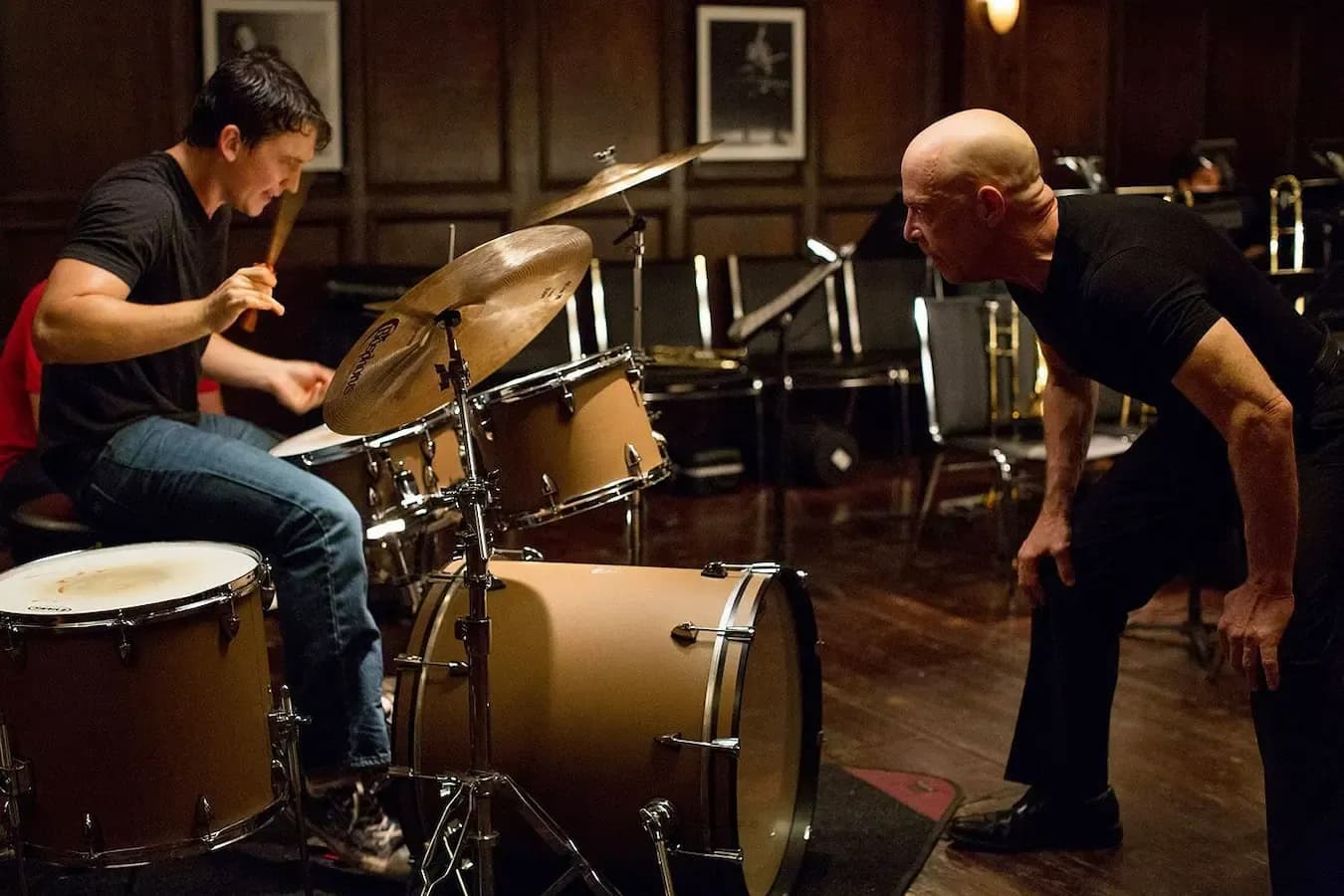
Think of a film that stayed with you long after the credits rolled. Not because of its plot twists or visual effects, but because of what happened to the person at its center. The way they started as one thing and ended as something else or the way the story made you desperately wish they had. That experience has a name: character arc. And it is the single most important structural element separating characters who feel alive from characters who merely function.
Explore a complete sample analysis and understand the feedback format.